HomeDiagramsDatabaseMapsForum About
     

Go Back   SkyscraperPage Forum > Regional Sections > United States > Mountain West


Reply

 
Thread Tools Display Modes
     
     
  #6661  
Old Posted Jan 20, 2016, 4:11 PM
Future Mayor's Avatar
Future Mayor Future Mayor is offline
Vote for me in 2019!
 
Join Date: Jun 2007
Location: Salt Lake City, UT
Posts: 4,803
I've said this since The Gateway was built, but what needed to happen, which I doubt will happen now. Is that the future commuter rail line (Front Runner) needed to be incorporated into the design of The Gateway. The UP Depot needed to be utilized as the main transit hub, just as Union Station in Denver is. The Front Runner and Amtrak lines needed to be brought in underground, to provide the opportunity to still remove the tracks in the middle of 400 W and still allow for the shortening of the viaducts to expand the downtown footprint.

Greyhound could even have been brought in to a below grade platform along with Front Runner and Amtrak. Trax would then be offered at grade on 400 W or even directly behind the UP Depot. Build The Gateway surrounding that and The Gateway wouldn't be in the situation it is currently in. With tens of thousands of people walking directly into your retail development on a daily basis, they would be struggling as much as they are, even with City Creek.

I guess it could still be done, but I don't see it happening for several decades if at all. Yes Central Station is on the edge of downtown, but I do think that Station Center will develop nicely and it will be a very vibrant neighborhood within the downtown core. I anticipate as soon as the homeless committee makes decisions as to where the shelters will be relocated to, even if just the mens shelter, that Station Center and the entire Gateway neighborhood will explode in development. It's surrounded by development and there is even some happening near by, Alta Gateway, along with Central 9th, it's the logical direction for growth in the city. I predict that in 10 years we will all be fine with Central Station in it's current location.
Reply With Quote
     
     
  #6662  
Old Posted Jan 20, 2016, 6:23 PM
Hatman's Avatar
Hatman Hatman is offline
Registered User
 
Join Date: Aug 2013
Location: Salt Lake City, Utah
Posts: 1,434
Okay, y'all got me thinkin' on what possible solutions there are to this problem. So here is my plan on how to get rail service back to not just one, but to BOTH historic depots.

LINK TO GOOGLE MAP

What this shows is a trench, 33 feet deep and 35-40 feet wide, down 500 West. It also shows a cut-off for the Amtrak California Zephyr to turn west along its regular route.* A concourse building connects the Union Pacific Depot to the platforms at 500 West; this concourse building would be a redesign of the Gateway Mall and would transform it into a true transit-oriented development. Other intermodal aspects, such as a Greyhound bus terminal, could be built by the Rio Gande, as Liberty Wellsian proposed.

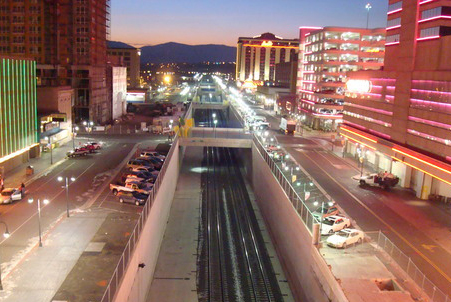
This trench proposal is modeled after the trench build through Reno**, Nevada, in 2005. Both trenches are 33 feet deep and are about 1.8 miles long. The trench in Reno also includes an Amtrak Station. The cost for the Reno trench was $282 million, indicating that a trench through Salt Lake City, including the spur, would cost somewhere between $300-400 million. For context, the Mid-Jordan TRAX line cost a total of $452 million.

The advantage of this design is, of course, that both depots get used, and the gateway gets redesigned. The disadvantages are that 1) transfers between FrontRunner and TRAX become longer, with passengers need to traverse historic buildings rather than simply crossing the plaza currently at the Intermodal Center 2)access to the platforms via staris, escalators, and elevators becomes longer and more difficult for those who use bikes or a wheelchair, and 3) the $300-400 million.

Still, I think something like this is not only feasible, but also a better alternative than what we have now. I've completely changed my mind on all this. For the cost of a light rail line (not insignificant) we could have a redesigned and more urban rail hub(s).

Thoughts?

*The Intercity Passenger Rail Northern Connection could also be used to re-route the California Zephyr or other Amtrak route north to Ogden before turning west - but that would require a redesign of the Ogden Union Station, which is a subject left for another time!

**The Trench in Reno, Nevada, also includes a short covered section, 1,200 feet long. The trench through Salt Lake City could also include a covered section, but overall it must remain a trench in order to allow diesel passenger (and also historic steam trains) to pass through on the Intercity Passenger Rail track. (It cannot be a tunnel the whole length, that would be prohibitively expensive.)

Views of the Reno Trench:


• Video Link

Last edited by Hatman; Jan 20, 2016 at 7:05 PM.
Reply With Quote
     
     
  #6663  
Old Posted Jan 20, 2016, 7:45 PM
Future Mayor's Avatar
Future Mayor Future Mayor is offline
Vote for me in 2019!
 
Join Date: Jun 2007
Location: Salt Lake City, UT
Posts: 4,803
While I see the advantages of the trench idea. I think if it was placed in 500 W it is simply to far away from the UP Depot to make any type of transfers feasible. Where would you place the Trax Platform for Front Runner riders, Where they currently are on 400 W? Or would they need to be moved? Depending on where in the 500 W trench the Front Runner platform is, it actually may be closer to get to the N. Temple Trax platform than it would be to get through the UP to 400 W.

I could see 500 W working if the Rio Grande Depot was used, as the trench would be placed directly behind the depot and you could have direct access to the depot through an underground entrance, taking people directly into the historic Depot, but putting the station nearly a block away from the UP Depot would not make sense.

If either Depot is to be used it could be Rio Grande currently, if the UP Depot were to be used it would pretty much require all of Gateway to be torn down, in order to get the train close enough to the depot for it to be effectively used as a train station. I think the best option if Front Runner and Amtrak were ever to use either of the Depots would be to come in underground, all passengers exit into the Depot, then Trax is waiting at grade behind the Depot on top of the tunnel where Front Runner came in. This would make the Depot the true center of all transit operations and transfers into and out of downtown. I suppose one trax line could be behind the Depot and one in front of the Depot, on Rio Grande Street or 400 W (depending on which Depot was used).

Again, while I would have love to have seen either of the Depot's utilized as an actual transit Center I think the placement of Central Station makes sense in today's reality. If you think about it both the UP and the Rio Grande Depots where at the very western edge of downtown and funneled traffic out into the city in only one direction. Essentially Central Station now does the same thing, most of the transit converges at that point and then it funnels people into downtown, in one direction.

Don't get me wrong, I like the thought process but I just don't think 500 W and the UP Depot is an option logistically.
Reply With Quote
     
     
  #6664  
Old Posted Jan 20, 2016, 8:36 PM
Hatman's Avatar
Hatman Hatman is offline
Registered User
 
Join Date: Aug 2013
Location: Salt Lake City, Utah
Posts: 1,434
Here's a screenshot of the map/design I linked to in the post above.


Yes, transfers are a much bigger deal at either of the old stations, even if TRAX is directly above the FrontRunner lines. But this design has merit, too; in fact, it was inspired by Denver's Union Station, which features separate LRT and CRT platforms separated by a transit concourse. Denver's platforms are 800+ feet apart. This design for Salt Lake City's Union Pacific Depot are 550 feet. Also, if the entire concourse is part of a Gateway Mall redesign, the entire length of the concourse could be lined with retail and commercial options. Like imagine arriving in Salt Lake City by FrontRunner and grabbing breakfast at a restaurant on the way to your transfer to TRAX, without needing to detour at all because the restaurant is on the way anyway. This is the same model that private for-profit subway operators in Hong Kong and Tokyo (and other places) use to turn their money-losing business (public transportation) into a for profit business (operating a mall and bringing people to it). So perhaps the first stage of this plan would be fore UTA to buy the Gateway. Unlikely, sure, and I doubt any of this will ever happen, but I've seen the light- it could happen, and in an ideal world, it would too.
Reply With Quote
     
     
  #6665  
Old Posted Jan 20, 2016, 9:04 PM
Future Mayor's Avatar
Future Mayor Future Mayor is offline
Vote for me in 2019!
 
Join Date: Jun 2007
Location: Salt Lake City, UT
Posts: 4,803
That makes much more sense. Are the Trax platforms also on 500 W, or would they be somewhere else, on 400 W?

If I'm not mistaken, Denver's Light Rail and Heavy Rail all converge in the giant Canopy area. At least that's what the transit map makes it look like. c

http://farm9.staticflickr.com/8387/8483934135_8b144d1c03_o.png

Last edited by Future Mayor; Jan 20, 2016 at 9:31 PM.
Reply With Quote
     
     
  #6666  
Old Posted Jan 20, 2016, 9:42 PM
Liberty Wellsian Liberty Wellsian is offline
Registered User
 
Join Date: Oct 2015
Posts: 810
What about routing the trench through the Gateway northwest parking garage and then down Rio Grande St through the Gateway? This would put the train much closer to UPD and still adjacent to RGS(to the east). Trax could be routed from 200 S left down 500 west to the rear of RGS and the trench could cut back to 500 w under 400 s.
Reply With Quote
     
     
  #6667  
Old Posted Jan 20, 2016, 9:45 PM
Hatman's Avatar
Hatman Hatman is offline
Registered User
 
Join Date: Aug 2013
Location: Salt Lake City, Utah
Posts: 1,434
Unfortunately for Denver, no, the Light Rail and Commuter Rail systems do not share the awesome white canopy. Much to the lament of Denver Transit advocates, there is a long gap between the Light Rail terminous (which looks like a regular LRT station) and the Commuter Rail terminous, which is in the train hall.

(LRT on the left, CRT on the right).

This is not something to emulate. I recognize that transfers are a major weakness of this redesign, especially compared to the amazing convenience of Salt Lake Central's current layout. The question to ask is if the experience of transferring trains at a historic depot - potentially one with a wide and inviting retail concourse - is worth the extra steps of a longer transfer. I think that if it is done 'right,' then it is worth it. Denver's is done 'sort-of-right', in which they have the historic depot and a great sense of place, but very little to make the transfer feel purposeful. 'Right' in this case, means doing the concourse as a redesign of the Gateway so that walking down the concourse would be like walking down, well, a really wide city creek walkway. The entire experience needs to have a purposeful sense of place, not just the depot.
Reply With Quote
     
     
  #6668  
Old Posted Jan 20, 2016, 9:55 PM
Hatman's Avatar
Hatman Hatman is offline
Registered User
 
Join Date: Aug 2013
Location: Salt Lake City, Utah
Posts: 1,434
Quote:
Originally Posted by Liberty Wellsian View Post
What about routing the trench through the Gateway northwest parking garage and then down Rio Grande St through the Gateway? This would put the train much closer to UPD and still adjacent to RGS(to the east). Trax could be routed from 200 S left down 500 west to the rear of RGS and the trench could cut back to 500 w under 400 s.
I'm not sure I follow your route. But beware of trying to put too many curves into your alignment. If it curves sharper than the current S-curves between Salt Lake Central and North Temple stations (on FrontRunner) then it is probably too sharp. Also, the tracks cannot go much more eastward when the pass under the North Temple Viaduct. That bridge used to be a block longer when there were tracks accessing the Union Pacific Depot directly - and once those tracks were removed, the bridge was able to be shortened by a block. I feel like 500 West is as close as tracks will ever get to the Union Pacific Depot, unless that bridge is either lengthened again, or the tracks are put into a deep-bore tunnel.
I do like the idea of LRT going to the backside of the Rio GRande depot. I think I'll update the map to show that.
Reply With Quote
     
     
  #6669  
Old Posted Jan 20, 2016, 10:17 PM
Liberty Wellsian Liberty Wellsian is offline
Registered User
 
Join Date: Oct 2015
Posts: 810
Quote:
Originally Posted by Hatman View Post
I'm not sure I follow your route. But beware of trying to put too many curves into your alignment. If it curves sharper than the current S-curves between Salt Lake Central and North Temple stations (on FrontRunner) then it is probably too sharp. Also, the tracks cannot go much more eastward when the pass under the North Temple Viaduct. That bridge used to be a block longer when there were tracks accessing the Union Pacific Depot directly - and once those tracks were removed, the bridge was able to be shortened by a block. I feel like 500 West is as close as tracks will ever get to the Union Pacific Depot, unless that bridge is either lengthened again, or the tracks are put into a deep-bore tunnel.
I do like the idea of LRT going to the backside of the Rio GRande depot. I think I'll update the map to show that.
Something along these lines (I realize it's very poorly done and the north turn is too sharp but I'm being lazy)


Reply With Quote
     
     
  #6670  
Old Posted Jan 20, 2016, 10:46 PM
PLANSIT's Avatar
PLANSIT PLANSIT is offline
ColoRADo
 
Join Date: May 2004
Location: Denver
Posts: 2,317
Quote:
Originally Posted by Hatman View Post
Unfortunately for Denver, no, the Light Rail and Commuter Rail systems do not share the awesome white canopy. Much to the lament of Denver Transit advocates, there is a long gap between the Light Rail terminous (which looks like a regular LRT station) and the Commuter Rail terminous, which is in the train hall.

(LRT on the left, CRT on the right).

This is not something to emulate. I recognize that transfers are a major weakness of this redesign, especially compared to the amazing convenience of Salt Lake Central's current layout. The question to ask is if the experience of transferring trains at a historic depot - potentially one with a wide and inviting retail concourse - is worth the extra steps of a longer transfer. I think that if it is done 'right,' then it is worth it. Denver's is done 'sort-of-right', in which they have the historic depot and a great sense of place, but very little to make the transfer feel purposeful. 'Right' in this case, means doing the concourse as a redesign of the Gateway so that walking down the concourse would be like walking down, well, a really wide city creek walkway. The entire experience needs to have a purposeful sense of place, not just the depot.
Just to be clear, there is an underground bus terminal the entire length of the "arcade" between the LRT station and DUS (under the CRT tracks). This is very purposeful.


Reply With Quote
     
     
  #6671  
Old Posted Jan 20, 2016, 11:18 PM
Hatman's Avatar
Hatman Hatman is offline
Registered User
 
Join Date: Aug 2013
Location: Salt Lake City, Utah
Posts: 1,434
The walkway underground is very direct. At least you don't need to cross streets to transfer. But it doesn't remove the fact that there is a large distance between the two rail modes.
I'm not trying to be disparaging against Denver - I'm at least 73% jealous of what Denver has compared to Salt Lake City in terms of a central transit hub - but I cannot understand why the light rail, which was so close to the future train hall site, was moved back farther away than it was before to make room for development. It's so counterproductive. That's the part that Salt Lake City should not emulate.
Reply With Quote
     
     
  #6672  
Old Posted Jan 20, 2016, 11:31 PM
wong21fr's Avatar
wong21fr wong21fr is offline
Reluctant Hobbesian
 
Join Date: Feb 2002
Location: Denver
Posts: 13,126
Quote:
Originally Posted by Hatman View Post
The walkway underground is very direct. At least you don't need to cross streets to transfer. But it doesn't remove the fact that there is a large distance between the two rail modes.
I'm not trying to be disparaging against Denver - I'm at least 73% jealous of what Denver has compared to Salt Lake City in terms of a central transit hub - but I cannot understand why the light rail, which was so close to the future train hall site, was moved back farther away than it was before to make room for development. It's so counterproductive. That's the part that Salt Lake City should not emulate.
One word: money. Originally the light rail would have gone underground and would have had platforms directly blow the commuter rail terminal while the bus terminal would have been in a parking garage above the train tracks. But this design was a $800M to $1B design so proposals were solicited for a cheaper option. Moving the light rail away from Union Station and connecting it via an U/G bus terminal ended up reducing the project cost to $500M.

It ultimately doesn't matter as much for Denver due to the separation of our light rail system. The light rail lines with a Union Station terminus don't go into downtown due to where the corridors converge SW of downtown. Rather, it's more important for our downtown bus circulators (the Mall Shuttle and MetroRide) to have close access to the light rail and commuter rail platforms, which they do. Having the rail modes separate is a hinderence for someone looking at thru-line service to elsewhere in the Denver metro area, but not for someone heading downtown.

SLC had a good setup with it's current system. But it you're envisioning ways to get the station closer to the historic one at Gateway why not look at running the light rail in the train trench as well?
__________________
"You don't strike, you just go to work everyday and do your job real half-ass. That's the American way!" -Homer Simpson

All of us who are concerned for peace and triumph of reason and justice must be keenly aware how small an influence reason and honest good will exert upon events in the political field. ~Albert Einstein

Reply With Quote
     
     
  #6673  
Old Posted Jan 21, 2016, 12:00 AM
Liberty Wellsian Liberty Wellsian is offline
Registered User
 
Join Date: Oct 2015
Posts: 810
Downtown Station


900 South Viaduct/Trench down west Temple/ New train Depot at 450 S Main/Frontrunner west down 400 S. A major upside(besides being right downtown) is that the University extension wouldn't need to be built and that money could be used on this project.

Would there be enough room to hang a left on that empty block?

Last edited by Liberty Wellsian; Jan 21, 2016 at 12:37 AM.
Reply With Quote
     
     
  #6674  
Old Posted Jan 21, 2016, 3:40 PM
Hatman's Avatar
Hatman Hatman is offline
Registered User
 
Join Date: Aug 2013
Location: Salt Lake City, Utah
Posts: 1,434
^^^

LW: Yeah, that's probably too sharp. For a TRAX line that would be totally fine, but for a commuter train you've got to use a minimum radius of 459 feet. That's hard to measure without the right software, so here's a circle of radius 459 feet drawn on that same block:
(459 ft radius circle. Commuter Rail vehicles cannot turn sharper than this.)

Quote:
Originally Posted by wong21fr View Post
One word: money. Originally the light rail would have gone underground and would have had platforms directly blow the commuter rail terminal while the bus terminal would have been in a parking garage above the train tracks. But this design was a $800M to $1B design so proposals were solicited for a cheaper option. Moving the light rail away from Union Station and connecting it via an U/G bus terminal ended up reducing the project cost to $500M.

It ultimately doesn't matter as much for Denver due to the separation of our light rail system. The light rail lines with a Union Station terminus don't go into downtown due to where the corridors converge SW of downtown. Rather, it's more important for our downtown bus circulators (the Mall Shuttle and MetroRide) to have close access to the light rail and commuter rail platforms, which they do. Having the rail modes separate is a hinderence for someone looking at thru-line service to elsewhere in the Denver metro area, but not for someone heading downtown.

SLC had a good setup with it's current system. But it you're envisioning ways to get the station closer to the historic one at Gateway why not look at running the light rail in the train trench as well?
Money is usually the answer to every political/development question, but it still doesn't completely answer the question as to why the LRT was moved, rather than left in place in order to save money. All I can figure is that part of the reason the LRT station was moved was in order to create a 'draw' for pedestrians and development on the edge of the railroad tracks - an area that otherwise would not have been as valuable. Which I guess leads back to the same answer of money, but in this case making it (by selling more valuable land) rather than saving it.

And you make a good point about the heightened importance of transfers to buses, rather than between rail modes, at DUS. With this trench idea, I can't see any way to add a nice bus transfer area other than doing the same thing that Denver did - building one underground. Maybe I'd widen the trench so that not only LRT, but buses could also share space at the bottom in the station areas. I mean, if none of this is ever going to happen anyway, why not dream big?
Reply With Quote
     
     
  #6675  
Old Posted Jan 21, 2016, 7:45 PM
Liberty Wellsian Liberty Wellsian is offline
Registered User
 
Join Date: Oct 2015
Posts: 810
Reply With Quote
     
     
  #6676  
Old Posted Jan 22, 2016, 12:10 AM
Hatman's Avatar
Hatman Hatman is offline
Registered User
 
Join Date: Aug 2013
Location: Salt Lake City, Utah
Posts: 1,434
I see you have made it fit. Impressive.

Now we need to talk about the platform(s). These typically need to be on straight sections, although Layton and Roy are built on very broad curves. Straight track or very broad curves are needed for level boarding. The platforms need to be 900 feet long (enough to hold 1 locomotive and 10 cars) and the horizontal alignment needs to be straight (or at the same curvature as the station) for an additional 100 feet on both ends in order to avoid any overhang.

I'm curious to see what you come up with.
Reply With Quote
     
     
  #6677  
Old Posted Jan 22, 2016, 8:53 PM
Hatman's Avatar
Hatman Hatman is offline
Registered User
 
Join Date: Aug 2013
Location: Salt Lake City, Utah
Posts: 1,434
I've thought out how to use Ogden Union Station for Amtrak and FrontRunner, and have included that on my map. Here are two links to that map. One of them should work.

Link#1 Link#2

(I would have used screenshots, but there are too many. Google Maps allows me to show the full extent of the redesigns (both SLC and Ogden are nearly 2 miles long each) and to include labels and explanations (if you click on them), and also layers that can be turned on or off to see more clearly what is going on.)

In this new plan, I was able to get rid of the small spur for Amtrak in Salt Lake City, as it won't need to turn westward anymore. That saves several hundred yards of trenching and makes the cost cheaper. It also means Amtrak can stop at the Union Pacific Depot instead of the Rio Grande, meaning a regular platform is no longer needed at the Rio Grande station, also making the design cheaper.

In Ogden, the current museum tracks are removed to make space for FrontRunner platforms. A new Amtrak platform is constructed to the west of the FrontRunner tracks, and trains reach it via a new flyover bridge directly parallel to the current FrontRunner bridge. Amazingly, FrontRunner platforms at Union Station are closer to the bus stations at the Ogden Intermodal Center than the current platform (260 feet compared to 130 feet), meaning that not only do FrontRunner trains get to access the historic depot, but it will also be more convenient for transferring passengers.

The added cost of including Ogden in this plan raises my estimates of the cost of such a project from $300-400 million to $400-500 million. Denver's Union Station cost about $500 million, and restored only the 1 station (which was currently in use, and already had LRT connectivity). For that amount we would get three historic depots back in service, plus rail service restored to Ogden, plus a more centralized intermodal hub.

One of the reasons I am so happy about this plan - and so skeptical before - was that I had thought the price would much higher. For context, the Banger Highway interchanges project will replace relatively new signalized intersections with freeway-style interchanges. This is done for the first 5 of 11 for $242 million ($48.4 million each) and there are still 6 more to go. If the next 6 cost the same amount per interchange as the first five, the total cost of this project will be $532.4 million. And that is just to improve one highway that is already functioning.
Surely that same amount of money (possibly less) could be spent to improve a rail system that also already functions. The same way that Bangerter will be improved, FrontRunner/Amtrak service will also be greatly improved. And you can't make the case either that highways serve disproportionately more people, either. Bangerter highway has a daily traffic total of about 56,000 vehicles per day, nearly all of them single-occupancy. FrontRunner, though it now carries only ~16,000 per day, could easily double its ridership to 34,100 riders per day if it runs at a higher frequency. If other transfers from buses were included (assuming buses were moved to a new station beside the Depots as well), and the number of people that would directly benefit from the move to the depots would rise by a few thousand more. Add to that the number of 'induced demand' riders, or riders who would not ride UTA now but would if these changes were made because they make UTA more convenient and/or attractive.

I really think this is a practical, feasible, workable, and financially attainable plan. This is something that would turn SLC from a city with good rail transit to one with GREAT rail transit - and money is already being spent on Utah transportation projects at a similar amount. We just need to get our priorities in order and get word of what is possible out to the people who make these types of decisions.

Reply With Quote
     
     
  #6678  
Old Posted Jan 22, 2016, 9:30 PM
Liberty Wellsian Liberty Wellsian is offline
Registered User
 
Join Date: Oct 2015
Posts: 810
Quote:
Originally Posted by Hatman View Post
I see you have made it fit. Impressive.

Now we need to talk about the platform(s). These typically need to be on straight sections, although Layton and Roy are built on very broad curves. Straight track or very broad curves are needed for level boarding. The platforms need to be 900 feet long (enough to hold 1 locomotive and 10 cars) and the horizontal alignment needs to be straight (or at the same curvature as the station) for an additional 100 feet on both ends in order to avoid any overhang.

I'm curious to see what you come up with.
I hope I haven't annoyed you?(hard to tell on the interwebs) If so I apologize. Also, kewl links.

Here is a basic idea for a Main St station. The Frontrunner is under main street with central boarding. The Frontrunner platform would basically mirror the Trax platforms above but obviously longer. The Frontrunner platform would span 2 Trax platforms making for a shorter walk depending on where you exit the train. The street parking on main would be removed and replaced with traffic. The extra space would then be used to broaden the platforms. (I know the turn onto 400 s is still to sharp but I think if I was more careful that could be avoided)


I think the Bus Depot is my favorite aspect of this. One way, all right hand turns, centrally located, with access to multiple freeway on-ramps and major thoroughfares.

Last edited by Liberty Wellsian; Jan 22, 2016 at 9:51 PM.
Reply With Quote
     
     
  #6679  
Old Posted Jan 25, 2016, 4:12 PM
Hatman's Avatar
Hatman Hatman is offline
Registered User
 
Join Date: Aug 2013
Location: Salt Lake City, Utah
Posts: 1,434
^^^
Kewl design. Very centralized. On the whole, a good solid design.
Some questions: Would FrontRunner travel in tunnels, or in a trench? And how does this routing through downtown tie in with the existing FR line? Also, I don't see Amtrak, so I assume they stay put where they are at the Intermodal Hub?

And don't worry, no annoyance. It's always a pleasure to talk trains and transit on the interwebs.
Reply With Quote
     
     
  #6680  
Old Posted Jan 25, 2016, 5:33 PM
Hatman's Avatar
Hatman Hatman is offline
Registered User
 
Join Date: Aug 2013
Location: Salt Lake City, Utah
Posts: 1,434
I saw that Salt Lake City was very briefly home to an Uber Helicopter service, in which you could ride from the SLC airport to Park City (for the Sundance Film Festival) by helicopter for $300 round trip. Then the sheriff shut it down for regulatory reasons. But apparently it was doing quite well.

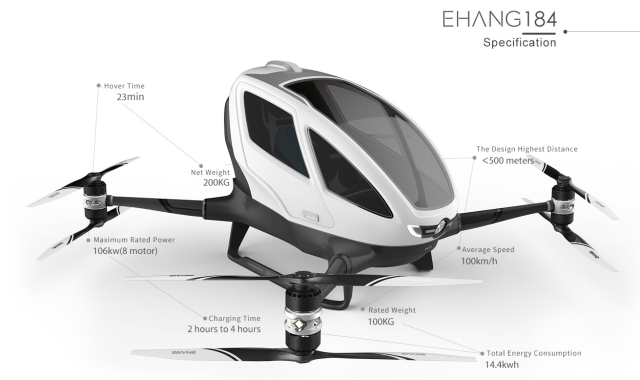
My prediction is that this sort of thing (commercially viable air transportation vs restrictive regulations) will be the central issue of transportation planning in the not-so-distant future, when this sort of thing becomes more common:

• Video Link

It is a giant quad-copter that has a passenger compartment in the middle. The passenger has two buttons: Launch (to start their journey) and Land (for emergencies). All the guidance is taken care of autonomously. It's completely electric and has a range of several miles, and its creators want to use it as an autonomous aerial taxi. Basically it's a self-driving flying car.
And as Uber just showed right here in SLC, such a service is already commercially viable, even with current technology.
Reply With Quote
     
     
This discussion thread continues

Use the page links to the lower-right to go to the next page for additional posts
 
 
Reply

Go Back   SkyscraperPage Forum > Regional Sections > United States > Mountain West
Forum Jump


Forum Jump


All times are GMT. The time now is 2:22 AM.


Powered by vBulletin® Version 3.8.7
Copyright ©2000 - 2026, vBulletin Solutions, Inc.