HomeDiagramsDatabaseMapsForum About
     

Go Back   SkyscraperPage Forum > Regional Sections > Canada > Atlantic Provinces > Halifax > Halifax Peninsula & Downtown Dartmouth


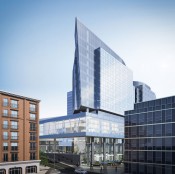
    Sutton Place Nova Centre in the SkyscraperPage Database

Building Data Page   • Halifax Skyscraper Diagram

Map Location

Reply

 
Thread Tools Display Modes
     
     
  #4761  
Old Posted Jan 20, 2016, 3:35 PM
fenwick16 fenwick16 is offline
Honored Member
 
Join Date: Feb 2007
Location: Toronto area (ex-Nova Scotian)
Posts: 5,558
Quote:
Originally Posted by ScovaNotian View Post
It's different in that the convention centre will hopefully generate a monetary return for the city and the province, isn't it? Assuming that a five-day convention attracts 400 attendees who wouldn't otherwise visit Nova Scotia, and who each spend $250 a day, that's half a million in spending, on hotels, restaurants, caterers, etc.
Absolutely. I hope that it will be so successful that they will have to expand it within a few years (possibly by renting space in the office towers for meeting rooms, and converting existing meeting rooms to exhibit space).
Reply With Quote
     
     
  #4762  
Old Posted Jan 20, 2016, 4:00 PM
OldDartmouthMark OldDartmouthMark is offline
Registered User
 
Join Date: May 2010
Posts: 10,352
Quote:
Originally Posted by fenwick16 View Post
Tax payers are only paying for space being used by the convention centre
Thanks for clearing that up. I wasn't aware of the distinction within the same building, that our tax money is going only towards the section of the building that contains the convention centre.


Quote:
There is publicly owned/leased space which isn't accessible to the public or seldom accessible such as the Bedford Institute of Oceanography, Naval Yards ...; how is this different than a publicly sponsored convention centre?
They are providing services of benefit to the citizens of Canada. Just like you wouldn't expect to be able to casually walk through a police station, a CRS office, a hospital operating room or parliament while in session.

A convention centre is an entertainment venue and will presumably operate as a business - i.e. private companies paying for use of the building. It won't exactly be public space typically, as it will be rented for private functions that the public won't usually have access to. I don't see these activities as a general benefit to the citizens in general, but just to private organizations (i.e. companies, which aren't necessarily even Canadian-owned).

That's how I make the distinction.

I do wonder, since we taxpayers are investing in the convention centre, will profits that come from its operation be filtered back into the tax base? If it's operated at a loss will we be expected to make up the difference?

My real concern was with the hotel/office space, which you've already addressed.
Reply With Quote
     
     
  #4763  
Old Posted Jan 20, 2016, 4:03 PM
OldDartmouthMark OldDartmouthMark is offline
Registered User
 
Join Date: May 2010
Posts: 10,352
Quote:
Originally Posted by ScovaNotian View Post
It's different in that the convention centre will hopefully generate a monetary return for the city and the province, isn't it? Assuming that a five-day convention attracts 400 attendees who wouldn't otherwise visit Nova Scotia, and who each spend $250 a day, that's half a million in spending, on hotels, restaurants, caterers, etc.
Yes, hopefully the spin-offs will be a boon to our economy, and maybe that's how to justify a benefit to our citizens. Hopefully it will work out in the long run.
Reply With Quote
     
     
  #4764  
Old Posted Jan 20, 2016, 4:22 PM
Drybrain Drybrain is offline
Registered User
 
Join Date: Sep 2012
Posts: 4,549
It's really unfortunate how polarizing the Nova Centre has become.

On one side you've got people who almost seem to think it's some sort of massive money-laundering scam, concocted in backrooms for the exclusive benefit of private developers, and will ruin downtown forever. On the other side you've got the "It's going to put us on the map!" boosters who think it will save downtown forever.

My hope is that it turns out to be overall positive. It seems pretty obvious that it wouldn't be this big and ambitious without all the public money that's gone into it, which raises the question IF so much public money should have gone into it (no, I don't think so). And the developers have received a LOT of concessions. The backstory is a bit of a clusterfuck. But I don't think it's going to be some crash and burn boondoggle. (It's no Yarmouth ferry!) I have a hard time justifying all the money that's been poured into it, but it'll still be a lot better for downtown than the old hulk of the Herald building rotting away there.

But yeah, if the convention side of things becomes a money-loser, the province better not start handing it cash. Let it sink or swim, and if it sinks, they'll have to get creative with the building and do something different with it.
Reply With Quote
     
     
  #4765  
Old Posted Jan 20, 2016, 4:41 PM
Keith P.'s Avatar
Keith P. Keith P. is offline
Registered User
 
Join Date: Mar 2006
Posts: 8,831
Quote:
Originally Posted by OldDartmouthMark View Post
I do wonder, since we taxpayers are investing in the convention centre, will profits that come from its operation be filtered back into the tax base? If it's operated at a loss will we be expected to make up the difference?
Same as the existing Trade Center Limited, the annual losses will be covered by the province. It has never made money and the new one will likely increase the annual loss significantly. Most convention centers are subsidized by govts.
Reply With Quote
     
     
  #4766  
Old Posted Jan 20, 2016, 4:45 PM
Jonovision's Avatar
Jonovision Jonovision is offline
Registered User
 
Join Date: Sep 2003
Posts: 5,052
The glass on the sharp edge started going in yesterday.


Reply With Quote
     
     
  #4767  
Old Posted Jan 20, 2016, 5:52 PM
portapetey portapetey is offline
Registered User
 
Join Date: May 2014
Posts: 509
Quote:
Originally Posted by fenwick16 View Post
Office space concentrated in the downtown core won't lead to a vibrant downtown core. Office workers just go home at 5 pm and there aren't enough residents to support retail shops. I like what is currently happening in the downtown area core with residential development outpacing office development. This will lead to a more desirable, vibrant downtown core where people will want to live and work.

The idea of concentrating office space downtown might think seem desirable as far as shiny towers on the skyline goes, but won't lead to a vibrant core with retail and people enjoying themselves during the evening. Why not let the downtown core develope naturally instead of artificially through government intervention creating a sterile, unpleasant environment?
Yup. Visit downtown Calgary after 6 pm for a perfect example of a ghost town of office buildings, and not a soul on the streets.
Reply With Quote
     
     
  #4768  
Old Posted Jan 20, 2016, 6:03 PM
RangerNS RangerNS is offline
Registered User
 
Join Date: Jan 2015
Posts: 45
One of the rationals about "needing" to sell Argyle Street to the developer is that *if* the complex is condoized, it needs free title to the land under (through?) it.

I would think that this is a pretty important thing to know up front. When that question is settled, is the $164M for pre-paid rent? Or to buy that part of the building? Those are very different things, which one is a good deal?

The finances of a huge building involve, unquestionably, loans. Which a 20 year lease will help you get. Pre-paid cash, even more so. It helps the developer with the banks, we should get credit for that time-value of cash. Are we? hahhaha. We all know the answer to that.

Office property in the same complex as the convention center will go for a premium. Will the rent or condo fees on the convention center reflect that value it brings? Hahahaha.

This is a large - huge - project with lots of opportunity for scope creep. With "unexpected" expenses. Or, expenses that will be presented as "unexpected".

Selling Argyle. "Woops, forgot about that. I guess we are committed now, gotta do it". Having to put in the tunnel. "Woops, forgot about that. I guess we are committed now, gotta do it".

I hope the accountants, lawyers, project managers on *both* sides are not that stupid that they just forgot. If not stupid, then what?

I'll grant that we the people need a convention center, and that we will for ever subsidize it. Today, all the risk is ours. The developer will come back to the city, or the province the next "woops", and we will pay. All the reward is his, in rent.

If we are risking everything, we should own it.
Reply With Quote
     
     
  #4769  
Old Posted Jan 20, 2016, 6:08 PM
portapetey portapetey is offline
Registered User
 
Join Date: May 2014
Posts: 509
So, after all of this, does this give a good overview of why the Thiel companies tried to sue over the fact that the Nova Centre received (real or perceived) concessions to allow its construction to move forward that other developers feel (rightly or wrongly) they would not have received, and therefore got a (real or perceived) jump on the competition for tenants for its office space?

Dollars to donuts, Thiel saw the writing on the wall and knew that 22nd Commerce Square didn't stand a chance to win exciting new tenants once it was clear that the Nova Centre was getting built first, and that's why 22nd Commerce hasn't proceeded.

Thiel has been accused in some circles of just being a whiner, but isn't there a valid point that the government gave its own favoured (and invested) project a leg up on the competition in a struggling market? Apparently, it was a perfectly legal leg up, but I don't think anyone can be blamed for feeling there was some conflict of interest.
Reply With Quote
     
     
  #4770  
Old Posted Jan 20, 2016, 6:12 PM
portapetey portapetey is offline
Registered User
 
Join Date: May 2014
Posts: 509
Quote:
Originally Posted by RangerNS View Post
I would think that this is a pretty important thing to know up front. When that question is settled, is the $164M for pre-paid rent? Or to buy that part of the building? Those are very different things, which one is a good deal?

I believe it is a pre-paid lease of sorts, with an option for buy-back after the lease expires. ("Congrats on your new / used Jetta!")

Is that correct? Many of you know this deal far better than I...
Reply With Quote
     
     
  #4771  
Old Posted Jan 20, 2016, 8:16 PM
RangerNS RangerNS is offline
Registered User
 
Join Date: Jan 2015
Posts: 45
Quote:
Originally Posted by portapetey View Post
I believe it is a pre-paid lease of sorts, with an option for buy-back after the lease expires. ("Congrats on your new / used Jetta!")

Is that correct? Many of you know this deal far better than I...
ISTR the media has all reported it as as a pre-paid lease of sorts, but if the building is to be leased, it wouldn't be condoized, and Argyle could have been not sold.

I suspect it will change from a pre-paid-lease to a partial-payment on the purchasing it as a condo unit... At least if the developer runs out of money/financing before they start collecting rent.

It is nice to have the condo option, down the road, but the developer should have asked for it up front (and the public known the actual cost to us).

Everything is out of order. Which is suspicious, and cause and justification for a critical eye.
Reply With Quote
     
     
  #4772  
Old Posted Jan 21, 2016, 12:07 AM
Colin May Colin May is offline
Registered User
 
Join Date: Mar 2014
Posts: 1,569
Quote:
Originally Posted by someone123 View Post
I think this is a good point.

In Halifax, the real incentives are distorted somewhat since the tax rates do not reflect the costs of development and servicing in different parts of the city. HRM charges lower taxes in the office parks even though they cost more
Some 'business' guy trotted out a similar argument claiming Walmart in Dartmouth Crossing was subsidised compared with stores on Gottingen and downtown Halifax.

The tax rates reflect the value of the property; that is not a distortion - just a fact of life in every location.
Reply With Quote
     
     
  #4773  
Old Posted Jan 21, 2016, 12:13 AM
Nouvellecosse's Avatar
Nouvellecosse Nouvellecosse is online now
Volatile Pacivist
 
Join Date: Aug 2005
Location: Nova Scotia
Posts: 11,244
Quote:
Originally Posted by Colin May View Post
Some 'business' guy trotted out a similar argument claiming Walmart in Dartmouth Crossing was subsidised compared with stores on Gottingen and downtown Halifax.

The tax rates reflect the value of the property; that is not a distortion - just a fact of life in every location.
I fail to see why you'd assume that the two things are mutually exclusive.
__________________
"The reasonable man adapts himself to the world; the unreasonable one persists in trying to adapt the world to himself. Therefore all progress depends on the unreasonable man." - George Bernard Shaw
Don't ask people not to debate a topic. Just stop making debatable assertions. Problem solved.
Reply With Quote
     
     
  #4774  
Old Posted Jan 21, 2016, 1:25 AM
someone123's Avatar
someone123 someone123 is online now
hähnchenbrüstfiletstüc
 
Join Date: Nov 2001
Location: Vancouver
Posts: 35,791
Quote:
Originally Posted by Colin May View Post
Some 'business' guy trotted out a similar argument claiming Walmart in Dartmouth Crossing was subsidised compared with stores on Gottingen and downtown Halifax.

The tax rates reflect the value of the property; that is not a distortion - just a fact of life in every location.
The tax rate is currently based on the assessed value of the property but there's no reason why that must be so. It could instead be based on servicing costs, like how some places bill for water use instead of others where it's paid for out of property tax revenues.

You could do the same for garbage collection, transportation costs, police, fire, etc.

Taxing businesses for the services they use encourages them to use less. Taxing them based on the value of their property encourages them to have cheaper property.
Reply With Quote
     
     
  #4775  
Old Posted Jan 21, 2016, 1:52 AM
counterfactual counterfactual is offline
Registered User
 
Join Date: Jul 2013
Location: Parts Unknown
Posts: 1,796
Quote:
Originally Posted by Colin May View Post
Some 'business' guy trotted out a similar argument claiming Walmart in Dartmouth Crossing was subsidised compared with stores on Gottingen and downtown Halifax.

The tax rates reflect the value of the property; that is not a distortion - just a fact of life in every location.
Huh? Colin you've raised problems with the land giveaways done by HRM but you're missing the obvious connection between those practices an land value. That is, supply/demand and property value and taxes.

Part of the reason why land in the business parks is so cheap, is because it's has essentially been given away in fire sales to the private sector.

And even taking that reality away, *of course* the Walmart in Dartmouth Crossing is being subsidized compared to businesses downtown. Infrastructure costs-- servicing these outlying business parks-- through transit, road, water, etc, everything, costs substantially more than a smaller business who locates downtown and is serviced by existing infrastructure.

Land giveaways, leading to cheaper land value and lower taxes. One subsidy. Servicing through costly infrastructure, another subsidy. Another subsidy is disparities in regulation. Developing and building downtown, as well as doing business, is far more regulated, compared to business parks. Have we ever heard of the Heritage Trust launching a lawsuit to challenge the height of a new office building in Burnside? Of course not. Such legal and regulatory challenges increase development costs, which in turn, lead to higher rental rates downtown. Less regulation, less restrictions, etc, in the business parks is another in kind government subsidy.
Reply With Quote
     
     
  #4776  
Old Posted Jan 21, 2016, 2:11 AM
counterfactual counterfactual is offline
Registered User
 
Join Date: Jul 2013
Location: Parts Unknown
Posts: 1,796
Quote:
Originally Posted by fenwick16 View Post
I completely disagree; Halifax by Design doesn't encourage residential growth downtown. This has been a natural process; there isn't a high demand for office space downtown so developers are building residential towers instead. The same natural process occurred in downtown Toronto; office supply outpaced demand in the late 1980's and led to the Bay-Adelaid Centre stump - http://www.blogto.com/city/2014/04/the_story_of_the_bay-adelaide_centre_stump/ . For almost 20 years there was virtually no office construction in downtown Toronto, instead new condos/residential loft conversions led to more people living downtown which resulted in a more vibrant downtown core.

I do not wish to be argumentative, but concentrating office space in downtown Halifax would require more harbour bridge capacity, rapid transit downtown, a Northwest Arm bridge, and expanded roads to the downtown core; what is natural about this? It is far more natural for people to have the choice of living close to where they work. In very large cities such as the Greater Toronto Area (GTA) this has occured. In my opinion, it has occurred in the Halifax area because of the topography that has led to long commutes because of the harbour, Bedford Basin and Northwest Arm.

I have never lived in Europe, but I wonder if this concept of having a large central downtown core is a North American concept or does it also exist in older European cities; this is just a question, I am not sure of the answer. It just seems more natural for people to live within short commuting distance of their homes.
I actually don't "completely" disagree, but I do disagree.

And I don't mind you being "argumentative" at all.

First off, at no point did I say I wish to "concentrate" commercial businesses downtown. I'm seeking a far more modest change, that is, more balance between offices spaces downtown and offices in the exurbs, burbs, and business parks.

Right now, we're around 45%, and that's like going to increase before it decreases. I'm not saying bring 90%-- that, to me, would be to "concentrate" businesses downtown-- but a healthier number for a healthier downtown. I think if you had approx 60% of businesses downtown, that would be far more healthy. And there would still be a lot of choice. Not only that, but you would save the city literally billions in infrastructure upkeep costs over time.

Again, not to be argumentative, but you're begging the question -- on the one hand, you're arguing that increasing residential development on the peninsula is natural and good, but on the other, arguing against more commercial offices on the peninsula will require bigger bridges, more roads, better transit.

Where are the people on peninsula going to be working if their offices aren't also on the peninsula? They're out in the business park. So, naturally, they'll have to drive, take the bus, or the ferry, leading to the very same infrastructure challenge you're using to argue against downtown commercial presence.

You avoid such congestion by having people living *and* working downtown. One and not the other, the problems remain. Only office spaces leads to the Cowtown ghost town. Residential and not offices, leads to outbound congestion. Speaking of European cities-- check out London. It's a constant mix of residential and commercial all over the city. There's the Strand, but there's plenty other areas of concentrated commercial space all over downtown.

Finally, if we fully accept the premises of your argument-- that we shouldn't invest in rapid transit, and try to concentrate businesses and residential downtown, then that's a fast route to one of our biggest and most costly problems -- sprawl. IMHO, a lot of the problems we've had in Halifax, on the planning side of things, is because we've left things over to a laissez fair attitude of letting businesses go where they want to go, or developers do what they want to do. For an efficient, well run city, you need to have proper planning; and for most of the world's great cities, that has included finding ways to excellent residential development, but also top end employers into downtown cores -- which leads not only to vibrant cores, but better run cities with less congestion.

I don't actually think we disagree on much-- perhaps you think I want to throw 90% of businesses downtown. But I think, absolutely, a clear majority should be downtown. Nothing is absolute.

Reply With Quote
     
     
  #4777  
Old Posted Jan 21, 2016, 2:23 AM
Keith P.'s Avatar
Keith P. Keith P. is offline
Registered User
 
Join Date: Mar 2006
Posts: 8,831
Quote:
Originally Posted by someone123 View Post
The tax rate is currently based on the assessed value of the property but there's no reason why that must be so. It could instead be based on servicing costs, like how some places bill for water use instead of others where it's paid for out of property tax revenues.

You could do the same for garbage collection, transportation costs, police, fire, etc.

Taxing businesses for the services they use encourages them to use less. Taxing them based on the value of their property encourages them to have cheaper property.

Why not tax residential properties the same way then? Tax families with lots of kids more than single folks - because they generate far more costs for education, rec programs, parks, etc. Tax by frontage to reflect servicing costs. Tax by square footage to reflect environmental impacts, etc.

It is a real can of worms.
Reply With Quote
     
     
  #4778  
Old Posted Jan 21, 2016, 2:50 AM
counterfactual counterfactual is offline
Registered User
 
Join Date: Jul 2013
Location: Parts Unknown
Posts: 1,796
Quote:
Originally Posted by Drybrain View Post
That's really interesting to look at. While I fully acknowledge our under-performance on this front, a few things jump out.

1. The way "downtown" is defined in different cities is inconsistent. Halifax's downtown is measured more or less as I would imagine: the CBD, plus the south stretches of Barrington and Hollis, and the SGR corridor. No problem there. But other cities are either too narrowly or too generously defined. Their downtown Edmonton borders, for example, include a pretty major chunk of residential real estate, and Hamilton even moreso. (I call out those cities specifically because by any measure, our downtown is vastly superior.)

Winnipeg's is also overly generous, including areas that can't at all be considered downtown, but Victoria, like Halifax, has very stingy boundaries. And so on.

Toronto is maybe the most extreme. Everything from Queen's Park to the Don River, and up into the Rosedale Ravine, is included, including St. Jamestown, Cabbagetown, the Annex, and a number of totally residential neighbourhoods that are absolutely not downtown. (Or at least not the CBD.) If they're going to do that in Toronto, it's ridiculous not to include Halifax's hospital/institutional area.


2. The other thing that strikes me is that this may be a way in which the regional municipality skews our stats (as I've mentioned before I suspect it does). There's no other city in which the "city" is equivalent to the entire CMA. Even the prairie cities (which tend to be very monopolar, with a lot of office space downtown) have at least a bit outside the city-proper boundaries. Due to the beast that is HRM, Halifax can only be compared with other cities on a CMA basis. I'm not sure this study is doing that; it may be comparing HRM to, for example, only the City of Toronto, which is an apples to oranges comparison, given that Toronto has less than 50% of its regional population, but Halifax has 100% of ours.

(That would also explain why Ottawa, another over-amalgamated city, is almost as low as we are for its percentage of total office inventory downtown.)

Also, Vancouver, has what, 600,000 people in an urban region of 2.8 million? I find it almost impossible to imagine that 73% of all Lower Mainland office space is in that relatively tiny slice of downtown Vancouver, much of which is occupied by residential buildings. So again, that suggests we're not really comparing comparables here. (i.e, it suggests that they've compared the entire Halifax region to only the City of Vancouver, which is less than one quarter of the Vancouver region.)

Anyway, one positive thing is that we've had among the highest downtown population growth. (Page 55.) Given everything happening since the last census, I imagine that's not only continued but escalated.
Seems to me the Study's definition for downtown cores for Toronto, Halifax, and other places, was eminently reasonable.

And I don't at all think they're "totally incomparable".

The main problem you've raised-- that the definition for Toronto or Edmonton include too many residential areas as part of "downtown"-- wouldn't skew their findings even if it was correct. Why? Because residential areas are naturally not going to include much office space, so it's not like by including these extra areas is going to significantly misrepresent the % of office space located in the downtown core.

As for Toronto, you don't view St. Jamestown, Cabbagetown, the Annex, and other parts included in that study's "downtown core" for Toronto as downtown? Really? I consider all of those places downtown Toronto. I mean, you can walk from the Annex to Toronto's central business district in about 30-35min. If I started walking tonight from downtown Halifax, I probably wouldn't reach Burnside park until sometime tomorrow morning. And, anyways, there's pretty much zero office space in residential areas like The Annex anyways, save for a few you'd count along Yonge St., but those should definitely be counted anyways.

I think it makes complete sense to measure Halifax on a CMA basis, given that our biggest struggle is business parks located within those boundaries. It really doesn't matter if Sheet Harbour or Cole Harbour are included in the Halifax "outside the core" metric, because office space there is negligible. Arguably, this approach best captures the city's challenges.

Given that Toronto is far bigger, yes, it's hard to apply strict standards across both cities, but in terms of the boundaries of the City of Toronto, it's still pretty generous. It includes Scarborough, York, North York, East York, and also Etobicoke, right out to the airport. That's a pretty significant chunk of suburban and industrial land.

By contrast, I don't think it's unfair to exclude other actual cities in Toronto's mapping, given that Brampton and Mississauga were previously stand alone cities just swallowed by Toronto's outgrowth of sprawl, and then connected for municipal administrative reasons. Admittedly, there are places that are caught in HRM, but saying Brampton should be included is like arguing Truro should be considered in Halifax's study boundary. Seeing as how I can get to Truro in a 40min commute, which is the same commute for coming downtown Toronto from Etobicoke on the Bloor line.

I don't see how you can dismiss the comparative conclusions of a 101 page report by haggling a bit with the definitions, and saying Halifax is "totally incomparable" to Fredericton, London, and the like. *shrug*
Reply With Quote
     
     
  #4779  
Old Posted Jan 21, 2016, 3:08 AM
fenwick16 fenwick16 is offline
Honored Member
 
Join Date: Feb 2007
Location: Toronto area (ex-Nova Scotian)
Posts: 5,558
Quote:
Originally Posted by counterfactual View Post
I actually don't "completely" disagree, but I do disagree.

And I don't mind you being "argumentative" at all.

First off, at no point did I say I wish to "concentrate" commercial businesses downtown. I'm seeking a far more modest change, that is, more balance between offices spaces downtown and offices in the exurbs, burbs, and business parks.

Right now, we're around 45%, and that's like going to increase before it decreases. I'm not saying bring 90%-- that, to me, would be to "concentrate" businesses downtown-- but a healthier number for a healthier downtown. I think if you had approx 60% of businesses downtown, that would be far more healthy. And there would still be a lot of choice. Not only that, but you would save the city literally billions in infrastructure upkeep costs over time.

Again, not to be argumentative, but you're begging the question -- on the one hand, you're arguing that increasing residential development on the peninsula is natural and good, but on the other, arguing against more commercial offices on the peninsula will require bigger bridges, more roads, better transit.

Where are the people on peninsula going to be working if their offices aren't also on the peninsula? They're out in the business park. So, naturally, they'll have to drive, take the bus, or the ferry, leading to the very same infrastructure challenge you're using to argue against downtown commercial presence.

You avoid such congestion by having people living *and* working downtown. One and not the other, the problems remain. Only office spaces leads to the Cowtown ghost town. Residential and not offices, leads to outbound congestion. Speaking of European cities-- check out London. It's a constant mix of residential and commercial all over the city. There's the Strand, but there's plenty other areas of concentrated commercial space all over downtown.

Finally, if we fully accept the premises of your argument-- that we shouldn't invest in rapid transit, and try to concentrate businesses and residential downtown, then that's a fast route to one of our biggest and most costly problems -- sprawl. IMHO, a lot of the problems we've had in Halifax, on the planning side of things, is because we've left things over to a laissez fair attitude of letting businesses go where they want to go, or developers do what they want to do. For an efficient, well run city, you need to have proper planning; and for most of the world's great cities, that has included finding ways to excellent residential development, but also top end employers into downtown cores -- which leads not only to vibrant cores, but better run cities with less congestion.

I don't actually think we disagree on much-- perhaps you think I want to throw 90% of businesses downtown. But I think, absolutely, a clear majority should be downtown. Nothing is absolute.

You seem to have made my point better than I did.

But on the one point that I disagree with, yes having more residential located downtown in close proximity to office space downtown would lead to less congestion since I assume that people who live downtown will work downtown or at least on the peninsula; I consider this to be a better concept than people living in Dartmouth and working in downtown Halifax.

I am arguing in favour of the London (UK) model that you mentioned, residential and commercial (retail/office) throughout the city as opposed to having more office space in downtown Halifax without the residents in close proximity to support it. The London (UK) model should result in less commuting.
Reply With Quote
     
     
  #4780  
Old Posted Jan 21, 2016, 4:00 AM
someone123's Avatar
someone123 someone123 is online now
hähnchenbrüstfiletstüc
 
Join Date: Nov 2001
Location: Vancouver
Posts: 35,791
Quote:
Originally Posted by fenwick16 View Post
I am arguing in favour of the London (UK) model that you mentioned, residential and commercial (retail/office) throughout the city as opposed to having more office space in downtown Halifax without the residents in close proximity to support it. The London (UK) model should result in less commuting.
I think the London, UK model would imply more of a focus on areas like the West End, Young Street, and downtown Dartmouth as secondary employment nodes.

I'm guessing a large percentage of London's employment areas have subway service, which isn't practical in Halifax. At best the city could build a modest light rail system.

Moving offices to areas like Bayers Lake and Hammonds Plains isn't going to cut down on traffic. They're at the edge of the metro area. Some people might be able to move to Clayton Park but a lot of people are going to be commuting from downtown or Dartmouth, and transit isn't really an option for them. Central areas have the shortest average travel distances (especially in the Halifax area due to the Bedford Basin) and are the most practical to serve with transit.

The lack of good transit is, I think, part of why office development in the city is kind of aimless. If there were a real primary transit corridor with good service businesses would want to be near it. That's what has happened in Toronto and Vancouver. Buses are not going to cause this effect unfortunately.
Reply With Quote
     
     
This discussion thread continues

Use the page links to the lower-right to go to the next page for additional posts
 
 
Reply

Go Back   SkyscraperPage Forum > Regional Sections > Canada > Atlantic Provinces > Halifax > Halifax Peninsula & Downtown Dartmouth
Forum Jump


Forum Jump


All times are GMT. The time now is 11:21 PM.


Powered by vBulletin® Version 3.8.7
Copyright ©2000 - 2026, vBulletin Solutions, Inc.