HomeDiagramsDatabaseMapsForum About
     

Go Back   SkyscraperPage Forum > Regional Sections > Canada


Closed Thread

 
Thread Tools Display Modes
     
     
  #4461  
Old Posted Nov 26, 2015, 5:58 PM
someone123's Avatar
someone123 someone123 is online now
hähnchenbrüstfiletstüc
 
Join Date: Nov 2001
Location: Vancouver
Posts: 35,912
Quote:
Originally Posted by Berklon View Post
More than a third of homeowners struggle to pay the bills: survey


And this is with interest rates at historical lows. Yet another indication that home prices aren't in line with incomes.
Yeah, I think a huge part of the story is simply that there's too much credit available and that people are willing to pay too much for housing because they believe, directly or indirectly, that prices will stay high and interest rates will stay low.

I suspect the problem with post-secondary education is pretty similar. Canada "solved" the problem of access to education by providing tons of cheap credit. As a result there's a lot of fat in the system now, captured mostly by administrators, and a lot of low-quality education.

Governments used to do things like build housing and fund education directly but that has gone out of fashion. Business-friendly regulation has been the only tool in the toolbox for quite some time now.
     
     
  #4462  
Old Posted Nov 26, 2015, 7:47 PM
Procrastinational's Avatar
Procrastinational Procrastinational is offline
Registered User
 
Join Date: Jan 2014
Location: British Columbia
Posts: 958
Quote:
Originally Posted by casper View Post
We already have that.

In BC there is a property transfer tax. I view it as a money grab by the government since they charge a separate registration fee and it is unclear what value is create. A tax that other projects such as Saskatchewan don't have.

We also have a very progressive property tax system. If you don't live in your property you pay the full rate. Live in your property you get a good discount and if your are senior the discount is even higher.

If I understand your proposal the property tax will be based on the assessed value of the land and not the building? How does that work with strata buildings where most of he value is the building? The idea has merits, I am just not certain of how the mechancis of it will work.
Even if the land is locked in under a strata set up, it still has value, effectively the same value as an otherwise identical piece of land in the same area. It's more of a "location tax" than anything.

From what I gather, determining land value separate from buildings and improvements should actually be pretty straightforward. The idea being that regardless of what is on a lot, two lots in the same area that are the same size, etc, would have roughly the same land value. So the owner of a 1/4 acre vacant lot would pay the same amount of tax as the owner of the 1/4 acre lot next door with a 3000 square foot house on it. It serves to discourage inefficient land use.

Relative to the current property tax system, most lots that are improved would pay similar or lower taxes, while unimproved, vacant lots would have their tax bill increased.

The beauty of the whole thing is that the tax is non-distorting. Nothing the property owner does would affect the value of land, and therefore the amount of tax paid. Whether you build a nice big house, a factory, a pool, or farm the land, it affects the value of improvements, not the value of the land. Taxing improvements effectively reduces the incentives to put land towards productive use. On the other hand, actions by the community and government are what affect the value of land. If the government improves transit, builds better schools or parks, the value of your land improves through no action of your own. The increase from these factors is an unearned windfall basically.

It's a neat idea. Much less distorting than taxing productive activities like labour (income and payroll taxes), investing (capital gains), and successful businesses (corporate tax).

https://en.wikipedia.org/wiki/Georgism
https://en.wikipedia.org/wiki/Land_value_tax

A well executed land value tax, plus maybe a GST and excise taxes (carbon tax, tobacco and alcohol taxes, etc) would be enough to fund the government, and would be more simple, more fair, and less distorting than the current tax code. As well, land values would adjust proportionately to the expected cost of paying the tax indefinitely. So a likely result would be a cooling of housing prices, and reduced land speculation. We wouldn't need to have this thread, because housing bubbles would become more unlikely in the first place.

     
     
  #4463  
Old Posted Nov 27, 2015, 12:22 AM
lio45 lio45 is offline
BANNED
 
Join Date: Aug 2007
Location: Quebec
Posts: 44,901
Non-urban areas would have to be exempt, though, or else you can kiss goodbye to most privately owned forests.

New Hampshire has the opposite policy for vacant land. The "current use" taxation category is meant to let people afford to keep land in its wild condition, instead of developing it, so that the state can, in general, stay green and picturesque and natural and clean. Thanks to that, my total yearly tax bill for 120 riverfront acres is $48. Normally, if the tax were based on the market value of the land, I'd probably pay some $5k yearly (and I'd either sell it to someone who'd develop it, or else develop it).

I have the "recreational discount", too. (20% rebate on my property tax.)

This means I can't have my land posted, and I have to let people hike, fish, hunt, wildlife watch, ski, snowshoe on it. (They, in exchange, have to commit to not leaving any trace. I've met fishermen a few times, and I've heard gunshots during hunting season -- BTW, I have one of these bright orange vests on whenever I go there during hunting season.)

Personally, I think it's a great alternative to government-funded parks/forests.

In urban cores though, I mostly agree with your idea, as it really encourages good land use.

It's just that I think some wilderness here and there is ALSO good land use......
     
     
  #4464  
Old Posted Nov 27, 2015, 12:30 AM
Procrastinational's Avatar
Procrastinational Procrastinational is offline
Registered User
 
Join Date: Jan 2014
Location: British Columbia
Posts: 958
Quote:
Originally Posted by lio45 View Post
Non-urban areas would have to be exempt, though, or else you can kiss goodbye to most privately owned forests.

New Hampshire has the opposite policy for vacant land. The "current use" taxation category is meant to let people afford to keep land in its wild condition, instead of developing it, so that the state can, in general, stay green and picturesque and natural and clean. Thanks to that, my total yearly tax bill for 120 riverfront acres is $48. Normally, if the tax were based on the market value of the land, I'd probably pay some $5k yearly (and I'd either sell it to someone who'd develop it, or else develop it).

I have the "recreational discount", too. (20% rebate on my property tax.)

This means I can't have my land posted, and I have to let people hike, fish, hunt, wildlife watch, ski, snowshoe on it. (They, in exchange, have to commit to not leaving any trace. I've met fishermen a few times, and I've heard gunshots during hunting season -- BTW, I have one of these bright orange vests on whenever I go there during hunting season.)

Personally, I think it's a great alternative to government-funded parks/forests.

In urban cores though, I mostly agree with your idea, as it really encourages good land use.

It's just that I think some wilderness here and there is ALSO good land use......
Interesting thought. I think one of the keys towards making a land value tax work would be effective zoning laws. Perhaps in the case of privately owned recreational lands (which seem to be very common in the States, and I agree are something to be encouraged) you could apply to have the land zoning changed to some sort of recreational use only, in which case you'd be tax exempt. You could do something similar with agricultural lands. In BC this would be easy to distinguish, as ALR could easily be exempt.

I think it is a bigger concern with privately held forests/nature areas closer to the city. The outer suburbs of Boston (and into New Hampshire I assume) have tons of awesome forests that are privately owned but open for recreational use (great places to walk your dog). Under a land value tax, if not exempt, these properties would likely be redeveloped. On the other hand, properties in far flung rural areas away from large cities are unlikely to be redeveloped. There wouldn't be enough demand to build anything on the lots. In that case, the value of the land would probably adjust accordingly, meaning relatively low land value, and low land value taxes as a result.
     
     
  #4465  
Old Posted Nov 27, 2015, 1:51 AM
dleung's Avatar
dleung dleung is offline
Registered User
 
Join Date: Nov 2009
Location: Toronto
Posts: 6,554
Have you guys ever looked at a property assessment? There is already one value assigned to "land" and one for "improvements". My parents' last assessment came in at like $1.3M for the land and $90k for the house. Discounting the house isn't going to make much of a dent in the property tax. What you should be looking at is how much are land and improvements assessed at for strata, relative to sale prices.
     
     
  #4466  
Old Posted Nov 27, 2015, 2:08 AM
Procrastinational's Avatar
Procrastinational Procrastinational is offline
Registered User
 
Join Date: Jan 2014
Location: British Columbia
Posts: 958
Quote:
Originally Posted by dleung View Post
Have you guys ever looked at a property assessment? There is already one value assigned to "land" and one for "improvements". My parents' last assessment came in at like $1.3M for the land and $90k for the house. Discounting the house isn't going to make much of a dent in the property tax. What you should be looking at is how much are land and improvements assessed at for strata, relative to sale prices.
That shows how easy it would be to switch to taxing land. The value is already assessed under the current system.
The goal isn't to tax less, it's to not tax improvements. If you tax anything, you'll generally get less of it, so taxing improvements discourages people from improving land, discouraging efficient use. In most places like Vancouver, the switch won't mean much, as the vast majority of market value is land. In places with lower land values like say a Brandon, Manitoba, it means a much lower tax bill as the land itself is worth very little.
Conventional property taxes don't encourage efficient land use in the same way.

There was a study done in the States quite a while back, that on average found land made up 46% of the market value of properties nationwide. Canada would likely be fairly similar.
     
     
  #4467  
Old Posted Nov 27, 2015, 2:16 AM
lio45 lio45 is offline
BANNED
 
Join Date: Aug 2007
Location: Quebec
Posts: 44,901
Quote:
Originally Posted by dleung View Post
Have you guys ever looked at a [Vancouver] property assessment?
Without the bracketed addition, the answer is, yep, countless ones.

But with it, it's "no". And I must say in your parents' case the land/house ratio is absolutely INSANE compared to everything I'm used to. (Not saying it's not a fair assessment of both house and land for Van, it seems reasonable -- in fact, shouldn't their house have a negative value? Considering that it's likely a teardown, the lot would be gaining a value approximately equivalent to the costs of demolition and disposal, plus a bit of a premium for the time saved as it'd be buildable immediately.)

In several areas of Van, I assume the most realistic municipal evaluation would be something along the lines of:

Land, $1.5M
Improvements (one old modest SFH), -$50k
Total market value of the property in its current state, $1.45M


But yeah, I'd say you're right that for a city like Vancouver, it wouldn't really change much. Nearly all the value is already in the land anyway.
     
     
  #4468  
Old Posted Nov 27, 2015, 2:32 AM
dleung's Avatar
dleung dleung is offline
Registered User
 
Join Date: Nov 2009
Location: Toronto
Posts: 6,554
My parent's house isn't at all a teardown, it's just 40 years old, and many subsequent renovations aren't accounted for. At $1.3M for a 60' lot, that's about $9 million per acre in suburban Richmond.

Let's look downtown. West Pender Place has 150 units on less than half an acre. Here's the assessment for all the units there. If you cross reference it with actual listings, the latter is usually at least 15-20% higher.

http://vanmapp.vancouver.ca/pubvanmap_ne...QY&LandCoordinate=59211509&SiteId=EPS390

With each unit, the land is still 2-3 times the value of the building. Add up just the land values, and it's ~$140 million for less than half an acre in Coal Harbour.

For sure downtown is worth more, but is it worth 30 times as much as suburban Richmond?

Here's a older condo in Kerrisdale for comparison: http://vanmapp.vancouver.ca/pubvanmap_ne...9C&LandCoordinate=74208188&SiteId=LMS450
     
     
  #4469  
Old Posted Nov 27, 2015, 2:42 AM
Procrastinational's Avatar
Procrastinational Procrastinational is offline
Registered User
 
Join Date: Jan 2014
Location: British Columbia
Posts: 958
Quote:
Originally Posted by dleung View Post
For sure downtown is worth more, but is it worth 30 times as much as suburban Richmond?
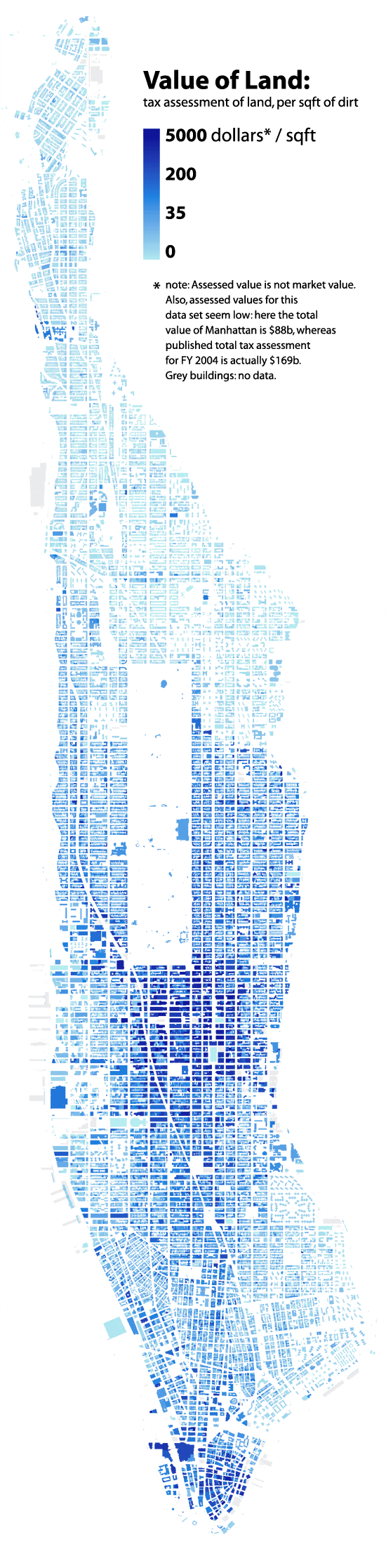
That's not that unusual in the grand scheme of things. I bet a piece of property in central London or on the middle of Manhattan is probably worth 30 times more than a similar sized piece of land in the suburbs.

Edit: There is a greater range than that on Manhattan alone...
     
     
  #4470  
Old Posted Nov 27, 2015, 2:54 AM
Procrastinational's Avatar
Procrastinational Procrastinational is offline
Registered User
 
Join Date: Jan 2014
Location: British Columbia
Posts: 958
Quote:
Originally Posted by dleung View Post
Add up just the land values, and it's ~$140 million for less than half an acre in Coal Harbour.
In that case, a relatively low 1% land value tax would mean a tax bill of $1.4 million per year. No one is going to sit on an underdeveloped piece of property with that amount of tax. It would cause a big surge in infill construction in central areas of the city, reducing the need for sprawl.
     
     
  #4471  
Old Posted Nov 27, 2015, 3:12 AM
casper's Avatar
casper casper is online now
Registered User
 
Join Date: Nov 2011
Location: Victoria
Posts: 12,895
Quote:
Originally Posted by geotag277 View Post
Who are you kidding? Single family detached housing hasn't been affordable in Vancouver since the 90s, even then pay cheques were stretched on upper middle class families to barely afford it. Average "Working Canadians" haven't been able to afford it for a generation.

This mentality that everyone who has a job in Vancouver is entitled to live in a single family detached home with a yard on a 5000+ sqft plot of land is doing more harm than good. These land plots need to be broken down into multiple more affordable living units in the form of townhomes and condos.

Let go of the entitlement.
I grew up in Vancouver in the 1970s and 1980s. In a nice middle class neighborhood and in a single family detached home. A 1950s bungalow my parents still own.

There are very few of those left on the street. In the 1980s and 1990s most of those were displaced by Vancouver Specials. Lets face it your typical Vancouver special is a duplex (both in square footage and rough layout between the two floors). However it was zoned and most as used as single family homes. By a 1950s definition these things are massive and not traditional middle class.

At some point the city outlawed Vancouver Specials. And now you have these basement plus two story homes many new ones with laneway suites over the garage. From a square footage and design perspective these building are not middle class housing.

Go to Saskatoon, Regina, Calgary or the suburbs around other Canadian cities and look at typical middle class housing of today and compare it to the inner city. Your typical middle class home today has a master suite with walk in closets, multipurpose rooms, two car garages and fax mansion finishes that a middle class family could only dream of in the 1950 and 1960s. As a society our expectations are out of sync with what is reasonable and many people are financing that with debt.
     
     
  #4472  
Old Posted Nov 27, 2015, 1:01 PM
lio45 lio45 is offline
BANNED
 
Join Date: Aug 2007
Location: Quebec
Posts: 44,901
Quote:
Originally Posted by Procrastinational View Post
In that case, a relatively low 1% land value tax would mean a tax bill of $1.4 million per year. No one is going to sit on an underdeveloped piece of property with that amount of tax. It would cause a big surge in infill construction in central areas of the city, reducing the need for sprawl.
If that ~0.5 acre where West Pender Place currently sits were instead vacant, this ~0.5 acre would presumably be valued at $140 million for tax purposes (right now, without any changes in the method of taxation.)

What's the tax rate for a vacant lot in Van?
     
     
  #4473  
Old Posted Nov 27, 2015, 3:10 PM
esquire's Avatar
esquire esquire is offline
Registered User
 
Join Date: Oct 2001
Posts: 37,480
Quote:
Originally Posted by casper View Post
Go to Saskatoon, Regina, Calgary or the suburbs around other Canadian cities and look at typical middle class housing of today and compare it to the inner city. Your typical middle class home today has a master suite with walk in closets, multipurpose rooms, two car garages and fax mansion finishes that a middle class family could only dream of in the 1950 and 1960s. As a society our expectations are out of sync with what is reasonable and many people are financing that with debt.
I would agree. Looking around Winnipeg I would say that many of the city's most distinguished citizens of a generation ago lived in homes that would be considered nothing particularly special today, while these days people who have a few bucks but aren't really wildly wealthy (think of self-employed professionals) often live in new homes that are as opulent as the ones built by legitimately filthy rich grain barons 100 years ago. Middle class expectations have really changed.
     
     
  #4474  
Old Posted Nov 27, 2015, 6:29 PM
ssiguy ssiguy is offline
Registered User
 
Join Date: Mar 2006
Location: White Rock BC
Posts: 11,964
It's interesting that since WW11 families have gotten mush smaller while homes have gotten much bigger.
     
     
  #4475  
Old Posted Nov 27, 2015, 6:34 PM
kwoldtimer kwoldtimer is offline
Registered User
 
Join Date: Jan 2008
Location: La vraie capitale
Posts: 26,222
Quote:
Originally Posted by ssiguy View Post
It's interesting that since WW11 families have gotten mush smaller while homes have gotten much bigger.
Back in the '50s, families of 5 and 6 people managed to live in one bathroom homes of maybe 1,200 sq ft. Now we're driving SUVs that are almost that large ( ). As our standard of living has risen, our space expectations have become excessive, imo.

     
     
  #4476  
Old Posted Nov 27, 2015, 6:43 PM
mistercorporate's Avatar
mistercorporate mistercorporate is offline
The Fruit of Discipline
 
Join Date: Mar 2013
Location: Toronto
Posts: 4,036
That's the North American dream!

Biggest shock to the system was seeing how average families were living in our suburbs...massive modern homes and big open sky! Unreal to most of the rest of the developed world.
__________________
MLS: Toronto FC
Canadian Premier League: York 9 FC
NBA: Raptors
     
     
  #4477  
Old Posted Nov 27, 2015, 6:53 PM
Procrastinational's Avatar
Procrastinational Procrastinational is offline
Registered User
 
Join Date: Jan 2014
Location: British Columbia
Posts: 958
Quote:
Originally Posted by lio45 View Post
If that ~0.5 acre where West Pender Place currently sits were instead vacant, this ~0.5 acre would presumably be valued at $140 million for tax purposes (right now, without any changes in the method of taxation.)

What's the tax rate for a vacant lot in Van?
Looks to be about $15 per $1000 of assessed value for businesses, and $3.50 for residential.
http://vancouver.ca/home-property-development/business-and-other.aspx
http://vancouver.ca/home-property-development/residential.aspx

Don't see anything about a different rate for vacant lots. If there is no separate rate, a $140 million residential lot would be $490,000.
     
     
  #4478  
Old Posted Nov 27, 2015, 6:57 PM
mistercorporate's Avatar
mistercorporate mistercorporate is offline
The Fruit of Discipline
 
Join Date: Mar 2013
Location: Toronto
Posts: 4,036
We're so screwed. Toronto passes Vancouver as focus of Chinese investors:
http://www.theglobeandmail.com/life/home...se-investors/article27477884/?cmpid=rss1


__________________
MLS: Toronto FC
Canadian Premier League: York 9 FC
NBA: Raptors
     
     
  #4479  
Old Posted Nov 27, 2015, 6:58 PM
flar's Avatar
flar flar is offline
..........
 
Join Date: Jan 2006
Location: Southwestern Ontario
Posts: 15,752
Quote:
Originally Posted by esquire View Post
I would agree. Looking around Winnipeg I would say that many of the city's most distinguished citizens of a generation ago lived in homes that would be considered nothing particularly special today, while these days people who have a few bucks but aren't really wildly wealthy (think of self-employed professionals) often live in new homes that are as opulent as the ones built by legitimately filthy rich grain barons 100 years ago. Middle class expectations have really changed.
Out of curiousity, I visited some model homes in Kanata, and the standard seems to be four bathrooms now. One for each floor, plus one in the master bedroom.

Four bathrooms!
__________________
RECENT PHOTOS:
TORONTOSAN FRANCISCO ROCHESTER, NYHAMILTONGODERICH, ON WHEATLEY, ONCOBOURG, ONLAS VEGASLOS ANGELES
     
     
  #4480  
Old Posted Nov 27, 2015, 7:42 PM
Berklon's Avatar
Berklon Berklon is offline
Registered User
 
Join Date: Oct 2006
Location: Hamilton
Posts: 3,145
Quote:
Originally Posted by kwoldtimer View Post
Back in the '50s, families of 5 and 6 people managed to live in one bathroom homes of maybe 1,200 sq ft. Now we're driving SUVs that are almost that large ( ). As our standard of living has risen, our space expectations have become excessive, imo.

People need more space in their homes to store all the crap they bought but didn't really need. George Carlin has a routine based on that theory.

It's really distorted how back then families had only 1 income, more kids and higher interest rates and yet were able to save money... but today most families have 2 incomes, less kids and historically low interest rates - but they're living paycheque-to-paycheque and are heavily in debt. It's mainly because people like to live beyond their means. Have to have the latest phones, tablets, TVs... want to eat out often, and have bigger houses than they need filled with stainless steel everything.

Housing is one of the biggest reason why people are so in debt. Both due to the out of wack pricing and the entitlement of buying a house they really can't afford.
     
     
This discussion thread continues

Use the page links to the lower-right to go to the next page for additional posts
 
 
Closed Thread

Go Back   SkyscraperPage Forum > Regional Sections > Canada
Forum Jump


Forum Jump


All times are GMT. The time now is 6:25 PM.


Powered by vBulletin® Version 3.8.7
Copyright ©2000 - 2026, vBulletin Solutions, Inc.