HomeDiagramsDatabaseMapsForum About
     

Go Back   SkyscraperPage Forum > Regional Sections > United States > Mountain West


Reply

 
Thread Tools Display Modes
     
     
  #8921  
Old Posted Oct 10, 2015, 5:12 PM
TakeFive's Avatar
TakeFive TakeFive is online now
Registered User
 
Join Date: Jun 2010
Posts: 8,435
Quote:
Originally Posted by CPVLIVE View Post
This illustrates why Denver will need to establish its own transit agency. RTD has political limitations which will prevent it from providing the sort of intra-city transit the city needs for future growth. A half-a$$ed BRT light like proposal for our busiest urban corridor is the sort of bottom dollar 'solution' I expect from them. Until we get the sort of leadership that refuses to punt to the REGIONAL Transportation District we're in for more of the same.
Exactly correct and well said.

RTD is Regional and for them to do anything outside of what they promised to the voters via Fastracks is a real stretch. Just ask voters in Boulder County how frustrating that can be.

Lacking metro cooperation Phoenix just passed a seven-tenths percent sales tax that will raise over $17 billion dollars. Actually it's not a transit tax it's a transportation tax but expanding light rail is a big piece.

With voter approval for funding you can accomplish whatever your heart desires
__________________
Cool... Denver has reached puberty.
Reply With Quote
     
     
  #8922  
Old Posted Oct 10, 2015, 6:28 PM
TakeFive's Avatar
TakeFive TakeFive is online now
Registered User
 
Join Date: Jun 2010
Posts: 8,435
Quote:
Originally Posted by Cirrus View Post
You seem to be assuming an ant-rail bias on my part. That could not be further from the truth. I merely don't want to waste precious rail dollars on highway-based lines, which take money away from better rail projects elsewhere, and undermine public support for rail spending. ... I think we should have spent our limited budget on rail on Colfax, rather than wasting it on highway lines.
I know. I just the saw the irony in a couple of things you mentioned and played with them.

It's a fair, legitimate, open question as to how well RTD's regional rail network will work. One obvious advantage that rail has over buses is that buses get stuck in the same traffic as cars do (general, not personal comment). Denver's rail system seems to be very much outside the conventional transit box. Unfortunately, it will take 20 years to determine how well it functions. Will walkable, dense TOD happen?

I can recall way back in the early 1980's seeing DTC office building developer plans that showed light rail on the east side of I-25. At that point there wasn't much of value on the west side of I-25. It only took that influential power base 25 years to accomplish their light rail dreams.

For better or worse Fastracks is what the voters bought. It's why I asked if Denver (and other cities) could re-write the transit rules. Many other cities are envious of Denver's suburb to city, commuter oriented system. Doesn't make it ideal; just sayin'.
__________________
Cool... Denver has reached puberty.
Reply With Quote
     
     
  #8923  
Old Posted Oct 12, 2015, 5:56 PM
Cirrus's Avatar
Cirrus Cirrus is offline
cities|transit|croissants
 
Join Date: Jul 2001
Location: Washington, DC
Posts: 18,718
Colfax BRT:


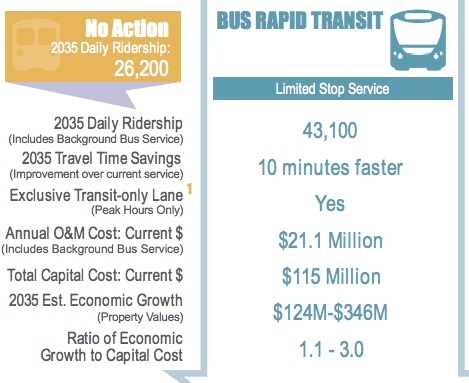
43,100 daily riders, on a 9 mile corridor. That's 4,800 riders per mile!

Imagine what it would get if it were real light rail.
__________________
writing | twitter | bluesky | flickr | instagram | ssp photo threads
Reply With Quote
     
     
  #8924  
Old Posted Oct 12, 2015, 6:11 PM
bunt_q's Avatar
bunt_q bunt_q is offline
Provincial Bumpkin
 
Join Date: Aug 2002
Location: Denver, CO
Posts: 13,203
Quote:
Originally Posted by Cirrus View Post
Colfax BRT:


43,100 daily riders, on a 9 mile corridor. That's 4,800 riders per mile!

Imagine what it would get if it were real light rail.
Mark my words, cars will fly before this City does a real transit investment. We can't even make it a full time transit lane - apparently that second lane is really valuable during non-peak hours. Nevermind that the City/RTD are completely inept when it comes to keeping the existing peak hour only lanes car-free. At least 3 days out of 5, there is a car parked in the Lincoln lane in the AM, to say nothing of enforcing cars driving in it (they don't enforce). Actually had the bus driver stop at yell at the person parking the other day - person yelled right back, and pointed at the sign, said "I can park here." No, she couldn't, but nevermind that, English is hard. And anybody can park in those lanes in Denver because the City is not at all committed to transit lanes. (Or they're incompetent - I'll be generous and go with a lack of commitment.) Proven again by a half-assed solution for Colfax. At least with full-time transit lanes you rely less on half-assed enforcement.

Another example of half-assed solutions. We could invest in sidewalk bulb-outs at bus stops, so the bus doesn't have to pull over. But nah, we'll pass legislation that requires cars to yield so the bus can get back into traffic. Which we don't enforce, so it doesn't work. I wonder if a Denver cop has ever written a ticket for not allowing a bus to re-enter traffic? Again, half-assed.
Reply With Quote
     
     
  #8925  
Old Posted Oct 12, 2015, 6:22 PM
wong21fr's Avatar
wong21fr wong21fr is offline
Reluctant Hobbesian
 
Join Date: Feb 2002
Location: Denver
Posts: 13,125
I'd kill for full-time transit lanes on Broadway and Colfax. Literally. I'd make a pyre out of a thousand cyclists and burn them as a sacrifice to the transit gods.

Petitions and letters don't work. But human sacrifice? Hell yes.

The 43K daily ridership number is cute. What's even cuter is that it uses the 15 local service (that remains as a bus not matter what other technology is used) to bolster the corridor ridership figures.
__________________
"You don't strike, you just go to work everyday and do your job real half-ass. That's the American way!" -Homer Simpson

All of us who are concerned for peace and triumph of reason and justice must be keenly aware how small an influence reason and honest good will exert upon events in the political field. ~Albert Einstein


Last edited by wong21fr; Oct 12, 2015 at 6:36 PM.
Reply With Quote
     
     
  #8926  
Old Posted Oct 16, 2015, 10:32 PM
TakeFive's Avatar
TakeFive TakeFive is online now
Registered User
 
Join Date: Jun 2010
Posts: 8,435
The R Line versus the W, G and N Lines
Let the best line win!

Outside of central Denver this is what I see looking out a decade or even two.

The R Line

My best guess is that the Peoria Station will become one of the busiest stations in the metro-wide system. Hop aboard the A Line and you can zip downtown (sports, anyone?) or zip out to DIA (trip to Tahiti?) Getting off at the Peoria Station will give good access to Fitzsimons. The R Line will be the key for this as it provides access from all of Aurora.

While not as busy as the Peoria Station perhaps, I see the Colfax Station as still being very busy. For one thing it's a good access point to/from the whole Colfax Corridor which Cirrus has fantasies about. Once the "beautiful" $1.6 billion VA Hospital is finished that should generate quite a lot of transit traffic. Didn't Anschutz pre-lease most of the space in the new office building across Colfax Street? I presume there's additional potential for primary and specialty (clinical) medical care development on the south side of Colfax.

Moving to the south end of Aurora the existing Nine Mile Station I believe is already one of he busier stations in the metro area. I wish I could access the numbers to confirm that though. Across Parker Road "A partnership between Denver-based firms Mile High Development and Koelbel and Company" are the city's designated developer to redevelop Regatta Plaza.

Moving to the next station a mile north the Iliff Station has the potential for impressive ridership numbers as well. There's a lot of (suburban) density inside of I-225. There's also very good density to the east of I-225 but it's more spread out along Iliff Ave. and Chambers and Buckley Roads. Initially the Iliff Station likely takes some ridership from Nine Mile but I'm not worried about that as Nine Mile will continue to grow ridership from along and to the east of South Parker Road.

As for the rest of the stations along the R Line, I have no defined opinion. I'll assume that light rail helps stimulate development at the Aurora City Center but how dense or what that might look like I have no idea. Presumably some day the adjacent Aurora Mall will be redeveloped with mixed use. I know there are still ample vacant land sites that could be developed into more affordable and mixed income housing as you move north from Alameda so at some point I'd expect that to happen.

The W Line

I like the potential of the W Line well enough, especially between Federal and Wadsworth Blvds. I like the ultimate potential of the Federal Center longer term and there is some existing density off Union Blvd. But once you reach the Denver boundary at Sheridan Blvd. from the west is when the line takes on more of an urban flavor and where I see the most potential in the near term. I'd put the W Line as a close second to the the R Line.

The G Line

I like Arvada even if I'm a little skeptical of ridership. I love Olde Town Arvada; I like the Arvada Center for the Arts and Humanities. I also like the cool newer Apex Center out near Ward Road and 72nd Ave. I rather like the more hilly topography out in that area. But Arvada will need a ton of TOD before ridership meets expectations IMO. It has the potential of course.

The N Line

I only know the area very generally and have no real opinion other than being skeptical.


That's the "seat of my pants" view as in mostly car seat. I haven't read any of the EIS's so I'm open and invite other opinions.

__________________
Cool... Denver has reached puberty.
Reply With Quote
     
     
  #8927  
Old Posted Oct 18, 2015, 10:55 PM
TakeFive's Avatar
TakeFive TakeFive is online now
Registered User
 
Join Date: Jun 2010
Posts: 8,435
I didn't go looking for this but it caught my attention and I connected a few dots.

According to Molly Armbrister, Denver Business Journal, BMC Investments (and Oak Coast Properties) recently purchased a 584 unit apartment complex at 13100 E. Kansas Dr. in Aurora. I can recall when that project was completed in 1981 but I didn't recall it having that many units. Maybe they added some when I wasn't looking.

Earlier this year BMC Investments purchased the 461 unit Aurora Meadows Apartments at 777 Dillon Way along with a 504 unit project in Westminster. Molly Armbrister, Denver Business Journal also reported on this transaction.
Quote:
"BMC invested in these properties because both sites are in strong submarkets with low vacancy and minimal new supply under construction," said Matthew Joblon, CEO for BMC Investments. "The areas are also experiencing substantial neighborhood gentrification with many older properties benefiting from significant new capital investments and their proximity to new light rail stations currently under construction."
If BMC Investments doesn't ring a bell they also developed this recently completed beauty at 1st ave. and Steele Street.

My own view of "New Aurora" has been from Mississippi Ave. south to Arapahoe Road and mostly within the Cherry Creek School district. East (and west for that matter) of the CC reservoir "Creek" runs between Hampden Ave. and the Arapahoe County line. For example, the newest high school, Cherokee Trail has an address of 25901 E Arapahoe Rd. The prior school, the well regarded Grandview HS has an address of 20500 E Arapahoe Rd.

It caught my attention and intrigued me where BMC Investments had purchased property, especially the apartments as far north as 777 Dillon Way. Maybe that part of Aurora has more potential than even I anticipated. If people want to live "closer in" then along I-225 is actually fairly close and accessible. Same for much of Lakewood.

It also appears there is growing interest from investors along most of the new rail transit lines.
__________________
Cool... Denver has reached puberty.
Reply With Quote
     
     
  #8928  
Old Posted Oct 22, 2015, 11:51 PM
Denver Dweller Denver Dweller is offline
Registered User
 
Join Date: Apr 2005
Location: Denver, CO
Posts: 828
RTD announces Union Station-to-DIA rail line will open April 22, 2016

Reply With Quote
     
     
  #8929  
Old Posted Oct 23, 2015, 4:41 PM
trubador trubador is offline
Registered User
 
Join Date: Oct 2010
Posts: 196
Quote:
Originally Posted by TakeFive View Post

While not as busy as the Peoria Station perhaps, I see the Colfax Station as still being very busy. For one thing it's a good access point to/from the whole Colfax Corridor which Cirrus has fantasies about. Once the "beautiful" $1.6 billion VA Hospital is finished that should generate quite a lot of transit traffic. Didn't Anschutz pre-lease most of the space in the new office building across Colfax Street? I presume there's additional potential for primary and specialty (clinical) medical care development on the south side of Colfax.
I'm not sure I understand what this means. Do you mean the Anschutz Foundation? The only building across the street is Fitz 100 and that building is leased to Childrens (except the ground level retail). Do you mean Fitz 200 which they haven't started building yet?
Reply With Quote
     
     
  #8930  
Old Posted Oct 23, 2015, 5:02 PM
TakeFive's Avatar
TakeFive TakeFive is online now
Registered User
 
Join Date: Jun 2010
Posts: 8,435
Quote:
Originally Posted by trubador View Post
I'm not sure I understand what this means. Do you mean the Anschutz Foundation? The only building across the street is Fitz 100 and that building is leased to Childrens (except the ground level retail). Do you mean Fitz 200 which they haven't started building yet?
Ahh, thanks for the clarification. Reason I put into question form is I couldn't remember who/what precisely, just that it was medical related. Fitz 100 then; I read something while it was still under construction.
__________________
Cool... Denver has reached puberty.
Reply With Quote
     
     
  #8931  
Old Posted Oct 23, 2015, 5:48 PM
wong21fr's Avatar
wong21fr wong21fr is offline
Reluctant Hobbesian
 
Join Date: Feb 2002
Location: Denver
Posts: 13,125
Quote:
Originally Posted by TakeFive View Post
While not as busy as the Peoria Station perhaps, I see the Colfax Station as still being very busy. For one thing it's a good access point to/from the whole Colfax Corridor which Cirrus has fantasies about. Once the "beautiful" $1.6 billion VA Hospital is finished that should generate quite a lot of transit traffic. Didn't Anschutz pre-lease most of the space in the new office building across Colfax Street? I presume there's additional potential for primary and specialty (clinical) medical care development on the south side of Colfax.
Probably not as busy as you would envision. Medical professionals won't ride the train that much due to the frequency, end location, and hours; and the VA pulls from such a large service area that a lot of the patients will find it unhelpful to ride the shitty train given other not-quite-as-shitty transit options such as dedicated VA shuttles.

Because nothing's too much for the veterans.
__________________
"You don't strike, you just go to work everyday and do your job real half-ass. That's the American way!" -Homer Simpson

All of us who are concerned for peace and triumph of reason and justice must be keenly aware how small an influence reason and honest good will exert upon events in the political field. ~Albert Einstein

Reply With Quote
     
     
  #8932  
Old Posted Oct 23, 2015, 8:27 PM
trubador trubador is offline
Registered User
 
Join Date: Oct 2010
Posts: 196
Quote:
Originally Posted by wong21fr View Post
Probably not as busy as you would envision. Medical professionals won't ride the train that much due to the frequency, end location, and hours; and the VA pulls from such a large service area that a lot of the patients will find it unhelpful to ride the shitty train given other not-quite-as-shitty transit options such as dedicated VA shuttles.

Because nothing's too much for the veterans.
I think this may be a pleasant surprise. Between outpatient clinics that run 9-5 which employ a large number of medical professionals there are a lot of jobs that are non medical on the campus It, radiology tech, custodial, finance, procurement, and the 4000+ students that are all on the campus. I left out the patient visits, which should easy reach 2 million visits a year once the VA hospital is built.

It wouldn't surprise me if the colfax and fitz stop have higher than estimated boardings.
Reply With Quote
     
     
  #8933  
Old Posted Oct 23, 2015, 8:52 PM
TakeFive's Avatar
TakeFive TakeFive is online now
Registered User
 
Join Date: Jun 2010
Posts: 8,435
It's a deep dark secret

I continue to check out other transit systems, primarily construction projects for their current or planned costs. Using some different key words I happened upon some great data assembled by Yonah Freemark on his TransportPolitic site.

Yonah has the following figures for Denver:
The Eagle (P3) Project:
The A, G and B (NW) lines cost is $2.1 billion or $53,157,895 per mile for the 40.2 miles
The R Line:
The 10.5 mile line has a cost of $350 million or $33,333,333 per mile
The N Line:
The 13 miles has a cost of $343 million or $26,384,615 per mile
Seeing those numbers got me to wondering about my vague recall of the $60-65 million per mile costs I have floated. My previous scratching's are gone so I decided to re-run the numbers as I do remember my methodology.

The W Line which Yonah doesn't list since it's completed, is simple and straight forward. It cost $707 million for the 12.1 miles or $58.5 million per mile.

It's the other lines that are tricky. The costs that Yonah has I assume are the hard construction costs and don't include the soft/P3 partner investment costs which I also assume are like a loan that will be paid back over time. I wanted to guestimate these costs to reach a "total cost" figure which as far as I know remain undisclosed.

With respect to the Eagle project I happened upon information that the consortium had borrowed something like $600-650 million through Lloyds Bank of London. (Light goes on) So I plugged in an additional cost of $600 million (to $2.1 billion) which adds about 29% to the cost for a total of $2.7 billion. With the A Line, I threw a $100 million on top and when I divided it also came out to about 29% so I said OK. I also added a $100 million to the N Line.

NOTE: I've generally seen soft costs that run from 25%-40% of total project costs. If I recalculate my 29% figure to a percentage of total costs it comes out to about 22.5%. I reasoned that RTD's prior work had lessoned the likely soft/design costs and including P3 efficiencies I decided that 22.5% was good enough.

Using my methodology the numbers look like this:
  • The W Line as stated is $58.5 million per mile, total cost of $707 million
  • The Eagle Lines are $67 million per mile, total cost of $2.7 billion
  • The R Line is $44 million per mile, total cost of $450 million
  • The N Line is $34 million per mile, total cost of $443 million.
Add it all up you get a total cost of $4.3 billion or $56.7 million per mile average.

NOTES:
1) The W Line costs include expanding the light rail maintenance facility and purchasing the needed extra LRT cars for both the W and R Lines.
2) The Eagle project covers the costs of acquiring all the rolling stock and the maintenance and control center facility.

BTW, based on some of my own checking I believe the rest of TransportPolitic's numbers are accurate; not aware of any other cities who have used P3's.
__________________
Cool... Denver has reached puberty.
Reply With Quote
     
     
  #8934  
Old Posted Oct 23, 2015, 8:53 PM
wong21fr's Avatar
wong21fr wong21fr is offline
Reluctant Hobbesian
 
Join Date: Feb 2002
Location: Denver
Posts: 13,125
Quote:
Originally Posted by trubador View Post
I think this may be a pleasant surprise. Between outpatient clinics that run 9-5 which employ a large number of medical professionals there are a lot of jobs that are non medical on the campus It, radiology tech, custodial, finance, procurement, and the 4000+ students that are all on the campus. I left out the patient visits, which should easy reach 2 million visits a year once the VA hospital is built.

It wouldn't surprise me if the colfax and fitz stop have higher than estimated boardings.
Here's hoping. I just don't think that the VA Hospital is going to be a massive catalyst for transit use via patients and visitors. It's a very different clientele spread over a huge geographic area with demographics that skew older than your average hospital.

Anecdotally, the current hospital probably has 2-3 times the passengers using transit vouchers instead of relying on RTD. You've also got a ton of Call-n-Ride use out of the facility. Doesn't bode well for crotchety, old vets suddenly opting to take the train to seek care.
__________________
"You don't strike, you just go to work everyday and do your job real half-ass. That's the American way!" -Homer Simpson

All of us who are concerned for peace and triumph of reason and justice must be keenly aware how small an influence reason and honest good will exert upon events in the political field. ~Albert Einstein

Reply With Quote
     
     
  #8935  
Old Posted Oct 23, 2015, 9:20 PM
bunt_q's Avatar
bunt_q bunt_q is offline
Provincial Bumpkin
 
Join Date: Aug 2002
Location: Denver, CO
Posts: 13,203
TakeFive you are completely misunderstanding how the procurement of the Eagle project worked. The only way to do what you are trying to do would be to take a net present value of the payments to the concessionaire over the term of the project, plus the milestone payments, plus owner incurred costs, likely including most of the right-of-way. There was no fixed construction cost plus a payment of soft costs, that's just not how it works.

Happy to describe in more detail when I am not driving!

I also think you are almost exactly backwards in your projections of ridership. You give too much weight to network effect and the ridership it generates from transfers, which with a system like ours, is essentially zero. You will see that in the Peoria station, which will not be anywhere near the busiest station in the system - probably not even top half. You underestimate lines like the Arvada line, when they are actually likely to perform quite well because they are fast, direct, and serve a corridor that is heavy in downtown workers. You should not forget that ours is still a commuter system, we're not London.
Reply With Quote
     
     
  #8936  
Old Posted Oct 23, 2015, 10:26 PM
TakeFive's Avatar
TakeFive TakeFive is online now
Registered User
 
Join Date: Jun 2010
Posts: 8,435
Quote:
Originally Posted by bunt_q View Post
TakeFive you are completely misunderstanding how the procurement of the Eagle project worked. The only way to do what you are trying to do would be to take a net present value of the payments to the concessionaire over the term of the project, plus the milestone payments, plus owner incurred costs, likely including most of the right-of-way. There was no fixed construction cost plus a payment of soft costs, that's just not how it works.
I protest!

I understand the concept of discounted cash flows. But I don't care how it all comes out in the wash, you can bet your bippy that the consortium is getting a return of and on their their soft costs investment. If they have to pay their loan back plus vigorish to Lloyds Bank you can be assured they're charging for that. That means I don't know or care how the contract reads, the costs are in there as well as their management fee return. In fact their own partnership agreement is likely complicated as not all are in it for the long term I'm pretty sure.
Quote:
Originally Posted by bunt_q View Post
I also think you are almost exactly backwards in your projections of ridership. You give too much weight to network effect and the ridership it generates from transfers, which with a system like ours, is essentially zero. You will see that in the Peoria station, which will not be anywhere near the busiest station in the system - probably not even top half. You underestimate lines like the Arvada line, when they are actually likely to perform quite well because they are fast, direct, and serve a corridor that is heavy in downtown workers. You should not forget that ours is still a commuter system, we're not London.
Some of this goes back partly to an old argument we've had so I won't rehash that. I can only add that Denver isn't going to be building 8 to 10-lane freeways all over the city like Phoenix has so the odds are reasonable that over time, more and more people will learn to appreciate riding the rails.

You make a fair point about Arvada but the drive is easier than many places also. Then again the Park N' Ride option is nice so maybe I'll upgrade my skepticism a bit.

I'm curious as to what stations you think will be busy and why?

The Nine Mile Station's 1225 parking spaces are well utilized so that station has already proved its mettle as a suburban commuter station. If one lives inside of I-225 or not too far to the east and works at the airport why would you not utilize rail transit? If one lives anywhere in Aurora and you work downtown why would you not use rail transit other than an express bus being a better option? Once the A Line opens which direction you want to go would presumably depend on where in downtown you'd want to end up at?
__________________
Cool... Denver has reached puberty.
Reply With Quote
     
     
  #8937  
Old Posted Oct 24, 2015, 12:01 AM
bunt_q's Avatar
bunt_q bunt_q is offline
Provincial Bumpkin
 
Join Date: Aug 2002
Location: Denver, CO
Posts: 13,203
I don't know what you mean by "soft costs" but of course there is a return. But we have no idea how or when that return is realized. My guess is it's almost all on the very end of the availability payments. Your mistake is assuming the $2.1m number and then adding on to it. That's adding apples and oranges and using it to back-calculate bananas.

If I worked at the airport I'd drive to the Peoria or 40th and Airport station and take the train from there. Probably cuts 30 minutes off the commute. Same reason I drive to Broadway today instead of boarding at Englewood, which is very close to me. The transfer alone makes transit uneconomical (from a time perspective). Our system is just too damn slow and infrequent to work as a transfer system for any choice rider.
Reply With Quote
     
     
  #8938  
Old Posted Oct 24, 2015, 1:22 AM
TakeFive's Avatar
TakeFive TakeFive is online now
Registered User
 
Join Date: Jun 2010
Posts: 8,435
Quote:
Originally Posted by bunt_q View Post
I don't know what you mean by "soft costs" but of course there is a return. But we have no idea how or when that return is realized. My guess is it's almost all on the very end of the availability payments. Your mistake is assuming the $2.1m number and then adding on to it. That's adding apples and oranges and using it to back-calculate bananas.

If I worked at the airport I'd drive to the Peoria or 40th and Airport station and take the train from there. Probably cuts 30 minutes off the commute. Same reason I drive to Broadway today instead of boarding at Englewood, which is very close to me. The transfer alone makes transit uneconomical (from a time perspective). Our system is just too damn slow and infrequent to work as a transfer system for any choice rider.
Soft costs are anything that aren't hard costs. Maybe EngiNerd or other expert can articulate them better than I?

ENR Mountain States used to have a fairly active site which I would read. Representing contractors they would typically quote costs - the (hard) contract costs or cost of actual construction. I noticed they were substantially different from the project costs that were quoted in other sources. That's how I learned. Soft costs would include things like planning costs, EIS's, the architectural, design and engineering costs. ROW acquisition costs maybe? etc.

If DTP (Denver Transit Partners) borrowed $650 million through Lloyds Bank of London it has to be to cover their "soft costs" and probably includes some extra or contingency money. That's a lot of money and there's no way they can wait to pay that off until the tail end. That would be like RTD bonding those costs and not having to pay it back until the tail end.

As for your fruit I do eat a banana and orange every day but not so keen on apples. That $2.1 is with a B not an m.

I'm not sure how valid extrapolating your choices onto the general population are. But even your choice does generate ridership at the Peoria Station.
__________________
Cool... Denver has reached puberty.
Reply With Quote
     
     
  #8939  
Old Posted Oct 24, 2015, 4:58 AM
bunt_q's Avatar
bunt_q bunt_q is offline
Provincial Bumpkin
 
Join Date: Aug 2002
Location: Denver, CO
Posts: 13,203
I hope you're being facetious. The concessionaire's costs include hard costs, soft costs, financing costs, insurance costs (above what would be required in a non-P3 context), equity costs, decades of operating costs, and their return. And their "bid" is a (single) payment amount over the length of the concession that includes all of those things, not broken out. RTD probably doesn't get a "bid" with line item construction costs on a concession deal like they would on another project. To some extent, RTD might not even know what the hard costs were (although they could re-create it from the financial model if they wanted to). Nor do they care - not their problem. They got the project they wanted with the money they had - how the concessionaire structured it doesn't really matter. P3 projects aren't like the 99% of projects you're reading about in ENR.

Their borrowing structure will be a lot more complicated as well. Equity probably isn't repaid until the tail end, that's normal. These are long term investments.

Also, I'm not extrapolating my choices, just using them as an example. I'm trying to tell you how transit ridership actually works. Not just on the Internet, or with pretty maps drawn by hobby transitists, where the network always looks better. Cirrus demonstrated pretty well actually in his comparison of Denver and Phoenix ridership numbers how we are already not seeing the effects you are claiming. I'm just trying to give you examples of why that is; it's not really an opinion sort of thing. Not like a GOP Congressman's take on climate change.

Last edited by bunt_q; Oct 24, 2015 at 5:12 AM.
Reply With Quote
     
     
  #8940  
Old Posted Oct 24, 2015, 5:21 PM
TakeFive's Avatar
TakeFive TakeFive is online now
Registered User
 
Join Date: Jun 2010
Posts: 8,435
Quote:
Originally Posted by bunt_q View Post
Also, I'm not extrapolating my choices, just using them as an example. I'm trying to tell you how transit ridership actually works. Not just on the Internet, or with pretty maps drawn by hobby transitists, where the network always looks better. Cirrus demonstrated pretty well actually in his comparison of Denver and Phoenix ridership numbers how we are already not seeing the effects you are claiming. I'm just trying to give you examples of why that is; it's not really an opinion sort of thing. Not like a GOP Congressman's take on climate change.
I may be familiar with why Phoenix generates the ridership numbers that they do.

Phoenix, in a sense, hit the jackpot with their first 20-mile line which is now being extended on both ends. It's primarily an urban trolley. Stopping every couple of blocks or so, just don't be in a hurry; makes me chuckle at the complaints on this thread over stops and times.

As the line moves away from downtown to the east on its way to Tempe, it does make a stop at the Sky Harbor 44th Street Park N' Ride where you can hop on the Sky Train or people mover to the airport. But unless you live near downtown Phoenix or Tempe there would be no reason to use the LRT.

The segment between downtown Phoenix and downtown Tempe with its adjacent 55,000-student campus does have fewer stops. ASU's recently created campus in downtown Phoenix serves about 11,500 students according to their web site. Presumably many live in Tempe, may take classes on both campuses so that using light rail for them is pretty nifty.


Phoenix light rail isn't really for commuters other than commuters that happen to live near downtown. Transportation for the suburbs and even most of Phoenix is served by a very modern, wide lanes, safe, 8 to 10 lane freeway system.
__________________
Cool... Denver has reached puberty.
Reply With Quote
     
     
This discussion thread continues

Use the page links to the lower-right to go to the next page for additional posts
 
 
Reply

Go Back   SkyscraperPage Forum > Regional Sections > United States > Mountain West
Forum Jump


Forum Jump


All times are GMT. The time now is 7:36 PM.


Powered by vBulletin® Version 3.8.7
Copyright ©2000 - 2026, vBulletin Solutions, Inc.