HomeDiagramsDatabaseMapsForum About
     

Go Back   SkyscraperPage Forum > Regional Sections > United States > Texas & Southcentral > Austin


Reply

 
Thread Tools Display Modes
     
     
  #541  
Old Posted Sep 17, 2015, 7:58 PM
Novacek Novacek is offline
Registered User
 
Join Date: Jan 2013
Posts: 2,571
Quote:
Originally Posted by wwmiv View Post
Well, in most places the areas outside the limits pay substantially more for services that the city provides.
Such as?

Austin energy customers outside the city limits pay _less_ than residents.

Soon to be the same for water
http://kut.org/post/puc-calls-order-...in-water-rates

Quote:
Originally Posted by wwmiv View Post
That and roads are also typically not paid for by the cities either, they're county and state maintained.
If a non-annexed area resident gets on a road and commutes into work, they're often driving part-way on a city maintained road. And if they get into an accident, the Austin fire department and EMS respond.

And any driving they're doing on a county road, again, that's a great deal for them. They're driving on a road that Austin residents are paying for (we pay county taxes too).


My subdivision never got a chance to vote. Could my block de-annex from the city?
Reply With Quote
     
     
  #542  
Old Posted Sep 18, 2015, 1:20 AM
drummer drummer is offline
World Traveler
 
Join Date: Jan 2015
Location: Austin metro area
Posts: 4,734
^^ And many county and state roads leave a lot to be desired. Annexation is certainly a big deal and one should weigh both sides of it - I support voting for it as well. Sometimes it's the right move, sometimes not.
Reply With Quote
     
     
  #543  
Old Posted Sep 18, 2015, 1:53 AM
lzppjb's Avatar
lzppjb lzppjb is offline
7th Gen Central Texan
 
Join Date: Feb 2007
Location: Austin TX
Posts: 3,150
I grew up my entire life on a road that was half city and half county. Let me just say that my experience is the complete opposite of what has been said in the last couple of posts. The county half is smooth and well maintained. The city half is a piece of shit.
Reply With Quote
     
     
  #544  
Old Posted Sep 18, 2015, 2:26 PM
Novacek Novacek is offline
Registered User
 
Join Date: Jan 2013
Posts: 2,571
Quote:
Originally Posted by drummer View Post
^^ And many county and state roads leave a lot to be desired. Annexation is certainly a big deal and one should weigh both sides of it - I support voting for it as well. Sometimes it's the right move, sometimes not.
Okay, so my next question. Who votes for it?

Residents? Landowners? What if those aren't the same people?

What about commercial or corporately owned land. Do they get a vote too?

Any proportionality? Could two single homeowners on 1/4 acre plots "force" the annexation of 5000 acres of corporate owned land? What about 5000 acres of family owned land (like an old ranch)?


It's just a huge bucket of worms, and as I've said, completely inequitable because no one else got the same opportunity.
Reply With Quote
     
     
  #545  
Old Posted Sep 21, 2015, 7:00 PM
Tech House Tech House is offline
Honored Member
 
Join Date: May 2012
Location: Austin, TX
Posts: 726
Quote:
Originally Posted by Novacek View Post
Okay, so my next question. Who votes for it?
I believe the Constitution settled that question: White male property owners. I'm sure they would have included "heterosexual" if there had been such a thing as being openly gay at the time, but today we would need to state that explicitly.

Kidding aside, I've been watching this debate with a lot of ambivalence because there seems to be no clear answer to any of these questions. I'm a pro-cooperation kind of guy and favor incorporation in most cases, but that's likely an uninformed knee-jerk reaction. But it does seem incredibly inefficient and inherently unfair for cities to be the geographic equivalent of a pair of torn, holey jeans. Austin's boundaries make the coast of Maine look like it was drawn with a ruler. Something about this just strikes me as being wrong.
Reply With Quote
     
     
  #546  
Old Posted Sep 22, 2015, 1:09 PM
Novacek Novacek is offline
Registered User
 
Join Date: Jan 2013
Posts: 2,571
Quote:
Originally Posted by Tech House View Post
I believe the Constitution settled that question: White male property owners. I'm sure they would have included "heterosexual" if there had been such a thing as being openly gay at the time, but today we would need to state that explicitly.

Kidding aside, I've been watching this debate with a lot of ambivalence because there seems to be no clear answer to any of these questions. I'm a pro-cooperation kind of guy and favor incorporation in most cases, but that's likely an uninformed knee-jerk reaction. But it does seem incredibly inefficient and inherently unfair for cities to be the geographic equivalent of a pair of torn, holey jeans. Austin's boundaries make the coast of Maine look like it was drawn with a ruler. Something about this just strikes me as being wrong.
At least Austin is mostly geographically compact and contiguous (not counting enclaves). Check out LA.
Reply With Quote
     
     
  #547  
Old Posted Sep 22, 2015, 3:43 PM
wwmiv wwmiv is offline
Registered User
 
Join Date: Sep 2009
Location: Austin -> San Antonio -> Columbia -> San Antonio -> Chicago -> Austin -> Denver -> Austin
Posts: 5,710
Quote:
Originally Posted by Novacek View Post
At least Austin is mostly geographically compact and contiguous (not counting enclaves). Check out LA.
LA is contiguous not counting enclaves of other cities (i.e. it has no exclaves itself).
Reply With Quote
     
     
  #548  
Old Posted Sep 22, 2015, 4:32 PM
Novacek Novacek is offline
Registered User
 
Join Date: Jan 2013
Posts: 2,571
Quote:
Originally Posted by wwmiv View Post
LA is contiguous not counting enclaves of other cities (i.e. it has no exclaves itself).
No exclaves, but almost.

I was referring more to the compactness. Austin is still somewhat circular, while LA has that extension along I110.
Reply With Quote
     
     
  #549  
Old Posted Sep 22, 2015, 4:37 PM
wwmiv wwmiv is offline
Registered User
 
Join Date: Sep 2009
Location: Austin -> San Antonio -> Columbia -> San Antonio -> Chicago -> Austin -> Denver -> Austin
Posts: 5,710
Quote:
Originally Posted by Novacek View Post
No exclaves, but almost.

I was referring more to the compactness. Austin is still somewhat circular, while LA has that extension along I110.
There is no such thing as being an almost exclave. It either isn't or it is, pure and simple. And by pretty much any measure of compactness that we use in academia, Los Angeles would be more compact than Austin even considering the Port of L.A. extension.
Reply With Quote
     
     
  #550  
Old Posted Sep 22, 2015, 5:09 PM
Tech House Tech House is offline
Honored Member
 
Join Date: May 2012
Location: Austin, TX
Posts: 726
For direct comparison, Austin:


And Los Angeles:


Austin looks like something that needs to be surgically removed, whereas LA looks like something that might be living in your attic.


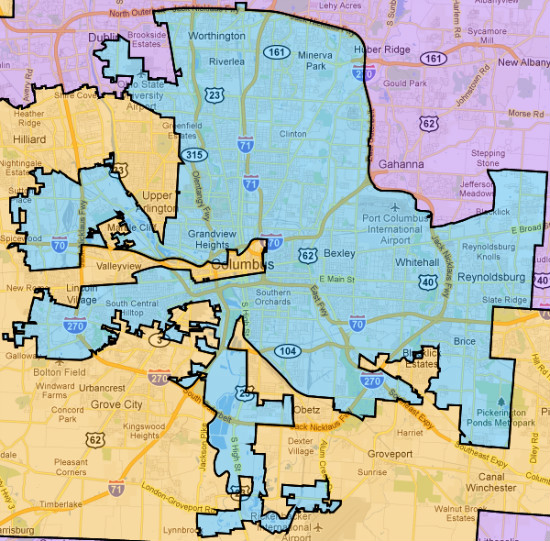
But Columbus, OH, takes the cake:


Last edited by Tech House; Sep 22, 2015 at 5:31 PM.
Reply With Quote
     
     
  #551  
Old Posted Sep 22, 2015, 5:39 PM
wwmiv wwmiv is offline
Registered User
 
Join Date: Sep 2009
Location: Austin -> San Antonio -> Columbia -> San Antonio -> Chicago -> Austin -> Denver -> Austin
Posts: 5,710
Quote:
Originally Posted by Tech House View Post

But Columbus, OH, takes the cake:

That image of Columbus is actually not the city limits, but rather a U.S. Congressional District proposal from the last round of redistricting which would have comprised the Columbus area had it been enacted. Columbus itself is actually significantly worse.

See here for the congressional districts which were eventually enacted (which are substantially similar):
http://images.dailykos.com/i/user/303419/OH_map.html
Reply With Quote
     
     
  #552  
Old Posted Sep 22, 2015, 6:02 PM
Tech House Tech House is offline
Honored Member
 
Join Date: May 2012
Location: Austin, TX
Posts: 726
Thanks for the correction. Daily Kos is where I got the original image, maybe from the same article but I failed to look at the context in my image search for "weird city limit maps". By the way, if you just search "weird city limits" you get images from ACL. I had to exclude those with -music -festival -acl. It was actually pretty hard to find images of Austin's city limits, other than a very good one that was way too large.
Reply With Quote
     
     
  #553  
Old Posted Sep 22, 2015, 6:29 PM
Novacek Novacek is offline
Registered User
 
Join Date: Jan 2013
Posts: 2,571
Quote:
Originally Posted by Tech House View Post
For direct comparison, Austin:


And Los Angeles:


Austin looks like something that needs to be surgically removed, whereas LA looks like something that might be living in your attic.


But Columbus, OH, takes the cake:

That Austin one isn't including parts of Austin that are limited purpose.

Update: Actually, I'm wrong. I hadn't realized those few limited annexation areas were actually disconnected (though connected by ETJ and presumably connecting long term).

Last edited by Novacek; Sep 22, 2015 at 6:58 PM.
Reply With Quote
     
     
  #554  
Old Posted Sep 22, 2015, 6:34 PM
Novacek Novacek is offline
Registered User
 
Join Date: Jan 2013
Posts: 2,571
Quote:
Originally Posted by wwmiv View Post
There is no such thing as being an almost exclave. It either isn't or it is, pure and simple.
Come on, if that extension along I110 was only 1 foot wide, or 1 inch (so that it wasn't physically possible to travel from the one part of LA to the other without leaving it) you wouldn't call that "almost an exclave"?
Reply With Quote
     
     
  #555  
Old Posted Sep 22, 2015, 6:55 PM
wwmiv wwmiv is offline
Registered User
 
Join Date: Sep 2009
Location: Austin -> San Antonio -> Columbia -> San Antonio -> Chicago -> Austin -> Denver -> Austin
Posts: 5,710
Quote:
Originally Posted by Novacek View Post
Come on, if that extension along I110 was only 1 foot wide, or 1 inch (so that it wasn't physically possible to travel from the one part of LA to the other without leaving it) you wouldn't call that "almost an exclave"?
No, I wouldn't, because exclave has a very precise and specific definition.
Reply With Quote
     
     
  #556  
Old Posted Sep 23, 2015, 1:26 PM
Novacek Novacek is offline
Registered User
 
Join Date: Jan 2013
Posts: 2,571
Quote:
Originally Posted by wwmiv View Post
And by pretty much any measure of compactness that we use in academia, Los Angeles would be more compact than Austin even considering the Port of L.A. extension.
Which measures are those? Not to be (too ) confrontational, I'm curious.


Like I said, Austin is still mostly circular. If you compare (overlay) Austin with the idealized compact Austin ( a perfect circle with radius 9.3 miles), it doesn't actually deviate all that much. A few miles in a few places.

Do the same thing with LA ( a circle of radius 12.6), and it deviates more.

Put another way, the longest (crow flys) distance from one point of Austin to another is about 27 miles (compared to a perfectly compact Austin where it would be 18.6).

In LA, that's 46 miles (while in perfectly round LA it would be 25). 80% longer vs. 50% longer.

Reply With Quote
     
     
  #557  
Old Posted Sep 23, 2015, 3:14 PM
wwmiv wwmiv is offline
Registered User
 
Join Date: Sep 2009
Location: Austin -> San Antonio -> Columbia -> San Antonio -> Chicago -> Austin -> Denver -> Austin
Posts: 5,710
One of the most standard ways is the length of the radius of the smallest circle's circumference as a ratio with the length of the distance around the cities outside boundary. Austin's ratio would be larger because of the significantly more deviations from the boundary of the circle itself, and thus is less compact.
Reply With Quote
     
     
  #558  
Old Posted Sep 23, 2015, 3:50 PM
Novacek Novacek is offline
Registered User
 
Join Date: Jan 2013
Posts: 2,571
Quote:
Originally Posted by wwmiv View Post
One of the most standard ways is the length of the radius of the smallest circle's circumference as a ratio with the length of the distance around the cities outside boundary. Austin's ratio would be larger because of the significantly more deviations from the boundary of the circle itself, and thus is less compact.
That measure just doesn't seem to capture the actual qualitative measure (and benefits) of compactness. Everyone being closer to downtown, being able to reach any part of the city from any other, etc.


It would value a long,thing (but smoothly surfaced) city over a nearly perfect circle with a fractal boundary.
Reply With Quote
     
     
  #559  
Old Posted Sep 23, 2015, 4:23 PM
wwmiv wwmiv is offline
Registered User
 
Join Date: Sep 2009
Location: Austin -> San Antonio -> Columbia -> San Antonio -> Chicago -> Austin -> Denver -> Austin
Posts: 5,710
Quote:
Originally Posted by Novacek View Post
That measure just doesn't seem to capture the actual qualitative measure (and benefits) of compactness. Everyone being closer to downtown, being able to reach any part of the city from any other, etc.


It would value a long,thing (but smoothly surfaced) city over a nearly perfect circle with a fractal boundary.
I don't think you realize that even if you talk about "being able to reach any part of the city from any other" Austin is less compact than Los Angeles... There are parts of Austin that are almost impossible to reach by road from anywhere else, whereas L.A. is for the most part almost entirely easy to navigate to any other part while staying entirely within the city limits.
Reply With Quote
     
     
  #560  
Old Posted Sep 23, 2015, 4:36 PM
Novacek Novacek is offline
Registered User
 
Join Date: Jan 2013
Posts: 2,571
Quote:
Originally Posted by wwmiv View Post
I don't think you realize that even if you talk about "being able to reach any part of the city from any other" Austin is less compact than Los Angeles... There are parts of Austin that are almost impossible to reach by road from anywhere else, whereas L.A. is for the most part almost entirely easy to navigate to any other part while staying entirely within the city limits.
The navigability/efficiency of the road system seems a totally separate issue from the geometric form of the city boundaries.

Which parts of Austin are impossible to reach from anywhere else? And are any of those cases an issue of geometry/political boundaries, or are they issues of geography (the river, hills)?

You're navigability claim also seems to presuppose motor vehicles as well. A more (geometrically) compact city layout also tends to be more easily navigable by bike/transit.
Reply With Quote
     
     
This discussion thread continues

Use the page links to the lower-right to go to the next page for additional posts
 
 
Reply

Go Back   SkyscraperPage Forum > Regional Sections > United States > Texas & Southcentral > Austin
Forum Jump


Forum Jump


All times are GMT. The time now is 8:22 AM.

     
SkyscraperPage.com - Privacy Statement - Top

Powered by vBulletin® Version 3.8.7
Copyright ©2000 - 2026, vBulletin Solutions, Inc.