I think that one important aspect of Sparks St.'s decline is that it doesn't really connect easily from anything on either end; To the west, it trickles off past Bank leading to a lonely albeit beautiful lookout. To the east, it's halted by the horrible series of — intersections between lifeless buildings (Old train station, NAC) and empty space (War Memorial and that weird piece of empty greenspace beside the NAC), culminating with a humiliating trip down an underpass to finally attain the active but unappealing Rideau street. There's a reason why the north, underpass-less sidewalk on Wellington is always so full and the south side is so empty - people would rather cross Rideau/Wellington twice than to have to go under that ungodly underpass, no matter how loud they blast the music or how many laminated reprints of art they stick up down there.

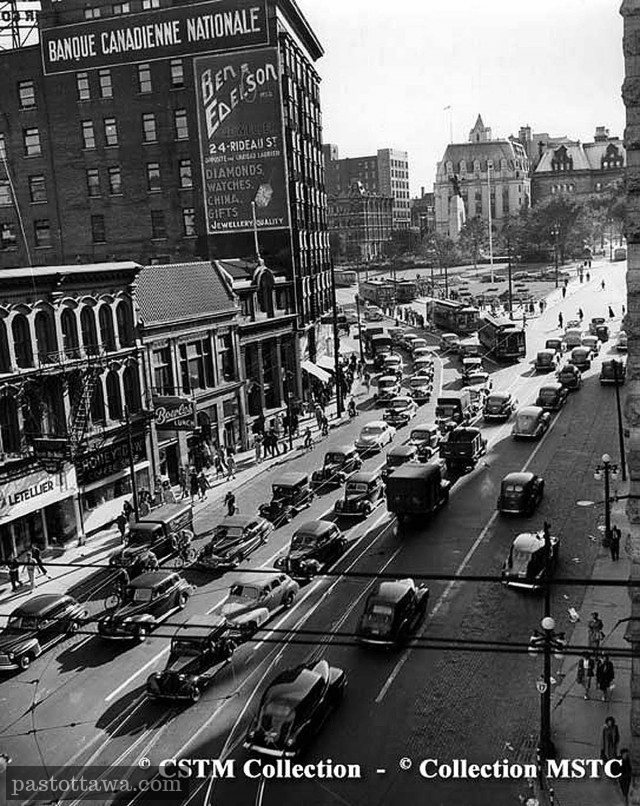
The entire reason that Sparks was so appealing in the first place is because it was the one street which connected Uppertown (downtown) and Lowertown across the canal*. It was the street you had to (and indeed wanted to) take for so many necessary, utilitarian trips and it worked as an almost seamless connection. In my opinion, the War Memorial was built in a very unfortunate place for exactly that reason - it turned a small gap in the urban fabric (the canal) into a wide, empty field of inactivity in the exact spot that had made it such an excellent crossing in the first place; crossing from one part of town to the next was no longer a natural flow - it required the 'determination' to cross past Elgin, something which it still does today.

(Notice how small a gap there is between Lowetown (Union Station) and Uppertown (the old post office) - perhaps all of 75m.
Of course, there's no moving the War Memorial nowadays - it is where it is. However, there's a LOT we can do to close the gap and make Sparks a natural link across the canal:
1. Built it out/Fill in the blanks Between Elgin and Sussex, there needs to be a concerted effort to close the "missing teeth" along the south side of the street, most notably the empty facade of the NAC, the slope towards the canal beside the NAC and the space between the old train station and the Rideau Centre. They could fill them with low-mid rise buildings (4-5 storeys) with excellent street presence to invite people to venture further along.
We could attain something even better than what was there before the demolition of the Corry block in the 60's, that is to say a connection which, though not seamless, isn't completely severed as it is today.
2. Tame the road
the horrible intersections and roads between Elgin and Sussex need to go. No more double-left-turns, no more highway overpass, no more traffic speeding past tiny pedestrian islands like sharks around a dinghy. If we want people to walk along it, Rideau/Wellington/Elgin need to be slow streets with easy-to-understand intersections and pedestrian priority - slowing down cars from 60km/h to 30km/h for 100m will make little to no difference for motorists, but will mean the world to the people walking and sitting as well as the businesses which depend on them (which is to say all of them except the Chateau Laurier). By slowing people down, we can even hope to attain to actually increase vehicle throughput like they did in Poynton, UK.
3. Make it comfortable It gets hella hot/cold in Ottawa and people are reluctant to have to walk across any significant distance of shade-less Serengeti in the summer and buffer-less arctic tundra in the winter. There needs to be some serious tree-planting to connect Sparks to Rideau, including on the Plaza bridge (which, as we've shown on the Somerset overpass, we CAN do).
The connection between Rideau and Sparks is, in my eyes, the element which made it so successful in the first place. The break in that connection is also what I believe has made Sparks so useless and unused even while other main streets like Bank do so well - there's just no really good reason to be on Sparks other than if it's your final destination; people who need to get somewhere have little use for it.
If we ever want to make Sparks anything more than an empty shell of itself, we are going to have to fix this.
*Wellington did too, but it failed as a commercial artery because of the huge presence of the Parliamentary precinct preventing development on both sides of the street





 Prev
Prev


 Linear Mode
