Quote:
Originally Posted by eschaton

At some point the local market is going to reach saturation, insofar as there will be enough (or close to enough) modern urban apartments available for everyone who wants to live in the city. I'm not sure this is a bad thing per se though - it just means we'll have hit relative stagnation at a new, higher level of urban activity.
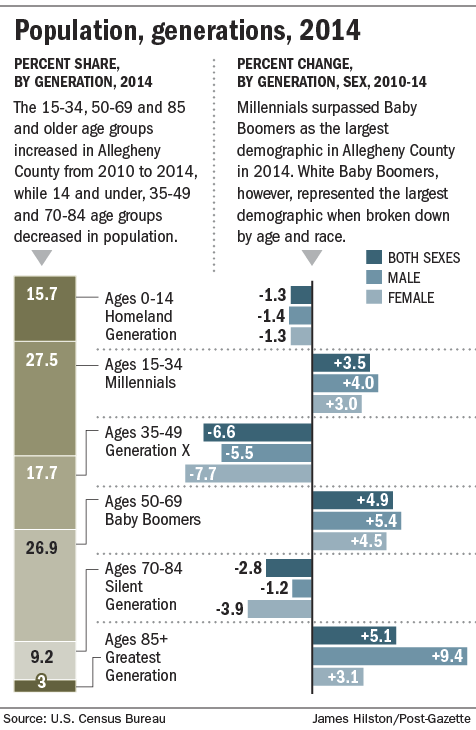
Unless/until there is seriously great net job growth for the metro, most of what we're seeing in terms of residential demand is the local element of the "great inversion" - housing demand for young professionals shifting from the suburbs to the city. This growth is zero sum to a great degree - the city's gain is the suburb's loss. There's also a relative upper limit, because at some point the mix of prices/amenities (both in the apartments and the neighborhood at large) won't convince many additional people to move in.
Add to this telecommuting, and the traditional office environment is clearly on the wane[/URL]. With everything which is going on in our broader economy, I expect that CBDs will be mainly civic and residential areas 20 years from now, simply because a lot less of the population will be working (at least full time) and relatively few of them will be working out of a centralized location.
|
As a distant admirer of Pittsburgh I'll make a couple points....
Downtown/core housing can create its own market to some degree, and seems to be creating a continuous upward spiral all over the country. Each net increase in residents will make the area more attractive for future residents by adding services, vibrancy, perception of safety, etc. Of course the potential population is deep...a small percentage of the typical downtown demographic (singles, couples, empty-nesters, retirees) actually lives in these places. This appears to be true regardless of how many units any city's core districts are adding.
I agree that telecommuting will increase, and so will office sharing, like 20 people sharing 15 desks. Also, the average square footage per office/desk has shrunk substantially as filing cabinets are going away, flat screens allow shallower spaces, private offices are getting more rare, etc. However many people and organizations also like to to be together in person, and telecommuting doesn't work in a lot of cases. Certain industries in particular thrive on being walkable in the same neighborhood. Often recruitment is aided by being in a good urban environment, close to housing, restaurants, etc. Downtown Pittsburgh might end up a winner as it becomes more mixed-use, making it more attractive to industries that need young adults in particular.





 Prev
Prev




 Linear Mode
