Kingston has drafted its new Transportation Master Plan. It's full of great stuff.
The city has increased its acceptability threshold for road congestion from V/C 0.9 to V/C 1.0. In English, that means that whereas previously, the city would classify a road as 'overcapacity' (and thus justifying widening or a new road), once its peak period vehicle count was 90% of its capacity, now the city will wait until it's at 100% before doing so. This is a healthy measure that reduces road expansions and allows for reasonable peak-period congestion to encourage modal shift away from driving. Several road projects were scaled back or abandoned as a result of this change.
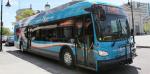
The city aims to have its non-driving (walk+cycle+transit) mode share at 26% by 2034. This will require among other things a doubling of per capita transit ridership. The TMP recommends that this be achieved through increased frequencies rather than through any rapid transit projects (aside from some transit-priority intersections/signals), and directs Kingston Transit to work towards a frequent service grid and recommends operational funding increases to achieve it:

Kingston Transit is to prepare a 5 year plan by September, covering the years 2016 through 2020, to utilize additional money given to it by council to work towards implementing some of that grid. The TMP wants it fully in place by 2034.





 Prev
Prev










 Linear Mode
