HomeDiagramsDatabaseMapsForum About
     

Go Back   SkyscraperPage Forum > Regional Sections > United States > Mountain West


Reply

 
Thread Tools Display Modes
     
     
  #6141  
Old Posted Jan 13, 2015, 6:24 AM
jubguy3's Avatar
jubguy3 jubguy3 is offline
Registered User
 
Join Date: May 2014
Location: SL,UT
Posts: 984
I agree that the rich need to be taxed more. They tax the poor through low wages and lobbying, so why can't we steal back from them?

I view all tax except for maybe part of the defense budget as necessary and I wouldnt mind seeing a good gas tax that gets shit built
Reply With Quote
     
     
  #6142  
Old Posted Jan 13, 2015, 8:43 AM
TakeFive's Avatar
TakeFive TakeFive is offline
Registered User
 
Join Date: Jun 2010
Posts: 8,436
Quote:
Originally Posted by brankrom View Post
Every time I read people bitching about taxes I wonder where they think the money goes? It's not like rolls of Benjamin's are being thrown into a furnace in the basement to heat the evil guvmint buildings. Taxes go to pay for infrastructure (parks, roads, transit), salaries, studies, incentives and every dime that comes in goes out again back into the economy.

The wealthy have somehow convince the dopey electorate that lowering the taxes on the wealthy trickles down meanwhile our infrastructure is crumbling and no one wants to pay to repair it.
Superbly stated. Once of the biggest propaganda hoaxes is that money sent to the government must be wasted, like most of it. Quite the opposite especially when you're speaking of transportation.

I'll just drop my own cut and paste rant from the Denver thread.
Quote:
Here's what drives me batty. With respect to "financing" the price of gas at the pump goes up and down like a yo-yo by a $ or more and sometimes even dramatically. When the auto's gas is getting low people pull up and fill-er-up. Yet the suggestion of adding a dime or two to the fuel tax sends (some) politicos into a dizzy tizzy.

Despite more fuel efficient cars AND cost of construction inflation, gas taxes haven't been raised since since 1993. It's the height of stupidity.

There is nothing more critical to our national interest than the efficient movement of people AND goods.

Understand though that during the Bush years Congress handed out "earmarks" for transportation projects like they were Halloween candy. They just added it to the General Fund ie. deficits. You want to go back to just doing that? Fine.
__________________
Cool... Denver has reached puberty.
Reply With Quote
     
     
  #6143  
Old Posted Jan 17, 2015, 12:37 AM
Hatman's Avatar
Hatman Hatman is offline
Registered User
 
Join Date: Aug 2013
Location: Salt Lake City, Utah
Posts: 1,434
This is a very small bit of transit news, but UTA is preparing to open all the bathrooms on all Frontrunner trains to the public, maybe as soon as Tomorrow. The supplies they used to keep in the locked restrooms will instead be stashed in little cabinets they have recently installed near the south door of every bombardier car (and in the north vestibule in the pullman/commet cars). I guess UTA got so many complaints over Christmas, when the trains are packed with families and kids, that they finally decided to do something about it. It just goes to show that UTA isnt uresponsive to suggestions . They're just slow.

It is unclear if the 'restrooms' that really were supply closets will be fitted with toilets as well. Certainly the newer bike cars which were built without restrooms will never be retrofitted with bathrooms, as that would cost way too much.

This also means that UTA has no interest in adding a second commet car to their trains, as the new cabinets in the vestibules would block the walkway between cars.
Reply With Quote
     
     
  #6144  
Old Posted Jan 17, 2015, 1:55 AM
jubguy3's Avatar
jubguy3 jubguy3 is offline
Registered User
 
Join Date: May 2014
Location: SL,UT
Posts: 984
TRAX train 1174AB has fully blue seats... No red like the regular S70 trains. I'll get a pic in a minute
Reply With Quote
     
     
  #6145  
Old Posted Jan 17, 2015, 4:30 AM
asies1981 asies1981 is offline
Registered User
 
Join Date: Apr 2009
Location: Salt Lake City
Posts: 1,173
Post on the Wasatch Front Regional Council's draft for the next Regional Transportation Plan.
Reply With Quote
     
     
  #6146  
Old Posted Jan 17, 2015, 6:01 AM
jubguy3's Avatar
jubguy3 jubguy3 is offline
Registered User
 
Join Date: May 2014
Location: SL,UT
Posts: 984
Quote:
Originally Posted by asies1981 View Post
Post on the Wasatch Front Regional Council's draft for the next Regional Transportation Plan.
Under transit projects there is a project called "Salt Lake City International Airport High Speed Rail Station" separate from the stop relocation. Interesting!
Reply With Quote
     
     
  #6147  
Old Posted Jan 17, 2015, 9:23 AM
bob rulz bob rulz is offline
Registered User
 
Join Date: May 2010
Location: SL,UT
Posts: 1,616
I've had people jump down my throat for suggesting that funding for the military is too high - but these same people are, of course, against giving "handouts" to "free-loaders" and "forcing people to ride trains", etc etc.
Reply With Quote
     
     
  #6148  
Old Posted Jan 19, 2015, 5:31 PM
Hatman's Avatar
Hatman Hatman is offline
Registered User
 
Join Date: Aug 2013
Location: Salt Lake City, Utah
Posts: 1,434
While riding north from Provo this morning, my FrontRunner train passed a train at an unusual location (at Orem siding, roughly at 1680 N in Provo - we passed at full speed). I got on my UTA Tracker app, because that's just the kind of transit nerd I am, and I discovered that it was an extra train, apparently running on a 15 minute schedule.

The only thing I can think is that this being MLK day, UTA decided to take advantage of the reduced ridership to test out if 15 minute service is feasible. When they originally opened the south line they did have one train scheduled 15 minutes after the other - one of them was a Pleasant View train - and if I remember correctly that one train caused most of the delays that eventually caused them to lengthen the schedule by 17 minutes.

Really, though, UTA has very few options for increasing ridership on FrontRunner. They could lengthen the platforms (the sidings are all long enough for that already) and buy more bi-level cars, but that would take many months of construction and cost quite a bit (bombardier commuter cars are something like $2 million a pop). They could even double-track sections, but that would cost even more and take even longer to implement. Adding more cars right now doesn't work because the platforms are not built for it (the north section high-block is for 3 bombardiers and 1 comet), and the Warm Springs yard wasn't designed for longer trains (lots of tracks would need to be re-arranged, costing $$$).

So, as I see it, the only way to increase capacity on FrontRunner without any huge expenses is to run more frequent trains. But as I've said before in other posts, that would most likely require the schedule to be lengthened even more, perhaps another 15 minutes between Provo and Ogden. What will riders say to a longer schedule with more departures? It would be an interesting trade off.

But does UTA really have any choice? They're over 16,000 daily trips, which makes them either the 10th or 11th busiest commuter line in the country, depending on how you count. I ride the train that leaves SLC at 5:11 and gets to Provo at 6:12, and it is standing room only between Murray and Lehi every single day. And not just a few people; people are hanging onto each other to keep from tipping over at station stops. It reminds me of transit in Japan or China:

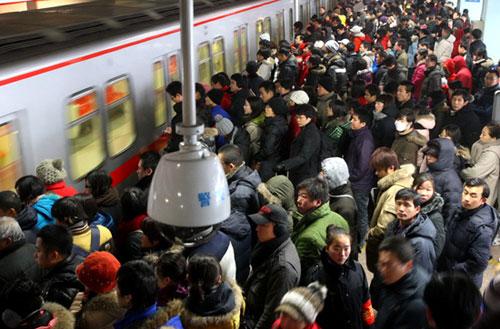


I'm glad UTA realizes that something needs to be done, and I really do favor more frequent departures... I just hope that 1) the schedule won't need to be lengthened too much, and 2) this will serve as a catalyst for some larger capacity improvement program, such as lengthening sidings or adding a second track.

In the long run, this is really a good problem to have.

Reply With Quote
     
     
  #6149  
Old Posted Jan 20, 2015, 4:04 PM
brankrom's Avatar
brankrom brankrom is offline
Transit Advocate
 
Join Date: Aug 2012
Location: Liberty Wells-- SLC
Posts: 292
Quote:
Originally Posted by Hatman View Post
...I got on my UTA Tracker app, because that's just the kind of transit nerd I am, and I discovered that it was an extra train, apparently running on a 15 minute schedule...
just curious what UTA tracker app you are using? I use UTA tracker+ but always curious if there is something else out there?
Reply With Quote
     
     
  #6150  
Old Posted Jan 20, 2015, 8:54 PM
Hatman's Avatar
Hatman Hatman is offline
Registered User
 
Join Date: Aug 2013
Location: Salt Lake City, Utah
Posts: 1,434
I use the same app. You must be a man of fine taste!
Reply With Quote
     
     
  #6151  
Old Posted Jan 21, 2015, 5:03 PM
Hatman's Avatar
Hatman Hatman is offline
Registered User
 
Join Date: Aug 2013
Location: Salt Lake City, Utah
Posts: 1,434
Okay, so I had a little extra time on my hands... perhaps a lot of extra time... and I was wondering just how FrontRunner frequency matched up with other transit agencies. So I searched through the listed time tables of various transit agencies and counted how many departures they had from their main cities... for example, Seattle's Sounder trains all depart from King Street Station, just like all our FrontRunner trains leave from Salt Lake Central Station. Some cities are large enough that there are multiple main stations, such as New York City (Penn Station and Grand Central Terminal), Chicago (Union Station, LaSalle Street Station, and Millennium Park Station), and Boston (North and South Stations). I included departures from all of these stations. I also included Amtrak departures, as many transit agencies include Amtrak trains on their schedules as well (Salt Lake City has two Amtrak departures per day, so we benefited too).

Then I took the total train departures from each city and divided it by the population of each city. The results surprised me:


Clearly Salt Lake City is benefiting from its lower population (lack of incorporating suburbs into the city), but that can't explain all of it. The largest thing to take away from this chart is that FrontRunner is AWESOME. I mean, REALLY AWESOME. Take a look at other cities that started running their commuter trains at the same time as SLC, such as Minneapolis, Albuquerque, and Seattle - and look at how many departures per day they have. The reason they are different is that they decided to use existing tracks owned by the freight railroads, which meant smaller up-front (capital) costs, but much higher operating costs. FrontRuner has its own tracks, which cost $$$, but operating trains over tracks you already own is relatively cheap. Also, it means you get to schedule your own trains, so they can leave as often as you like. I know of no other transit agency that has done this (since WWII), which is why SLC is 3rd on the list of daily train departures per capita (And 2nd if all Amtrak trains are removed from counting).

I should add that Denver is following SLC's example, and doing it better by electrifying and (mostly) double-tracking their lines... when their commuter rail projects are done, they will most likely trump SLC.

However, until they are done, we can celebrate that we are the city second-best served by our transit agency in the country (commuter rail-wise)!

Reply With Quote
     
     
  #6152  
Old Posted Jan 21, 2015, 5:13 PM
jubguy3's Avatar
jubguy3 jubguy3 is offline
Registered User
 
Join Date: May 2014
Location: SL,UT
Posts: 984
According to a UTA rep all red-blue upholstery will be replaced with full blue on new TRAX trains within 18 months - determined to be easier to clean, longer life, makes red warnings stand out, looks nicer.
Reply With Quote
     
     
  #6153  
Old Posted Jan 21, 2015, 8:35 PM
brankrom's Avatar
brankrom brankrom is offline
Transit Advocate
 
Join Date: Aug 2012
Location: Liberty Wells-- SLC
Posts: 292
Quote:
Originally Posted by jubguy3 View Post
According to a UTA rep all red-blue upholstery will be replaced with full blue on new TRAX trains within 18 months - determined to be easier to clean, longer life, makes red warnings stand out, looks nicer.
That's good news cuz those seats are nasty. My kids always make clouds when they ride the train they can tap on the head rests and turn the train into a cloud... I have a vid somewhere. I don't understand why a mass transit system is still using cloth seats... gross. I hope they do something a little nicer than the blue burlap of the old siemens cars. I'd prefer they make the move to the vinyl stuff they are using on the new BART cars in the bay area... That was another system that kept cloth seats for WAY too long.
Reply With Quote
     
     
  #6154  
Old Posted Jan 21, 2015, 10:24 PM
jubguy3's Avatar
jubguy3 jubguy3 is offline
Registered User
 
Join Date: May 2014
Location: SL,UT
Posts: 984
Quote:
Originally Posted by brankrom View Post
That's good news cuz those seats are nasty. My kids always make clouds when they ride the train they can tap on the head rests and turn the train into a cloud... I have a vid somewhere. I don't understand why a mass transit system is still using cloth seats... gross. I hope they do something a little nicer than the blue burlap of the old siemens cars. I'd prefer they make the move to the vinyl stuff they are using on the new BART cars in the bay area... That was another system that kept cloth seats for WAY too long.
1174AB has the seats installed - just blue burlap. Its basically the red blue seats in design except with the red as blue. I have a pic if anyone wants to see it.

If I remember correctly RTD uses cloth
Reply With Quote
     
     
  #6155  
Old Posted Jan 21, 2015, 10:43 PM
Makid Makid is online now
Registered User
 
Join Date: Jun 2006
Posts: 2,107
Quote:
Originally Posted by Hatman View Post
Okay, so I had a little extra time on my hands... perhaps a lot of extra time... and I was wondering just how FrontRunner frequency matched up with other transit agencies. So I searched through the listed time tables of various transit agencies and counted how many departures they had from their main cities... for example, Seattle's Sounder trains all depart from King Street Station, just like all our FrontRunner trains leave from Salt Lake Central Station. Some cities are large enough that there are multiple main stations, such as New York City (Penn Station and Grand Central Terminal), Chicago (Union Station, LaSalle Street Station, and Millennium Park Station), and Boston (North and South Stations). I included departures from all of these stations. I also included Amtrak departures, as many transit agencies include Amtrak trains on their schedules as well (Salt Lake City has two Amtrak departures per day, so we benefited too).

Then I took the total train departures from each city and divided it by the population of each city. The results surprised me:

<image removed to shorten the load time and bulk of the quoted section>

Clearly Salt Lake City is benefiting from its lower population (lack of incorporating suburbs into the city), but that can't explain all of it. The largest thing to take away from this chart is that FrontRunner is AWESOME. I mean, REALLY AWESOME. Take a look at other cities that started running their commuter trains at the same time as SLC, such as Minneapolis, Albuquerque, and Seattle - and look at how many departures per day they have. The reason they are different is that they decided to use existing tracks owned by the freight railroads, which meant smaller up-front (capital) costs, but much higher operating costs. FrontRuner has its own tracks, which cost $$$, but operating trains over tracks you already own is relatively cheap. Also, it means you get to schedule your own trains, so they can leave as often as you like. I know of no other transit agency that has done this (since WWII), which is why SLC is 3rd on the list of daily train departures per capita (And 2nd if all Amtrak trains are removed from counting).

I should add that Denver is following SLC's example, and doing it better by electrifying and (mostly) double-tracking their lines... when their commuter rail projects are done, they will most likely trump SLC.

However, until they are done, we can celebrate that we are the city second-best served by our transit agency in the country (commuter rail-wise)!
Hatman, do you happen to know or have the boardings per capita for the lines? I think it would be nice to see how SLC does for boardings as well. I know that we are top 10/11 for ridership but if boardings are also top 5, this may be a big incentive to push faster for towards the 15 minute frequencies for Frontrunner.

With the estimated doubling of ridership at 15 minute frequencies, this may have a larger effect on pollution and commuting habits that would provide the needed ROI for additional double tracked segments.

Also, do you or anyone else know if UTA has enough ROW in places to allow "Express Trains" to bypass a stop? I know some stations don't have enough ROW available to allow this.
Reply With Quote
     
     
  #6156  
Old Posted Jan 22, 2015, 3:21 AM
Future Mayor's Avatar
Future Mayor Future Mayor is offline
Vote for me in 2019!
 
Join Date: Jun 2007
Location: Salt Lake City, UT
Posts: 4,803
I am happy to hear about the standing room only between Draper and Lehi, I had no idea that it was that busy. I wonder if in order to accommodate 15 minute departures if they could start by double tracking in just a few additional key areas that will decrease some of the stoppage times. Obviously eventually double tracking the entire line.
Reply With Quote
     
     
  #6157  
Old Posted Jan 22, 2015, 5:15 AM
Hatman's Avatar
Hatman Hatman is offline
Registered User
 
Join Date: Aug 2013
Location: Salt Lake City, Utah
Posts: 1,434
Quote:
Originally Posted by Makid View Post
Hatman, do you happen to know or have the boardings per capita for the lines? I think it would be nice to see how SLC does for boardings as well. I know that we are top 10/11 for ridership but if boardings are also top 5, this may be a big incentive to push faster for towards the 15 minute frequencies for Frontrunner.

With the estimated doubling of ridership at 15 minute frequencies, this may have a larger effect on pollution and commuting habits that would provide the needed ROI for additional double tracked segments.

Also, do you or anyone else know if UTA has enough ROW in places to allow "Express Trains" to bypass a stop? I know some stations don't have enough ROW available to allow this.
Boardings per capita... I could very easily come up with that number by using the reported ridership numbers for commuter rail - but I would have a harder time finding the exact ridership on the Amtrak routes (some areas include those as commuter trains, such as San Diego or Seattle). I could do that tomorrow morning sometime.

But what would such a number mean if I only use the 'core' city, as commuter rail lines generally serve those in the suburbs. It would be a lot of work to determine the whole population of the service area for each transit system... I guess what it would mean if I only use the population of the city proper is how many people work in the city without living in it? I can pretty well tell you already that FrontRunner will do extremely well in that category.

For 15 minute frequencies, I don't think they need to add that many trains. Potentially just two in each direction, one before and one after the heaviest-used train (which is mine - I talked with some UTA people who confirmed this). That sort of incremental addition wouldn't necessarily throw off schedules any more than they already get off, and it wouldn't 'bust the budget' either.

Maybe that's what UTA should do with their extra savings from fuel...

And as for a passing siding for express trains... I'm not sure there is much space. The track would need to go between the UTA and UP tracks (between the station and the parking lot is not an option). This would most likely require the UP tracks to be moved outward in order to fit the extra track - making the right-of-way five tracks wide (plus the service road UP requires on the opposite side of their tracks). In some places this is very reasonable. In other places not so much.

I'm just blue sky thinking here (I like to do that) about which stations specifically should be skipped? I mean, it is a lot of infrastructure to put in place in order to skip one station, and the time savings for skipping one stop may not be large enough to justify the cost of said infrastructure (we're talking ~ 5 minutes per stop, max, assuming the trains remain at full speed). So we'd better be absolutely sure that the stop we want to skip really is useless.

I think for the most part FrontRunner stops are spaced pretty well (Except for Vineyard, whenever that is built). UTA planners were very firm in placing the stops ~6 miles apart. Operationally, this allows the trains to get up to their full speed between every stop, which is the most time-efficient way to go. If there were stops too close together which would not let the trains get to their full speed, then I would advocate one of them being skipped on operational grounds. But so far there is no operational reason to skip a stop, meaning it all comes down to ridership.

How would we go about finding out the number of boardings at each station?
Reply With Quote
     
     
  #6158  
Old Posted Jan 22, 2015, 6:27 AM
justiny justiny is offline
Registered User
 
Join Date: Aug 2008
Location: Reno, NV
Posts: 154
Quote:
Originally Posted by Hatman View Post
Then I took the total train departures from each city and divided it by the population of each city. The results surprised me:


Clearly Salt Lake City is benefiting from its lower population (lack of incorporating suburbs into the city), but that can't explain all of it.
The same could be said of DC. Here, the Metro serves a population over five million, into Virginia and Maryland, despite the District's population of around 650k.

Although it isn't fair to compare all of these transit systems, since they are so different, thanks for compiling the data together. Very interesting.
Reply With Quote
     
     
  #6159  
Old Posted Jan 22, 2015, 4:46 PM
Makid Makid is online now
Registered User
 
Join Date: Jun 2006
Posts: 2,107
Quote:
Originally Posted by Makid View Post
Hatman, do you happen to know or have the boardings per capita for the lines? I think it would be nice to see how SLC does for boardings as well. I know that we are top 10/11 for ridership but if boardings are also top 5, this may be a big incentive to push faster for towards the 15 minute frequencies for Frontrunner.

With the estimated doubling of ridership at 15 minute frequencies, this may have a larger effect on pollution and commuting habits that would provide the needed ROI for additional double tracked segments.

Also, do you or anyone else know if UTA has enough ROW in places to allow "Express Trains" to bypass a stop? I know some stations don't have enough ROW available to allow this.
I agree that it might be best to know the ridership on a per station basis. This would be nice to know just to see if TODs do affect ridership at the various stations as they are built.

I know that UTA does track this information but I haven't seen anywhere that they publish this.

I do know what you mean about ridership on a per capita basis compared to the base city and understand the Amtrak ridership numbers issue. I am just curious to see if we might be pulling in more riders per capita than others.
Reply With Quote
     
     
  #6160  
Old Posted Jan 22, 2015, 4:58 PM
Hatman's Avatar
Hatman Hatman is offline
Registered User
 
Join Date: Aug 2013
Location: Salt Lake City, Utah
Posts: 1,434
^^^(Justiny)
Yeah, no comparison between transit systems is really very fair (except maybe % of mode share, though that's debatable too), but they are fun and this is one comparison SLC looks good in.

Here's another we fare pretty well at. As requested, Boardings Per Capita:


Several things... 1) I pulled daily the boardings number directly from the average weekday unlinked passenger trip from apta's website.. These numbers do not include Amtrak ridership (which could potentially give a boost to Philadelphia, but that's just too messy to try and interpret who is a commuter and who is an intercity rider). Also, Washington DC gets an extra boost because Baltimore is included in those daily boarding (MARC serves both cities, and I wasn't about to try and divide their ridership by cities...) - but because Washington is so far ahead of SLC it doesn't make any practical difference.

But guess what! SLC is still #5 on this list!

Not really surprising, considering SLC's population is so small and FrontRunner's service area is so huge. What this ranking means is that there are a lot of people who work in/near Salt Lake City who don't actually live there, and that at least as far as commuter trains are concerned, it's ranked #5 in the country in severity of this phenomenon.

Yeah, it's sort of a hack-job of an analysis, but the underlying point is unaffected by the quality (or lack thereof) of my work: UTA serves a disproportionate amount of people for the population in its service area. Blame it on the crimping geography in which we live, credit it to UTA's superior rail planning, or shrug it off as a fluke, but UTA is doing an amazing job with the little* they have to work with.

*little meaning both population and funding compared to other comparable transit agencies

Last edited by Hatman; Jan 22, 2015 at 5:12 PM.
Reply With Quote
     
     
This discussion thread continues

Use the page links to the lower-right to go to the next page for additional posts
 
 
Reply

Go Back   SkyscraperPage Forum > Regional Sections > United States > Mountain West
Forum Jump


Forum Jump


All times are GMT. The time now is 9:10 PM.


Powered by vBulletin® Version 3.8.7
Copyright ©2000 - 2026, vBulletin Solutions, Inc.