Quote:
Originally Posted by sacrifice333

I'm a walker, driver, or cyclist depending on the day.
And as those three I have a huge problem with many cyclists. Not because they have low morals or break many laws. My beef is that many cyclists pick which set of "rules" they'll follow on a moment-by-moment basis.
Bicyclist are supposed to adhear to the same set of rules as automobiles. Pedestrians have their own, sidewalk-based rules. This is a good system. Not without potential challenges, but it works.
The most serious problem, IMHO, and the one that gets "drivers" up in arms, but frankly also pisses me off when I have my "pedestrian" hat on is when cyclists switch between rules sets on a whim. When cyclists switch at random it makes it extremely difficult to anticipate their future road / sidewalk usage and therefore any potential interaction or 'impact' points.
Please, for the sake of our rules based society, just pick some rules and stick with 'em!
|
^ Could you offer examples for the sake of discussion?
I'm also a walker, transit user, driver, and cyclist, depending on the situation. An example I can think of off the top of my head is that cyclists sometimes ride on the sidewalk, but that is frequently due to them reaching their destination (a business, a residence, etc.) and the bike racks are located on a sidewalk. It's unsafe to ride one's bike in the street and then come to a stop beside parked cars in a travel lane, dismount, and then maneuver the bike through the gap in cars to the sidewalk and the destination. Instead, many cyclists will ride on the sidewalk of their destination block (at walking speed if they are considerate, not at walking speed if they are not) and then dismount, lock up, etc., at their destination. On-street bike corrals solve this problem perfectly, but they also require the reallocation of some road space from car parking to bike parking, albeit at far higher parking densities (a dozen bikes in the space of a single car).
Another prime example is turning left. Unless one is on a street retrofitted to bikes, like 10th Avenue, if you want to turn left one must merge into the left lane and await their turn to either turn in a left turn bay, or remain in the travel lane and turn left when it is safe to do so. If you are not a regular urban cyclist you do not know how vulnerable this is makes you feel. Full stop. I'm an experienced commuter cyclist with more than a dozen years of nearly daily riding in Vancouver, Toronto, and now Richmond, and without a doubt this is the single most stressful and dangerous activity one can perform on a bike.
For
most cyclists it is perceived as being too dangerous to contemplate, and instead they proceed through the intersection in the curb lane adjacent to the crosswalk, or in it if intersection through traffic is heavy, and they then stop at the far corner and reorient before crossing in the curb travel lane at the next cycle of the lights. This "two point left turn" allows a cyclist to safely make a left turn at a major intersection but to pedestrians and drivers it appears as if the cyclists is 'acting like a pedestrian' by using the crosswalk and not turning left like a car. Most drivers and pedestrians are long gone by the time the cyclist completes their two point turn and give it no further thought, save for mentally adding another 'transgression' to naughty-or-nice register of cyclist behavior. Rhetorically, how many parents on this forum would take their kid for a ride and make a left turn in the street at, say, 41st and Cambie? How about Number 3 Road and Williams Road in Richmond, where there are no side streets or alternatives to the major road grid? Both those examples include bike lanes on one of the intersecting streets and are, thus, preferred bike routes in a city.
The other frustrating thing for many left-turning cyclists is pedestrian-controlled or sensor-driven T-intersections. I encounter one daily on my ride into work at Minoru Blvd and Blundel Rd. in Richmond. Blundel is the main street and Minoru T-intersections into it. There are in-road sensors but they are calibrated to cars and they do not respond to the presence of a cyclist. The intersection street signals are programed to be continuously green for Blundel unless a pedestrian presses the walk signal or a vehicle rests on a sensor. I regularly encounter situations where I am waiting to turn left onto east-bound Blundel, in the left turn bay south-bound on Minoru, and the lights just never change to let me turn. If no cars come along and dwell on the left-turn sensor that light
just won't change. In situations like this, including Monday morning of this week when I was waiting for more than three minutes (I counted) for the light to change due to a car or pedestrian (good luck, it's suburban Richmond), I turned and rode through the crosswalk over to the sidewalk and pressed the pedestrian crossing button, which triggered the light to change so fast that I could not make my way back to the left turn bay, and instead rode to the far side of the street and then turned left and resumed my commute on Blundel.
TL;DR: there are situations when cyclists 'act like pedestrians' because of incomplete street design and it's frustrating to all parties. The solution is to fix the streets and change behaviour by having a safe and practical alternative.





 Prev
Prev



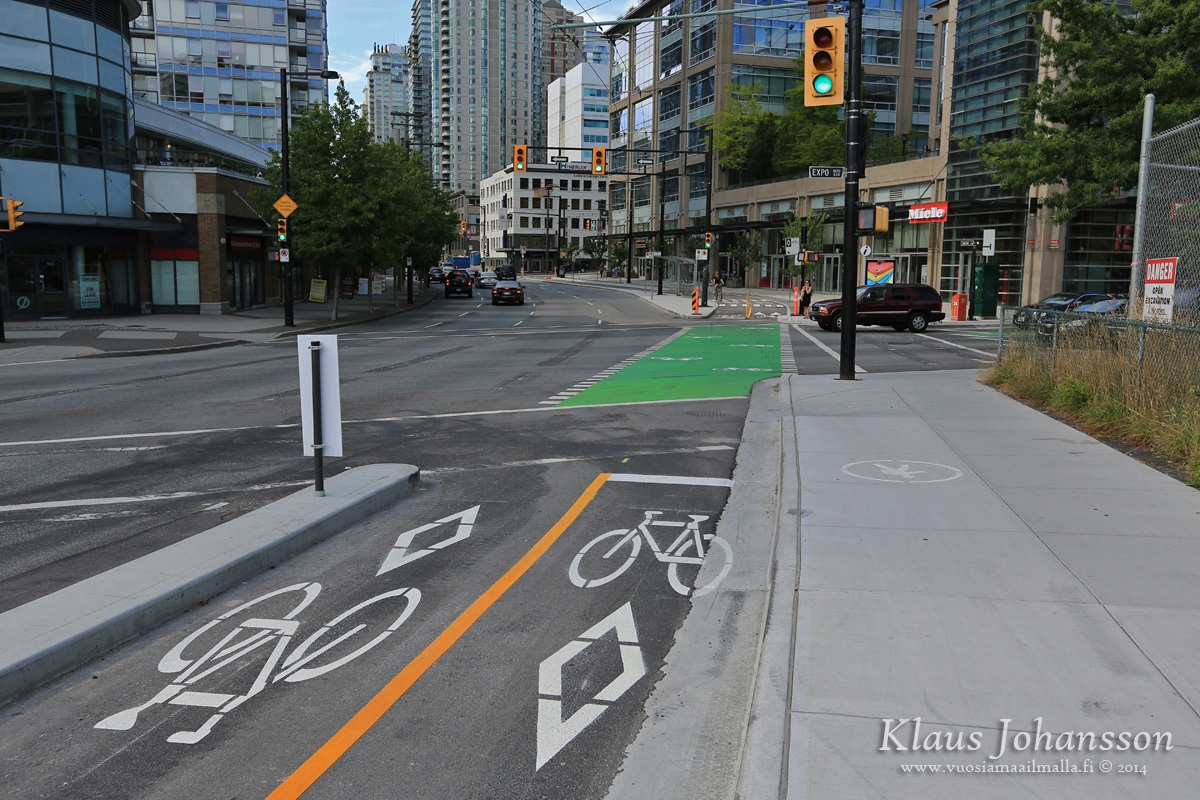
 Here's the new-ish bikelane piece on Smithe Street.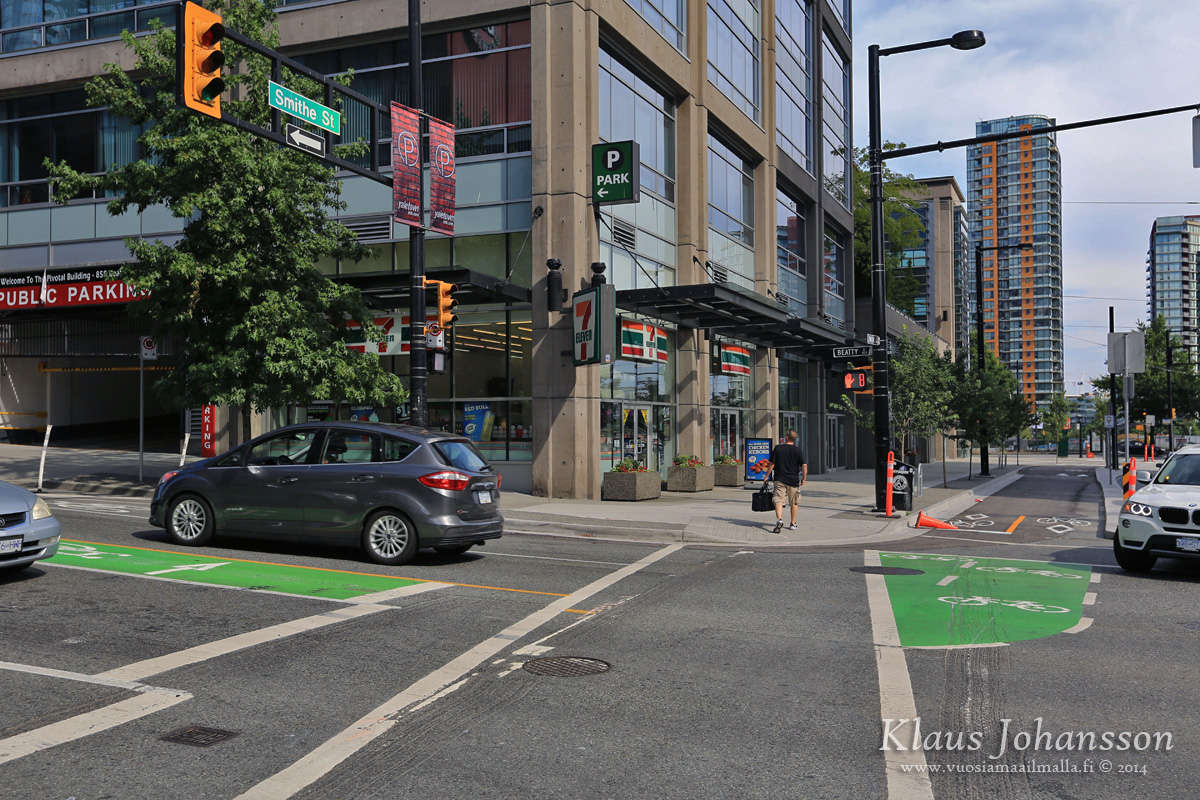




 Linear Mode
