HomeDiagramsDatabaseMapsForum About
     

Go Back   SkyscraperPage Forum > Regional Sections > Canada > Atlantic Provinces > Halifax > Transportation & Infrastructure


Reply

 
Thread Tools Display Modes
     
     
  #901  
Old Posted Apr 2, 2014, 2:49 PM
MalcolmTucker MalcolmTucker is offline
Registered User
 
Join Date: May 2007
Posts: 11,629
Can HRM borrow through the province, or is the city stuck with the open bond market?
Reply With Quote
     
     
  #902  
Old Posted Apr 2, 2014, 3:08 PM
Keith P.'s Avatar
Keith P. Keith P. is offline
Registered User
 
Join Date: Mar 2006
Posts: 8,890
Quote:
Originally Posted by MalcolmTucker View Post
Can HRM borrow through the province, or is the city stuck with the open bond market?
They have to borrow through the Municipal Finance Corporation.

Municipalities should only ever participate in the debt market to pay for fixed assets and infrastructure. Borrowing to pay for Arts Councils and other operating costs is a road to ruin.
Reply With Quote
     
     
  #903  
Old Posted Apr 2, 2014, 3:11 PM
Keith P.'s Avatar
Keith P. Keith P. is offline
Registered User
 
Join Date: Mar 2006
Posts: 8,890
Quote:
Originally Posted by Drybrain View Post
Actually, HRM has one of the lowest per-capita municipal debts in Canada, so there's actually a good case to be made for spending, especially on arts and transit, which tend to have an extremely high ROI in the medium and long term. That is, cities that invest intelligently in transit and arts tend to be more successful than those that don't.
Citation please. While cities that have a vibrant arts community are often better off, it is an open question whether the artsy types generate the well-being or, as I suspect, if the arts groups merely follow the money where it already is in order to get bigger/more handouts.

Quote:
Also, I think characterizing the Khyber renovations as a "rebuild" is a bit much--but yeah, they are spending substantial cash to fix up one of the most iconic and important structures in town. (Don't worry, your dislike for the building has previously been noted.)
Thank you for pointing that out. It is clearly a waste of taxpayer money. It is hardly iconic nor important, but instead acts as an albatross around the neck of that block of Barrington.
Reply With Quote
     
     
  #904  
Old Posted Apr 2, 2014, 7:26 PM
Drybrain Drybrain is offline
Registered User
 
Join Date: Sep 2012
Posts: 4,565
Quote:
Originally Posted by Keith P. View Post
It is clearly a waste of taxpayer money. It is hardly iconic nor important, but instead acts as an albatross around the neck of that block of Barrington.
Some of the city's most important cultural exports have been nurtured there...I mean, hell, need this even be pointed out?

Rather than an albatross around the block, it's an asset to the entire province. It stands up right alongside the country's most recognized and important artist-run centres, and as a centre with a national reputation, it's an attractor of talent and money. Halifax would be poorer without it. It's a good thing for the city to have. Just 'cause you're not personally interested in what goes on there doesn't make it wasteful.

And you might not like the building's appearance, but in my opinion it's a monumental Gothic twist on Canadian Victorian traditional architecture. And not that it necessarily even matters, but I think if you stopped average Haligonians on the street and asked them if they thought it was a good-looking building, they'd say that it is.

And as far as the economic value of the arts, I dunno, read this Conference Board of Canada report, if you want. I'm not going to have a fruitless discussion about its merits though. Suffice to say the Conference Board is an economic organization, not an arts advocacy group.
Reply With Quote
     
     
  #905  
Old Posted Apr 3, 2014, 6:35 PM
OldDartmouthMark OldDartmouthMark is offline
Registered User
 
Join Date: May 2010
Posts: 10,511
Quote:
Originally Posted by Drybrain View Post
Some of the city's most important cultural exports have been nurtured there...I mean, hell, need this even be pointed out?

Rather than an albatross around the block, it's an asset to the entire province. It stands up right alongside the country's most recognized and important artist-run centres, and as a centre with a national reputation, it's an attractor of talent and money. Halifax would be poorer without it. It's a good thing for the city to have. Just 'cause you're not personally interested in what goes on there doesn't make it wasteful.

And you might not like the building's appearance, but in my opinion it's a monumental Gothic twist on Canadian Victorian traditional architecture. And not that it necessarily even matters, but I think if you stopped average Haligonians on the street and asked them if they thought it was a good-looking building, they'd say that it is.

And as far as the economic value of the arts, I dunno, read this Conference Board of Canada report, if you want. I'm not going to have a fruitless discussion about its merits though. Suffice to say the Conference Board is an economic organization, not an arts advocacy group.
I think that this building a very interesting and valuable asset to our city and specifically to the heritage vibe of that section of Barrington. The building has an interesting history in its own right (which would be an amazing thing to share with the public via historic placards as discussed in another thread).

Don't feel you have to defend the arts. In our commerce-based society there will always be those who will define value based on something's ability to generate profit while totally missing the humanistic value that arts has already added to their own lives. It's a concept that is sadly misunderstood by many but thankfully completely understood by some. The arts will always be part of our lives and I am glad there are still those out there who recognize its value and will go to great lengths to support it.
Reply With Quote
     
     
  #906  
Old Posted Apr 3, 2014, 7:23 PM
scryer scryer is offline
Registered User
 
Join Date: Feb 2014
Posts: 1,964
Bringing it back to LRT discussion for a moment....

Rapid transit has a fantastic way of densifying the areas around it. So for those of you mentioning that Dartmouth is mostly low-density (which it is); a line going from downtown Halifax to Dartmouth would raise land values surrounding an LRT station which would in turn help densify the buildings across the sea. A good example that comes to mind includes Metrotown in Vancouver.
Reply With Quote
     
     
  #907  
Old Posted Apr 3, 2014, 7:40 PM
xanaxanax xanaxanax is offline
Registered User
 
Join Date: Nov 2013
Posts: 244
Quote:
Originally Posted by scryer View Post
Bringing it back to LRT discussion for a moment....

Rapid transit has a fantastic way of densifying the areas around it. So for those of you mentioning that Dartmouth is mostly low-density (which it is); a line going from downtown Halifax to Dartmouth would raise land values surrounding an LRT station which would in turn help densify the buildings across the sea. A good example that comes to mind includes Metrotown in Vancouver.
I don't think there's ever been any intention of this running through dartmouth
Reply With Quote
     
     
  #908  
Old Posted Apr 3, 2014, 8:22 PM
halifaxboyns halifaxboyns is offline
Registered User
 
Join Date: Feb 2010
Location: Planet earth
Posts: 3,883
Quote:
Originally Posted by xanaxanax View Post
I don't think there's ever been any intention of this running through dartmouth
I think scryer's point was despite the fact it hasn't been talked about - it SHOULD.

Very few Cities (Toronto and I think Vancouver are the only ones) have additional revenue generation tools beyond property taxes, fees (like rec centre fees) and tourism levies on hotels. Vancouver and Toronto, because they have civic charters have additional taxing powers for revenue. For example: If you register a car in Toronto, not only do you pay the Provincial registration fee, but you pay an equal fee to the city. Toronto also has a land transfer tax - cities that size or even the size of Halifax need that additional revenue because of the pressure to build and grow.

What scryer is pointing out is an issue that our GM out here in Calgary realized when he got here - we have to grow land value in order to get more money to do more things. So, redevelopment does that.

This is a clip from an E squared documentary on Portland talking about the investment in the streetcar and how it created a huge return on the investment. They spent $90 million on the streetcar, got $3 billion back in private investment. One point which I liked was that with streetcar (or LRT) - using a fixed based track transport system gave certainty to developers because it's so easy to move buses and be without service; not so much with LRT. Thus the land value goes up around the LRT as redevelopment happens...

I would imagine that a circulator streetcar system in Halifax/Dartmouth that used common track would be in the realm of about $150 million depending on how long it is and provide a high frequency corridor of service without needing to wait for CN.
Reply With Quote
     
     
  #909  
Old Posted Apr 4, 2014, 1:56 AM
someone123's Avatar
someone123 someone123 is offline
hähnchenbrüstfiletstüc
 
Join Date: Nov 2001
Location: Vancouver
Posts: 35,975
Quote:
Originally Posted by halifaxboyns View Post
I would imagine that a circulator streetcar system in Halifax/Dartmouth that used common track would be in the realm of about $150 million depending on how long it is and provide a high frequency corridor of service without needing to wait for CN.
HRM needs to take a step back and consider the many options that are available when it comes to building better transit corridors to serve the entire region.

Commuter rail might be a good thing but the process has been seriously dysfunctional. The same plan has been debated for well over a decade and council has flip-flopped back and forth between the idea of commuter rail and a fast ferry. Even if commuter rail moves forward, the planning material shared so far appears to suffer from a serious lack of imagination and foresight. There's no thought given to post-1980's transit technology, multi-modal integration, or transit-oriented development. Without TOD and integration with buses you lose maybe 50% of the value of these projects.

Maybe the commuter rail study itself will be better but I feel like it's already been set down a narrowly-defined, flawed path established by past councils (who quietly assumed a bunch of things like "no car lanes can be converted to transit" -- that's what they mean when they say "there's no space here"). Streetcars + BRT might easily be a much better alternative.
Reply With Quote
     
     
  #910  
Old Posted Apr 4, 2014, 2:11 AM
scryer scryer is offline
Registered User
 
Join Date: Feb 2014
Posts: 1,964
Quote:
Originally Posted by someone123 View Post

Maybe the commuter rail study itself will be better but I feel like it's already been set down a narrowly-defined, flawed path established by past councils (who quietly assumed a bunch of things like "no car lanes can be converted to transit" -- that's what they mean when they say "there's no space here"). Streetcars + BRT might easily be a much better alternative.
Watch out for BRT.... Winnipeg just had it done and their government completely mucked it up to the point where it's ineffective and embarrassing. So follow the Calgary model to suit Halifax.

Offtopic: Halifax and Dartmouth are located in a beautiful Geographic part of Canada. It would be nice to see both of the city centres build up and twin each other while preserving all of the Heritage buildings. I would like to see Halifax and Dartmouth start to really make money off of tourism because after all, Canada's history begins on the east.
Reply With Quote
     
     
  #911  
Old Posted Apr 4, 2014, 12:41 PM
Drybrain Drybrain is offline
Registered User
 
Join Date: Sep 2012
Posts: 4,565
Quote:
Originally Posted by halifaxboyns View Post
Very few Cities (Toronto and I think Vancouver are the only ones) have additional revenue generation tools beyond property taxes, fees (like rec centre fees) and tourism levies on hotels. Vancouver and Toronto, because they have civic charters have additional taxing powers for revenue. For example: If you register a car in Toronto, not only do you pay the Provincial registration fee, but you pay an equal fee to the city. Toronto also has a land transfer tax - cities that size or even the size of Halifax need that additional revenue because of the pressure to build and grow.
What does Vancouver have?

Unfortunately, thanks to Rob Ford, both Toronto's vehicle-registration and land-transfer taxes were scrapped in the past couple of years, which is part of the reason the city is now having an impossible time trying to figure out where to get money for transit expansion. Most of the municipal politicians running in this year's election, and all three major provincial parties are stuck in this ridiculous game of trying to assuage the GTA's transit concerns and promise major expansion, and none have even the most marginally adequate funding plan in place. (The Liberals under Wynne were leading the revenue-tools discussion, but have backed away big-time because it's politically unpopular to even mention raising taxes.)

Transit in Toronto is a nightmare--it's already so inadequately built, and the conversation around revenue tools is so juvenile, and there's simply no way to raise the money needed to do what has to be done. I honestly see no way out for Toronto in the short or medium-term.

It's a cautionary tale: That's exactly where we don't want to be. Having said that, Nova Scotia already has higher taxes than most other places, so the wiggle room to introduce new revenue tools here is less than in other places. (Fortunately, HRM is also not in the degree of debt most Canadian cities are.)

Reply With Quote
     
     
  #912  
Old Posted Apr 4, 2014, 2:11 PM
OldDartmouthMark OldDartmouthMark is offline
Registered User
 
Join Date: May 2010
Posts: 10,511
Quote:
Originally Posted by halifaxboyns View Post
I think scryer's point was despite the fact it hasn't been talked about - it SHOULD.

Very few Cities (Toronto and I think Vancouver are the only ones) have additional revenue generation tools beyond property taxes, fees (like rec centre fees) and tourism levies on hotels. Vancouver and Toronto, because they have civic charters have additional taxing powers for revenue. For example: If you register a car in Toronto, not only do you pay the Provincial registration fee, but you pay an equal fee to the city. Toronto also has a land transfer tax - cities that size or even the size of Halifax need that additional revenue because of the pressure to build and grow.

What scryer is pointing out is an issue that our GM out here in Calgary realized when he got here - we have to grow land value in order to get more money to do more things. So, redevelopment does that.

This is a clip from an E squared documentary on Portland talking about the investment in the streetcar and how it created a huge return on the investment. They spent $90 million on the streetcar, got $3 billion back in private investment. One point which I liked was that with streetcar (or LRT) - using a fixed based track transport system gave certainty to developers because it's so easy to move buses and be without service; not so much with LRT. Thus the land value goes up around the LRT as redevelopment happens...

I would imagine that a circulator streetcar system in Halifax/Dartmouth that used common track would be in the realm of about $150 million depending on how long it is and provide a high frequency corridor of service without needing to wait for CN.
Yes! and...

Quote:
Originally Posted by scryer View Post
Watch out for BRT.... Winnipeg just had it done and their government completely mucked it up to the point where it's ineffective and embarrassing. So follow the Calgary model to suit Halifax.

Offtopic: Halifax and Dartmouth are located in a beautiful Geographic part of Canada. It would be nice to see both of the city centres build up and twin each other while preserving all of the Heritage buildings. I would like to see Halifax and Dartmouth start to really make money off of tourism because after all, Canada's history begins on the east.
Yes! very much!

The downtown area of Dartmouth is a diamond in the rough, just waiting to be discovered. IMHO, if proper transit options are available, downtown Dartmouth could become an extension of downtown Halifax, thus at least doubling the amount of space available for development.

I was just thinking this week at how it amazes me that Dartmouth always has been and continues to be a "bedroom community" to Halifax, when it has such potential for growth. For some reason it always seems to get passed by. Why are we even talking about urban sprawl when there is so much available in the downtown area of HRM, but on the Dartmouth side. It astounds me.

So yes, to keep it on the topic of transit - keep Dartmouth in the plan for rail transit and it will pay off in the long run.
Reply With Quote
     
     
  #913  
Old Posted Apr 12, 2014, 7:24 PM
xanaxanax xanaxanax is offline
Registered User
 
Join Date: Nov 2013
Posts: 244
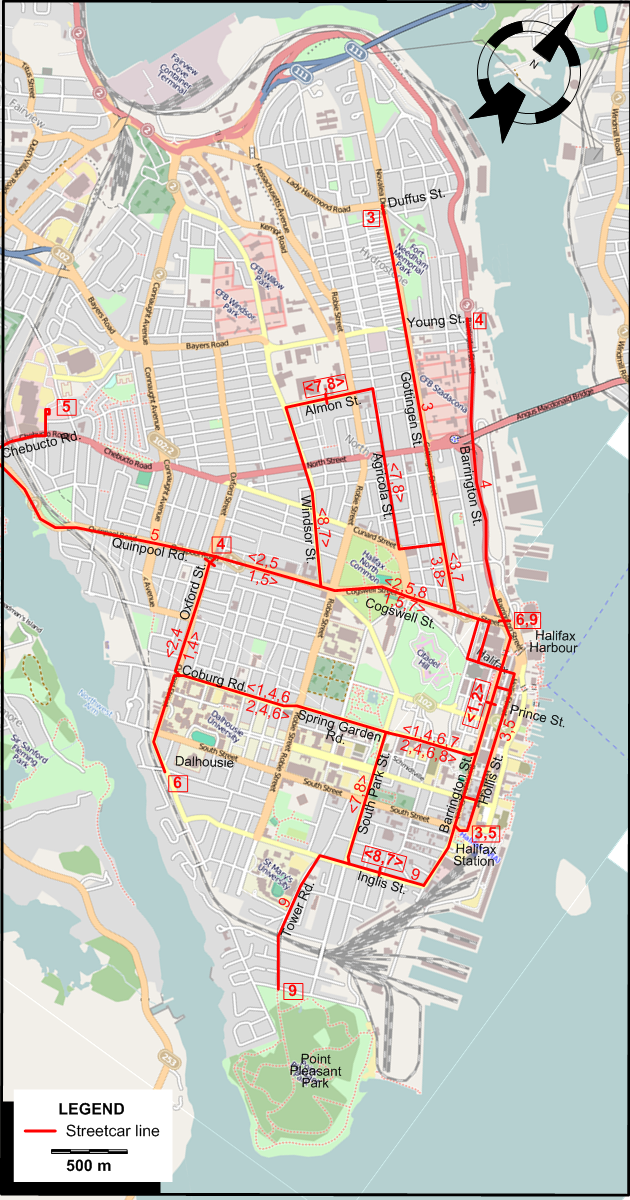
How much would it cost to implement a small LRT Streetcar system like this again as seen here http://www.tundria.com/trams/CAN/Halifax-1945.shtml

Would it be 5 million, 10, or a lot more? Is there a Streetcar system thread on here or is this it
Reply With Quote
     
     
  #914  
Old Posted Apr 12, 2014, 10:05 PM
MalcolmTucker MalcolmTucker is offline
Registered User
 
Join Date: May 2007
Posts: 11,629
^ Way more. Somewhere inbetween one or two orders of magnitude more.
Reply With Quote
     
     
  #915  
Old Posted Apr 13, 2014, 5:32 AM
scryer scryer is offline
Registered User
 
Join Date: Feb 2014
Posts: 1,964
As a Canadian who doesn't live in Halifax, I want to let you guys know that there is also a similar discussion in regards to a proposed streetcar system in Vancouver. An interesting point was made by aberdeen5698 (that I very much agree with and I think that he sums it up perfectly) on this topic, that I would like to bring to this discussion:


Quote:
....I've never understood the attraction of at-grade rail. It just doesn't seem to me that it provides enough benefit over and above what you can achieve with buses, especially modern ones which can include multiple articulated units. Pretty much all of the things that LRT proponents tout as advantages can also be applied to buses, including dedicated rights of way.

IMHO it boils down to at-grade transit for basic to intermediate capacity, and grade separation beyond that. Next to that basic choice, the technology you choose to use for each has only a relatively minor impact on the kind of service you're able to provide.

If you're going to be talking rapid transit, I think that the question is more about whether you want at-grade or grade-separated technology and which would suit Halifax the best. And who say's you can't have both in the ultra-long run ?

Cheers from the West .

Last edited by scryer; Apr 14, 2014 at 3:10 AM.
Reply With Quote
     
     
  #916  
Old Posted Apr 13, 2014, 9:05 AM
worldlyhaligonian worldlyhaligonian is offline
Registered User
 
Join Date: Jun 2006
Posts: 4,049
Quote:
Originally Posted by scryer View Post
As a Canadian who doesn't live in Halifax, I want to let you guys know that there is also having a similar discussion in regards to a proposed streetcar system in Vancouver. An interesting point was made by aberdeen5698 (that I very much agree with and I think that he sums it up perfectly) on this topic, that I would like to bring to this discussion:

If you're going to be talking rapid transit, I think that the question is more about whether you want at-grade or grade-separated technology and which would suit Halifax the best. And who say's you can't have both in the ultra-long run ?

Cheers from the West .
Cheers for the discussion. I think the issue in Halifax is that we don't even have a BRT in place and every time a road could be widened to support a future system people fly off the handle in stating that "all road widening"

I think the obsession many of us have with a street car / LRT, whether at grade or not, is the perception that its a bigger city thing and also more dedicated (meaning in a place like Halifax, you never know if the bus will actually come) versus trams that tend to run on time. Just my analysis.

We need BRT and then LRT... this will require road widening and use of the current unused space in the rail cut.
Reply With Quote
     
     
  #917  
Old Posted Apr 13, 2014, 10:21 AM
fenwick16 fenwick16 is offline
Honored Member
 
Join Date: Feb 2007
Location: Toronto area (ex-Nova Scotian)
Posts: 5,558
Quote:
Originally Posted by scryer View Post
.
.
If you're going to be talking rapid transit, I think that the question is more about whether you want at-grade or grade-separated technology and which would suit Halifax the best. And who say's you can't have both in the ultra-long run ?

Cheers from the West .
Thanks for your input scryer. As you pointed out, a streetcar system isn't really an advantage over buses (since both have to contend with cars). San Francisco kept its old streetcar system but it is just a tourist attraction not an actual rapid transit system which is what Halifax needs.

I think Halifax should focus on a BRT (Bus Rapid Transit) system and develop the grade separation (or Right of Ways) to make it a rapid transit system.

Commuter rail is sometimes mentioned for Bedford since there is a CN track that it could run on (if allowed by CN) however it would be grade separated and doesn't have to deal with traffic jams.

Last edited by fenwick16; Apr 13, 2014 at 1:31 PM.
Reply With Quote
     
     
  #918  
Old Posted Apr 13, 2014, 11:49 AM
ILoveHalifax ILoveHalifax is offline
Registered User
 
Join Date: Aug 2011
Location: Palm Beach Gardens FL
Posts: 1,073
I really think a street car system should replace the buses on the peninsula.
Buses actually have to wait for 1 bus to leave to get the next bus to the stop.
1 or 2 routes on the peninsula would be a great start; 1 north to south another east to west. Basically when buses come onto the peninsula they should be off loading to the street car system and heading back to the suburbs. It is crazy to have so many buses on Spring Garden and Barrington.
Reply With Quote
     
     
  #919  
Old Posted Apr 13, 2014, 2:15 PM
fenwick16 fenwick16 is offline
Honored Member
 
Join Date: Feb 2007
Location: Toronto area (ex-Nova Scotian)
Posts: 5,558
Quote:
Originally Posted by ILoveHalifax View Post
I really think a street car system should replace the buses on the peninsula.
Buses actually have to wait for 1 bus to leave to get the next bus to the stop.
1 or 2 routes on the peninsula would be a great start; 1 north to south another east to west. Basically when buses come onto the peninsula they should be off loading to the street car system and heading back to the suburbs. It is crazy to have so many buses on Spring Garden and Barrington.
I don't really see the advantage unless you are thinking of having lanes specifically for streetcars that motor vehicles are restricted from using. I have ridden on the Toronto streetcar system and it is as slow or even slower than buses. When driving my car in Toronto it means navigating over steel tracks in the street and concrete islands associated with the streetcar. There doesn't seem to be much love for the streetcar system in Toronto. On the other hand, the TTC subway system and GO commuter rail are popular rapid transit systems since they run on Right of Ways and don't have to contend with vehicular traffic.

PS: I did a bit of research and I see that some TTC streetcar routes have been made into right-of-way routes such as St. Clair 512 and Spadina 510 - http://en.wikipedia.org/wiki/512_St._Clair, http://en.wikipedia.org/wiki/510_Spadina. These streetcar routes are what many would consider to be LRT instead of traditional streetcar routes that share the street lanes with cars. However, the same concept could be done with buses for BRT (Bus Rapid Transit) routes.

Last edited by fenwick16; Apr 13, 2014 at 7:47 PM.
Reply With Quote
     
     
  #920  
Old Posted Apr 13, 2014, 4:47 PM
hfx_chris hfx_chris is offline
Registered User
 
Join Date: Apr 2007
Location: Dartmouth, NS
Posts: 1,450
Quote:
Originally Posted by xanaxanax View Post
How much would it cost to implement a small LRT Streetcar system like this again as seen here http://www.tundria.com/trams/CAN/Halifax-1945.shtml

Would it be 5 million, 10, or a lot more? Is there a Streetcar system thread on here or is this it
If rail (trams, streetcar whatever) probably in the area of $600-700 million, maybe more

Trackless trolleys would be cheaper, but I don't see the benefit over conventional buses.
Reply With Quote
     
     
This discussion thread continues

Use the page links to the lower-right to go to the next page for additional posts
 
 
Reply

Go Back   SkyscraperPage Forum > Regional Sections > Canada > Atlantic Provinces > Halifax > Transportation & Infrastructure
Forum Jump


Forum Jump


All times are GMT. The time now is 10:41 AM.


Powered by vBulletin® Version 3.8.7
Copyright ©2000 - 2026, vBulletin Solutions, Inc.