HomeDiagramsDatabaseMapsForum About
     

Go Back   SkyscraperPage Forum > Discussion Forums > Transportation


Reply

 
Thread Tools Display Modes
     
     
  #1981  
Old Posted Mar 4, 2014, 5:21 PM
peanut gallery's Avatar
peanut gallery peanut gallery is offline
Only Mostly Dead
 
Join Date: Apr 2007
Location: Marin
Posts: 5,234
Interesting proposal. It would improve access from Parkmerced, and as the article suggests, enable the potential for running trains into the center of it.

I wonder if it's just not feasible to start the subway north of St. Francis Circle. That's such a mess of an intersection, it seems like avoiding that would help travel times as much as anything.
Reply With Quote
     
     
  #1982  
Old Posted Mar 4, 2014, 5:43 PM
electricron's Avatar
electricron electricron is offline
Registered User
 
Join Date: Aug 2008
Location: Granbury, Texas
Posts: 3,616
Lightbulb

Quote:
Originally Posted by peanut gallery View Post
Interesting proposal. It would improve access from Parkmerced, and as the article suggests, enable the potential for running trains into the center of it.

I wonder if it's just not feasible to start the subway north of St. Francis Circle. That's such a mess of an intersection, it seems like avoiding that would help travel times as much as anything.
Interesting point, but the reasons why they aren't going underground nearer the western portal are the same reasons why they are further south, to make room for 5,000 more apartments (housing units being just a more hip way of saying the same thing). It's really not about saving transit time, nor about providing alternate transportation services because the muni train and tracks are already there in the center median of 19th Street.
This proposal is really about real estate developments, any talk about improving transit times is steering us away from the truth. Transit time might improve as a result some, but the real goal is to build more apartments so somebody can get rich on rents. More apartments should mean more people taking the Muni, and the Muni stops are already overcrowded in this area. By building a subway along this stretch of the highway, all those passengers waiting to take the Muni are now out of sight in what would more than likely be an overcrowded subway station. At least it would get waiting passengers away from heavy traffic at this specific station, but not anywhere else on the Muni system.

Last edited by electricron; Mar 4, 2014 at 8:10 PM.
Reply With Quote
     
     
  #1983  
Old Posted Mar 4, 2014, 7:07 PM
Wizened Variations's Avatar
Wizened Variations Wizened Variations is offline
Registered User
 
Join Date: Apr 2008
Posts: 1,611
I took this from skyscrapercity due to it's importance. Japan|urban transport compilation 02/27/14, entry #6707.

(quashlo has given me, via his blog entries, an understanding of how Tokyo's commuter system has evolved since I lived there.)

Quote:
Originally Posted by quashlo View Post
For sure, BART has a lot it could improve upon... One thing the Japanese do really well that few other systems do is express / skip-stop service, making it possible to provide relatively high station density (good for making transit accessible to passengers) while minimizing travel time impacts. Given how spread out the BART network is (and will be, once more of the suburban extensions are built), hopefully they can start looking into this, coupled together with re-focusing expansion into the urban core of the system with infill stations and urban alignments.

BART actually has quite a few stations that are performing visibly poorer than their counterparts in terms of ridership, and with the relatively low train traffic densities, it should be quite easy to implement a rudimentary express service without any major infrastructure improvements like passing tracks, just some simple scheduling creativity and willpower.

Daily ridership at stations:


Potential candidates for skipped stations:

Richmond line:
Richmond
El Cerrito Plaza
North Berkeley
Ashby

Pittsburg / Bay Point line:
North Concord / Martinez
Lafayette
Orinda

Fremont line:
Lake Merritt
San Leandro
Bay Fair
South Hayward
Union City

Dublin / Pleasanton line:
Castro Valley
West Dublin / Pleasanton

San Francisco / SFO / Millbrae line:
West Oakland
Glen Park
Daly City
Colma
South San Francisco
San Bruno
I think his write up is brilliant.
Reply With Quote
     
     
  #1984  
Old Posted Mar 4, 2014, 8:27 PM
electricron's Avatar
electricron electricron is offline
Registered User
 
Join Date: Aug 2008
Location: Granbury, Texas
Posts: 3,616
Lightbulb

Quote:
Originally Posted by Wizened Variations View Post
I took this from skyscrapercity due to it's importance. J
I think his write up is brilliant.
I don't. Why do people from New Zealand quote people from Japan about a transit system in San Francisco Bay area that they have never seen or ridden? From what I can reason, the guy from Japan recommends skipping stations because they had less than 10,000 daily riders, to provide express services. That's being exclusively a bean counter, there's no consideration at all about the politics why those stations were included into the system at all. It's entirely possible everyone getting on at those smaller ridership stations are heading for San Francisco, and everyone getting on at the higher ridership stations aren't, although I'll admit that probability is very small. But I strongly suggest some sort of ridership study should be finished discovering what the ridership history and patterns are for every station before committing to bypassing it for express services - something better than some bean point based on daily ridership boardings and a lightings.

In other words, how about studying the commuting patterns of the Bay Area before making recommendations on how to improve the service? Something that can't be found from afar after solely reading daily ridership data. The grand idea, providing express services, might be a grand idea, but try to provide some data supporting it first. Local administrators and politicians would certainly look at such recommendations more seriously if the proposals were more seriously based on facts.

Additionally, every change the administrators might suggest have to go through a public process, and I guarantee every rider and politician associated with any bypass station would certainly voice their disapproval; on the streets, in the media, and in their ballot boxes. Blood might flow in the streets over such radical changes - you better have the facts well documented to justify these proposed changes.

Skipping three stations is only going to save 90 seconds (30 seconds per station) over a train ride an hour long. Even 5 minutes savings, 10 stations skipped, isn't worth the political upheaval to establish express services.

Last edited by electricron; Mar 4, 2014 at 8:42 PM.
Reply With Quote
     
     
  #1985  
Old Posted Mar 4, 2014, 10:21 PM
Wizened Variations's Avatar
Wizened Variations Wizened Variations is offline
Registered User
 
Join Date: Apr 2008
Posts: 1,611
Quote:
Originally Posted by electricron View Post
I don't. Why do people from New Zealand quote people from Japan about a transit system in San Francisco Bay area that they have never seen or ridden? From what I can reason, the guy from Japan recommends skipping stations because they had less than 10,000 daily riders, to provide express services. That's being exclusively a bean counter, there's no consideration at all about the politics why those stations were included into the system at all. It's entirely possible everyone getting on at those smaller ridership stations are heading for San Francisco, and everyone getting on at the higher ridership stations aren't, although I'll admit that probability is very small. But I strongly suggest some sort of ridership study should be finished discovering what the ridership history and patterns are for every station before committing to bypassing it for express services - something better than some bean point based on daily ridership boardings and a lightings.

In other words, how about studying the commuting patterns of the Bay Area before making recommendations on how to improve the service? Something that can't be found from afar after solely reading daily ridership data. The grand idea, providing express services, might be a grand idea, but try to provide some data supporting it first. Local administrators and politicians would certainly look at such recommendations more seriously if the proposals were more seriously based on facts.

Additionally, every change the administrators might suggest have to go through a public process, and I guarantee every rider and politician associated with any bypass station would certainly voice their disapproval; on the streets, in the media, and in their ballot boxes. Blood might flow in the streets over such radical changes - you better have the facts well documented to justify these proposed changes.

Skipping three stations is only going to save 90 seconds (30 seconds per station) over a train ride an hour long. Even 5 minutes savings, 10 stations skipped, isn't worth the political upheaval to establish express services.
The time saved is actually higher, because if one were to employ platform edge gates and/or walls, trains do not have to slow down to go through the station to be bypassed.

I suspect that from normal speed to stop to back to normal speeds takes between 90 and 100 seconds per station (20 second doors open). 3 stations at 100 seconds (upper end) is 5 minutes. 10 stations (upper end) is 16 minutes.

Put in 3 passing station out of those 10 run through stations, prevents bunching. At a 10 minute headway, a given train would pass 2 trains going in the same direction. At a 5 minute headway, a given train would pass 3.

Per scheduled time, a Richmond to Fremont express would shave the trip from 1:00 hours to 0:46 hours.

This even gets better: let's say the train skipped the Fruitvale, and Lake Merritt stations. Per the same schedule, the interval between Colliseum and 12 St Oakland City Center is 8 minutes. From Coliseum/Oakland > Fruitvale takes 3 minutes; from Fruitvale > Lake Merrit takes 4 minutes; from Lake Merrit to 12th St, Oakland City Center, takes three minutes. Using the 100 seconds figure, that's 200 seconds or almost 3.5 minutes shaved off via express running. But that's not quite accurate, as the maximum speeds between these stations are lower, possibly 5 or so mph slower than would be for an express. This might save another 15 to 20 seconds.

(http://www.bart.gov/schedules/bylineresults?route=3&date=03/04/2014)

Short station to station times abound on this route, where out of 18 stations on the route 7 stations are separated by 4 minutes, 3 by 3 minutes, 4 by 2 minutes and 2 by 5 minutes, and 1 by six minutes. Let's assume that instead of 100 seconds per stop including acceleration and deceleration, that as the stops are closer together that we consider 70 seconds for 2 minute intervals, 90 for 3 minutes, and, 100 for 4 or more minutes. Here the maximum speed increases as the stations are skipped so we gain at least 20 seconds between each station in addition to the stop and go times. Per rough calculation you save about 17.5 to 20 minutes per run, making the Richmond to Freemont run in 43.5 to 40 minutes instead of 1 hour.

To put this in perspective, the time required to travel end to end would be equal to what it now takes to travel from Freemont to a bit past the 19th Street Station.

*************

It's the principle. And, this would truly stimulate East Bayside traffic. Of course, this also could be done on the SF side. From the Embarcadero to Daly City takes 25 minutes. No stop is separated by more than 4 minutes, with most between 2 and 3 minutes. Here again the 90 or 100 second per stop rule applies and the maximum speed increase rule too. I would think that 8 or more minutes, perhaps as many as 10 could be shaved off here.

*************

Oh yes, you can increase train schedule density by both better equipment utilization and frequency tweaking. There is a semi-express system where every train skips every other station, where during rush hour for example, every station gets an express train every 30 minutes on a straight 15 minute scheduling. There is a whole gamut of different schedule types.


Last edited by Wizened Variations; Mar 4, 2014 at 10:31 PM.
Reply With Quote
     
     
  #1986  
Old Posted Mar 5, 2014, 1:48 AM
fflint's Avatar
fflint fflint is offline
Triptastic Gen X Snoozer
 
Join Date: Jul 2001
Location: San Francisco
Posts: 22,150
Quote:
Originally Posted by peanut gallery View Post
Interesting proposal. It would improve access from Parkmerced, and as the article suggests, enable the potential for running trains into the center of it.
Yes, that's the idea. Currently, the M-Ocean View's Holloway surface station is the only point of access to Muni Metro for both SF State's 27,000 students and Parkmerced's 9,000 residents. That's why it's so overcrowded. Putting a subway station under SF State's campus and another subway station under Parkmerced proper will split up that ridership and reduce overcrowding, and thus, delays. Eliminating the — at-grade crossings at 19th Avenue and Junipero Serra will also speed up the trains.

Quote:
I wonder if it's just not feasible to start the subway north of St. Francis Circle. That's such a mess of an intersection, it seems like avoiding that would help travel times as much as anything.
Alas, tunneling couldn't begin north of Sloat because the M-Ocean View shares the same tracks with the K-Ingleside, which will remain a surface line. Fortunately for the city, the tunnels would begin at its exclusive ROW just south of Sloat--no businesses or homes front that ROW so it while we'll get the usual NIMBY complaints about noise and dust nobody can complain cut-and-cover will ruin their business.
Reply With Quote
     
     
  #1987  
Old Posted Mar 5, 2014, 2:11 AM
fflint's Avatar
fflint fflint is offline
Triptastic Gen X Snoozer
 
Join Date: Jul 2001
Location: San Francisco
Posts: 22,150
Quote:
Originally Posted by electricron View Post
Interesting point, but the reasons why they aren't going underground nearer the western portal are the same reasons why they are further south, to make room for 5,000 more apartments (housing units being just a more hip way of saying the same thing). It's really not about saving transit time, nor about providing alternate transportation services because the muni train and tracks are already there in the center median of 19th Street.

This proposal is really about real estate developments, any talk about improving transit times is steering us away from the truth. Transit time might improve as a result some, but the real goal is to build more apartments so somebody can get rich on rents. More apartments should mean more people taking the Muni, and the Muni stops are already overcrowded in this area. By building a subway along this stretch of the highway, all those passengers waiting to take the Muni are now out of sight in what would more than likely be an overcrowded subway station. At least it would get waiting passengers away from heavy traffic at this specific station, but not anywhere else on the Muni system.
1. You clearly don't understand the situation on the ground here. Read my response to Peanut Gallery regarding why it's not feasible to take the M-Ocean View underground north of Sloat.

2. Your conspiracy theorizing is not compelling. It is no secret rental housing in San Francisco is a goldmine for property owners, nor is it a secret this city needs as many new units as we can possibly get. It is no secret the Board of Supervisors approved Parkmerced's expansion plans back in May of 2011. It is no secret, either, that since early 2012 the SFCTA has been looking into ways to speed up the M-Ocean View line and expand service into Parkmerced proper. All of this has been public knowledge, out in the open, proceeding at San Francisco's customarily glacial pace.

3. I applied to work on this project in February 2012. I met the project leader, and am personally acquainted with several staffers (which is how I got the interview in the first place). You have no special knowledge about this proposal--indeed, you apparently don't understand even the most basic aspects what is involved here. It's irresponsible for you to come onto this forum and make wild and unfounded accusations about some government conspiracy to defraud the people for the benefit of crony capitalists.

4. Nobody calls it "The Muni." It's either "the M" or just "Muni."
Reply With Quote
     
     
  #1988  
Old Posted Mar 5, 2014, 2:30 AM
electricron's Avatar
electricron electricron is offline
Registered User
 
Join Date: Aug 2008
Location: Granbury, Texas
Posts: 3,616
Lightbulb

Quote:
Originally Posted by fflint View Post
1. You clearly don't understand the situation on the ground here. Read my response to Peanut Gallery regarding why it's not feasible to take the M-Ocean View underground north of Sloat.

2. Your conspiracy theorizing is not compelling. It is no secret rental housing in San Francisco is a goldmine for property owners, nor is it a secret this city needs as many new units as we can possibly get. It is no secret the Board of Supervisors approved Parkmerced's expansion plans back in May of 2011. It is no secret, either, that since early 2012 the SFCTA has been looking into ways to speed up the M-Ocean View line and expand service into Parkmerced proper. All of this has been public knowledge, out in the open, proceeding at San Francisco's customarily glacial pace.

3. I applied to work on this project in February 2012. I met the project leader, and am personally acquainted with several staffers (which is how I got the interview in the first place). You have no special knowledge about this proposal--indeed, you apparently don't understand even the most basic aspects what is involved here. It's irresponsible for you to come onto this forum and make wild and unfounded accusations about some government conspiracy to defraud the people for the benefit of crony capitalists.

4. Nobody calls it "The Muni." It's either "the M" or just "Muni."
Wow! I'll reply simply by stating that if overcrowding was the primary concern, the cheapest solution would be to add another at grade station at either of those locations. They'll be adding at least two subway stations anyways with all the additional costs building them below grade.
Therefore, pleasing the real state developers is the primary concern.
Reply With Quote
     
     
  #1989  
Old Posted Mar 5, 2014, 3:34 AM
quashlo quashlo is offline
Registered User
 
Join Date: Sep 2006
Posts: 566
I have to sort of echo fflint here… I'm not sure you really understand the situation. I'm actually "familiar" with this project and have worked with many private developers on many similar large-scale redevelopments in the city and elsewhere, including some of SF’s most high-profile projects. I can guarantee you that developers do not want to be spending any of their money on improvements to transit infrastructure... In fact, I'm not even sure how you came to that conclusion, because it's the polar opposite of what typically happens in land use development.

Developers want to build as much as they can while minimizing their contributions to the public infrastructure that will support their project... They want the government and taxpayers to bear those costs. Usually, you have things like impact fees or other structures that allow the local government to recoup some of the externalized impacts of developments (such as overcrowding on transit), which can then be directed toward social programs or infrastructure improvements. In this case, the developer of Parkmerced will probably be asked to make a (substantial) contribution towards construction of the realigned and redesigned M, when in reality, he probably couldn't care less since bringing the train into his site will, most likely, have a negligible impact on his ability to market and sell units.

In addition, the travel time concerns are quite legitimate... I used to take the M almost daily to and from school, and the intersections at 19th / Junipero Serra and at St. Francis Circle (Junipero Serra / Sloat / West Portal / Portola / St. Francis) are major sources of delay for the line. The additional crossing of 19th Avenue north of Winston is not a only a source of delay but also a huge safety issue... When they laid the tracks many decades ago, they didn't conceive that 19th Avenue would be serving all the traffic it now does. Not saying that I totally agree with the subway concept, but the concerns motivating the project are real.
Reply With Quote
     
     
  #1990  
Old Posted Mar 5, 2014, 3:36 AM
quashlo quashlo is offline
Registered User
 
Join Date: Sep 2006
Posts: 566
Quote:
Originally Posted by electricron View Post
I don't. Why do people from New Zealand quote people from Japan about a transit system in San Francisco Bay area that they have never seen or ridden? From what I can reason, the guy from Japan recommends skipping stations because they had less than 10,000 daily riders, to provide express services. That's being exclusively a bean counter, there's no consideration at all about the politics why those stations were included into the system at all. It's entirely possible everyone getting on at those smaller ridership stations are heading for San Francisco, and everyone getting on at the higher ridership stations aren't, although I'll admit that probability is very small. But I strongly suggest some sort of ridership study should be finished discovering what the ridership history and patterns are for every station before committing to bypassing it for express services - something better than some bean point based on daily ridership boardings and a lightings.
I ride BART everyday of the week, so I'm fairly familiar with the travel patterns, thank you. The dominant travel pattern is commute traffic between the minor stations and Downtown Oakland / Downtown SF, although there are "blips" in the network, like Downtown Berkeley, Walnut Creek, Balboa Park, etc. that exhibit reverse commute or other patterns. I'm not from Japan... I'm actually born and raised SF, and I do transportation planning as a profession.

Anyways, your argument about "politics" is probably one of the reasons BART hasn't capitalized on its full potential... Concerns about "equity" to people in farflung communities who have been paying taxes into the BART district for decades but have not yet seen BART service have helped drive the continued expansion of the system into the suburbs, all in the name of a utopian vision for a regionwide transit system that was developed ages ago and is no longer in touch with the reality of today. SF, the ridership core of the system, is still vastly underserved, and any line built in the city would virtually guarantee far better returns than further extensions into the boondocks (Livermore, Antioch, et al.).

Anyways, I do agree that a full analysis would need to be done for express or skip-stop service... My post was never meant to be a comprehensive study on the merits of express service and a potential implementation plan, only to introduce simple, low-cost ideas that can make transit work better.
Reply With Quote
     
     
  #1991  
Old Posted Mar 5, 2014, 3:56 AM
electricron's Avatar
electricron electricron is offline
Registered User
 
Join Date: Aug 2008
Location: Granbury, Texas
Posts: 3,616
Lightbulb

Quote:
Originally Posted by quashlo View Post
I ride BART everyday of the week, so I'm fairly familiar with the travel patterns, thank you. The dominant travel pattern is commute traffic between the minor stations and Downtown Oakland / Downtown SF, although there are "blips" in the network, like Downtown Berkeley, Walnut Creek, Balboa Park, etc. that exhibit reverse commute or other patterns. I'm not from Japan... I'm actually born and raised SF, and I do transportation planning as a profession.

Anyways, your argument about "politics" is probably one of the reasons BART hasn't capitalized on its full potential... Concerns about "equity" to people in farflung communities who have been paying taxes into the BART district for decades but have not yet seen BART service have helped drive the continued expansion of the system into the suburbs, all in the name of a utopian vision for a regionwide transit system that was developed ages ago and is no longer in touch with the reality of today. SF, the ridership core of the system, is still vastly underserved, and any line built in the city would virtually guarantee far better returns than further extensions into the boondocks (Livermore, Antioch, et al.).

Anyways, I do agree that a full analysis would need to be done for express or skip-stop service... My post was never meant to be a comprehensive study on the merits of express service and a potential implementation plan, only to introduce simple, low-cost ideas that can make transit work better.
If BART never intends to service far flung suburbs without services today after 40 years, how about returning the revenues collected from those cities the last 40 years so they can invest those funds into something that does service them, like a local bus system?
Political pressure for services will always arise once you start collecting taxes. That should be the normal expectation in a democracy.
Reply With Quote
     
     
  #1992  
Old Posted Mar 5, 2014, 5:56 AM
Gordo's Avatar
Gordo Gordo is offline
Registered User
 
Join Date: Jul 2007
Location: Seattle, WA/San Francisco, CA/Jackson Hole, WY
Posts: 4,256
The taxes are collected at the county level. Their county has received service all 40 years.

Numerous neighborhoods in SF much larger than places like Livermore or Antioch have not yet received service that was a part of the original BART plan 40 years ago. Now, again, the county of SF has had service in that time so there can't be too much complaining, but the Richmond not having service and paying taxes all these years is no different than Livermore not having service and paying taxes.
Reply With Quote
     
     
  #1993  
Old Posted Mar 5, 2014, 7:38 AM
CharlesCO's Avatar
CharlesCO CharlesCO is offline
Aspiring Amateur
 
Join Date: Jul 2010
Location: Berkeley, CA
Posts: 415
My understanding was that the original BART plan called for express trains, but that the bores that were reserved for them were later given to the nascent Muni Metro (and one bore each in the downtown Oakland stations weren't dug out). Building the infrastructure for express trains or skip stop service at high frequency would likely require a lot of passing track, and if the entire BART system is above or below grade, that's by no means an inexpensive project.

And we don't have to go to Japan to see the effects of express trains or skip stop. We have that on Caltrain already, and the reason that was an easier switch was that Caltrain runs at grade.
Reply With Quote
     
     
  #1994  
Old Posted Mar 5, 2014, 4:29 PM
Wizened Variations's Avatar
Wizened Variations Wizened Variations is offline
Registered User
 
Join Date: Apr 2008
Posts: 1,611
Quote:
Originally Posted by CharlesCO View Post
My understanding was that the original BART plan called for express trains, but that the bores that were reserved for them were later given to the nascent Muni Metro (and one bore each in the downtown Oakland stations weren't dug out). Building the infrastructure for express trains or skip stop service at high frequency would likely require a lot of passing track, and if the entire BART system is above or below grade, that's by no means an inexpensive project.

And we don't have to go to Japan to see the effects of express trains or skip stop. We have that on Caltrain already, and the reason that was an easier switch was that Caltrain runs at grade.
Interesting point on the original BART plan. I need more info: thinkers behind BART were not (all) wild eyed dreamers.

The reason Japan has been brought up, is that Japanese railroad companies simply have the most experience dealing with express travel along high volume routes as well as the most experience in scheduling passenger trains across transfer points.

Express scheduling on Caltrain is a far simpler proposition than on BART, because Caltrain is merely a straight line. While made more complicated by tightly controlled limited freight train movements, and, by future HSR coexistence, Caltrain express issues do not involve a multi-leg network that branches off of a very busy tunnel (yet).

*******

BART, IMO, for a reasonably low price compared to a new Bay Tunnel, has great opportunities to increase that traffic that does not have to go between SF and Oakland via express scheduling. These opportunities could radically increase when San Jose is hooked into BART and express train synergies exploited on the Oakland - San Jose corridor.

*******

I suspect that most mass transit study in the US has been hampered by not looking enough at constantly improving efficiencies, train frequency, and, average speed. Many such improvements can be made in increments by steadily straightening out switch approaches, by replacing slower crossing speed switches with higher speed switches, by putting in wider radii curves, by steadily putting in extra tracks at stations where relatively cheap to do, etc.

Efforts should be more towards constant improvement, rather than towards grandiose projects because the total cost is spread out, and, the "return on investment" will be higher over the short to medium term. Such improvements are noted by the public, and, the politicians who "serve" them.

I have learned this lesson while watching routing and switching mistakes being made on new mass transit lines, and, through experiencing resistance towards correcting serious mistakes while still fairly cheap to do.
Reply With Quote
     
     
  #1995  
Old Posted Mar 5, 2014, 5:35 PM
CharlesCO's Avatar
CharlesCO CharlesCO is offline
Aspiring Amateur
 
Join Date: Jul 2010
Location: Berkeley, CA
Posts: 415
Here's the most recent study of express trains. This plan calls for express trains through Daly City-Dublin Pleasanton and Daly City-Fremont/San Jose, with additional peak hour trains through Contra Costa County (which already exist).

http://www.mercurynews.com/traffic/ci_22...ans-express-trains-more-frequent-service

Reply With Quote
     
     
  #1996  
Old Posted Mar 5, 2014, 6:47 PM
Wizened Variations's Avatar
Wizened Variations Wizened Variations is offline
Registered User
 
Join Date: Apr 2008
Posts: 1,611
Quote:
Originally Posted by CharlesCO View Post
Here's the most recent study of express trains. This plan calls for express trains through Daly City-Dublin Pleasanton and Daly City-Fremont/San Jose, with additional peak hour trains through Contra Costa County (which already exist).

http://www.mercurynews.com/traffic/ci_22...ans-express-trains-more-frequent-service

Splitting trains is routinely done in Japan with the understanding that splitting trains apart is much easier than putting them back together for two reasons:

A) When train A is at the station on time, and, train B is running behind schedule train A has to wait for train B, and train AB is running behind scedule.

B) Coupling forces are higher than Detachment forces, i.e., you cannot miss the "coupling" if you are detaching . When coupling, at least two and preferably 3 people are needed- if A is coupling B, then A would have to have an engineer, 1 witness would be need to watch the process and possibly an engineer in train B. Detaching, I would think would not need an outside witness, just the two engineers.
I think what BART is suggesting is using only the detachment scenario for select outbound routes. This negates problem A. In addition, as the procedures get worked out through repeated practice, as BART becomes more confident in the practice, and, as stations with 3 or more tracks (should) go on stream, then slack can be built into scheduling to accommodate wait times at the junction.

This two way ability to form and detach trains is another benefit that 3 and 4 track stations can provide at a minimum wasted time cost.

Last edited by Wizened Variations; Mar 5, 2014 at 6:58 PM.
Reply With Quote
     
     
  #1997  
Old Posted Mar 11, 2014, 1:13 AM
fflint's Avatar
fflint fflint is offline
Triptastic Gen X Snoozer
 
Join Date: Jul 2001
Location: San Francisco
Posts: 22,150
Anyone who's ever been stuck on a Muni Metro train inside a station, wondering when the damned doors will open, has reason to celebrate this planned change:

Muni Metro tries doubling up

Call it a two-fer, double duty or two in one but Muni is preparing to start using double berthing — having two trains stop at a single station platform — at three downtown stations.

The plan is to use double berthing at the Civic Center, Powell and Montgomery stations to speed the morning commute. Muni employees tested double berthing, which requires adjustments to the computerized train control system, early Friday morning in the Powell and Montgomery stations after the subway shut down Thursday night.

John Haley, the Municipal Transportation Agency’s transit director, said the test went well, with the trains stopping safely, and as planned, at two locations on the platforms with some buffer space in between.....
....
“We’re excited about it,” Haley said. “It should be a really valuable customer service.”
Reply With Quote
     
     
  #1998  
Old Posted Mar 11, 2014, 1:27 AM
fflint's Avatar
fflint fflint is offline
Triptastic Gen X Snoozer
 
Join Date: Jul 2001
Location: San Francisco
Posts: 22,150
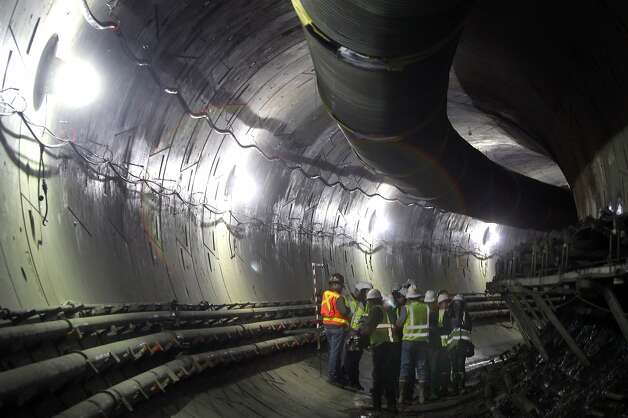
Machines quietly tunneling in Muni's Central Subway project


Visitors get a peek at the progress in the northbound tunnel of Muni's Central Subway project in San Francisco.


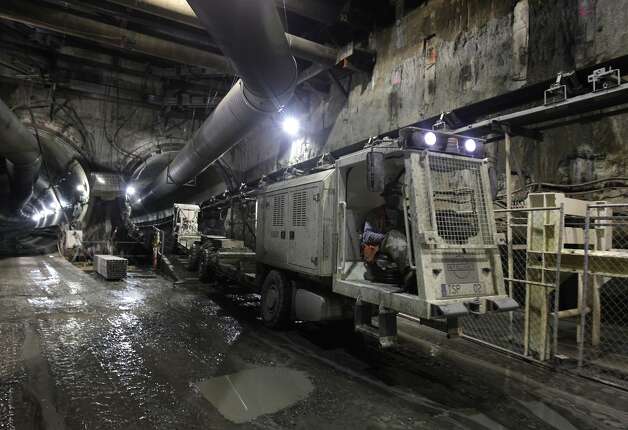
A transport vehicle emerges from the northbound tunnel of Muni's Central Subway construction project in San Francisco, Calif. on Saturday, March 8, 2014. Two large boring machines, Big Alma and Mom Chung, are grinding their way north from Fourth and Bryant streets towards Chinatown and North Beach.

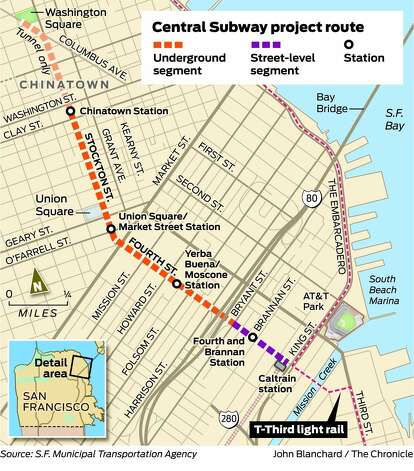
....a tour of the under-construction northbound bore of the Central Subway - the Municipal Transportation Agency's $1.6 billion transit link between the Caltrain station and Chinatown.

The line will stretch 1.7 miles, with a twin-bore tunnel going underground where Interstate 80 crosses Fourth Street. An above-ground station will be built at Fourth and Brannan streets with subterranean stations near Moscone Center at Fourth and Folsom streets, at Union Square and in Chinatown at Stockton and Washington streets, where the tracks will end.

But the tunnel will extend to Powell Street and Columbus Avenue, the site of the old Pagoda Palace Theater in North Beach, where the two tunnel-boring machines will be plucked from the ground and an extension might someday be built.

For now, the two machines - each longer than a football field and weighing 750 tons - are steadily and surreptitiously gnawing 20-foot wide tunnels beneath one of the most-congested parts of the city. Tunneling crews work five days a week, 12 hours a day, with maintenance work taking place when they're not digging.
....
Imperceptible on surface
So far, it seems to be working. John Funghi, the MTA's Central Subway project manager, said the work has been imperceptible on the surface, even when passing beneath some of the city's busiest areas, such as Fourth and Market streets, where the boring machines had to dig beneath Old Navy and Forever 21.

"You could be in the Nike store shopping and you wouldn't feel a thing," Funghi said. "We've been very fortunate. Nothing on the surface has moved. We crossed under BART without stopping or even disrupting service."
....
The machines excavate and build about 50 feet of tunnel a day, Funghi said. Big Alma is quicker at 54 feet a day compared to Mom Chung's 44-foot average, but Mom Chung holds the performance record of 96 feet in a single day.
....The tunneling may be done this summer, but it will be another 4 1/2 years before passengers can ride the Central Subway in 2019....
....
Metro system connector
"This will be the Metro system connecting north and south, which has not been connected by rail so far," said Paul Rose, an MTA spokesman. "It's connecting Chinatown, one of the densest areas not only in the city but in the state and country."

He said the project is on schedule and on budget.
....
Reply With Quote
     
     
  #1999  
Old Posted Mar 11, 2014, 2:38 AM
CharlesCO's Avatar
CharlesCO CharlesCO is offline
Aspiring Amateur
 
Join Date: Jul 2010
Location: Berkeley, CA
Posts: 415
Quote:
Originally Posted by fflint View Post
Anyone who's ever been stuck on a Muni Metro train inside a station, wondering when the damned doors will open, has reason to celebrate this planned change:

Muni Metro tries doubling up

Call it a two-fer, double duty or two in one but Muni is preparing to start using double berthing — having two trains stop at a single station platform — at three downtown stations.

The plan is to use double berthing at the Civic Center, Powell and Montgomery stations to speed the morning commute. Muni employees tested double berthing, which requires adjustments to the computerized train control system, early Friday morning in the Powell and Montgomery stations after the subway shut down Thursday night.

John Haley, the Municipal Transportation Agency’s transit director, said the test went well, with the trains stopping safely, and as planned, at two locations on the platforms with some buffer space in between.....
....
“We’re excited about it,” Haley said. “It should be a really valuable customer service.”
That's excellent to hear, though I hope they also double up in the afternoon as well.

I also always wondered why they couldn't or haven't done three or even four car trains for the S-Castro Shuttle. I would think that might also help congestion.
Reply With Quote
     
     
  #2000  
Old Posted Mar 11, 2014, 3:12 AM
urbanlife's Avatar
urbanlife urbanlife is offline
A before E
 
Join Date: Aug 2001
Location: Milwaukie, Oregon
Posts: 11,978
Quote:
Originally Posted by fflint View Post
Anyone who's ever been stuck on a Muni Metro train inside a station, wondering when the damned doors will open, has reason to celebrate this planned change:

Muni Metro tries doubling up

Call it a two-fer, double duty or two in one but Muni is preparing to start using double berthing — having two trains stop at a single station platform — at three downtown stations.

The plan is to use double berthing at the Civic Center, Powell and Montgomery stations to speed the morning commute. Muni employees tested double berthing, which requires adjustments to the computerized train control system, early Friday morning in the Powell and Montgomery stations after the subway shut down Thursday night.

John Haley, the Municipal Transportation Agency’s transit director, said the test went well, with the trains stopping safely, and as planned, at two locations on the platforms with some buffer space in between.....
....
“We’re excited about it,” Haley said. “It should be a really valuable customer service.”
That's good to hear, I always thought the Muni stations were extremely underused compared to the shortness of their trains. Might as well be able to stop more than one train at each of the stations if there is room.


Great to see the new tunnel for Muni is coming along, I can't wait to get back to SF again and see all the things that have changed since my last visit.
Reply With Quote
     
     
This discussion thread continues

Use the page links to the lower-right to go to the next page for additional posts
 
 
Reply

Go Back   SkyscraperPage Forum > Discussion Forums > Transportation
Forum Jump


Forum Jump


All times are GMT. The time now is 10:01 PM.


Powered by vBulletin® Version 3.8.7
Copyright ©2000 - 2026, vBulletin Solutions, Inc.
