Quote:
Originally Posted by CharlesCO

This is armchair speculation, but I really would want to see how existing station upgrades might improve service before constructing a completely new tube. I don't remember the exact number of trains per hour, but the current Transbay Tube is quite surrprisingly below its maximum capacity mostly because it can't board and deboard passengers at Embarcadero and Montgomery fast enough on the other end. Upgrading those stations, the new fleet, and a new computer system could have a huge effect on reducing headways through the tube. It's too bad they're not looking at rebuilding Powell as well, though.
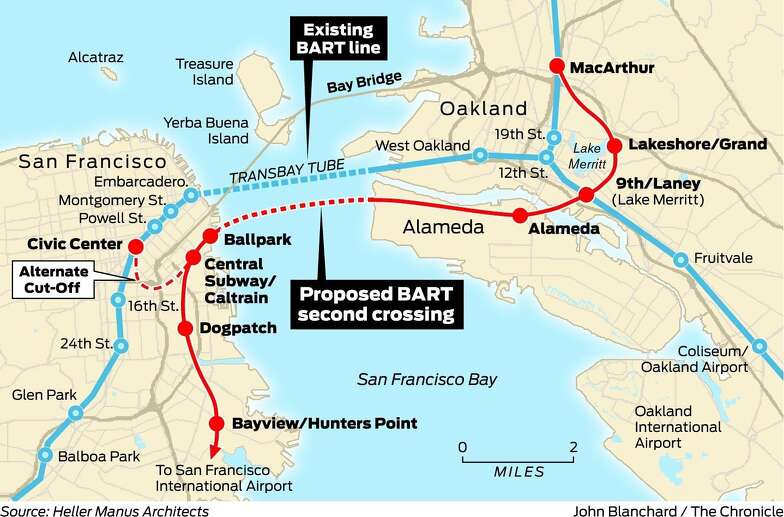
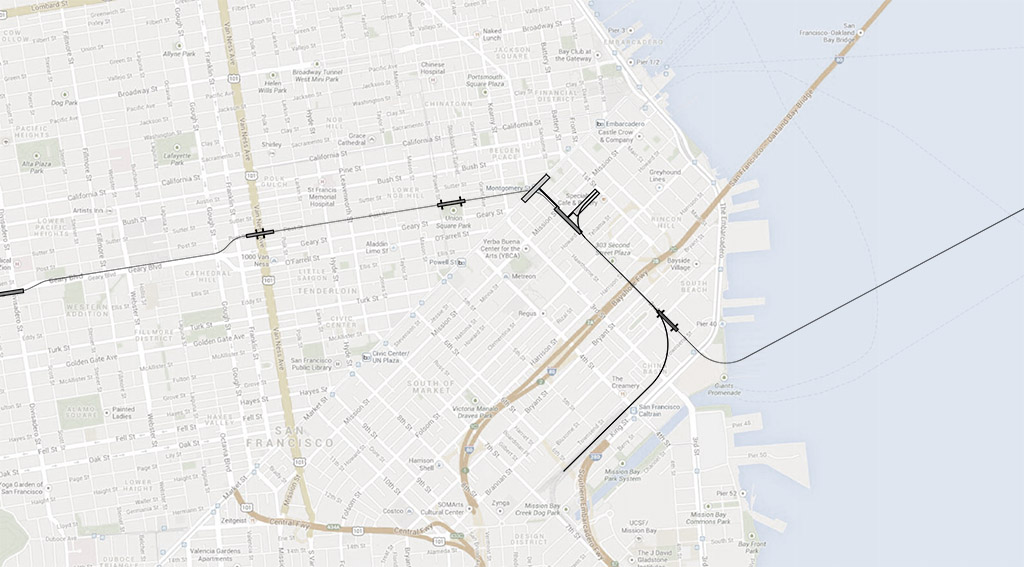
If they ever do build a second tube, I would prefer the Geary alignment as shown over the one seen in the Chronicle, which would mostly duplicate T-Third and Caltrain service in my opinion.
|
IMO, a double tube loop would be the most effective, and, actually the only way to get the system to work at full potential.
Granted it would be extremely expensive, but, if done correctly- i.e., as an endless loop the entire system would benefit.
Every spoke of the system would be accessed via the loop with 1 transfer. Every spoke of the system would meet a line with very high frequencies. For example, a person transferring off of a spoke would have a 4 minute wait max at the loop station for trains in either direction.
In addition, trains particularly on the Oakland side can be dedicated to run from one end of a given spoke to the end of another, avoiding the tube, slow downs in SF, etc. On the SF side, Civic Station and Central Subway/Caltrain would become terminal stations for traffic from and to the south where linking traffic going in both directions would arrive and depart every 4 minutes.
Increase the length of platforms on the Bay Loop, run 8 car trains every 3 minutes (done in Tokyo, Moscow, Seoul, Shanghai, Beijing, etc.) and suddenly the figures get staggering.
8 cars x 150 (make more people stand) people per car x 20 trains per hour x2 directions equals 48,000 people per hour EVERYWHERE on the loop, and between any station set.
As the Loop covers 13 stations there will naturally be a lot of user traffic that does not need to use the tube(s). While feeder traffic has a lower frequency, each feeder rider would only have a 3 minute wait to travel on the loop to board a train going to 5 SF stations.
IMO, the short hops might even approach the tube ridership in SF. On the Oakland side, any rider on a feeder line would have a 3 minute wait at the platform to travel to 6 stations on the Oakland side.
Taking a huge amount of liberties, say that 30,000 people per hour use the loop and stay on their side of the Bay (mostly SF side including transfers from Caltrain .) Say 40,000 riders per hour head to SF via the two tubes and 20,000 riders per hour go to Oakland via the tubes. Consider 50,000 per hour transferring from the Loop to a BART feeder on both sides of the Bay
We are running about 140,000 people per hour for all portions of the loop. Consider 2 rush hours with a total of 4 hours under the "curve" and we get about 560,000 people per day during rush.
Add 25% for non-rush hours, and, we get 700,000 riders per day on the loop.
I have no doubt that synergies would kick in and the rest of the system could easily carry an addition 250,000 to 300,000 riders. Remember in both SF and Oakland transfers are quick from the feeder lines so the commuter's comfort zone would increase. Run trains on end to end runs on the Oakland side, for example, at 10 minute intervals (remember no feeder lines use the tubes) and the capacity of feeder lines doubles. Similar the feeder lines from the south could easily double their frequency to 10 minutes, rather than twenty. Do this effectively doubles system capacity outside the loop.
I see little reason why such a system could not carry 1,000,000 riders per day.





 Prev
Prev



 .
.


 Linear Mode
