Quote:
Originally Posted by Fatty McButterpants

Ditto. No offence intended. No offence taken.
Heritage is a polarizing issue. Some people like old historic strutures, some like contemporary modern ones. I happen to like both. In the case of this bridge, I see what "could be" as being more impressive than what "has been". And once again I would say that LOCATION is the key to this. The Alexandra bridge doesn't offend me. I'd have no problem with it a little bit up or down the river. And I certainly don't believe for a second that the Alexandra bridge is going anywhere. But this is a thread about visions. A fantasy thread. I personally think it's sad that some of the ideas put forth in this "fantasy" thread talk about sidewalks. It's even more sad that there are people who can't possibly fathom something bold that would singlehandedly and instantly change the landscape of the city.
It just seems to me that historical enthusiasts believe heritage is a trump card. There is a certain arrogance in that, and it makes your criticism of my post a little ironic. Looking back should not always trump looking forward. And people who's vision includes a balance of new and old should have a say too.
|
There are some people who always view heritage as superior, not always understanding the forces that created those buildings and cities of the past (e.g. Paris' 6-floor height buildings), but then there are those who are perfectly fine demolishing everything, like what used to be done a few decades ago, to construct something new. I fall in between and say there's quite a lot of stuff that should be preserved, as they provided character, contribute to identity, all of which makes a city look distinct from other cities around the world.
A current concern for many, even in architecture and urbanism, is this trend of designing buildings that could easily be placed anywhere in the world, that doesn't scream the name of one actual city. That our cities are becoming to uniform. So, heritage preservation is one way we can maintain our distinct identity. That means keeping what we have that works and looks good, and replacing other things with something new, to enhance the experience. I wouldn't want to see Centretown demolished and replaced with all new towers, but I think some sprouting up here and there on empty properties or fixing up old buildings on main streets with some modern additions is ideal.
However, but judged J.OT13 as someone who's completely opposed to change or development because he wants to see a bridge, one that you see no value in, preserved for posterity. That is quite the fallacy, there.
For me, there's a lot of "could-bes" in Ottawa, and that's definitely the point in having this thread. But I feel the bridge actually kind of complements our view of Parliament and Major Hill (the view with Connaught Building, Château Laurier), along with Confederation and Justice Buildings and the Supreme Court. It ties into this heritage for Ottawa (you can argue for Canada, but I don't care so much about how other Canadians identify with this city/ I can't imagine how people can think of themselves as an Ottawan). As much as I understand that this bridge is in a prominent position, I still think it's quite fitting and picturesque, something I've noticed when photographing it and other views that include it. There are other places where a new bridge would fit well, for example at Chaudière.
I disagree with what you say this thread is about. I think it, much like
Architecture for Ottawa that I started, it's about sharing what we would like to see happen in Ottawa. We can think of some fantastical or whimsical thing to put or do in Ottawa, but an important thing is that it be realistic. We could say we'd love to see a 150-storey building sprout up somewhere, but we all know that would never happen and might not even be ideal. 40-50 stories, yes.
You underestimate the importance of sidewalks. Sidewalks are one of the most important paths to being able to experience the city and architecture, to move around the city. A good pedestrian path (sidewalk and trees, etc.) creates a good urban experience that can get people out of cars, living in more urban areas, shop more, spend more time outside and interacting with people, and overall falling in love with the city. A sidewalk is not mundane, as it is quite powerful, I think. Beside, we can do all sorts of interesting things with them, including bulb-outs, widened spaces for public gathering, heating them (like Japan's heated sidewalks).
But in response to your last paragraph, I don't think you quite get what I'm saying, and I think that is where you end up criticizing someone: because you misunderstand them. It seems more like you're not someone who wants a balance between preservation and development, but rather you want to see development without preservation. What should be preserved? You can argue that this bridge shouldn't be preserved, as well as many other buildings. But truthfully, what does deserve preservation if not something as significant as this bridge?





 Prev
Prev


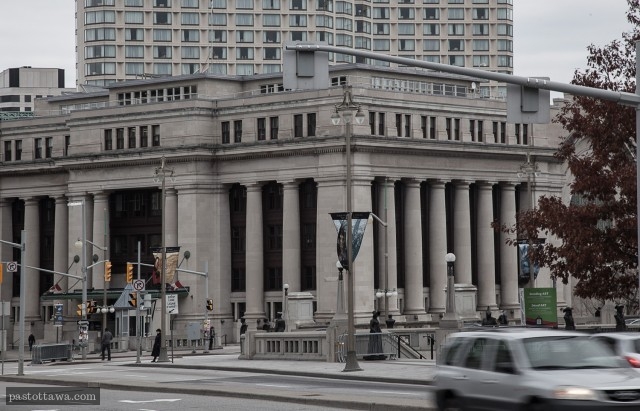
 In its place, I would put a building that has the same mass and presence as the Langevin Block (not a copy but a contemporary version, much like the way the East and West Blocks are not mirror images). This would complete the "urban room" around the Parliament Hill lawn. I would give this building a public function, maybe a place where people actually learn about democracy (funny that aside from the guided tours of Parliament, there really is no place in the capital that discusses Canadian politics in depth), or at least be a place where the federal government engages the public through press releases or committee hearings. London's









 Linear Mode
