Late to the discussion, but wanted to add my two cents.
Re: NYC bikeshare (Citibikes)
I was in NYC for a week last month. Bikis were in use everywhere (Manhattan). However, they also had new bike lanes everywhere full of bixis and private bikes. Their role-out came with a massive investment and political commitment (champions) to bike lanes first. As of 2009 they had built 270 km of bike lanes simply marked with paint and signage, and
lie between a parking lane and a traffic lane These are known as class 2. (the new lanes down Richards St. are class 2) Since 2009, they have been upgrading many of these lanes to full class 1 (completely separated) lanes. Then they started to role out their bike share. What a shock it is very popular with locals and tourists. Primarily because the bike share (and lanes) are not for those already bicycling it for those who would cycle if it was convenient and safer.
Vancouver should use the same approach to building class 2s everywhere first (based on a master plan....oh wait we don't have an OCP...we have a library of small plans...). Anyway, phased implementation always allows for wider application and spreads the cost of the final implementation while still providing desperately need bicycle infrastructure to more people. And, the more complete a network is the more people can use and access it. (Try getting to the Burrard st bridge bike lanes from Dunbar) I find it funny all the hate and attribution Gregor gets for the bicycle program in Vancouver. First the NPA started most of the bicycle programs that the mayor inherited. Second, the Hornby and Dunsmuir lanes are far from an ambitious launch of separated bike lanes. The implementation has been incremental and you wouldn't know it from the news, but the engineering department has done adjustments to every stretch of bike lanes to accommodate businesses. Instead of what is done essentially everywhere else: plan for the lane with feedback at the beginning, announce the lane, build the lane. Many of these same businesses won't even cooperate with the study of how the lanes are affecting their business. (This is why the results from any study on the impact of the bike lanes in Vancouver cannot be taken seriously as they are not an accurate sample)
Now my pet-peeve: Stop bringing Montreal into the discussion of bikeshare. Yes, they were a pioneer in Canada, but the contracts there were set-up completely different. The good part was the city supported bike lanes and even provided snow and debris clearing services. (People do use the bike lanes there in the winter) However, the bike share was not managed properly from the start. And, I cannot even begin to explain why the city doesn't just absorb the program so they can control operations and funding. Instead of writing cheques.
Now the second issue subsidies.
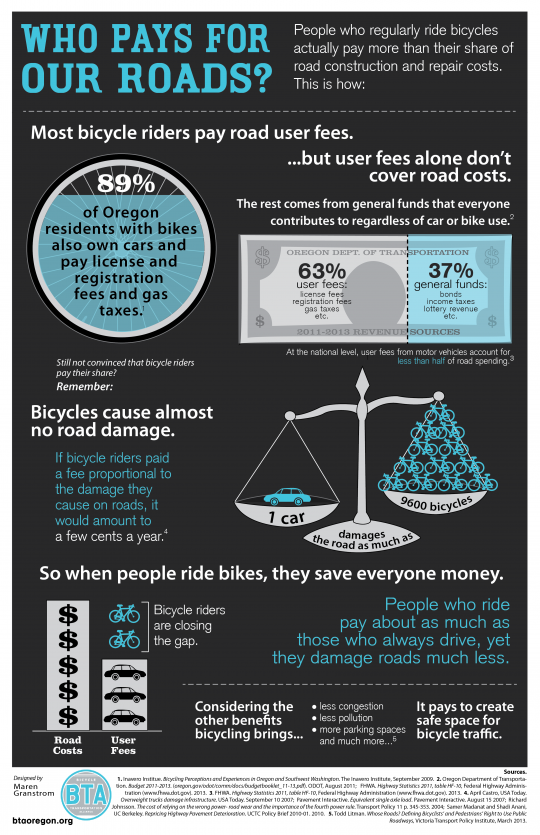
All transportation infrastructure is subsidized. From sidewalks, to bike lanes, to transit, to roads. Subsidizing bicycle infrastructure costs a lot less than car infrastructure. I understand why there is resentment for bicycle infrastructure. Car usage has the appearance of user pay (gas, insurance, vehicle, tolls, parking) whereas bikes (bike share or private bike and helmet-for those who wear them). As governments look to reduce costs it is shifting more of the costs to the users (drivers). There is also the perception of breaking the rules (of the road) such as not wearing a helmet, bicycling on sidewalks, and general dangerous cycling behavior. However, how many drivers stay below 50km/hr in the city, pass on the right at intersections, change lanes in the intersection, talk/text on the their phones, change lanes without signaling, etc. etc. This is human nature. An idiot on a bike and an idiot in a car are just idiots. The modes are irrelevant. However, the damage a car can do versus a bicycle is massive. Should bicycle infractions be enforced as much as driving ones? Absolutely. However, why don't we let the police decide what the best use of their resources are and agree that stereotyping all users of a mode is irrelevant to mode investment.
Now to the bad news. Most of us grew up on very subsidized car infrastructure that was built when labour and input costs were a lot cheaper. We can not afford to maintain what we have and definitely cannot afford to maintain an expanding system. This system was great gas was cheap and everyone had a car. The problem was population growth and land required to service this system.
....skip a whole lot explaining the problems with this model....
Fast forward today you live in a community that has busy transit and and heavy traffic congestion but you and many people you know need a car to get around still. Some politician announces he is going to build bike lanes. You don't bike and the people you know don't bike. You see this as less parking and less lanes for cars.
So why should you support these policies? You should because in the long run they save money, improve safety, reduce car trips, improve public realm, health, and a score of other reasons. The mode switch to bicycling saves government money in the long run and taxpayers/citizens individually.
If you still disagree with me or want to read someone who is a better authority on the subject of transportation subsidies check out
Todd Littman's paper
Also consider that bike lanes are one of the only approaches local governments can use to combat congestion. Highway and transit priorities and funding are controlled by senior levels of government.





 Prev
Prev




 Linear Mode
