HomeDiagramsDatabaseMapsForum About
     

Go Back   SkyscraperPage Forum > Regional Sections > Canada


Closed Thread

 
Thread Tools Display Modes
     
     
  #2661  
Old Posted Aug 28, 2013, 4:32 PM
Riise's Avatar
Riise Riise is offline
City Maker
 
Join Date: Feb 2006
Location: Calgary | London
Posts: 3,195
Quote:
Originally Posted by jeremy_haak View Post
And I suppose Ottawa's new system will be a metro as well, as would be the O-Train, though no one really thinks of it as such.
By strict definition, I wouldn't be too quick to call Ottawa's new system a metro. Grade separation is only one key trait of a metro with another important trait being its high capacity as a metro is a type of heavy rail. I'd break it down as follows:

Heavy Rail
Metro - Grade Separate, High Capcity and High Frequency
Commuter Rail - High Capacity

Light Rail
Automatic Light Rapid Transit / Light Metro - Grade Separation, Light Capacity and High Frequency
Light Rapid Transit* - Segregated RoW, Light Capacity and High Frequency

*Or Light Rapid Rail Transt (LRRT)

Below light rapid transit it becomes less rigidly defined. I'd categorize the CTrain as an LRRT but think it is markedly different to what is being proposed in KW. In turn, KW's system is different to the streetcar system in Toronto. In reality, I think it looks like this:

Undefined Light Rail Transit
City Rail - Segregated RoW, Light Capacity and Low to Moderate Frequency
Tram - Mixed Traffic, Light Capacity and Low to Moderate Frequency

__________________
“Such suburban models are being rationalized as ‘what people want,’ when in fact they are simply what is most expedient to produce. The truth is that what people want is a decent place to live, not just a suburban version of a decent place to live.”
- Roberta Brandes Gratz
     
     
  #2662  
Old Posted Aug 28, 2013, 5:02 PM
J.OT13's Avatar
J.OT13 J.OT13 is offline
Moderator
 
Join Date: Mar 2012
Location: Ottawa
Posts: 28,354
If I'm not mistaking, both Vancouver (1.5 min. frequency) and Ottawa's (2 min. frequency) max capacities are 24,000 phpd. Toronto's (2 min. frequency) is 33,000 phpd. Montreal (2 min. frequency) is about 45,000 phpd.

I was unable to find enough information to calculate Calgary and Edmonton capacities.
     
     
  #2663  
Old Posted Aug 28, 2013, 5:09 PM
Chadillaccc's Avatar
Chadillaccc Chadillaccc is offline
ARTchitecture
 
Join Date: Feb 2011
Location: Cala Ghearraidh
Posts: 22,842
I posted extensive information about the Ctrain three pages back, here it is:

Average speed: 35 km/h
Maximum Speed: 80 km/h
Minimum headway: 120 seconds
Actual at-peak passenger movement: 7 255/h
Current practical at-peak passenger movement(3-car trains): 14 580
Future practical at-peak passenger movement(4-car trains): 19 440 (next year)

Maximum single direction capacity (pass./hr/dir) at 256 pass./car and 2 min. headway:
3-car train 23,040 (current)
4-car train 30,720 (next year)


Source: http://www.calgarytransit.com/html/technical_information.html


I don't know what Edmontons stats are, but they typically run 4-car trains, so with 2 minute headways their capacity would be 30,720 per hour, but since they also run 5-car trains, their actual maximum is probably 38,400.
__________________
Strong & Free

Mohkínstsis — 1.6 million people at the Foothills of the Rocky Mountains, 400 high-rises, a 300-metre SE to NW climb, over 1000 kilometres of pathways, with 20% of the urban area as parkland.
     
     
  #2664  
Old Posted Aug 28, 2013, 5:50 PM
J.OT13's Avatar
J.OT13 J.OT13 is offline
Moderator
 
Join Date: Mar 2012
Location: Ottawa
Posts: 28,354
Thanks. Seems like a lot for LRT until you look at the C-train seating arrangement; seats are lined up on the wall instead of having 2 rows of 2 seats like Ottawa's train sets, which makes for a narrow aisle, limiting standing capacity.

Canadian light rail rolling stock interiors. I've taken the liberty of also indicating platform or maximum train length.

Ottawa O-Train Alstom Coradia LINTS (41 meters) and Confederation Line Alstom Citadis (130 meter platforms in subway, City will initially run 98 meter train sets) will have a similar seating arrangement;


Calgary (100 meters with 4 car trains), seating arrangement makes for more standing room, therefore more capacity. Ottawa should have opted for this;


Edmonton (125 meters), longer trains than Calgary but seating arrangement limits capacity (although satisfactory for ridership level);


  #2665  
Old Posted Aug 28, 2013, 6:16 PM
Nouvellecosse's Avatar
Nouvellecosse Nouvellecosse is offline
Volatile Pacivist
 
Join Date: Aug 2005
Location: Nova Scotia
Posts: 11,107
I'd say seating should only be optimized for capacity if the system really needs it, or you end up reducing comfort unnecessarily. It's only for a few hours a day that the passenger volumes are high enough to really need to have crush load standing room, and the rest of the time you're making people stand that could have otherwise been seated.
__________________
"The reasonable man adapts himself to the world; the unreasonable one persists in trying to adapt the world to himself. Therefore all progress depends on the unreasonable man." - George Bernard Shaw
Don't ask people not to debate a topic. Just stop making debatable assertions. Problem solved.
     
     
  #2666  
Old Posted Aug 28, 2013, 6:20 PM
nname nname is offline
Registered User
 
Join Date: Aug 2005
Posts: 5,058
There is a difference in some stat posted though - some of them are 'crush load' while some of them are not. This creates a huge difference in capacity value. I know Toronto don't use crush load for capacity, as does the stat for Vancouver (although the max capacity should about 25,700pphpd). Believe it or not, with max frequency, max train length, and ultra-crush load, Bombardier actually marketed the ART technology with maximum capacity of 53,280 pphpd . For the Calgary, the 'practical' value should be used rather than the 'theoretical' (ie. crush load) for comparison. However, I'm not sure if the 2min headway meant the downtown portion or the branch? I remember reading somewhere that the minimum headway for an at-grade crossing with signal priority is 3 minutes.
     
     
  #2667  
Old Posted Aug 28, 2013, 6:37 PM
franktko's Avatar
franktko franktko is offline
Registered User
 
Join Date: Mar 2013
Location: Montréal
Posts: 1,297
Quote:
Originally Posted by J.OT13 View Post
Calgary (100 meters with 4 car trains), seating arrangement makes for more standing room, therefore more capacity. Ottawa should have opted for this;
NYC Transit planners did a research in seats arrangements that's pretty interesting... They say that their traditional layout (similar to Calgary's) "wastes usable seating space."

One of their proposed layouts:


http://www.wired.com/autopia/2013/04/rethinking-subway-seating/
     
     
  #2668  
Old Posted Aug 28, 2013, 6:42 PM
J.OT13's Avatar
J.OT13 J.OT13 is offline
Moderator
 
Join Date: Mar 2012
Location: Ottawa
Posts: 28,354
Quote:
Originally Posted by nname View Post
There is a difference in some stat posted though - some of them are 'crush load' while some of them are not. This creates a huge difference in capacity value. I know Toronto don't use crush load for capacity, as does the stat for Vancouver (although the max capacity should about 25,700pphpd). Believe it or not, with max frequency, max train length, and ultra-crush load, Bombardier actually marketed the ART technology with maximum capacity of 53,280 pphpd . For the Calgary, the 'practical' value should be used rather than the 'theoretical' (ie. crush load) for comparison. However, I'm not sure if the 2min headway meant the downtown portion or the branch? I remember reading somewhere that the minimum headway for an at-grade crossing with signal priority is 3 minutes.
The headways I provided are the maximum for the central segments where all lines meet. My stats are mostly based on Wikipedia and whether or not the system is automated (1.5 min automated or 2 min for conductor/heavy rail) or heavy rail (which usually has a lower max frequency than lrt even with full automation).

The ART crush load capacity is ridiculous. That's like an Asian subway system.


  #2669  
Old Posted Aug 28, 2013, 6:57 PM
J.OT13's Avatar
J.OT13 J.OT13 is offline
Moderator
 
Join Date: Mar 2012
Location: Ottawa
Posts: 28,354
Quote:
Originally Posted by Nouvellecosse View Post
I'd say seating should only be optimized for capacity if the system really needs it, or you end up reducing comfort unnecessarily. It's only for a few hours a day that the passenger volumes are high enough to really need to have crush load standing room, and the rest of the time you're making people stand that could have otherwise been seated.
I agree. In the case of Edmonton, it works fine; with 125 meter trains and a ridership level of around 97,000, having more seats assures comfort without overcrowding the trains.

Ottawa's line is predicted to have a daily ridership of over 100,000 and will start with 98 meter trains. If the City wanted to cheap out on full length platforms throughout (130 meters) and amount of initial rolling stock (limiting frequency to 3 mins) then they should have opted for the Calgary seating model.

franktko, that is an interesting study. The "ideal" layout seems to be sort of a hybrid of the Calgary and Edmonton models.
     
     
  #2670  
Old Posted Aug 28, 2013, 7:30 PM
Riise's Avatar
Riise Riise is offline
City Maker
 
Join Date: Feb 2006
Location: Calgary | London
Posts: 3,195
Quote:
Originally Posted by nname View Post
There is a difference in some stat posted though - some of them are 'crush load' while some of them are not. This creates a huge difference in capacity value.
The system is broken down as follows:

AW0: Weight of empty vehicle.
AW1: Weight of vehicle with full seated load.
AW2: Weight of vehicle with a full seated load plus standees at 4 passengers/m2.
AW3: Weight of vehicle with a full seated load plus standees at 6 passengers/m2.
AW4: Weight of vehicle with a full seated load plus standees at 8 passengers/m2.

Theoretical would be the capacity at AW4, however, this is often achieved or exceeded during peak-periods.
__________________
“Such suburban models are being rationalized as ‘what people want,’ when in fact they are simply what is most expedient to produce. The truth is that what people want is a decent place to live, not just a suburban version of a decent place to live.”
- Roberta Brandes Gratz
     
     
  #2671  
Old Posted Aug 28, 2013, 7:58 PM
Chadillaccc's Avatar
Chadillaccc Chadillaccc is offline
ARTchitecture
 
Join Date: Feb 2011
Location: Cala Ghearraidh
Posts: 22,842
Quote:
Originally Posted by J.OT13 View Post
Calgary (100 meters with 4 car trains), seating arrangement makes for more standing room, therefore more capacity. Ottawa should have opted for this;


Calgary has three LRV models in service, this one is the newest model. 80 of our original 84 LRVs are still in service. I don't know the total amount we have of all three though.
__________________
Strong & Free

Mohkínstsis — 1.6 million people at the Foothills of the Rocky Mountains, 400 high-rises, a 300-metre SE to NW climb, over 1000 kilometres of pathways, with 20% of the urban area as parkland.
     
     
  #2672  
Old Posted Aug 28, 2013, 8:17 PM
Beedok Beedok is offline
Exiled Hamiltonian Gal
 
Join Date: Jun 2012
Posts: 6,792
Quote:
Originally Posted by Nouvellecosse View Post
I'd say seating should only be optimized for capacity if the system really needs it, or you end up reducing comfort unnecessarily. It's only for a few hours a day that the passenger volumes are high enough to really need to have crush load standing room, and the rest of the time you're making people stand that could have otherwise been seated.
Yeah, Thunder Bay has a bus design with fold away seats that could hold a huge number of people standing, unfortunately it's never full enough to need that and instead it just ends up with seniors and the like stuggling to balance on the poorly designed fold away seats.

Quote:
Originally Posted by J.OT13 View Post
The headways I provided are the maximum for the central segments where all lines meet. My stats are mostly based on Wikipedia and whether or not the system is automated (1.5 min automated or 2 min for conductor/heavy rail) or heavy rail (which usually has a lower max frequency than lrt even with full automation).

The ART crush load capacity is ridiculous. That's like an Asian subway system.

I've encountered buses that crowded than that in Ottawa and Hamilton, and I think Toronto Streetcars are sometimes more crowded. (!)

Last edited by Beedok; Aug 28, 2013 at 8:27 PM.
     
     
  #2673  
Old Posted Aug 28, 2013, 8:22 PM
Chadillaccc's Avatar
Chadillaccc Chadillaccc is offline
ARTchitecture
 
Join Date: Feb 2011
Location: Cala Ghearraidh
Posts: 22,842
Quote:
Originally Posted by Nouvellecosse View Post
I'd say seating should only be optimized for capacity if the system really needs it, or you end up reducing comfort unnecessarily. It's only for a few hours a day that the passenger volumes are high enough to really need to have crush load standing room, and the rest of the time you're making people stand that could have otherwise been seated.
Dude we need it. It's not really a contention of if or why. If you've experienced rush hour in Calgary on the LRT, you'll know we need it. As has been mentioned several times, our trains are only 3 cars long. We've needed five car trains for like 6 years, but are only bringing 4-car trains online in 13 months.

I don't even know if it will be possible for us to ever have 5-car trains. I guess on the 201 line once they put it underground through DT, and then just re-lengthen all of the outer station platforms. But as long as we have the 10 (or however many it is) downtown stations, that won't be possible as the blocks aren' long enough.
__________________
Strong & Free

Mohkínstsis — 1.6 million people at the Foothills of the Rocky Mountains, 400 high-rises, a 300-metre SE to NW climb, over 1000 kilometres of pathways, with 20% of the urban area as parkland.
     
     
  #2674  
Old Posted Aug 28, 2013, 9:00 PM
Innsertnamehere's Avatar
Innsertnamehere Innsertnamehere is offline
Registered User
 
Join Date: Jan 2010
Location: Hamilton
Posts: 12,809
Quote:
Originally Posted by J.OT13 View Post
If I'm not mistaking, both Vancouver (1.5 min. frequency) and Ottawa's (2 min. frequency) max capacities are 24,000 phpd. Toronto's (2 min. frequency) is 33,000 phpd. Montreal (2 min. frequency) is about 45,000 phpd.

I was unable to find enough information to calculate Calgary and Edmonton capacities.
There is no way Montreal has 45,000 pphd with the skinnier trains. (Even if they are longer)

When Toronto gets the new signalling system on the Yonge line it will be well over 40,000 pphd.
     
     
  #2675  
Old Posted Aug 28, 2013, 10:49 PM
J.OT13's Avatar
J.OT13 J.OT13 is offline
Moderator
 
Join Date: Mar 2012
Location: Ottawa
Posts: 28,354
Quote:
Originally Posted by Innsertnamehere View Post
There is no way Montreal has 45,000 pphd with the skinnier trains. (Even if they are longer)

When Toronto gets the new signalling system on the Yonge line it will be well over 40,000 pphd.
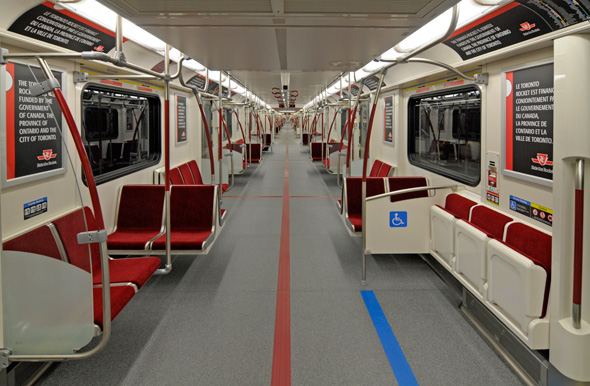
Those are the MR-73 according to Wikipedia; 1440 passengers per train, currently runs every 3 minutes at rush hour (28,800 phpd) but could run every 2 minutes (43,200). The new trains are estimated to have 19% to 24% more capacity (depending on which article you read, either way it seems a little steep) because of gangways allowing people to walk from one end of the train to the other. Although Montreal's trains are narrower than Toronto's, they are nearly 20 meters longer. And again with the seats, Toronto has 2.9 seats per meter vs. Montreal's (MPM-10) 1.6 seats per meter. That said, we don't know which load that is calculated with (which Riise posted 5 posts ago).

Montreal MPM-10


Toronto Rocket


Is Toronto's 40,000 at a two minute headway?

To answer Chadillaccc question about the number of C-Train models in service, again from Wikipedia. I'm not sure if these are train sets or individual cars;

*81-84 models; 83
*01-06 models; 72
*07 models; 38

Last edited by J.OT13; Aug 28, 2013 at 11:04 PM.
     
     
  #2676  
Old Posted Aug 28, 2013, 11:51 PM
vid's Avatar
vid vid is offline
I am a typical
 
Join Date: Apr 2004
Location: Thunder Bay
Posts: 39,065
What Thunder Bay does wrong with the fold-seat buses, is it runs them on regular routes at any time, instead of running them on the busiest routes at the busiest times. The connection between downtown and the University in the morning would be perfect for that, rush hour mainline routes would make good use for it. But a suburban route at 6pm on Sunday? Stupid.

They should have got more Orion VIIs. They seat 41 and the back door opens outward, which allows 6 people to stand at the back door with minimal inconvenience compared to just four standing at the back of a Novabus.
     
     
  #2677  
Old Posted Aug 28, 2013, 11:58 PM
Rusty van Reddick's Avatar
Rusty van Reddick Rusty van Reddick is offline
formerly-furry flâneur
 
Join Date: Oct 2004
Location: Bankview, Calgary
Posts: 6,906
Quote:
Originally Posted by Beedok View Post
Yeah, I've encountered buses that crowded than that in Ottawa and Hamilton, and I think Toronto Streetcars are sometimes more crowded. (!)
Calgary's trains are absolutely this crowded during rush hour. I've never seen the Toronto subway as crowded as the C-Train gets, ever.
     
     
  #2678  
Old Posted Aug 29, 2013, 12:09 AM
Beedok Beedok is offline
Exiled Hamiltonian Gal
 
Join Date: Jun 2012
Posts: 6,792
Quote:
Originally Posted by vid View Post
What Thunder Bay does wrong with the fold-seat buses, is it runs them on regular routes at any time, instead of running them on the busiest routes at the busiest times. The connection between downtown and the University in the morning would be perfect for that, rush hour mainline routes would make good use for it. But a suburban route at 6pm on Sunday? Stupid.

They should have got more Orion VIIs. They seat 41 and the back door opens outward, which allows 6 people to stand at the back door with minimal inconvenience compared to just four standing at the back of a Novabus.
The bigger issue is that normal seats are concave, while the folding seats on those buses are perfectly flat, so you slide out of them when the us accelerates or turns.

Quote:
Originally Posted by Rusty van Reddick View Post
Calgary's trains are absolutely this crowded during rush hour. I've never seen the Toronto subway as crowded as the C-Train gets, ever.
I've never seen the subway that full either. The streetcars are just rediculous thought. I had people leaning over me because it was too full them to stand up straight.
     
     
  #2679  
Old Posted Aug 29, 2013, 12:11 AM
J.OT13's Avatar
J.OT13 J.OT13 is offline
Moderator
 
Join Date: Mar 2012
Location: Ottawa
Posts: 28,354
Quote:
Originally Posted by vid View Post
What Thunder Bay does wrong with the fold-seat buses, is it runs them on regular routes at any time, instead of running them on the busiest routes at the busiest times. The connection between downtown and the University in the morning would be perfect for that, rush hour mainline routes would make good use for it. But a suburban route at 6pm on Sunday? Stupid.

They should have got more Orion VIIs. They seat 41 and the back door opens outward, which allows 6 people to stand at the back door with minimal inconvenience compared to just four standing at the back of a Novabus.
Speaking of running the wrong buses in the wrong place, it reminds me of Ottawa's hybrid buses. They were running them on the high speed Transitways instead of the slow urban routes, thus wasting a hell load of fuel. When they realized how dumb that was, they did something even dumber; instead of switching routes, the City converted the five of the 154 hybrids to regular diesel at a cost of 550,000 $.

That was back in the Fall of 2012, not sure if they converted anymore.

To comment on the C-Train; it sounds like it is in fact running on the absolute crush load! Is Calgary looking at building a tunnel to allow for longer platforms, due to lack of space at grade?

Last edited by J.OT13; Aug 29, 2013 at 12:41 AM.
     
     
  #2680  
Old Posted Aug 29, 2013, 12:47 AM
vid's Avatar
vid vid is offline
I am a typical
 
Join Date: Apr 2004
Location: Thunder Bay
Posts: 39,065
Thunder Bay considered buying sixty thirty-foot buses to replace the 49 forty-foot buses we have now, until they were informed that the 30 foot models had the same mileage, and would require a 30% increase in bus drivers.
     
     
This discussion thread continues

Use the page links to the lower-right to go to the next page for additional posts
 
 
Closed Thread

Go Back   SkyscraperPage Forum > Regional Sections > Canada
Forum Jump


Forum Jump


All times are GMT. The time now is 9:10 AM.

     
SkyscraperPage.com - Privacy Statement - Top

Powered by vBulletin® Version 3.8.7
Copyright ©2000 - 2026, vBulletin Solutions, Inc.