Blargh, my long post just got lost when I got logged out...
Anyways, this area is not what is officially considered Milton's urban area, but does show that the contiguous built up land is 13.18 square miles.
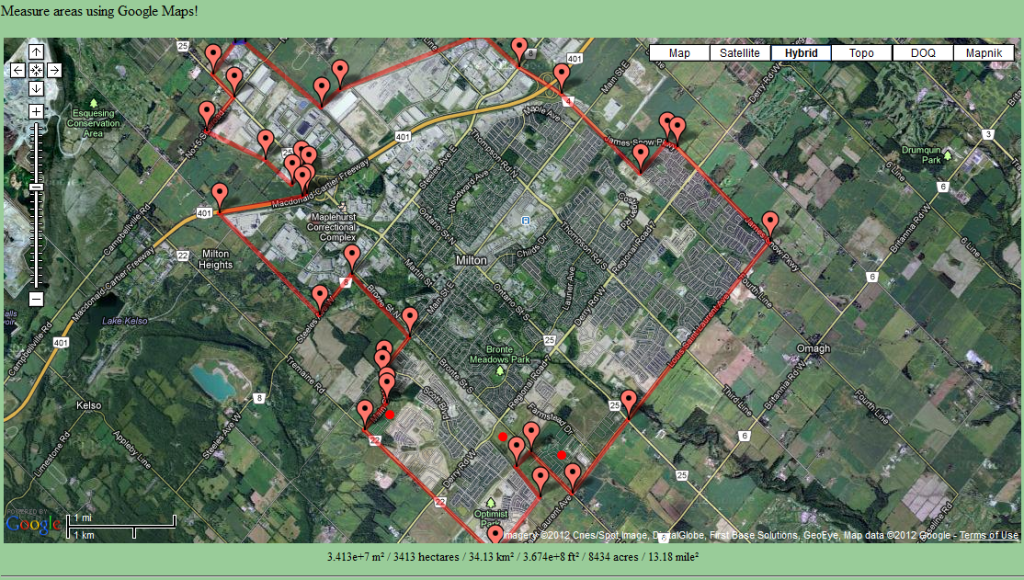
This area had a population of around 88,000 when the street map the boundaries are based on was last updated (May, 2012), for a density of 6,676ppsm. This includes a very large employment area. I don't think Milton is so much of a commuter suburb. Although 58% of Milton workers commute out of town, 45% of Mississauga workers commute out of town too, despite Mississauga having more jobs than workers, so a fair bit of people must commute into Milton too. If you look at just the density of just the new primarly residential areas, it's around 11,000 ppsm.
With 3 storey back to back townhouses:
http://goo.gl/maps/Y7iKR
And 2 storey SFHs with small backyards, no sideyard and front doors sometimes literally steps from the sidewalk:
http://goo.gl/maps/kYZZa
Milton feels dense on the ground too.
However, it is autocentric and there are plenty of equally dense neighbourhoods in other Toronto suburbs like Brampton or Mississauga, and in Calgary and Vancouver's suburbs too.
It's probably pretty rare to have that kind of density stateside though. The suburbs brickel listed are all inner suburbs, not outer suburbs like Milton, Mississauga or Langley, BC.
And in response to jeremy haak, I don't thing dwelling density is a better measure than population density. Fifteen 2500sf homes per acre will always have a higher FSI and population density than fifteen 500sf apartments. I don't think Milton's average household size will decrease drastically a couple decades from now.
As for why people move to Milton? Being far away, it's cheaper, and small lots and backyards have been the norm for most of the GTA's history, so people are probably not bothered by that. If they want more space, there are quite a few parks nearby, and the streets are quiet and suitable for games of street hockey or basketball. It's also good to have a certain density to have enough neighbourhood kids to play with, something that estate homes would have a hard time achieving. Plus, estate homes would be too expensive for most families anyways.
As for who moves into apartments in the suburbs? Well they're cheaper than apartments in the city, or houses in the suburbs, often by quite a bit. They are smaller than a house, but if you're a small household you don't need much space. These condos in the suburbs are new and modern, and still a big step up from a run down tower in the park apartment in Toronto's inner suburbs. Suburbs, like every other place have people working in them that belong to a smal household. Also, Mississauga, Markham and Vaughan (which are building these big projects) have more jobs than workers, so living there will shorten the commute for many people, as opposed to living in downtown Toronto. These 3 suburbs are building these high density areas near highways and transit too, so there will be good access to jobs. Plus, I'm sure that there are people who are into the urban lifestyle, but who want to live in a suburban municipality because that's where they work, or have family, or used to live and have friends (ex. downsizing empty nesters).





 Prev
Prev


 "
"




 France and Quebec have banned traditional Arab clothing. And Canada's Sikh MPs have been victims of Islamophobia quite a few times.


 Linear Mode
