HomeDiagramsDatabaseMapsForum About
     

Go Back   SkyscraperPage Forum > Regional Sections > Canada > Alberta & British Columbia > Calgary > Transportation & Infrastructure


Closed Thread

 
Thread Tools Display Modes
     
     
  #5181  
Old Posted Jul 26, 2012, 2:21 PM
fusili's Avatar
fusili fusili is offline
Retrofit Urbanist
 
Join Date: Sep 2007
Posts: 6,692
Quote:
Originally Posted by frinkprof View Post

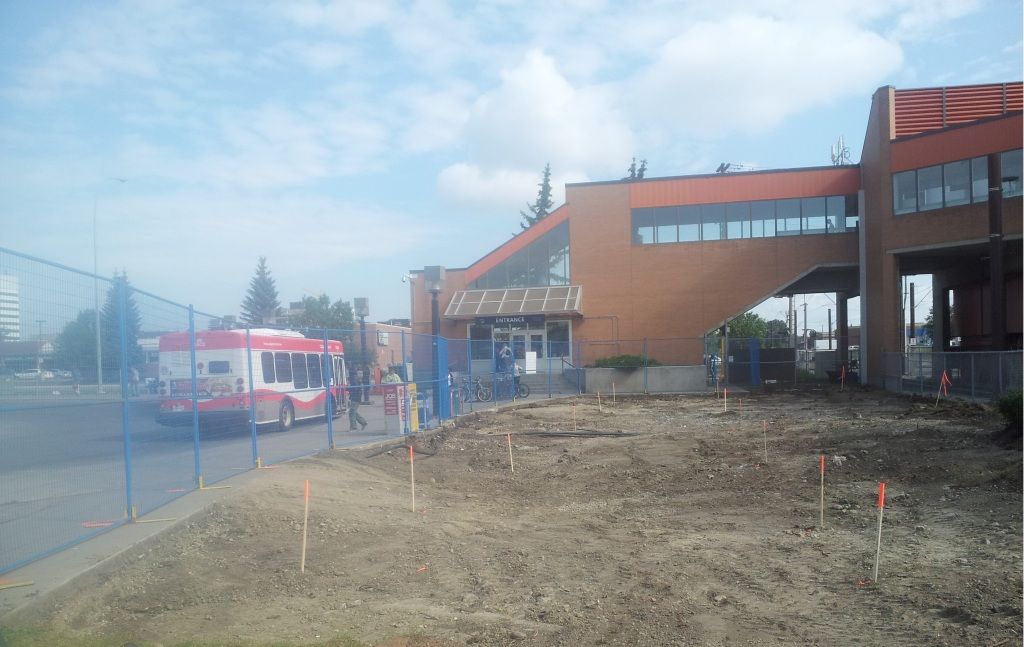
Pile layout for the bus shelter. These will be drilled on Monday. Not long after, you will see the beginnings of the new building going up.

Are there plans to have a cross-platform transfer to the buses at this location? I can't seem to find any plans for the changes to the station. It seems like a great idea to have a cross platform transfer (i.e. providing a LRT platform on the west side of the tracks adjacent to the bus loop).

Does anyone know?
__________________
Not everything that can be counted counts, and not everything that counts can be counted.
     
     
  #5182  
Old Posted Jul 26, 2012, 2:25 PM
fusili's Avatar
fusili fusili is offline
Retrofit Urbanist
 
Join Date: Sep 2007
Posts: 6,692
Some thoughts on the TransitCamp blog on the SE/NC LRT debate (and a 3rd, neither option).

http://transitcamp.ca/2012/07/26/southeast-lrt-north-central-lrt-or-neither/
__________________
Not everything that can be counted counts, and not everything that counts can be counted.
     
     
  #5183  
Old Posted Jul 26, 2012, 3:01 PM
You Need A Thneed's Avatar
You Need A Thneed You Need A Thneed is offline
Construction Enthusiast
 
Join Date: Feb 2007
Location: Castleridge, NE Calgary
Posts: 5,892
Quote:
Originally Posted by fusili View Post
Are there plans to have a cross-platform transfer to the buses at this location? I can't seem to find any plans for the changes to the station. It seems like a great idea to have a cross platform transfer (i.e. providing a LRT platform on the west side of the tracks adjacent to the bus loop).

Does anyone know?
There is no such plans. It's a pretty short and easy walk to the Bus Shelter as it is.
     
     
  #5184  
Old Posted Jul 26, 2012, 3:59 PM
Calgarian's Avatar
Calgarian Calgarian is online now
Registered User
 
Join Date: Jun 2006
Location: Calgary, AB
Posts: 25,121
Just moved into a new apartment with a great view of the western half of the city, I'll try and post some vantage pictures of Sunalta Station and the elevated guideway soon, just have to find that damn camera cable lol.
__________________
Git'er done!
     
     
  #5185  
Old Posted Jul 26, 2012, 10:31 PM
RyLucky's Avatar
RyLucky RyLucky is offline
Registered User
 
Join Date: Feb 2012
Posts: 2,498
Quote:
Originally Posted by fusili View Post
Some thoughts on the TransitCamp blog on the SE/NC LRT debate (and a 3rd, neither option).

http://transitcamp.ca/2012/07/26/southeast-lrt-north-central-lrt-or-neither/
Another decent read by TransitCamp. I believe the Stephen Ave Metro (SAM?) needs to take priority over either project as the new lines would be two levels under 2nd Street. What IS important to determine before we build the SAM is the alignment of the NCLRT so that SAM design can accomodate the future line. A line continuous with the SELRT up 2nd St W and under Centre St N seems most practical.
     
     
  #5186  
Old Posted Jul 26, 2012, 10:44 PM
Radley77's Avatar
Radley77 Radley77 is offline
The City That Moves
 
Join Date: Sep 2008
Location: Bridgeland, Calgary
Posts: 1,450
Cool article about the Sturgess's 7th Ave LRT Revitalization being short listed for an international award:

http://www.avenuecalgary.com/blogs/7th-a...ted-for-international-architecture-award

I really love the look and design of the LRT renovations. Whereas so many subway systems seem dark, antiquated, poor air circulation, and poor interface with the street level, Calgary's downtown LRT is refreshing.
     
     
  #5187  
Old Posted Jul 27, 2012, 2:31 AM
ByeByeBaby's Avatar
ByeByeBaby ByeByeBaby is offline
Crunchin' the numbers.
 
Join Date: Mar 2009
Location: T2R, YYC, 403, CA-AB.
Posts: 791
Quote:
Originally Posted by fusili View Post
Some thoughts on the TransitCamp blog on the SE/NC LRT debate (and a 3rd, neither option).

http://transitcamp.ca/2012/07/26/southeast-lrt-north-central-lrt-or-neither/
Three really good arguments. Here's my attempt at three rebuttals.

Rebuttal to: What About Us? The Forgotten SE LRT

The SE LRT has been on the books for 35 years. Let's imagine that the government of Canada was planning infrastructure 35 years ago; perhaps as we followed this plan, the five largest cities (Toronto, Montreal, Vancouver, Ottawa and Winnipeg) would get a new infrastructure project. There certainly wouldn't have been any thought about what was then the 9th largest city in the country, a little burg called Calgary. While a strategic plan is essential, we cannot afford to make tactical errors by ignoring changing conditions on the ground; a 35 year old principle may be decades overdue or decades out-of-date, and we need to be sensible about which that is.

The route for the SE LRT passes through primarily industrial lands, and industrial workers do not currently use the LRT in significant numbers. 39th Avenue is one example; the NE industrial area in Calgary has twice as many jobs as the SE industrial, but even though the LRT runs along two sides of the NE industrial district, transit use is low. While Quarry Park may be a good development - or just another modest suburban office park - the LRT station is almost 800m from the central intersection in the area along 18th St, and none of the residential development is within 800m of the LRT station. (But plenty of open field parks and surface parking will be.) The South Health Campus is perhaps the strongest employment centre along the line, but it will only employ 2500 workers, compared to the 150000 in the Centre City. These health workers will also have the option of a reverse-flow commute on Deerfoot on the empty southbound lanes in the morning, which is tough for transit to beat.

On the residential side, the case for the SE LRT also doesn't add up. The Southeast sector has 86,000 residents today, while the North has 121,000. While the SE is growing faster, it won't catch up to the North over the next 15 years, and perhaps not over the next 30. The north also has a regional component; Stoney Trail gives easy access to the Country Hills park-n'-ride for Airdrie residents, but there's no equivalent market in the southeast; Okotoks residents can already use Somerset for that purpose. The north has already proven a strong transit market; one LRT train could take a dozen buses (and their driver's salaries) off of the busy Centre street corridor; in the southeast, that one LRT train would replace... one half-empty "BRT" bus.

The southeast LRT is a massive infrastructure expense to service a corridor that may never produce enough ridership to justify the service or the expense. Prioritizing it over the shorter, denser, higher-riding north sector, or the much needed Stephen Ave Subway downtown to keep the trains serving the areas that do have high ridership would be a critical mistake.


Rebuttal to: Half the Length, More Passengers- The North Central Route

It sounds great, doesn't it? Build north, and cover half the distance. The problem is simple; length isn't everything. The planning of the north central LRT is barely past the conceptual stage; the much more complete southeast plans are ready to build, and we have an idea of the kind of ridership they could generate. There are three main routes to the north that are being discussed; a Nose Creek route that would interline with the NE/W LRT, and a pair of straight shot routes, up either Centre St. or Edmonton Trail. I'll call these the "urban" routes, since they share the same basic strengths and weaknesses. All three routes would be the same north of Beddington Trail.

The Nose Creek route runs through empty land, much of which will stay empty due to landfill and slope issues. The most transit-friendly station south of Beddington Trail would be in the Greenview industrial area, which is so transit-unfriendly that Calgary Transit's Spring Gardens facility needs a large parking lot for their own staff. This line would be an operational nightmare as well; it would require NC trains to share the tracks with the Northeast line, and increase the pressure on 7th Avenue, which is already well past it's limit. The Nose Creek alignment would also result in duplicating the service at Zoo and Bridgeland (the two least busy stations in the system), and on the West LRT which is predicted to have barely half the ridership of the northeast. So it's a low-ridership route that covers all the wrong tracks. This would be ameliorated if the Stephen Avenue tunnel were built first, which could enable this cheaper route to the commuter communities in the far north.

An urban route would run more directly north from downtown, starting from a tunnel along 2nd St that would be an extension of the southeast LRT. So it wouldn't have the same operational problems. But one km of train is not one km of train. The advantage of an urban route is that it would go through established urban neighbourhoods, with strong growth potential and high ridership. But the problem is those neighbourhoods already exist, and we didn't plan to put LRT through them. There would be citizen outrage no matter what was done, and there are three broad options. A surface-running LRT would take away lanes on a busy road like Centre or Edmonton Tr, but it would be a huge barrier dividing those neighbourhoods; either crossings would be limited, cutting access off, or there would be a huge number of conflicts, like 36th St NE on steroids. An elevated route would impose a heavy visual cost, and cast a permanent gloom over the communities. It would also double the cost, and create a potential construction nightmare. And a tunnelled route, which would please the most people, would cost twice as much again. It would be foolish to say that it would be cheaper; a route that the communities are willing to live with could easily be far more expensive than the Southeast LRT.

And that misses one huge advantage of the SE LRT; the ability to build the project in stages. It makes no sense to argue about which multi-billion dollar project we should build, when we can't afford either. What we can afford is a partial transitway, which could be constructed from Inglewood to Glenmore, and would significantly increase ridership in the SE. As more money comes available, we could either extend the transitway, or put LRT into place. There's no such option for the north central route; an elevated or tunnelled track would not be suitable for use by buses. If we did build a section of the LRT, we would not even be able to afford 16th Ave to Eau Claire, and transit riders would not take kindly to being asked to get off their bus, just for the privilege of taking a train one stop. If the Nose Creek route prevails, we would be building a high-speed route for buses... about 100 feet away from Deerfoot Trail, the highest-speed road in the city.

The north central LRT is simply too expensive to build right, and we can't afford to build it wrong. Prioritizing it over the much more practical southeast, or the much needed Stephen Ave Subway downtown to keep the trains serving the areas that do have high ridership would be a critical mistake.


Rebuttal to: All Strength Arises from a Strong, Stout Heart

The LRT system has been fantastically successful; riders from three of the seven major sectors of the city are served by this high-quality transit system, with the fourth opening up next year with the West LRT. The trains are pretty full, and 7th Avenue is "at capacity". So some would argue that we should increase capacity on the core lines before we build new lines. I have good news for these people; you've already won.

The truth is, 7th Avenue is only operating at 75% of capacity. Look at any station; when the train pulls up, there is a big gap at the end, just big enough to put another train car. The new stations at the ends of the lines are also under capacity; it's the other stations that limit train capacity, and they are being retrofitted as I type this; go to Sunnyside if you don't believe me. (Go to Fish Creek-Lacombe if you use a wheelchair and don't believe me.) On the South route, the busiest by far, there are three 15 minute periods per day when 7th Avenue is at maximum frequency (8000+ capacity per hour) and the demand is near the capacity. The four car extension will relieve these demands for at least 10 years, and riders may realize that they don't need to travel during the same 15 minutes as everybody else.

There are two basic sources of ridership growth on the existing lines; either an extension is built, or new residents move into the service area. The short extensions being built in the NW and NE move the train to the logical endpoints for the near future; especially since the NW is build out and future residential growth in the NE is focused more along Metis Trail and near Stoney. The south has no plans for an extension before 2020; there are plans being developed for a southwest BRT that would reduce the demand on the south LRT.

As far as new residents go, the city is divided into eight sectors for planning purposes. 58% of the new suburban growth over the next 15 years is forecast to go into the two fastest-growing sectors; the southeast (31%) and the north-central (27%). If our goal is increased transit ridership, surely providing new high-quality service to these markets at the edges of the city is the way to go. Even a partial transitway to the southeast would result in 15,000 more riders on the BRT; a Stephen Avenue Subway will mostly reallocate the riders we already have. It should also be noted that both the southeast and north-central (urban route) systems would create a new path into downtown for transit, not providing any additional demand on 7th Avenue. And there is no requirement to paralyze downtown with a massive two-tunnel construction project; if a roughed-in station under City Hall has survived since the 1980s, surely a roughed-in station on the NC/SE LRT at 2nd St and Stephen Ave could similarly survive until we have the money to build a full subway.

A Stephen Avenue Subway is a solution to a problem we're already solving. Prioritizing it over new lines that will build our transit ridership and tap underserved markets would be a critical mistake.

     
     
  #5188  
Old Posted Jul 27, 2012, 4:05 AM
RyLucky's Avatar
RyLucky RyLucky is offline
Registered User
 
Join Date: Feb 2012
Posts: 2,498
Quote:
Originally Posted by Radley77 View Post
Cool article about the Sturgess's 7th Ave LRT Revitalization being short listed for an international award:

http://www.avenuecalgary.com/blogs/7th-a...ted-for-international-architecture-award

I really love the look and design of the LRT renovations. Whereas so many subway systems seem dark, antiquated, poor air circulation, and poor interface with the street level, Calgary's downtown LRT is refreshing.
Well said. One of the best things (maybe the best thing) about the c-train relative to a sub-grade metro is the atmosphere: well lit, safe-feeling, great visibility.
     
     
  #5189  
Old Posted Jul 27, 2012, 4:44 AM
Bassic Lab Bassic Lab is offline
Registered User
 
Join Date: Oct 2005
Location: Calgary
Posts: 1,934
Quote:
Originally Posted by ByeByeBaby View Post
Three really good arguments. Here's my attempt at three rebuttals.

Rebuttal to: What About Us? The Forgotten SE LRT

The SE LRT has been on the books for 35 years. Let's imagine that the government of Canada was planning infrastructure 35 years ago; perhaps as we followed this plan, the five largest cities (Toronto, Montreal, Vancouver, Ottawa and Winnipeg) would get a new infrastructure project. There certainly wouldn't have been any thought about what was then the 9th largest city in the country, a little burg called Calgary. While a strategic plan is essential, we cannot afford to make tactical errors by ignoring changing conditions on the ground; a 35 year old principle may be decades overdue or decades out-of-date, and we need to be sensible about which that is.

The route for the SE LRT passes through primarily industrial lands, and industrial workers do not currently use the LRT in significant numbers. 39th Avenue is one example; the NE industrial area in Calgary has twice as many jobs as the SE industrial, but even though the LRT runs along two sides of the NE industrial district, transit use is low. While Quarry Park may be a good development - or just another modest suburban office park - the LRT station is almost 800m from the central intersection in the area along 18th St, and none of the residential development is within 800m of the LRT station. (But plenty of open field parks and surface parking will be.) The South Health Campus is perhaps the strongest employment centre along the line, but it will only employ 2500 workers, compared to the 150000 in the Centre City. These health workers will also have the option of a reverse-flow commute on Deerfoot on the empty southbound lanes in the morning, which is tough for transit to beat.

On the residential side, the case for the SE LRT also doesn't add up. The Southeast sector has 86,000 residents today, while the North has 121,000. While the SE is growing faster, it won't catch up to the North over the next 15 years, and perhaps not over the next 30. The north also has a regional component; Stoney Trail gives easy access to the Country Hills park-n'-ride for Airdrie residents, but there's no equivalent market in the southeast; Okotoks residents can already use Somerset for that purpose. The north has already proven a strong transit market; one LRT train could take a dozen buses (and their driver's salaries) off of the busy Centre street corridor; in the southeast, that one LRT train would replace... one half-empty "BRT" bus.

The southeast LRT is a massive infrastructure expense to service a corridor that may never produce enough ridership to justify the service or the expense. Prioritizing it over the shorter, denser, higher-riding north sector, or the much needed Stephen Ave Subway downtown to keep the trains serving the areas that do have high ridership would be a critical mistake.


Rebuttal to: Half the Length, More Passengers- The North Central Route

It sounds great, doesn't it? Build north, and cover half the distance. The problem is simple; length isn't everything. The planning of the north central LRT is barely past the conceptual stage; the much more complete southeast plans are ready to build, and we have an idea of the kind of ridership they could generate. There are three main routes to the north that are being discussed; a Nose Creek route that would interline with the NE/W LRT, and a pair of straight shot routes, up either Centre St. or Edmonton Trail. I'll call these the "urban" routes, since they share the same basic strengths and weaknesses. All three routes would be the same north of Beddington Trail.

The Nose Creek route runs through empty land, much of which will stay empty due to landfill and slope issues. The most transit-friendly station south of Beddington Trail would be in the Greenview industrial area, which is so transit-unfriendly that Calgary Transit's Spring Gardens facility needs a large parking lot for their own staff. This line would be an operational nightmare as well; it would require NC trains to share the tracks with the Northeast line, and increase the pressure on 7th Avenue, which is already well past it's limit. The Nose Creek alignment would also result in duplicating the service at Zoo and Bridgeland (the two least busy stations in the system), and on the West LRT which is predicted to have barely half the ridership of the northeast. So it's a low-ridership route that covers all the wrong tracks. This would be ameliorated if the Stephen Avenue tunnel were built first, which could enable this cheaper route to the commuter communities in the far north.

An urban route would run more directly north from downtown, starting from a tunnel along 2nd St that would be an extension of the southeast LRT. So it wouldn't have the same operational problems. But one km of train is not one km of train. The advantage of an urban route is that it would go through established urban neighbourhoods, with strong growth potential and high ridership. But the problem is those neighbourhoods already exist, and we didn't plan to put LRT through them. There would be citizen outrage no matter what was done, and there are three broad options. A surface-running LRT would take away lanes on a busy road like Centre or Edmonton Tr, but it would be a huge barrier dividing those neighbourhoods; either crossings would be limited, cutting access off, or there would be a huge number of conflicts, like 36th St NE on steroids. An elevated route would impose a heavy visual cost, and cast a permanent gloom over the communities. It would also double the cost, and create a potential construction nightmare. And a tunnelled route, which would please the most people, would cost twice as much again. It would be foolish to say that it would be cheaper; a route that the communities are willing to live with could easily be far more expensive than the Southeast LRT.

And that misses one huge advantage of the SE LRT; the ability to build the project in stages. It makes no sense to argue about which multi-billion dollar project we should build, when we can't afford either. What we can afford is a partial transitway, which could be constructed from Inglewood to Glenmore, and would significantly increase ridership in the SE. As more money comes available, we could either extend the transitway, or put LRT into place. There's no such option for the north central route; an elevated or tunnelled track would not be suitable for use by buses. If we did build a section of the LRT, we would not even be able to afford 16th Ave to Eau Claire, and transit riders would not take kindly to being asked to get off their bus, just for the privilege of taking a train one stop. If the Nose Creek route prevails, we would be building a high-speed route for buses... about 100 feet away from Deerfoot Trail, the highest-speed road in the city.

The north central LRT is simply too expensive to build right, and we can't afford to build it wrong. Prioritizing it over the much more practical southeast, or the much needed Stephen Ave Subway downtown to keep the trains serving the areas that do have high ridership would be a critical mistake.


Rebuttal to: All Strength Arises from a Strong, Stout Heart

The LRT system has been fantastically successful; riders from three of the seven major sectors of the city are served by this high-quality transit system, with the fourth opening up next year with the West LRT. The trains are pretty full, and 7th Avenue is "at capacity". So some would argue that we should increase capacity on the core lines before we build new lines. I have good news for these people; you've already won.

The truth is, 7th Avenue is only operating at 75% of capacity. Look at any station; when the train pulls up, there is a big gap at the end, just big enough to put another train car. The new stations at the ends of the lines are also under capacity; it's the other stations that limit train capacity, and they are being retrofitted as I type this; go to Sunnyside if you don't believe me. (Go to Fish Creek-Lacombe if you use a wheelchair and don't believe me.) On the South route, the busiest by far, there are three 15 minute periods per day when 7th Avenue is at maximum frequency (8000+ capacity per hour) and the demand is near the capacity. The four car extension will relieve these demands for at least 10 years, and riders may realize that they don't need to travel during the same 15 minutes as everybody else.

There are two basic sources of ridership growth on the existing lines; either an extension is built, or new residents move into the service area. The short extensions being built in the NW and NE move the train to the logical endpoints for the near future; especially since the NW is build out and future residential growth in the NE is focused more along Metis Trail and near Stoney. The south has no plans for an extension before 2020; there are plans being developed for a southwest BRT that would reduce the demand on the south LRT.

As far as new residents go, the city is divided into eight sectors for planning purposes. 58% of the new suburban growth over the next 15 years is forecast to go into the two fastest-growing sectors; the southeast (31%) and the north-central (27%). If our goal is increased transit ridership, surely providing new high-quality service to these markets at the edges of the city is the way to go. Even a partial transitway to the southeast would result in 15,000 more riders on the BRT; a Stephen Avenue Subway will mostly reallocate the riders we already have. It should also be noted that both the southeast and north-central (urban route) systems would create a new path into downtown for transit, not providing any additional demand on 7th Avenue. And there is no requirement to paralyze downtown with a massive two-tunnel construction project; if a roughed-in station under City Hall has survived since the 1980s, surely a roughed-in station on the NC/SE LRT at 2nd St and Stephen Ave could similarly survive until we have the money to build a full subway.

A Stephen Avenue Subway is a solution to a problem we're already solving. Prioritizing it over new lines that will build our transit ridership and tap underserved markets would be a critical mistake.

I generally agree with your first two critiques. Those are basically the downsides of the SE LRT and NC LRT. That said, the critique of the 8 Ave subway is problematic. C-Train ridership has essentially been stagnant since 2007, peaking in 2008 at levels well above comfortable capacity. It seems pretty clear to me that capacity has been a serious issue for five years and that ridership would be higher today if that were not the case. I have no idea how long four car trains will suffice but the excess capacity would not survive a jump in demand akin to 2006-2007 let alone anything that has been pent up for the past five years.

I can't see four car trains supporting anymore than 330 000 weekday riders on the three existing lines and even that is pushing it. Headways are currently beyond 7 Ave's ideal capacity with three car trains and four car trains require more time to clear intersections.

For comparison's sake here are the third quarter average weekday ridership numbers by year (from APTA) along with any stations that had opened in the intervening period:

2001: 133 900
2002: 143 800 (Canyon Meadows, Fishcreek-Lacombe)
2003: 147 100
2004: 155 000 (Dalhousie) (Shawnessy, Somerset-Bridlewood)
2005: 171 000
2006: 188 600
2007: 249 300
2008: 276 800 (McKnight-Westwinds)
2009: 218 200 (Crowfoot)
2010: 252 600
2011: 246 800

Ten years seems like an incredibly optimistic forecast for the next capacity crunch. Even if it is accurate, it is doubtful whether we can afford to build the 8 Ave subway within ten years along with another line (especially considering the other large capital expense that must be undertaken in that timeframe, replacing the U2 fleet). The NW-S line will need its own ROW through downtown in a much more pressing way than the city will need additional lines.

The 8 Ave Subway will also be significantly cheaper than either the SE LRT or NC LRT, like easily a quarter of the cost cheaper.
     
     
  #5190  
Old Posted Jul 27, 2012, 4:51 AM
You Need A Thneed's Avatar
You Need A Thneed You Need A Thneed is offline
Construction Enthusiast
 
Join Date: Feb 2007
Location: Castleridge, NE Calgary
Posts: 5,892
The south line will definately absorb the capacity of the additional cars quickly. I imagine that they are going to be "full" right of the bat. Maybe not as full as they are now, but comfortably full.
     
     
  #5191  
Old Posted Jul 27, 2012, 6:11 AM
ByeByeBaby's Avatar
ByeByeBaby ByeByeBaby is offline
Crunchin' the numbers.
 
Join Date: Mar 2009
Location: T2R, YYC, 403, CA-AB.
Posts: 791
Quote:
Originally Posted by Bassic Lab View Post
I generally agree with your first two critiques. Those are basically the downsides of the SE LRT and NC LRT. That said, the critique of the 8 Ave subway is problematic. C-Train ridership has essentially been stagnant since 2007, peaking in 2008 at levels well above comfortable capacity.
<snip>
Ten years seems like an incredibly optimistic forecast for the next capacity crunch. Even if it is accurate, it is doubtful whether we can afford to build the 8 Ave subway within ten years along with another line (especially considering the other large capital expense that must be undertaken in that timeframe, replacing the U2 fleet). The NW-S line will need its own ROW through downtown in a much more pressing way than the city will need additional lines.

The 8 Ave Subway will also be significantly cheaper than either the SE LRT or NC LRT, like easily a quarter of the cost cheaper.
Obviously, I was playing a bit of a devil's advocate with my rebuttals. My source for four car operation is this LPT report from last year I found with lucky googling. The report says that four cars will be sufficient through 2020; of course, there will be some crowding. The busiest hour today has 43 trains leave the downtown (all 3 directions). Headways can't be reduced any further; indeed, Policy Wonk will remind us that they are too short as it is. Transit does need more capacity currently; they suggest 20 of the 43 trains be four-car in the AM and 14 in the PM to meet current demand. That rises to 27 four car trains for 2020 (both AM and PM), which suggests to me that there would still be a small amount of spare capacity; an additional 16 four-car trains could still be added.

I would be pleasantly surprised if the subway was as little as 1/4 the price of one of the two legs of LRT. I'd always thought it would be in the $800M range, given the expense of underground construction and the need for an interchange station. IIRC, there was a discussion some time back suggesting that 6th Ave would have to be elevated somewhat to permit the connection to the NW.
     
     
  #5192  
Old Posted Jul 27, 2012, 5:25 PM
RyLucky's Avatar
RyLucky RyLucky is offline
Registered User
 
Join Date: Feb 2012
Posts: 2,498
Another advantage to building the Stephen Ave Metro is that it could greatly reduce travel times for all trips into the core. Presently, the greatest bottleneck in the system is where the NW line crosses 4th, 5th, and 6th Aves SW, where trains frequently have to stop and wait for the signal. Because all the LRT lines currently share 7th ave, this bottleneck results in increased travel times for all lines heading all directions. Saving 2 minutes per day might not seem like a lot, but multiply that by 300 000 trips per day and you are saving Calgarians 10 000 hours per day that we could instead spend at work, with our families, at recreation, or at self-improvement.

In my opinion (though I'd like to see metrics on this), the Stephen Ave Metro could get by just fine with only 3 stations instead of 4: 8th Street SW, 2nd Street SW (transfer for future SE/NCLRT), and Olympic Plaza. The underground stations will have 5-car capacity (spanning longer than a block), and well places entrances could make the stations feel closer than they really are. Most importantly, having only 3 stations would reduce construction costs.
     
     
  #5193  
Old Posted Jul 27, 2012, 7:26 PM
fusili's Avatar
fusili fusili is offline
Retrofit Urbanist
 
Join Date: Sep 2007
Posts: 6,692
Quote:
Originally Posted by RyLucky View Post
In my opinion (though I'd like to see metrics on this), the Stephen Ave Metro could get by just fine with only 3 stations instead of 4: 8th Street SW, 2nd Street SW (transfer for future SE/NCLRT), and Olympic Plaza. The underground stations will have 5-car capacity (spanning longer than a block), and well places entrances could make the stations feel closer than they really are. Most importantly, having only 3 stations would reduce construction costs.
That is a good point. Three stations would save a lot on construction costs. I think the platforms would be about 150m (the Siemens SD160s are 25m in length) so you could space them pretty well. There is 1600m between 8th street and Macleod Trail, so subtracting 450m for stations, that leaves 1150m that is divided between the two gaps between stations, so roughly 600m each (assuming one City hall station head would be closer to 1st SE). That may be a bit much. 4 stations would take up 600m, leaving 1000m for three gaps between stations, so about 350m each, which may be a bit more acceptable. Definitely a conversation that should be had.
__________________
Not everything that can be counted counts, and not everything that counts can be counted.
     
     
  #5194  
Old Posted Jul 27, 2012, 8:01 PM
MalcolmTucker MalcolmTucker is offline
Registered User
 
Join Date: May 2007
Posts: 11,596
Quote:
Originally Posted by fusili View Post
That is a good point. Three stations would save a lot on construction costs. I think the platforms would be about 150m (the Siemens SD160s are 25m in length) so you could space them pretty well. There is 1600m between 8th street and Macleod Trail, so subtracting 450m for stations, that leaves 1150m that is divided between the two gaps between stations, so roughly 600m each (assuming one City hall station head would be closer to 1st SE). That may be a bit much. 4 stations would take up 600m, leaving 1000m for three gaps between stations, so about 350m each, which may be a bit more acceptable. Definitely a conversation that should be had.
3 vs 4 stations would be a hard optimization problem. 3 stations would all need larger wiating areas, street access and could overwhelm any +15 connections more than 4 stations would.

If the entire route is dug up as well, I am not sure if the marginal cost of expanding 3 stations would be more or less than building a 4th.
     
     
  #5195  
Old Posted Jul 27, 2012, 10:37 PM
elconsulto's Avatar
elconsulto elconsulto is offline
Registered User
 
Join Date: Apr 2010
Location: Calgary
Posts: 214
Quote:
Originally Posted by DizzyEdge View Post
Re: the issue with centre street transit corridor filling up necessitating the need for LRT

Just replace the existing buses with these


http://www.bussales.nl/?item=69&article=1455
I gotta say, that thing looks almost as fun to ride as any subway or train. Are they a smoother ride due to their size?
     
     
  #5196  
Old Posted Jul 28, 2012, 4:17 PM
RyLucky's Avatar
RyLucky RyLucky is offline
Registered User
 
Join Date: Feb 2012
Posts: 2,498
Quote:
Originally Posted by MalcolmTucker View Post
3 vs 4 stations would be a hard optimization problem. 3 stations would all need larger wiating areas, street access and could overwhelm any +15 connections more than 4 stations would.

If the entire route is dug up as well, I am not sure if the marginal cost of expanding 3 stations would be more or less than building a 4th.
I think you are right, but even if it only saves tens of millions of dollars on a billion dollar project, that's tens of millions of dollars.

I also think having only three stations would actually improve service because there would be one less stop, therefore allowing passengers to travel through down town a couple minutes faster.

Three five-car stations with street-level entrances at almost every cross street on 8th Ave (if each station spans 2 blocks there could be three cross street entrances per station, times three stations is 9 entrances over 10 blocks), good integration to the +15, and easy connection to the 7th Ave c-train could easily offer the same level of service (I think better) as having 4 stations.

It would be best to put one station as far west and one as far east as possible. The middle station needs easy connection to 2nd Street.

If we did decide to go with a fourth station, it might be worth considering putting it under 9th St W between 5th and 7th Ave S. This would allow easy transfer to the NE/WLRT and offer a new pedestrian route in one of the highest car traffic areas of downtown.
     
     
  #5197  
Old Posted Jul 28, 2012, 5:28 PM
DarkKeyo DarkKeyo is offline
Transit/Cartography Geek
 
Join Date: May 2008
Location: Burnaby
Posts: 332
Quote:
Originally Posted by RyLucky View Post
I think you are right, but even if it only saves tens of millions of dollars on a billion dollar project, that's tens of millions of dollars.

I also think having only three stations would actually improve service because there would be one less stop, therefore allowing passengers to travel through down town a couple minutes faster.

Three five-car stations with street-level entrances at almost every cross street on 8th Ave (if each station spans 2 blocks there could be three cross street entrances per station, times three stations is 9 entrances over 10 blocks), good integration to the +15, and easy connection to the 7th Ave c-train could easily offer the same level of service (I think better) as having 4 stations.

It would be best to put one station as far west and one as far east as possible. The middle station needs easy connection to 2nd Street.

If we did decide to go with a fourth station, it might be worth considering putting it under 9th St W between 5th and 7th Ave S. This would allow easy transfer to the NE/WLRT and offer a new pedestrian route in one of the highest car traffic areas of downtown.
I think you're missing the point. The reason we are building a downtown subway is because thousands of people travel to downtown and from downtown for work, during rush hour. That is where the capacity will be at it's limit. So, we want to make it as easy as possible for people to get on and off the train downtown, and to and from the stations.

Even if you managed entrances on 3 streets per station, the platform will still be the same size, and you will have spent the money you were saving on overbuilding the entrances.

If you built the other stations as far from 2nd St as possible, you would end up with almost all downtown traffic as well as any NC-SELRT transfer traffic all in one place. For an example of how crowded that would be, and how much you would need to overbuild, look at Bloor-Yonge station in Toronto.

That said, I'm not sure how I would divide 4 stations downtown. Possibly City Hall (Between 3 St E and 1 St E), between Centre and 2nd, between 4th and 5th, and between 7th and 9th. But without a study, those are just guesses.
     
     
  #5198  
Old Posted Jul 28, 2012, 5:35 PM
DarkKeyo DarkKeyo is offline
Transit/Cartography Geek
 
Join Date: May 2008
Location: Burnaby
Posts: 332
Related to my last post, and I've said this before, but there are major skyscraper projects being built adjacent to future subway stations, such as City Centre at the Eau Claire station, and Herald Square at the 2nd St-7th Ave station. 8th Ave Place was built alongside the route of the Stephen Ave subway, and places such as Olympic Plaza, the Epcor Centre, and Century Gardens, may get renovated/upgraded.

Since we don't have anything more than vague plans for building subway stations, all of these will be built/reconstructed as though there were no subway. I think that's quite a wasted opportunity.
     
     
  #5199  
Old Posted Jul 28, 2012, 6:16 PM
fusili's Avatar
fusili fusili is offline
Retrofit Urbanist
 
Join Date: Sep 2007
Posts: 6,692
Quote:
Originally Posted by DarkKeyo View Post
Related to my last post, and I've said this before, but there are major skyscraper projects being built adjacent to future subway stations, such as City Centre at the Eau Claire station, and Herald Square at the 2nd St-7th Ave station. 8th Ave Place was built alongside the route of the Stephen Ave subway, and places such as Olympic Plaza, the Epcor Centre, and Century Gardens, may get renovated/upgraded.

Since we don't have anything more than vague plans for building subway stations, all of these will be built/reconstructed as though there were no subway. I think that's quite a wasted opportunity.
Which is why we need a plan!
__________________
Not everything that can be counted counts, and not everything that counts can be counted.
     
     
  #5200  
Old Posted Jul 28, 2012, 6:22 PM
DizzyEdge's Avatar
DizzyEdge DizzyEdge is offline
My Spoon Is Too Big
 
Join Date: Oct 2006
Location: Calgary
Posts: 9,162
Quote:
Originally Posted by elconsulto View Post
I gotta say, that thing looks almost as fun to ride as any subway or train. Are they a smoother ride due to their size?
Well I'm guessing that the ride would be closer to a Red Arrow/Greyhound coach than the "if-your-car's-suspension-felt-like-that-you'd-get-it-replaced" feel of the city busses.
__________________
Concerned about protecting Calgary's built heritage?
www.CalgaryHeritage.org
News - Heritage Watch - Forums
     
     
This discussion thread continues

Use the page links to the lower-right to go to the next page for additional posts
 
 
Closed Thread

Go Back   SkyscraperPage Forum > Regional Sections > Canada > Alberta & British Columbia > Calgary > Transportation & Infrastructure
Forum Jump


Forum Jump


All times are GMT. The time now is 9:48 PM.


Powered by vBulletin® Version 3.8.7
Copyright ©2000 - 2026, vBulletin Solutions, Inc.