Edluva:
Quote:
. Quote:
Originally Posted by LosAngelesSportsFan
Downtown LA, Century City and Glendale alone account for something like 75 million square feet of office space, so ya, they do account for much of the office space in the LA area. you are right though, the scattered 2 story offices do make up a significant amount unfortunately
actually it's more like:
glendale - 6msf
century city-10msf
downtown la- 32msf
total = 48 msf
and just for some perspective:
westside+wilshire (includes century city) - 59msf
los angeles county - 186msf
*source - grub ellis
so 48msf out of 186msf for la county (roughly 300msf for the metro) is relativey minor. so going back to my point about la forumers giving our landmark skyscraper nodes way more psychological importance than is reflected by reality, you can see that the vast majority of la's white collar employees drive to non-descript office parks in random suburbs, and that with "nodes" like century city, downtown glendale, and burbank, even though their mini-skylines appear psychologically significant against the backdrop of the suburban wastelands that surround them, they are peanuts in terms of their actual role as employment centers.
so no matter what happens, LA will never see a skyscraper boom even a fraction of the level seen in tokyo, or even chicago. we have too much office space, and 87 percent of it is scattered across literally thousands of square miles in such a way that we won't ever have a dominant urban employment center. this city has gone awry for so long that nothing, not even a mass transit renaissance, can turn things around. la has been a victim of its own success - of sprawling its way into a generic hell. it is the epitome of the generic city. unimportant locations for unimportant office parks for unimportant people, and a present day struggle to find meaning amongst ubiquity.
our hope is in laying a good framework (a concentrated mass transit infrastructure) to support future inner-city growth. but the question then becomes, how much more will we grow?
|
I don't think the Southern California region is as bleak as you claim. You dismissively mention Costa Mesa, but the office area around John Wayne Airport/Santa Ana/Costa Mesa had as much office space as downtown San Francisco, according to a 1996 Bank of America report (
http://www.radicalurbantheory.com/misc/beyondSprawl.html). Similarly, the LA Times noted in 2002 that the area around SNA/Costa Mesa had more office space than either downtown Dallas or Atlanta (
http://articles.latimes.com/2002/nov/05/local/me-scraper5). Yes, much of this is surrounded by wide roads and large surface parking lots, but there is significant density in areas like this.
Just a few miles away, the Fashion Island area of Newport Beach, admittedly entirely suburban, has several million feet of office and hotel space and the largest bond-trader, Pimco, is building a 20-story office building with nearly 400,000 sq feet of space (
http://www.dailypilot.com/news/tn-dpt-0313-pimco-20110313,0,5014970.story).
Both the town of Orange and the city of Santa Ana have dense, walkable, concentrations of office space in some locations.
I also see that you've left Long Beach off of this list. This is just a pure estimate but Long Beach likely adds another 10-20 million sq feet of office and hotel space in an area that is one of the most walkable in Southern California.
Most of the supply of Southern California's office space is likely already built, but I think a fairer and more realistic estimate is that 100M sq feet out of the 300M sq feet is in areas that are already walkable or that can become so with improvements such as road diets, infill development, or a focused effort on limiting the amount parking. Similarly, even though much of the supply of the LA region's office space is already built doesn't mean that new transportation investments shouldn't be made in a way that encourages more infill development at these currently-existing walkable urban nodes.





 Prev
Prev


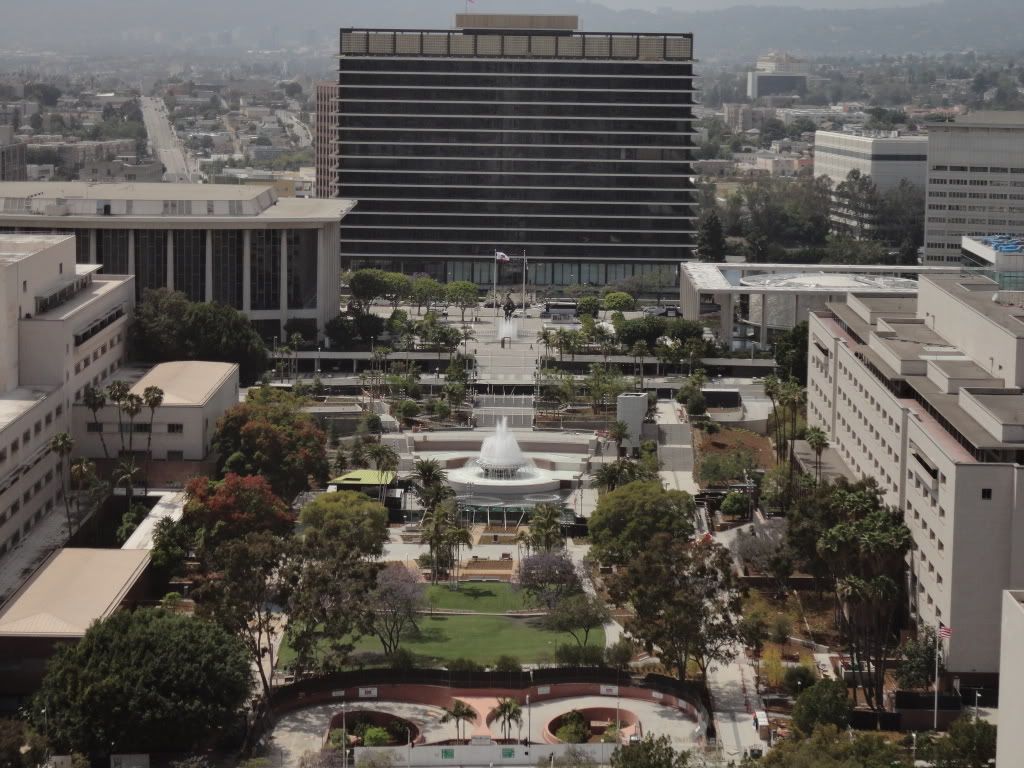
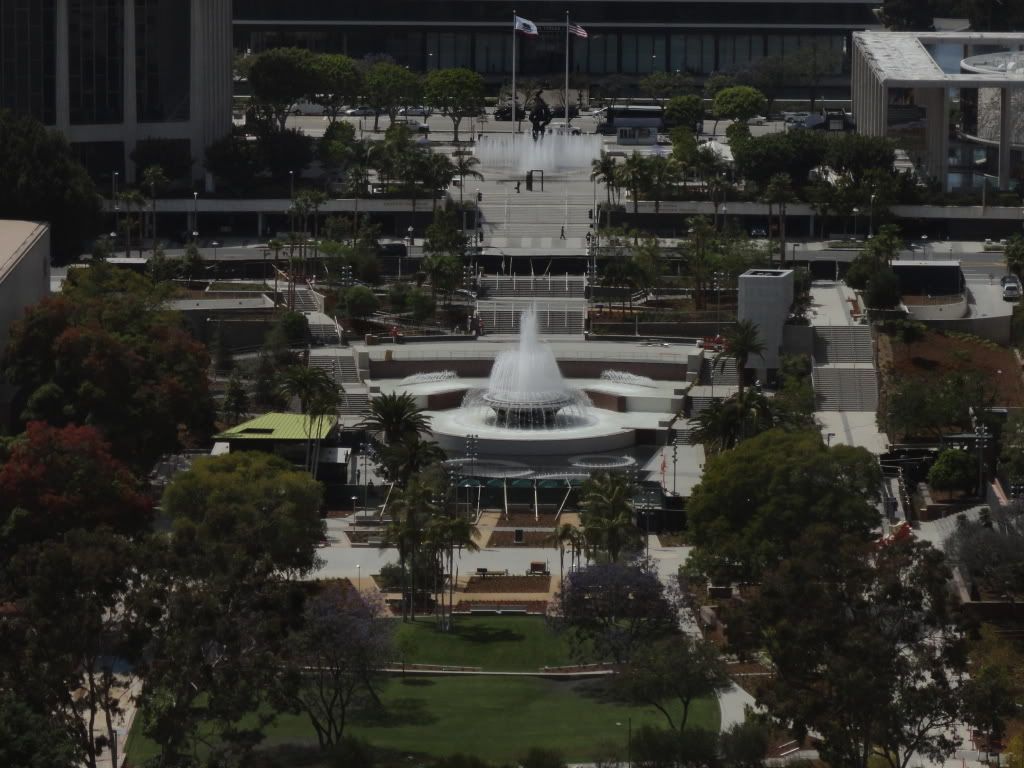


 parking lots are in the hood today & how many will still be there even when the new apt proj is completed.
  old masonry bldg containing a hooters restaurant & some other restaurant themed to knights in armor (or whatever) is located. That's the bldg that was remodeled not long ago, covered in

 that deadzone, esp since it was such a fugly foreground to one of the most well known bldgs in LA. as for the mall area farther west, I guess if one looks closely at the pic taken a few decades ago & the one shot recently, some of the walkways are a slight bit narrower, & there appears to be a bit more green space. Of course, even that was better than what used to sit there over 45 yrs ago....a
  big parking lot, & before that----from before the 1950s-----a lot of slummy bummy bldgs.


 Linear Mode
