HomeDiagramsDatabaseMapsForum About
     

Go Back   SkyscraperPage Forum > Regional Sections > Canada


Reply

 
Thread Tools Display Modes
     
     
  #241  
Old Posted Feb 12, 2012, 12:44 AM
eemy's Avatar
eemy eemy is offline
Closed account
 
Join Date: Aug 2006
Posts: 4,456
Those changes might make sense to you, but then you can no longer compare CMAs with each other since they are not based on a consistent set of criteria, they are basically just arbitrary boundaries based on someone's opinion.

Instead, what rules would you change?

Does anyone know whether it is possible to get more detailed commuting data?
Reply With Quote
     
     
  #242  
Old Posted Feb 12, 2012, 12:47 AM
isaidso isaidso is offline
North of Gilead
 
Join Date: Dec 2008
Location: North of Gilead
Posts: 11,007
Quote:
Originally Posted by eternallyme View Post
Looking at only the nine largest CMAs (those over 500,000), here IMO are the areas that should be added:

Toronto

Current population: 5,583,064
Recommended population: 6,115,020

Reason: Eliminate the Oshawa CMA and absorb into the Toronto CMA. Shift Burlington to the Toronto CMA from the Hamilton CMA. No other additions.

Hamilton

Current population: 721,053
Recommended population: 608,449

Reason: Remove Burlington (to Toronto CMA). Add Norfolk County.
I'd much rather have Oakville taken from the Toronto CMA and added to the Hamilton CMA. It's closer to Hamilton than Toronto.

Toronto
Current population: 5,583,064
Recommended population: 5,400,544


Hamilton
Current population: 721,053
Recommended population: 903,573
__________________
ELBOWS UP CANADA, ELBOWS UP UKRAINE, ELBOWS UP GREENLAND
CANADA, EUROPE, NZ, AUSTRALIA, JAPAN, MEXICO STRONG

US REPUBLICANS/MAGA/ICE NOT WELCOME HERE, STAY OUT

Last edited by isaidso; Feb 12, 2012 at 2:11 AM.
Reply With Quote
     
     
  #243  
Old Posted Feb 12, 2012, 1:41 AM
caltrane74's Avatar
caltrane74 caltrane74 is offline
gettin' rich!
 
Join Date: Aug 2002
Location: Toronto
Posts: 34,207
Snobs in Oakville doth protest having any association with Hamilton.
Reply With Quote
     
     
  #244  
Old Posted Feb 12, 2012, 1:48 AM
waterloowarrior's Avatar
waterloowarrior waterloowarrior is offline
National Capital Region
 
Join Date: Nov 2005
Location: Eastern Ontario
Posts: 9,252
Oakville commuting flow stats

in the 06 census out of 71k commuters:
37% worked in Oakville
25% worked in Toronto
23% worked in Mississauga
6% worked in Burlington
2% worked in Brampton
2% worked in Hamilton

For the 65k jobs in Oakville
40% lived in Oakville
16% lived in Missisauga
16% lived in Burlington
11% lived in Hamilton
5% lived in Toronto
3% lived in Brampton

http://www12.statcan.gc.ca/census-re...NAMEE=&VNAMEF=
Reply With Quote
     
     
  #245  
Old Posted Feb 12, 2012, 2:23 AM
Andrewjm3D's Avatar
Andrewjm3D Andrewjm3D is offline
Registered User
 
Join Date: Dec 2010
Posts: 1,702
I worked for Nelvana in Oakville, I hated every minute I was in that town. Nice historic area by the lake but everything north of the QEW is a suburban sprawling nightmare.
Reply With Quote
     
     
  #246  
Old Posted Feb 12, 2012, 3:19 AM
vid's Avatar
vid vid is offline
I am a typical
 
Join Date: Apr 2004
Location: Thunder Bay
Posts: 41,172
They have The Weather Network and Nelvana? Fan-cy!
Reply With Quote
     
     
  #247  
Old Posted Feb 12, 2012, 4:16 AM
eemy's Avatar
eemy eemy is offline
Closed account
 
Join Date: Aug 2006
Posts: 4,456
Thanks for drawing my attention to those tables waterloowarrior.

I did some quick analysis:

In 2006, Okotoks was *very* close to being included in the Calgary CMA. 48.5% of labour force of the combined Foothills municipalities worked in Calgary (needs to be 50%), and 23.9% of the people working in those municipalities commuted from Calgary (needs to be 25%). Granted, this was looking at the Calgary CSD - the delineation urban core is somewhat more specific, so the percentages of each of those is probably slightly less in actuality.

As for Burlington, more people work in Oakville, Mississauga, and Toronto than Hamilton, but by far most work in Burlington itself, so it would not be considered a part of any other CMA under the forward-commuting rule. Under the reverse commuting rule, 33.5% of the people working in Burlington live in Hamilton, so it clearly is a part of Hamilton's CMA under the reverse commuting rule.

As for the Oshawa CMA, about 65% of it's labour force works in Oshawa and about 78% of those working in Oshawa live in Oshawa. Based on the 35% rule for merging CAs and CMAs, that would mean that Oshawa would merge with Toronto were it not for the rule that CMAs cannot merge with each other. It, however, does not satisfy either the forward or reverse commuting rules.
Reply With Quote
     
     
  #248  
Old Posted Feb 12, 2012, 4:41 AM
eemy's Avatar
eemy eemy is offline
Closed account
 
Join Date: Aug 2006
Posts: 4,456
Maybe someone can verify the numbers for me, but I'm getting that a number of townships surrounding Ottawa should be included in its CMA under the forward commuting rule. Mississippi Mills, Beckwith, Carleton Place and North Grenville (possibly among others, the only other one I checked was Arnprior) all had greater than 50% commuting into the Ottawa CMA. In most cases, it was only a bit more than 50% of the population of those municipalities, but in the case of Beckwith Twp, it was 62%.

In the 2006 rules, they must be working within the delineation urban core in order to count for the forward commuting rule. I'm not entirely clear what constitutes the delineation urban core, but my understanding is that it would refer to the primary urban core of the municipality. In that case, I wonder if the fact that Kanata being classified as urban fringe means that people commuting into Ottawa, but working in Kanata do not count when tallying commuters for the forward-commuting rule. The fact that Kanata is a very large employment node means that those municipalities to the west of Ottawa are likely going to see more commuters working in Kanata than in the rest of the city. Anyone have any insight?
Reply With Quote
     
     
  #249  
Old Posted Feb 12, 2012, 5:15 AM
waterloowarrior's Avatar
waterloowarrior waterloowarrior is offline
National Capital Region
 
Join Date: Nov 2005
Location: Eastern Ontario
Posts: 9,252
Quote:
Originally Posted by jeremy_haak View Post
Maybe someone can verify the numbers for me, but I'm getting that a number of townships surrounding Ottawa should be included in its CMA under the forward commuting rule. Mississippi Mills, Beckwith, Carleton Place and North Grenville (possibly among others, the only other one I checked was Arnprior) all had greater than 50% commuting into the Ottawa CMA. In most cases, it was only a bit more than 50% of the population of those municipalities, but in the case of Beckwith Twp, it was 62%.

In the 2006 rules, they must be working within the delineation urban core in order to count for the forward commuting rule. I'm not entirely clear what constitutes the delineation urban core, but my understanding is that it would refer to the primary urban core of the municipality. In that case, I wonder if the fact that Kanata being classified as urban fringe means that people commuting into Ottawa, but working in Kanata do not count when tallying commuters for the forward-commuting rule. The fact that Kanata is a very large employment node means that those municipalities to the west of Ottawa are likely going to see more commuters working in Kanata than in the rest of the city. Anyone have any insight?
I wonder if that is the case... here are some of the rules from
http://www12.statcan.ca/census-recen...eo049a-eng.cfm

The delineation rules for population centres (POPCTR) are ranked in order of priority:

1. The 2006 urban areas are retained as 2011 population centres if their current population is 1,000 or more. Kanata stays as a population centre
2. If a dissemination block with a population density of at least 400 persons per square kilometre is adjacent to a population centre, then it is added to that population centre. Greenbelt keeps Kanata/Ottawa separate
3. If a dissemination block or group of contiguous dissemination blocks, each having a minimum population of 1,000 and a population density of at least 400 persons per square kilometre for the current census, then the dissemination block or group of contiguous dissemination blocks is delineated as a new population centre. N/A
4. The distance by road between population centres is measured. If the distance is less than two kilometres, then the population centres are combined to form a single population centre, provided they do not cross census metropolitan area (CMA) or census agglomeration (CA) boundaries. Kanata is less than 2KM from Ottawa population centre as the crow flies... but not by road (based on a few test measurements I did)
5. If a population centre is contained within a census subdivision (CSD) or a designated place (DPL), the difference in land area between the population centre and the CSD or DPL is calculated. For confidentiality purposes, if the difference between the CSD and the population centre is less than 10 square kilometres, then the boundary for the population centre is adjusted to the CSD boundary. However, if the difference between the DPL and the population centre is less than 10 square kilometres and the remaining population is less than 100, then the population centre will annex the entire DPL. Greenbelt means it will be more than 10KM^2
Reply With Quote
     
     
  #250  
Old Posted Feb 12, 2012, 5:52 AM
trebor204's Avatar
trebor204 trebor204 is offline
Registered User
 
Join Date: Apr 2010
Posts: 761
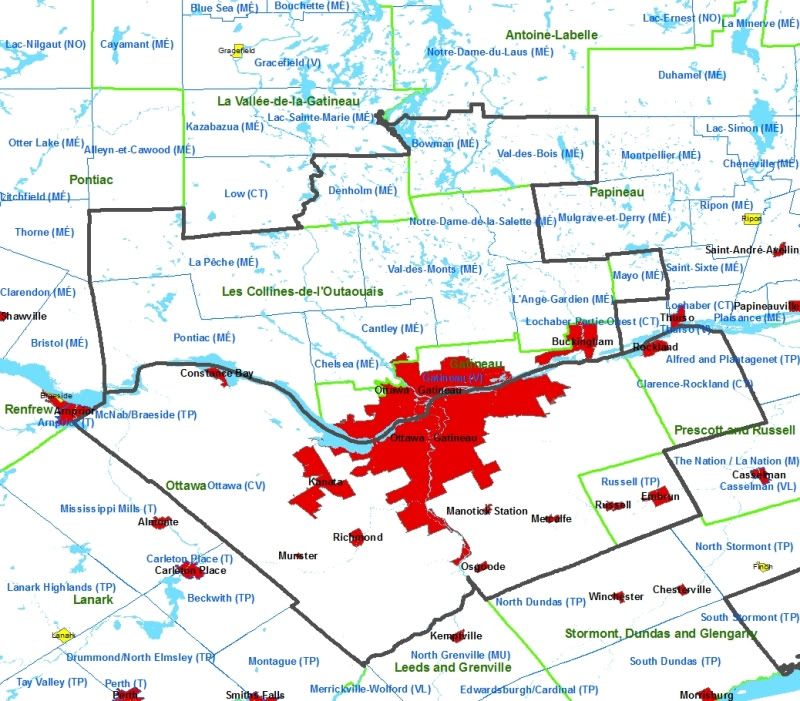
Here is a map of the Ottawa CMA (large grey Outline) (Created Using ArcMap with Shapefiles from StatsCan)
The map is a bit crowded


Red Regions - Population Centres
Black Bold Text - Name of Popilation Centres

Green Outline - Census Division
Green Text - Name of CD

Blue Outline - Census Subdivision
Blue Text - Name of CSD

Yellow Regions - Designated Places
Reply With Quote
     
     
  #251  
Old Posted Feb 12, 2012, 6:01 AM
dennis1 dennis1 is offline
Registered User
 
Join Date: Sep 2007
Posts: 1,253
Quote:
Originally Posted by jeremy_haak View Post
Those changes might make sense to you, but then you can no longer compare CMAs with each other since they are not based on a consistent set of criteria, they are basically just arbitrary boundaries based on someone's opinion.

Instead, what rules would you change?

Does anyone know whether it is possible to get more detailed commuting data?
They change their Metro Data in the US. The Standards for last years census are not the same as in 1990. Canada can do this. Or is Statistics Canada lazy?
Reply With Quote
     
     
  #252  
Old Posted Feb 12, 2012, 6:03 AM
Razor Razor is offline
Registered User
 
Join Date: Jul 2011
Location: Ottawa
Posts: 2,998
Quote:
Originally Posted by jeremy_haak View Post
We'll have to wait two more years to see what the undercounts were, but in the meantime, Statistics Canada recommends using the estimates as they are a more accurate representation of population. In that sense, I think we can legitimately say that Calgary has surpassed Ottawa in population, even if the preliminary results from the census don't reflect that.
Nah..The only thing you can "legitimately say" are quoted numbers from the Stats Canada website. Until those numbers change, it's pure speculation as far as I'm concerned..Sure, there's going to be undercount adjustments made for all cities, but until it changes on their records it's all we can go on.
Reply With Quote
     
     
  #253  
Old Posted Feb 12, 2012, 6:19 AM
jmt18325's Avatar
jmt18325 jmt18325 is offline
Heart of the Continent
 
Join Date: Apr 2009
Location: Winnipeg
Posts: 7,286
The estimates are also stats Canada numbers...numbers that they seem to trust.
Reply With Quote
     
     
  #254  
Old Posted Feb 12, 2012, 8:19 AM
isaidso isaidso is offline
North of Gilead
 
Join Date: Dec 2008
Location: North of Gilead
Posts: 11,007
Quote:
Originally Posted by vid View Post
They have The Weather Network and Nelvana? Fan-cy!
They also have the Canadian headquarters for Ford and they have Glenn Abbey, home to the Canadian Open. It may be boring, but it's one of the most wealthiest cities in the country.
__________________
ELBOWS UP CANADA, ELBOWS UP UKRAINE, ELBOWS UP GREENLAND
CANADA, EUROPE, NZ, AUSTRALIA, JAPAN, MEXICO STRONG

US REPUBLICANS/MAGA/ICE NOT WELCOME HERE, STAY OUT
Reply With Quote
     
     
  #255  
Old Posted Feb 12, 2012, 9:26 AM
Andrewjm3D's Avatar
Andrewjm3D Andrewjm3D is offline
Registered User
 
Join Date: Dec 2010
Posts: 1,702
Quote:
Originally Posted by isaidso View Post
They also have the Canadian headquarters for Ford and they have Glenn Abbey, home to the Canadian Open. It may be boring, but it's one of the most wealthiest cities in the country.
Well Nelvana is no more (in Oakville that is). I bailed before they closed their small studio at Sheridan Campus. Now it's a lame studio called Pipeline leeching off the college for cheap inexperienced labour.
Reply With Quote
     
     
  #256  
Old Posted Feb 12, 2012, 11:39 AM
Phil McAvity Phil McAvity is offline
BANNED
 
Join Date: Nov 2006
Location: Victoria
Posts: 3,622
Quote:
Originally Posted by vid View Post
Because Fort MacMurray is just one small part of the Municipality of Wood Buffalo. It would be like calling Ontario "Toronto".
No, that's not the same thing. Do you understand the difference between a regional municipality and a consolidated metropolitan area? A CMA is a city and it's surrounding municipalities while a regional municipality is more like a suburb. In this thread we're discussing consolidated metropolitan areas like Toronto, Lethbridge and Halifax. Wood Buffalo is a regional municipality, of which Fort McMurray is part of, yet Wood Buffalo is on this list as a CMA. As far as I know Fort McMurray is the sole source of population in Wood Buffalo, which means that for the purposes of the census, Wood Buffalo and Fort McMurray are the exact same thing, yet rather than calling the city Fort McMurray, for reasons I highly doubt I will ever understand, the census continues to refer to it as Wood Buffalo.

Maybe someone can state this in simpler terms for Vid because i'm quite confident he won't get this.
Reply With Quote
     
     
  #257  
Old Posted Feb 12, 2012, 1:17 PM
mbeaumont mbeaumont is offline
Registered User
 
Join Date: Nov 2006
Location: Quebec city
Posts: 96
Quote:
Originally Posted by Phil McAvity View Post
As far as I know Fort McMurray is the sole source of population in Wood Buffalo
Anzac, Conklin, Draper, Fort Mackay, Fort Chipewyan, Janvier to name a few are other sources of population in the regional municipality
Reply With Quote
     
     
  #258  
Old Posted Feb 12, 2012, 2:26 PM
eemy's Avatar
eemy eemy is offline
Closed account
 
Join Date: Aug 2006
Posts: 4,456
Quote:
Originally Posted by Razor View Post
Nah..The only thing you can "legitimately say" are quoted numbers from the Stats Canada website. Until those numbers change, it's pure speculation as far as I'm concerned..Sure, there's going to be undercount adjustments made for all cities, but until it changes on their records it's all we can go on.
I suggest reading what Statistics Canada says on the matter, since they're the ones conducting the actual census. The population estimates are quoted numbers from Statistics Canada and "provide a more accurate measure of population counts."
http://www.statcan.gc.ca/hp-pa/estima-eng.htm

Quote:
Originally Posted by Phil McAvity View Post
No, that's not the same thing. Do you understand the difference between a regional municipality and a consolidated metropolitan area? A CMA is a city and it's surrounding municipalities while a regional municipality is more like a suburb. In this thread we're discussing consolidated metropolitan areas like Toronto, Lethbridge and Halifax. Wood Buffalo is a regional municipality, of which Fort McMurray is part of, yet Wood Buffalo is on this list as a CMA. As far as I know Fort McMurray is the sole source of population in Wood Buffalo, which means that for the purposes of the census, Wood Buffalo and Fort McMurray are the exact same thing, yet rather than calling the city Fort McMurray, for reasons I highly doubt I will ever understand, the census continues to refer to it as Wood Buffalo.

Maybe someone can state this in simpler terms for Vid because i'm quite confident he won't get this.
Statistics Canada has methodology for everything, and as it turns out, that includes the naming of a CMA/CA. It is outlined here: http://www12.statcan.gc.ca/census-re...geo009-eng.cfm

The CA/CMA derives its name from the principal population centre in the municipality. It could be possible to request the name be changed to something like Wood Buffalo-Fort McMurray with the consensus of all municipalities, but as long as the municipality is Wood Buffalo, the first part will stick.

As others have noted, Wood Buffalo is not unique in this regard. Saguenay, Cape Breton, Kawartha Lakes, Norfolk, Centre Wellington, and Temiskaming Shores are also examples of CAs that do not share a name with their better known population centres (Chicoutimi/Jonquire, Sydney, Lindsay, Simcoe, Elora/Fergus, and New Liskeard respectively).
Reply With Quote
     
     
  #259  
Old Posted Feb 12, 2012, 4:00 PM
vid's Avatar
vid vid is offline
I am a typical
 
Join Date: Apr 2004
Location: Thunder Bay
Posts: 41,172
Quote:
Originally Posted by Phil McAvity View Post
No, that's not the same thing.
You're right. The more accurate comparison would be calling the Ville de Saguenay "Chicoutimi" or "Jonquiere".

Quote:
Originally Posted by Phil McAvity View Post
Do you understand the difference between a regional municipality and a consolidated metropolitan area? A CMA is a city and it's surrounding municipalities while a regional municipality is more like a suburb.
Census Metropolitan Area. A CMA is a statistical division used by Statistics Canada to explain relationships of large cities with their surrounding municipalities. It is not a form of government.

A regional municipality is a form of local government that provides services to a large area with multiple communities in it, and it may or may not have other municipalities below it. Examples include Greater Sudbury, Ottawa and pre-amalgamation Metropolitan Toronto.

Quote:
Originally Posted by Phil McAvity View Post
In this thread we're discussing consolidated metropolitan areas like Toronto, Lethbridge and Halifax. Wood Buffalo is a regional municipality, of which Fort McMurray is part of, yet Wood Buffalo is on this list as a CMA. As far as I know Fort McMurray is the sole source of population in Wood Buffalo, which means that for the purposes of the census, Wood Buffalo and Fort McMurray are the exact same thing, yet rather than calling the city Fort McMurray, for reasons I highly doubt I will ever understand, the census continues to refer to it as Wood Buffalo.
Toronto, Lethbridge, Halifax, and Wood Buffalo are all incorporated local governments. Their proper names, respectively, are "City of Toronto", "City of Lethbridge", "Regional Municipality of Halifax" and "Regional Municipality of Wood Buffalo". They are all CSDs—Census Subdivisions. The census refers to the Regional Municipality of Wood Buffalo because that is the proper, legal name for that government entity. Statistics Canada doesn't refer to Thunder Bay as "Lakehead", so why should it refer to Wood Buffalo as "Fort McMurray"?

You want the population for Fort McMurray itself? Here it is: the population for the Population Centre (formerly known as Urban Area) of Fort McMurray, Alberta. It has 61,374, contrasted to Wood Buffalo's 65,565 people.

If you want Wood Buffalo's name changed to Fort McMurray, then don't complain to Statistics Canada about it. Complain to the Alberta Government, which gave the community that name when it was created in 1995.

Quote:
Originally Posted by Phil McAvity View Post
Maybe someone can state this in simpler terms for Vid because i'm quite confident he won't get this.
Insulting other forumers, as well as creating new profiles to continue posting here after you've been banned, are both against forum rules. I'm surprised you've managed to last this long.

Reply With Quote
     
     
  #260  
Old Posted Feb 12, 2012, 5:09 PM
Razor Razor is offline
Registered User
 
Join Date: Jul 2011
Location: Ottawa
Posts: 2,998
[QUOTE=jeremy_haak;5587920]I suggest reading what Statistics Canada says on the matter, since they're the ones conducting the actual census. The population estimates are quoted numbers from Statistics Canada and "provide a more accurate measure of population counts."
http://www.statcan.gc.ca/hp-pa/estima-eng.htmQUOTE]

So what are you saying ?...It's simple really.."Official" population satistics are found on the stats can site, and people can't speculate nor can cities conduct their own "un-official" censuses every year.Once every 5 years the federal government conducts a detailed census where everyone must participate.The results then gets put into record and then these counts are posted on their web-site..Subsequently, in about two years an adjustment will be made for an undercount..This updated figure will then be released to the public. Until the next census or adjustment, no figures should be taken as gospel on any forums etc. until the next census, or adjutment figures are released. Black and white really. Any number that is posted by someone on this forum that isn't a reflection of the government count is just speculation really.I also noticed that Wikipedia already has the new 2011 official numbers up now, and they are pretty good at mirroring "official" results.
Reply With Quote
     
     
This discussion thread continues

Use the page links to the lower-right to go to the next page for additional posts
 
 
Reply

Go Back   SkyscraperPage Forum > Regional Sections > Canada
Forum Jump


Forum Jump


All times are GMT. The time now is 9:40 PM.

     
SkyscraperPage.com - Privacy Statement - Top

Powered by vBulletin® Version 3.8.7
Copyright ©2000 - 2026, vBulletin Solutions, Inc.