HomeDiagramsDatabaseMapsForum About
     

Go Back   SkyscraperPage Forum > Discussion Forums > City Discussions


Reply

 
Thread Tools Display Modes
     
     
  #21  
Old Posted Feb 9, 2012, 9:14 AM
babybackribs2314 babybackribs2314 is offline
Registered User
 
Join Date: Apr 2006
Location: UWS, Manhattan
Posts: 1,726
Funny that Washington-Baltimore and Toronto-Hamilton are almost the exact same size (Washington's 2010 MSA had 5.6 million, same as Toronto's this year, while both 'greater' regions having 8.7 million). The differences in terms of skyline are quite stark.
Reply With Quote
     
     
  #22  
Old Posted Feb 9, 2012, 11:57 AM
glowrock's Avatar
glowrock glowrock is offline
Becoming Chicago-fied!
 
Join Date: Dec 2002
Location: Chicago (West Avondale)
Posts: 19,443
Quote:
Originally Posted by memph View Post
Actually Ajax (and Pickering) are officially considered part of Toronto's CMA. Oshawa's CMA is Oshawa, Whitby and Clarington (mostly the communities of Bowmanville, Courtice, Newcastle and Darlington).
Thanks for the clarification, memph. Heck, I wasn't really too far off, at least!

Also, to babybackribs, can we please not devolve this thread into a skylines issue?

Aaron (Glowrock)
__________________
"Deeply corrupt but still semi-functional - it's the Chicago way." -- Barrelfish
Reply With Quote
     
     
  #23  
Old Posted Feb 9, 2012, 2:25 PM
miketoronto miketoronto is offline
Registered User
 
Join Date: Jul 2001
Location: Toronto, Ontario, Canada
Posts: 9,932
Quote:
Originally Posted by caltrane74 View Post
This explains why Downtown Toronto seems so crowded and bustling. Thank god people are moving downtown, the stress on the subways and transit should be alleviated because of this.
Actually the numbers for downtown Toronto just put it slightly over its peak population which I think peaked in the 60's or 70's, if I remember correctly from the report on downtown Toronto done for the city a few years ago.
__________________
Miketoronto

Last edited by miketoronto; Feb 9, 2012 at 5:55 PM.
Reply With Quote
     
     
  #24  
Old Posted Feb 9, 2012, 2:55 PM
OhioGuy OhioGuy is offline
Registered User
 
Join Date: Jul 2004
Location: DC
Posts: 7,772
Vancouver faces mild population growth while Tri-Cities and Surrey boom

Quote:
Metro Vancouver continues to lure new migrants and suck residents from B.C’s rural towns, but it appears most people are skipping Vancouver in favour of settling in the Tri-Cities or neighbourhoods south of the Fraser.

Port Moody, Coquitlam and Surrey were the fastest-growing communities in the 2011 Census, with some neighbourhoods in those cities doubling or tripling their population between 2006 and 2011, according to data released Wednesday.

Port Moody experienced 19.9-per-cent growth during this five-year period, followed by Surrey with 18.6 per cent. Vancouver’s growth rate, meanwhile, sat at 4.4 per cent, with population increases concentrated in its downtown core, Mount Pleasant and Fairview.

While growth was more vigorous than expected in the Tri-Cities, it is consistent with the regional growth strategy, which calls for development to be centred along transit corridors and town centres.
Quote:
The Tri-Cities also took a hefty chunk of the growth in Port Moody and Coquitlam Town Centre, where the land was already zoned and ready, based on a promise that it would receive the Evergreen Line. Port Moody’s 19.9-per-cent growth took place despite a no-growth policy implemented in 2009.

“When we were saying zero to minimal growth we were still taking all these people from previous developments that had already been approved,” said Port Moody Mayor Mike Clay. “It was part of the plan. The part that was missing was the rapid transit line.”

A similar phenomenon was seen in the mid-1990s when Richmond experienced huge growth while expecting the Canada line. This growth slowed near 2000 but picked up again once the line finally went ahead, bringing an economic boom for the city, said Richmond Mayor Malcolm Brodie.

Richmond, which saw an 9.2-per-cent increase in population from 2006-2011, has one of the highest jobs-to-worker ratios, with one-and-a-half jobs for every worker, Brodie said, as well as diverse industries and an educated workforce.
Reply With Quote
     
     
  #25  
Old Posted Feb 9, 2012, 3:37 PM
dennis1 dennis1 is offline
Registered User
 
Join Date: Sep 2007
Posts: 1,253
Quote:
Originally Posted by miketoronto View Post
Its all based on commuter percentages. If enough people don't commute into the core city, they are not considered part of the metro region. Which explains why Oshawa is not part of Toronto's metro region, but is part of the GTA.

Toronto's inner city population is now approaching the 1 million mark, with about 990,000 residents in about 54.6 sq miles. Not bad
That includes the old Toronto, East York, and York.
Really Mike? Everyone from Oshawa that I know of works in Toronto. Oshawa, you either are at the GM plant or in Downtown.
Reply With Quote
     
     
  #26  
Old Posted Feb 9, 2012, 4:58 PM
flar's Avatar
flar flar is offline
..........
 
Join Date: Jan 2006
Location: Southwestern Ontario
Posts: 15,740
^^I think you are really overestimating the number of people who commute into Toronto. There are many major employment centres throughout the GTA.
__________________
RECENT PHOTOS:
TORONTOSAN FRANCISCO ROCHESTER, NYHAMILTONGODERICH, ON WHEATLEY, ONCOBOURG, ONLAS VEGASLOS ANGELES
Reply With Quote
     
     
  #27  
Old Posted Feb 9, 2012, 5:31 PM
isaidso isaidso is offline
North of Gilead
 
Join Date: Dec 2008
Location: North of Gilead
Posts: 11,067
Quote:
Originally Posted by miketoronto View Post
Actually the numbers for downtown Toronto just put it slightly over its peak population which I think peaked in the 60's or 70's, If i remember correctly from the report on downtown Toronto done for the city a few years ago.
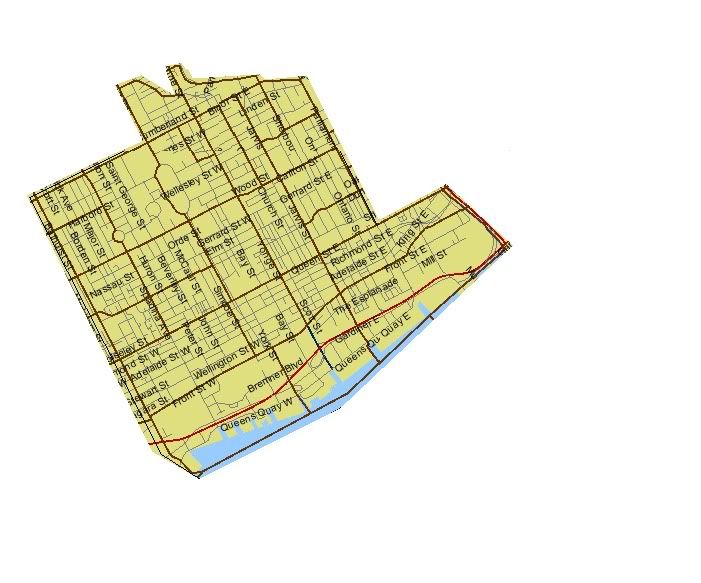
I consider this to be downtown:


Was it really at 175,000 back in the 60s? Another 10 years of growth like the last 5 years, and this area would pass 300,000 people. We'd have nice busy streets by then. I'm also surprised how many more people live in downtown Toronto vs downtown Vancouver. Are they comparable in area?

Quote:
Originally Posted by J. Will View Post
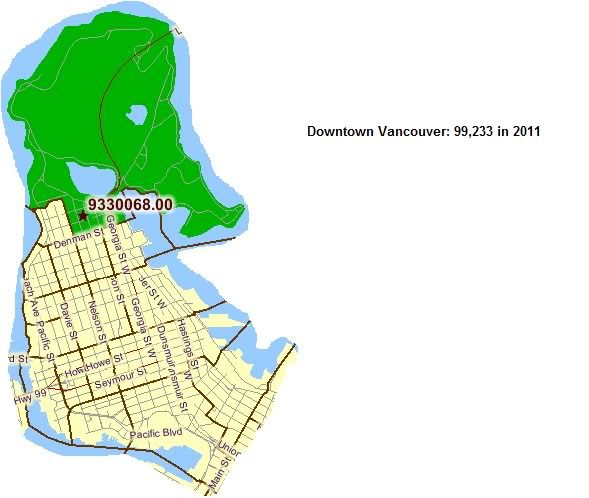
Downtown Vancouver had 99,233 people in 2011:

__________________
ELBOWS UP CANADA, ELBOWS UP UKRAINE, ELBOWS UP GREENLAND
CANADA, EUROPE, NZ, AUSTRALIA, JAPAN, MEXICO STRONG

US REPUBLICANS/MAGA/ICE NOT WELCOME HERE, STAY OUT

Last edited by isaidso; Feb 9, 2012 at 5:49 PM.
Reply With Quote
     
     
  #28  
Old Posted Feb 9, 2012, 5:51 PM
Chicago103's Avatar
Chicago103 Chicago103 is offline
Future Mayor of Chicago
 
Join Date: Mar 2003
Location: Chicago
Posts: 6,062
Quote:
Originally Posted by J. Will View Post
City, 2011 population (2006 population), % growth

Toronto, 2,615,060 (2,503,281), 4.5
So the city of Toronto is only 80,538 less than the population of the city of Chicago and Toronto's land area is only slightly bigger, that translates to Toronto only having about 1,000 less people per square mile than Chicago. That is pretty impressive given how suburban parts of the greater city of Toronto are, of course there are more highrises in the suburban areas of Toronto than bungalow belts of Chicago.
Reply With Quote
     
     
  #29  
Old Posted Feb 9, 2012, 5:59 PM
miketoronto miketoronto is offline
Registered User
 
Join Date: Jul 2001
Location: Toronto, Ontario, Canada
Posts: 9,932
That translates basically into what the city considers downtown as well.

Yep downtown Toronto's population has always been high.
Downtown living is hardly a new thing for Toronto.
We had busy streets and continue to have them regardless of residents. Because it is not the residents that animate most of downtown. It is the 900,000 people who come into the downtown core each day who do.

Quote:
Originally Posted by isaidso View Post
I consider this to be downtown:


Was it really at 175,000 back in the 60s? Another 10 years of growth like the last 5 years, and this area would pass 300,000 people. We'd have nice busy streets by then. I'm also surprised how many more people live in downtown Toronto vs downtown Vancouver. Are they comparable in area?
__________________
Miketoronto
Reply With Quote
     
     
  #30  
Old Posted Feb 9, 2012, 6:02 PM
miketoronto miketoronto is offline
Registered User
 
Join Date: Jul 2001
Location: Toronto, Ontario, Canada
Posts: 9,932
Quote:
Originally Posted by dennis1 View Post
Really Mike? Everyone from Oshawa that I know of works in Toronto. Oshawa, you either are at the GM plant or in Downtown.

It is not as many as you may think. Oshawa really is the "core" city of the east. I have family who live out in Clarington, and Oshawa is like the "big city" for them. A day out is going to Oshawa, not Toronto.
So I can understand why the areas are considered separate.
We may be connected by seamless development. But at the end of the day, the residents do not interact as one city.

Just like Toronto and Hamilton. Seamless development. But a very small number of Hamilton people go into Toronto on a daily basis. And even fewer Toronto people have ever been to Hamilton.

It would be interesting to see how things would unfold though with the continued suburbanization of jobs. What if we hit a point where so few suburbanites commute into the core city, that they themselves fall below the % of commuters needed to make a town part of a metro area.
Could we lose metro areas?
__________________
Miketoronto
Reply With Quote
     
     
  #31  
Old Posted Feb 9, 2012, 6:20 PM
LeftCoaster's Avatar
LeftCoaster LeftCoaster is offline
Moderator
 
Join Date: Nov 2005
Location: Toroncouver
Posts: 13,139
Quote:
Originally Posted by isaidso View Post
I consider this to be downtown:


Was it really at 175,000 back in the 60s? Another 10 years of growth like the last 5 years, and this area would pass 300,000 people. We'd have nice busy streets by then. I'm also surprised how many more people live in downtown Toronto vs downtown Vancouver. Are they comparable in area?
No the area show above is much larger than downtown Vancouver.

DT Toronto is about 3.4km x 3.4km or about 11.5 sqkm

DT Vancouver is about 3km x 1.8km at its widest, and since it is oval in shape would be smaller than the implied 5.4 sqkm
Reply With Quote
     
     
  #32  
Old Posted Feb 9, 2012, 7:33 PM
dennis1 dennis1 is offline
Registered User
 
Join Date: Sep 2007
Posts: 1,253
Quote:
Originally Posted by flar View Post
^^I think you are really overestimating the number of people who commute into Toronto. There are many major employment centres throughout the GTA.
I probably am. I though less people from Oakville worked in the core then Oshawa but I guess I am wrong.

Quote:
Originally Posted by miketoronto View Post
It is not as many as you may think. Oshawa really is the "core" city of the east. I have family who live out in Clarington, and Oshawa is like the "big city" for them. A day out is going to Oshawa, not Toronto.
So I can understand why the areas are considered separate.
We may be connected by seamless development. But at the end of the day, the residents do not interact as one city.

Just like Toronto and Hamilton. Seamless development. But a very small number of Hamilton people go into Toronto on a daily basis. And even fewer Toronto people have ever been to Hamilton.

It would be interesting to see how things would unfold though with the continued suburbanization of jobs. What if we hit a point where so few suburbanites commute into the core city, that they themselves fall below the % of commuters needed to make a town part of a metro area.
Could we lose metro areas?

Clarington... I know people from there that work in Toronto as well. But your point is taken. The Suburbanization of jobs is a two headed shark. On one part, less time driving = less polution, otherwise More mcmansions because you have to build around employment centers.
Reply With Quote
     
     
  #33  
Old Posted Feb 9, 2012, 8:55 PM
niwell's Avatar
niwell niwell is offline
sick transit, gloria
 
Join Date: Nov 2004
Location: Roncesvalles, Toronto
Posts: 11,628
It's very impressive that the City of Toronto grew by over 110,000. And likely more than that once undercount is corrected for. That's virtually all through intensification.
Reply With Quote
     
     
  #34  
Old Posted Feb 9, 2012, 10:11 PM
memph memph is offline
Registered User
 
Join Date: Dec 2010
Posts: 1,855
Downtown Vancouver (the peninsula) is about 3.75 square miles.

It grew considerably less than downtown Toronto though, from 87,973 people in 2006 to 99,233 people in 2011, or an increase of 12.8%. Some parts of the West Side actually decreased in population. Still a decent increase overall though.
Reply With Quote
     
     
  #35  
Old Posted Feb 9, 2012, 11:13 PM
miketoronto miketoronto is offline
Registered User
 
Join Date: Jul 2001
Location: Toronto, Ontario, Canada
Posts: 9,932
Quote:
Originally Posted by dennis1 View Post
I probably am. I though less people from Oakville worked in the core then Oshawa but I guess I am wrong.
Actually Oakville would have more commuters to Toronto, as Oakville residents are the type that would work at King & Bay.

In fact if you look up Oakville, they have one of the highest transit usage rates for work trips in the 905, with 20% of commuters using transit. That actually may be the highest in the 905, and it stems from so many of them working in downtown Toronto and taking GO Transit.

Oshawa residents I would say tend to commute more to Scarborough if they are coming into Toronto. They are more of the blue collar industrial type.

But still the majority work out in the Oshawa area.
__________________
Miketoronto
Reply With Quote
     
     
  #36  
Old Posted Feb 10, 2012, 1:51 AM
J. Will J. Will is offline
BANNED
 
Join Date: Nov 2005
Posts: 3,882
Mississauga now has about the same population as Detroit city (713,000). And Mississauga is only 111 square miles. Detroit is 139 square miles.
Reply With Quote
     
     
  #37  
Old Posted Feb 10, 2012, 2:46 AM
dennis1 dennis1 is offline
Registered User
 
Join Date: Sep 2007
Posts: 1,253
Quote:
Originally Posted by miketoronto View Post
Actually Oakville would have more commuters to Toronto, as Oakville residents are the type that would work at King & Bay.

In fact if you look up Oakville, they have one of the highest transit usage rates for work trips in the 905, with 20% of commuters using transit. That actually may be the highest in the 905, and it stems from so many of them working in downtown Toronto and taking GO Transit.

Oshawa residents I would say tend to commute more to Scarborough if they are coming into Toronto. They are more of the blue collar industrial type.

But still the majority work out in the Oshawa area.
Of course. Oakville is richy rich and Oshawa is a factory town.
Reply With Quote
     
     
End
 
 
Reply

Go Back   SkyscraperPage Forum > Discussion Forums > City Discussions
Forum Jump


Forum Jump


All times are GMT. The time now is 10:23 AM.


Powered by vBulletin® Version 3.8.7
Copyright ©2000 - 2026, vBulletin Solutions, Inc.