Quote:
Originally Posted by SnyderBock

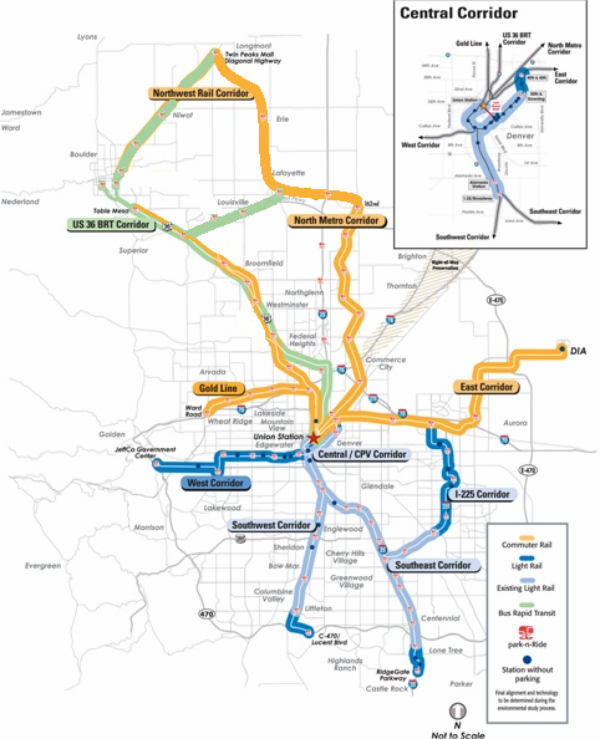
1.) To to use the BRT to "feed" passengers into the EMU stations
2.) Use the BRT as a Boulder hubbed system, feeding commuters in and out of Boulder, and the US 36 Rail as a Denver hubbed system to feed commuters in and out of Denver.
3.) Transform the US 36 corridor, into a truely multi-model transportation corridor.
|
Multi-modal only works if the modes are doing different things. What you're saying makes no sense.
If we move away from the BNSF, the only right of way available is US 36 (or else way out of our budget). The BRT is, obviously, going to be in the US 36 ROW. If they are running next to each other, they are competing modes. That's insane.
If you just want to run rail to Boulder, then BRT from there, fine, done right, I could get on board with that. But then you have four problems that I see:
(1) the political problem - Longmont gets the shaft,
(2) the easiest right of way is actually the Boulder-Longmont segment, which reinforces problem (1),
(3) The other L-towns (where a lot of traffic to Boulder originates) are not directly along US 36 and also get the shaft - the whole reason for the split in the first place was the political compromise; the camel, and
(4) the forced transfer massively lowers new ridership. All Longmont is getting at that point is, at best, slight improvements to what they already have, which is pretty damn good bus service throughout Boulder County (if everybody up there gets the same thing, it might be more politically tenable).
And even then, US 36 rail is still much more expensive than the current option.
If we're going back to that and re-evaluating, then in comparison between US 36 rail and US 36 BRT, BRT will win, hands down. That is an
ideal BRT corridor, for a number of reasons:
(1) it is already an incredibly strong bus corridor,
(2) if your rail option in confined to a highway right-of-way, especially a park-n-ride based one, your ridership advantage using rail technology is almost nullified, and
(3) most importantly, you are forcing a transfer in Boulder. BRT would be a one-seat ride.
Factor (3) alone would put BRT over the top (
real BRT - forget this off-ramp stuff, if we're re-evaluating from the start, then we have budget to go back to the real BRT option).
That's why we got the compromise we got. Because for ego ans sex appeal reason, folks up there wanted a train. And the only way the train made any sense at all was to use the existing rail right-of-way.
I emphasize, real BRT. You may not have ever seen real BRT. But done right, it's actually quite nice. Even preferable, in my opinion, to a diesel commuter rail.
This is how a one-seat ride from Denver to Downtown Boulder/East Boulder/Longmont/etc. could work in the highway ROW (you could even run once hourly direct buses to Lafayette, Louisville, etc. if you wanted, and if that sold the deal politically). Not my best pictures ever, but here:

Regular platforms:


In a station:

In the city (ideal, but unnecessary in Boulder/Longmont):


Wayfinding, just like a train:


Vehicles - this is very basic, could use this, have a mix (local/express), or go much nicer:

Alas, I think it's probably too little too late. Nobody is realistically going to reevaluate the US 36 corridor now. Which is a shame. May break Fastracks II at the ballot, who knows. If we're willing to lay off thousands of teachers after a rather tame opposition to a tax hike (last year's election), we'll certainly vote down an arguably bad transit hike (resulting from arguably poor management of the first tax hike) that will face fierce nasty opposition.





 Prev
Prev







 Linear Mode
