HomeDiagramsDatabaseMapsForum About
     

Go Back   SkyscraperPage Forum > Regional Sections > United States > Mountain West


Reply

 
Thread Tools Display Modes
     
     
  #2521  
Old Posted Aug 12, 2011, 2:51 PM
Cirrus's Avatar
Cirrus Cirrus is offline
cities|transit|croissants
 
Join Date: Jul 2001
Location: Washington, DC
Posts: 18,718
It annoys me that we're calling that a cycle track. It's about as good as a cycle track, but it's not one.

It's sort of like when people call DMUs "light rail," except this time apparently it's the city endorsing the wrong term rather than the uninformed public.
Reply With Quote
     
     
  #2522  
Old Posted Aug 12, 2011, 3:35 PM
DenverInfill's Avatar
DenverInfill DenverInfill is offline
mmmm... infillicious!
 
Join Date: Jan 2004
Location: Lower Highland, Denver
Posts: 3,357
From what I find on the internet, it meets the definition of a cycle track. From bicyclinginfo.org:

"Cycle tracks, also known as sidepaths, are separated bicycle facilities that run alongside a roadway. Unlike bike lanes, cycle tracks are typically separated from automobile traffic by a physical barrier, such as parked cars, bollards, a landscaped buffer, or a curb. Cycle tracks may be one-way running with traffic, one-way running against traffic, two-way on the same side of the road, or two-way on both sides of the road."

And from what looks like a pretty comprehensive PDF document about cycle tracks at AltaPlanning.com:

"A cycle track is an exclusive bicycle facility that combines the user experience of a separated path with the on-street infrastructure of a conventional bike lane. Cycle tracks have different forms, but all share common elements. Cycle tracks provide space that is intended to be exclusively or primarily for bicycles, and are separated from vehicle travel lanes, parking lanes and sidewalks. Cycle tracks can be either one-way or two-way, on one or both sides of a street, and are separated from vehicles and pedestrians by pavement markings or coloring, bollards, curbs/medians or a combination of these elements."

But rather than splitting hairs over a technical definition, this new bike facility on Bannock is a nice improvement and, along with all the new and proposed bike lanes in downtown, plus additional (and much needed) better signage, we are making good progress in Denver.

Reply With Quote
     
     
  #2523  
Old Posted Aug 12, 2011, 3:39 PM
Cirrus's Avatar
Cirrus Cirrus is offline
cities|transit|croissants
 
Join Date: Jul 2001
Location: Washington, DC
Posts: 18,718
Does Black Hawk count as "Denver area"?

Quote:
Originally Posted by Streetsblog
Cyclists Take Black Hawk Bike-Ban Case to Colorado Supreme Court
http://streetsblog.net/2011/08/12/cyclists-take-black-hawk-bike-ban-case-to-colorado-supreme-court/

Of all the places we’ve criticized for antagonistic treatment of cyclists, Black Hawk, Colorado stands alone. This tiny town of just 118 has taken intolerance of people on bikes to its logical conclusion: an outright ban on cycling.

Richard Masoner at Streetsblog Network member Cyclelicio.us has the details:

In January 2010, the casino town of Black Hawk, CO banned bicycles from the main roads through town because of “safety concerns.” After a trio of cyclists passing through town were ticketed, they took the tickets to the small town city judge with the help of Bicycle Colorado and several attorneys and law students who provided free help for the case. Judge Ronald W. Carlson heard the case and rejected the constitutional arguments, affirming the tickets and fines. The Black Hawk city council, incidentally, hires and fires their city judges.

The cyclists and attorneys have now presented the case to the state Supreme Court. Attorneys Paul Schwartz and Andrew Shoemaker of Shoemaker Ghiselli & Schwartz LLC argue that Black Hawk overstepped its rights as a local authority in ignoring state laws by not providing an alternative access route for bicyclists to follow. The bicycle ban prohibits bicycle travel on most Black Hawk roads and cuts any paved bicycle connection between Central City and the Peak to Peak Highway. The ban also severs a national cycling route, with the nearest detour increasing the distance by approximately 27 miles.
Reply With Quote
     
     
  #2524  
Old Posted Aug 12, 2011, 3:48 PM
The Dirt The Dirt is offline
Registered User
 
Join Date: Dec 2007
Posts: 3,215
I heard that they also cut bus service between Black Hawk and Central City over some petty dispute. Now that Black Hawk has the tallest building outside of Denver metro (to answer your question), they've got quite the big head.
Reply With Quote
     
     
  #2525  
Old Posted Aug 12, 2011, 3:51 PM
bunt_q's Avatar
bunt_q bunt_q is offline
Provincial Bumpkin
 
Join Date: Aug 2002
Location: Denver, CO
Posts: 13,203
Hang on, there are at least two layers of appeals between the city-hired Blackhawk judges and the Colorado Supreme Court. Let me check, see what happened.
Reply With Quote
     
     
  #2526  
Old Posted Aug 12, 2011, 3:56 PM
The Dirt The Dirt is offline
Registered User
 
Join Date: Dec 2007
Posts: 3,215
I was going through the 2010 Annual Report to DRCOG on FasTracks document and noticed something on pg.27 (pg. 35/197 in real pages).

Unless I'm reading it wrong, RTD is still expecting a very steady 4.36% average rise in annual sales and use tax growth. This is even after their graph shows a sharp 10% decrease in 2009. Isn't this the same kind of projections that got them in trouble in the first place? Was this before they hired an independent firm to do their projections? I would think that they would account for at least 3 busts in the next 25 years.
Reply With Quote
     
     
  #2527  
Old Posted Aug 12, 2011, 3:57 PM
Cirrus's Avatar
Cirrus Cirrus is offline
cities|transit|croissants
 
Join Date: Jul 2001
Location: Washington, DC
Posts: 18,718
Quote:
Originally Posted by DenverInfill View Post
But rather than splitting hairs over a technical definition, this new bike facility on Bannock is a nice improvement and, along with all the new and proposed bike lanes in downtown, plus additional (and much needed) better signage, we are making good progress in Denver.

Yes it's a nice improvement, and yes I'm splitting hairs. No argument.

But we split hairs over rail all the time (DMU vs EMU vs LRT) and nobody complains. Why should we accept it for one mode and not another?

Quote:
Originally Posted by DenverInfill
From what I find on the internet, it meets the definition of a cycle track. From bicyclinginfo.org:

"Cycle tracks, also known as sidepaths, are separated bicycle facilities that run alongside a roadway. Unlike bike lanes, cycle tracks are typically separated from automobile traffic by a physical barrier, such as parked cars, bollards, a landscaped buffer, or a curb. Cycle tracks may be one-way running with traffic, one-way running against traffic, two-way on the same side of the road, or two-way on both sides of the road."

And from what looks like a pretty comprehensive PDF document about cycle tracks at AltaPlanning.com:

"A cycle track is an exclusive bicycle facility that combines the user experience of a separated path with the on-street infrastructure of a conventional bike lane. Cycle tracks have different forms, but all share common elements. Cycle tracks provide space that is intended to be exclusively or primarily for bicycles, and are separated from vehicle travel lanes, parking lanes and sidewalks. Cycle tracks can be either one-way or two-way, on one or both sides of a street, and are separated from vehicles and pedestrians by pavement markings or coloring, bollards, curbs/medians or a combination of these elements."
The first one is non-committal on the subject, although the repeated language that cycle tracks "run along the roadway" certainly strongly connects cycle tracks to streets (as opposed to trails).

The second one is completely clear: cycle tracks are separated paths that are on-street. It's right there in the first sentence (bolded for convenience). I don't see how you could cite that as an argument that I'm wrong.
Reply With Quote
     
     
  #2528  
Old Posted Aug 12, 2011, 4:06 PM
bunt_q's Avatar
bunt_q bunt_q is offline
Provincial Bumpkin
 
Join Date: Aug 2002
Location: Denver, CO
Posts: 13,203
Okay, reading the District Court opinion in the Blackhawk case (the initial appeal from the municipal judge).

We should also clarify - the case is not "going to the Colorado Supreme Court." They filed a writ of certiorari, requesting the Supreme Court take the case. It is unclear to me why they are skipping the Colorado Court of Appeals. I'll keep reading, but I cannot see why the Supreme Court would even take the case.

I'll save my legal opinions... except to say, as a home rule municipality, it seems like a fairly straightforward win for Blackhawk. Of the three issues presented on appeal, two relate to whether Blackhawk is exercising its police power reasonably. Municipalities very rarely lose when that's the issue - deference to legislatures and all that.

So all that leaves is whether a municipality has the power to ban bicycles absent another alternative. Interesting issue, perhaps, but not a powerful one.
Reply With Quote
     
     
  #2529  
Old Posted Aug 12, 2011, 4:09 PM
DenverInfill's Avatar
DenverInfill DenverInfill is offline
mmmm... infillicious!
 
Join Date: Jan 2004
Location: Lower Highland, Denver
Posts: 3,357
Well, if you look through the whole PDF you'll see much more discussion about the variety of design options for cycle tracks, including several photos that show essentially the Denver design. Another source I found said cycle tracks may be at street level, sidewalk level, or somewhere in between. The important thing in defining a cycle track is that it is clearly intended to be used by bikes only and is buffered from vehicles and pedestrians through the use of any one of a variety of design elements (curbs, markings, colored pavement, bollards, etc.).

Regarding BlackHawk, it (city of BlackHawk) is a member of DRCOG so in that sense it is part of the greater Denver region. That doesn't mean, however, that they are *urban* in any desired sense of the word.
Reply With Quote
     
     
  #2530  
Old Posted Aug 12, 2011, 4:55 PM
Cirrus's Avatar
Cirrus Cirrus is offline
cities|transit|croissants
 
Join Date: Jul 2001
Location: Washington, DC
Posts: 18,718
Interesting. I'm willing to grant that these (image from the pdf) are cycle tracks, and they appear to be off street:


In that case, this becomes the key part of the definition: "Cycle tracks provide space that is intended to be exclusively or primarily for bicycles, and are separated from vehicle travel lanes, parking lanes and sidewalks... by pavement markings or coloring, bollards, curbs/medians or a combination of these elements."

That's still an inadequate definition because alone it wouldn't differentiate between cycle tracks and trails. It also raises another question, which becomes the leading problem with the Bannock facility: Are pavement markings alone enough to qualify as "separation"? Bannock has a curb to separate it from cars, but only pavement markings to separate it from pedestrians, which is also important. I don't think that's enough. If pavement markings are all you need to define a cycle track then otherwise normal green bike lanes would also have to qualify, and that would dilute the meaning of the term so much that it would become practically useless.

If we're going to dilute the term that much then we need a whole set of new terms to define the differences between what common sense tells us are different things. That would be a failing. Better to define the terms we already have in useful ways.

So here's my compromise: Bannock doesn't need to be on street to qualify as a cycle track, but it does need some additional level of separation from pedestrians. Bollards, or a plastic/rubber curb, or a row of raised bricks, or even some street furniture.

Or leave it alone and it will still be a good facility, but don't call it a cycle track.
Reply With Quote
     
     
  #2531  
Old Posted Aug 12, 2011, 5:20 PM
Cirrus's Avatar
Cirrus Cirrus is offline
cities|transit|croissants
 
Join Date: Jul 2001
Location: Washington, DC
Posts: 18,718
Here's my proposed better definition:

Cycle tracks are dedicated bike facilities that are part of a complete street, but are physically separated from both vehicular and pedestrian traffic, and intended to be used exclusively by bikes. Separation may be attained in different ways, but is usually through some combination of three-dimensional elements such as raised curbs, bollards, or a row of parked cars. Two dimensional elements such as pavement type/color and painted markings may also be used, but may not provide adequate separation by themselves. Cycle tracks are unique from bike lanes or shared-use paths due to their degree of physical separation from other modes. They are unique from trails in that they do not follow a completely distinctive route, but rather are adjacent to (and often considered part of) the street.
Reply With Quote
     
     
  #2532  
Old Posted Aug 12, 2011, 11:19 PM
awholeparade awholeparade is offline
Registered User
 
Join Date: Jun 2010
Posts: 362
It definitely needs some kind of separation. To say that it's illegal to ride on sidewalks, but then to turn around and say that it's ok, if there's signs allowing it...is a bit confusing. There's also safety issues, issues that pedestrians will certainly bring up, if there isn't some type of separation.
Reply With Quote
     
     
  #2533  
Old Posted Aug 13, 2011, 2:22 AM
Cirrus's Avatar
Cirrus Cirrus is offline
cities|transit|croissants
 
Join Date: Jul 2001
Location: Washington, DC
Posts: 18,718
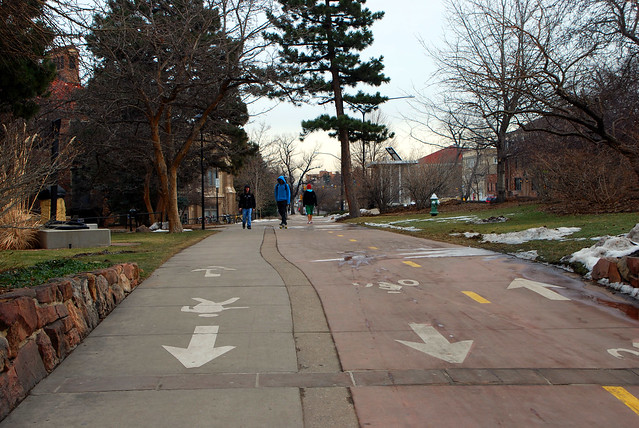
The one in Boulder, which has been around for years and as far as I'm aware nobody has ever called a cycle track, is packed with pedestrians pretty much all the time. I know that when I went to school at CU I paid absolutely no attention to the paint, and walked wherever I wanted.

That's OK. It's a perfectly good, even great facility. I show this picture to people all the time as a good example of an off-street bikeway. It's a TON better than being in the street with cars (especially busy Broadway). It's just not a clear bike-only path by any means.

Reply With Quote
     
     
  #2534  
Old Posted Aug 13, 2011, 3:39 AM
bunt_q's Avatar
bunt_q bunt_q is offline
Provincial Bumpkin
 
Join Date: Aug 2002
Location: Denver, CO
Posts: 13,203
If THAT is inadequate in any way, shape, or form for cyclists, then I think there needs to be some collective head examination in the bicycling advocacy community.

That said, I'm not sure I'd use examples from college communities. It's just not reflective of a normal urban pattern I don't think. I'm not sure we can (or want to) mirror the commuting patterns of that demographic. Choice riders is one thing. But many students are not, strictly speaking, riders of choice. Rather, poverty, proximity, flexibility, etc. - factors that for most of us go away in the "real world" - drive that decision.
Reply With Quote
     
     
  #2535  
Old Posted Aug 13, 2011, 3:51 AM
awholeparade awholeparade is offline
Registered User
 
Join Date: Jun 2010
Posts: 362
If anyone ever argued that Boulder has inadequate cycling infrastructure...well, they'd be batshit crazy. I do agree, a college town is totally different, and generally much easier to get people to use alternative methods of transportation. That said, things like this sure do help to get your average person to travel around by bike, college town or not.
Reply With Quote
     
     
  #2536  
Old Posted Aug 13, 2011, 4:21 PM
bunt_q's Avatar
bunt_q bunt_q is offline
Provincial Bumpkin
 
Join Date: Aug 2002
Location: Denver, CO
Posts: 13,203
Besides, bicycles are theoretically higher in the food chain than pedestrians, right? If a group of four sorority girls walking arm-in-arm in the bike lane get plowed over, well...yeah. Not to say I didn't walk there too, but I knew full well what I was in for.
Reply With Quote
     
     
  #2537  
Old Posted Aug 15, 2011, 3:29 PM
Cirrus's Avatar
Cirrus Cirrus is offline
cities|transit|croissants
 
Join Date: Jul 2001
Location: Washington, DC
Posts: 18,718
The *facility* is not inadequate. Only the *term* is inadequate. Have all these statements not been clear? Honestly.

Quote:
Originally Posted by me
it's still a nice-looking facility
Quote:
Originally Posted by me
It's about as good as a cycle track
Quote:
Originally Posted by me
Yes it's a nice improvement
Quote:
Originally Posted by me
Or leave it alone and it will still be a good facility
Quote:
Originally Posted by me
It's a perfectly good, even great facility.
Quote:
Originally Posted by me
I show this picture to people all the time as a good example of an off-street bikeway.
That's six times... SIX TIMES... that I have said the facility is good. How many more times do I have to say that before I'm allowed to criticize its name without being misunderstood for criticizing the infrastructure? I'd really like to know.

I did NOT say you need separation from pedestrians to be a good bike facility. All I did was ask for different WORDS for facilities where bikes and peds share versus those where they're separate. Is that really such a horrible and inflexible demand on my part? I don't think it is. We have unique terms for light rail, commuter rail, and third rail systems. We have unique terms for limited-access highways versus surface streets versus alleys. I don't understand why there is so much hostility to giving different types of bikeways unique terms as well.

Last edited by Cirrus; Aug 15, 2011 at 3:41 PM.
Reply With Quote
     
     
  #2538  
Old Posted Aug 15, 2011, 3:55 PM
bunt_q's Avatar
bunt_q bunt_q is offline
Provincial Bumpkin
 
Join Date: Aug 2002
Location: Denver, CO
Posts: 13,203
It sounds like you need some engineers to create a standards manual for bicycle infrastructure with proper terminology defined. You sure you want to go there? Because you know engineers are the only bunch out there that'll get you the consistency you want. Be careful what you wish for!
Reply With Quote
     
     
  #2539  
Old Posted Aug 15, 2011, 4:48 PM
PLANSIT's Avatar
PLANSIT PLANSIT is offline
ColoRADo
 
Join Date: May 2004
Location: Denver
Posts: 2,317
Quote:
Originally Posted by bunt_q View Post
It sounds like you need some engineers to create a standards manual for bicycle infrastructure with proper terminology defined. You sure you want to go there? Because you know engineers are the only bunch out there that'll get you the consistency you want. Be careful what you wish for!
Like this?

AASHTO: Guide for the Planning, Design, and Operation of Bicycle Facilities (PDF)

Although, I don't think Cycle Tracks are defined.
Reply With Quote
     
     
  #2540  
Old Posted Aug 15, 2011, 5:00 PM
bunt_q's Avatar
bunt_q bunt_q is offline
Provincial Bumpkin
 
Join Date: Aug 2002
Location: Denver, CO
Posts: 13,203
Yeah, I figured it was out there, I've just never looked. But if cycle tracks aren't defined, then it is clearly obsolete. AASHTO is probably hopeless anyways.

Hasn't ITE come up with anything? What are these folks up to? http://www.ite.org/councils/Ped_Bike/

EDIT: Ah, okay, it's in there. Lots of 'cycle track' specific stuff. Here, fun, an online continuing ed course from NACTO, "THE NACTO URBAN BIKEWAY DESIGN GUIDE" http://www.ite.org/education/NACTO/NACTO_Presentation_.pdf

Cirrus, this gets cited all the time, do they have an engineer-acceptable definition? - Dublin Transportation Office (1997). Cycle Track Design Guidelines Manual. Although, never trust the Irish.

EDIT2: Love the internet, what a fantastic perpetual distraction tool. Can't find the update (or not going to take the time), but the 1997 version is available. http://www.dto.ie/web2006/chapter1.pdf

“Cycle Track“ is defined in the Road Traffic
(Traffic and Parking) Regulations as meaning
part of a road, including part of a footway or
part of a roadway, which is reserved for the
use of pedal cycles and from which all
mechanically propelled vehicles, other than
mechanically propelled wheelchairs, are
prohibited or restricted from entering.
A cycle track may be provided:
(a) on the roadway (in which case it is often
referred to as a “cycle lane”); or,
(b) physically segregated from the roadway by
means of a grass verge, raised kerb, or other
similar means.


Hmm, I think over the pond, cycle track is much broader.

Last edited by bunt_q; Aug 15, 2011 at 5:10 PM.
Reply With Quote
     
     
This discussion thread continues

Use the page links to the lower-right to go to the next page for additional posts
 
 
Reply

Go Back   SkyscraperPage Forum > Regional Sections > United States > Mountain West
Forum Jump


Forum Jump


All times are GMT. The time now is 5:46 AM.


Powered by vBulletin® Version 3.8.7
Copyright ©2000 - 2026, vBulletin Solutions, Inc.