from the travel section of a paper on the east coast, so these type of articles often pull their punches. Not totally in this case. But it wasn't that long ago when such coverage would have been mostly a big "huh"?!
Reviving on food and drink
Eat, drink, sleep it off, walk
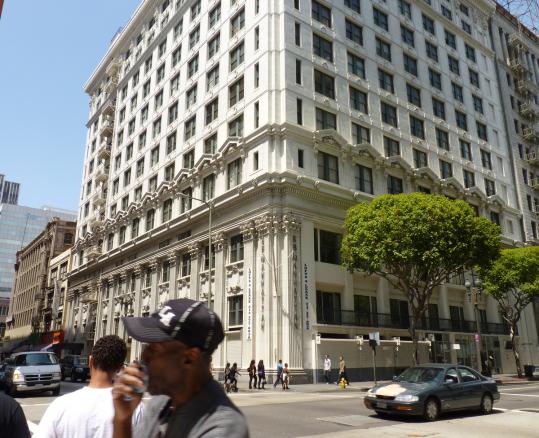 Jonathan Levitt for The Boston Globe
By Jonathan Levitt
Globe Correspondent / June 19, 2011
Caña is a members-only rum bar on a quiet stretch of Flower Boulevard, within sight of the Staples Center, where the Lakers and the Clippers play basketball..... Pay the $20 annual membership fee and walk inside. You’re in the Petroleum Building, built in 1924 by Edward L. Doheny.... Specifically you are in a leather- and wood-lined concrete bunker of a room attached to a glass greenhouse where Doheny’s wife grew orchids....
Caña is just one of many new, high-concept eating and drinking places in what was a blighted downtown. Los Angeles is a city of neighborhoods. Each has its own particular feeling, but one blends into another. Heading east from the ocean, gritty and beachy Venice becomes beachy and suburban Santa Monica, which becomes suburban and hilly Brentwood, which becomes hilly and kooky Hollywood, which becomes hilly and hipster Silverlake . . .
But downtown is different. In the movies it is often a stand-in for Manhattan. With its dense grid of modern skyscrapers and historic brick and mortar, it is easy to see why. But
compared with Manhattan, downtown Los Angeles is a ghost town. It was not always this way. By the 1920s more than 1,100 miles of train track connected downtown to the rest of Los Angeles. It was the business and shopping center of the growing city, strategically located with the mountains to the north and east, and the ocean to the west.
But then came World War II and suburbanization. Urban centers declined around the country. Downtown LA was basically emptied. Freeways and cars replaced trains. Historic buildings were torn down to make room for parking lots.
Over the past 20 years there has been a significant effort to remake the downtown.
It still feels faded and pruned too hard, but it is, after all, the geographical and transportation center of a metropolitan area with over 14 million people. Now the sports teams play here, as do the Los Angeles Philharmonic and the Los Angeles Master Chorale. Office buildings have been converted into loft apartments, and Metro Rail turns 21 next month.
People who could be anywhere are choosing to be downtown. Night life and food are at the heart of this reversal. The best places are set in reimagined and repurposed spaces in neighborhoods that had been dead for decades.
I spent a few days eating and drinking my way around the area. It was not enough time. The breadth of downtown dining is wide, of drinking wider still.
I started in the historic core. Not far from the rum greenhouse of Caña there is a whole cluster of perfect watering holes: Seven Grand, a whisky bar clad in taxidermy, leather, and plaid; The Golden Gopher, a fantasy dive bar with a good jukebox; Casey’s, a classic Irish pub; Cole’s, a saloon that has been serving French dip sandwiches and beer since 1908, with The Varnish, a neo-speakeasy serving prohibition-era cocktails through an unmarked door in the back; and Las Perlas, mescal and beer with a big patio. They are all great, but playing pool and drinking perfect Manhattans at Seven Grand, or tearing into a puro — a smoky mezcal-based old-fashioned with sugar, mole bitters, and a twist of grapefruit — at Las Perlas is particularly thrilling.
There are restaurants all over the civic center neighborhood and the core. Rivera is chef John Rivera Sedlar’s master class on modern Latin cuisine.... Bottega Louie, a crowd pleaser, serves everything from brick oven pizza...to pedigreed cheeseburgers...to those fancy French soft-colored macarons. The space is the size of a train station, clad in brass and white marble, and open all day long.
From the city center it is about a mile east to the arts district and developing industrial districts on the outskirts of Little Tokyo. On foot, there are two ways to get here — either straight ahead or down and around. Down and around means a tame stroll past bank buildings and through the spotless streets of Little Tokyo. Straight ahead means
a shorter walk but through the depths of skid row, a stretch of downtown that still feels like night of the living dead. Tents are staked down in the middle of the street, campfires burn. The empty wander but they keep to themselves and are soon replaced with yoga people buying Vinho Verde at wine shops, eating oysters on outdoor patios, and parking their electric cars outside luxury lofts.
...It is nice to see downtown reimagined and repurposed as the center of Los Angeles.
 Patricia Borns for The Boston Globe
Around the corner from the Fashion Institute of Design and Merchandising, a mobile
Patricia Borns for The Boston Globe
Around the corner from the Fashion Institute of Design and Merchandising, a mobile
gourmet awaits the lunch crush of new entrepreneurs and loft dwellers who've moved
downtown.
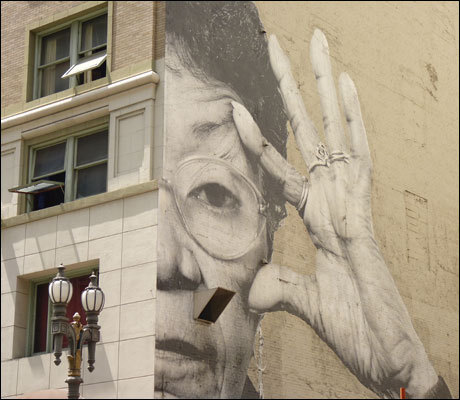 Patricia Borns for The Boston Globe
Eye-opening is the best description for the transformation of downtown
Patricia Borns for The Boston Globe
Eye-opening is the best description for the transformation of downtown
LA's Spring St. The former Wall Street of the West is rich in 1920s bank
buildings being redeveloped as luxury lofts that sell as fast as the paint
dries.





 Prev
Prev








 Linear Mode
