HomeDiagramsDatabaseMapsForum About
     

Go Back   SkyscraperPage Forum > Discussion Forums > City Discussions


Reply

 
Thread Tools Display Modes
     
     
  #741  
Old Posted Mar 11, 2011, 12:41 PM
Chase Unperson's Avatar
Chase Unperson Chase Unperson is offline
Freakbirthed
 
Join Date: Nov 2003
Location: Papa Songs.
Posts: 4,329
Quote:
Originally Posted by Thundertubs View Post
No city on that list has ever seen a 35+% drop like you are assuming in STL's case, not even in the brutal decade of the 1970's. I can't imagine how casually suggesting historically rapid acceleration of decline would lead to productive discussion. Silly post. Moving on.

Also, this [?] is a question mark, it goes at the end of sentences that are questions.
I don't mean by 2020.
__________________
There are two novels that can change a bookish fourteen-year old's life: The Lord of the Rings and Atlas Shrugged. One is a childish fantasy that often engenders a lifelong obsession with its unbelievable heroes, leading to an emotionally stunted, socially crippled adulthood, unable to deal with the real world. The other, of course, involves orcs
Reply With Quote
     
     
  #742  
Old Posted Mar 11, 2011, 3:56 PM
Steely Dan's Avatar
Steely Dan Steely Dan is online now
devout Pizzatarian
 
Join Date: Jul 2001
Location: Lincoln Square, Chicago
Posts: 30,420
Quote:
Originally Posted by Ch.G, Ch.G View Post
Some metros in Illinois and Wisconsin:

Madison, WI 568,593 (+66,819)
Peoria, IL 379,186 (+12,287)
Rockford, IL 349,431 (+29,227)
Springfield, IL 210,170 (+8,733)
would you mind compiling metro milwaukee too?

i'm very heartened to see milwaukee city proper stabilize. after the news coming out of other rust belt cities, including milwukee's big brother to the south, to see a statistically insignificant drop of only 0.4% in brew city is truly a surprise. it looks like milwaukee's explosive growth in latinos helped stabilize its population, just as an explosive growth in latinos powered growth in chicago back in the 90s.
__________________
"Missing middle" housing can be a marvelous middle ground for many middle class families.
Reply With Quote
     
     
  #743  
Old Posted Mar 11, 2011, 4:23 PM
CentralGrad258's Avatar
CentralGrad258 CentralGrad258 is offline
Registered User
 
Join Date: Sep 2008
Location: Fishtown, Philadelphia
Posts: 562
Quote:
Originally Posted by BevoLJ View Post
Did you varify this through the census tracts? I would love to see the numbers from the areas that did a lot of gentrification. From what I have read and everyone has been saying in every other city it has shown that those area have had a huge decrease in population due to smaller household sizes and the higher cost pushing people out to the burbs that used to live in those areas. I am not denying what you say is true, but if some how Phily was able to do what no one else has then it would be interesting to see how they managed it.
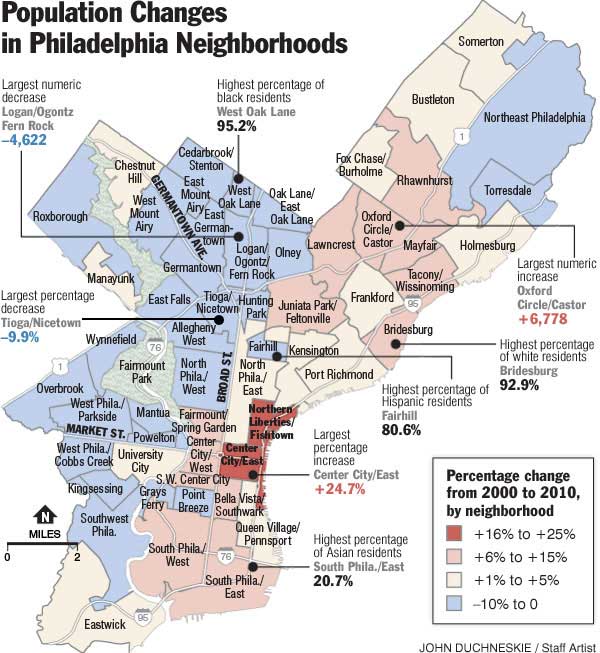
Yup, here's a nifty map of population changes by neighborhood. The biggest percentage increases were in Center City and Northern Liberties, two of most gentrified neighborhoods in the city. A lot of that is due to new construction, so no families are being pushed out.

http://www.philly.com/philly/hot_topics/117455888.html?appSession=072206455496444

Quote:
That's great and all, but I'm strictly going by U.S. Census numbers. The Census shows that Philly metro attracts relatively few immigrants compared to the other three Northeast metros.

By proportion, Philly and Detroit attract almost the exact same number of foreign-born residents.

Philly MSA- 8.8% foreign-born

Detroit MSA- 8.6% foreign-born
You can actually look up Philadelphia's numbers and it's 11% foreign born. The data is from the ACS survey (which uses the last census as its base) and it undercounts our population by about 100,000 compared to the actual Census count. Again, just about every local expert believes the growth is coming from the influx of Hispanic and Asian immigrants. The Census number bare that out (although the new foreign born numbers aren't available yet).
__________________
Helsinki and the Finnish countryside || Kiev || St. Petersburg, Russia- Summer Palace

Philadelphia is not a city of palaces for the few, but a city of homes for the many.
Reply With Quote
     
     
  #744  
Old Posted Mar 11, 2011, 4:33 PM
Chicago103's Avatar
Chicago103 Chicago103 is offline
Future Mayor of Chicago
 
Join Date: Mar 2003
Location: Chicago
Posts: 6,062
Quote:
Originally Posted by Chase Unperson View Post
For Chicago, I think the next census will be 2500000 and it won't go lower.
I think Chicago hit bottom in this census of 2010. The 2000 census proved that the city can increase in population and in 2010 there was a unique set of circumstances that won't be moving forward. The question is will there be stability or outright significant growth moving forward in Chicago.
Reply With Quote
     
     
  #745  
Old Posted Mar 11, 2011, 5:02 PM
MayorOfChicago's Avatar
MayorOfChicago MayorOfChicago is offline
You had me at herro...
 
Join Date: Aug 2003
Location: Lakeview, Chicago
Posts: 2,110
Quote:
Originally Posted by Chicago103 View Post
I think Chicago hit bottom in this census of 2010. The 2000 census proved that the city can increase in population and in 2010 there was a unique set of circumstances that won't be moving forward. The question is will there be stability or outright significant growth moving forward in Chicago.
That and the fact there were probably a LOT of people missed. I mean many south and west side tracts covering many square miles when added together suddenly lost 25% of their population in the past 10 years - yet if you look the school enrollment and households receiving mail in those areas was stable throughout the period. North side areas along the lakeshore from Irving Park through Howard lost 30,000 people, yet the area was very stable with a lot of new construction. Sure household sizes are shrinking, but those areas weren't packed with families before, and with all the new condos and things going on in areas like Edgewater - it's surprising they'd be losing tens of thousands of people.

The estimates were based off things like people registering, people receiving mail, enrollments, etc. Suddenly they do a headcount and over 150,000 people just disappear from the estimates.
__________________
So I was out biking with Jesus last week...
Reply With Quote
     
     
  #746  
Old Posted Mar 11, 2011, 5:09 PM
Chicago103's Avatar
Chicago103 Chicago103 is offline
Future Mayor of Chicago
 
Join Date: Mar 2003
Location: Chicago
Posts: 6,062
Quote:
Originally Posted by MayorOfChicago View Post
That and the fact there were probably a LOT of people missed. I mean many south and west side tracts covering many square miles when added together suddenly lost 25% of their population in the past 10 years - yet if you look the school enrollment and households receiving mail in those areas was stable throughout the period. North side areas along the lakeshore from Irving Park through Howard lost 30,000 people, yet the area was very stable with a lot of new construction. Sure household sizes are shrinking, but those areas weren't packed with families before, and with all the new condos and things going on in areas like Edgewater - it's surprising they'd be losing tens of thousands of people.

The estimates were based off things like people registering, people receiving mail, enrollments, etc. Suddenly they do a headcount and over 150,000 people just disappear from the estimates.
With that in mind it is possible that if the 2020 census is done much better Chicago might actually see a rather significant increase in population and not just from legitimate growth over the next ten years but also counting populations that were missed in 2010.

On a side note I wonder if Chicago should seriously challenge the census results. I just read yesterday in a book from the early 1980's that initial 1980 census results showed that Chicago had slightly fewer people than Los Angeles and had under 3 million people. The city challenged the results and the census readjusted the figure to 3.005 million people and put it slightly ahead of Los Angeles to retain its spot as the second largest city for a few more years. If you look at books from the 1980's some of them will actually show different census figures for Chicago in 1980 from the official ones we see today.
Reply With Quote
     
     
  #747  
Old Posted Mar 11, 2011, 6:26 PM
Crawford Crawford is offline
Registered User
 
Join Date: Nov 2003
Location: Brooklyn, NYC/Polanco, DF
Posts: 34,861
Quote:
Originally Posted by CentralGrad258 View Post
You can actually look up Philadelphia's numbers and it's 11% foreign born.
Philly is 8.8% foreign-born, not 11% foreign-born.

But even using your 11%, the proportion of foreign-born is far below that of NYC, DC, and Boston, which was my original point (and hence the surprise at the population growth, given that immigration is the primary driver of U.S. urban growth).
Quote:
Originally Posted by CentralGrad258 View Post
The data is from the ACS survey (which uses the last census as its base) and it undercounts our population by about 100,000 compared to the actual Census count.
It sounds like mere speculation on your part that the Census is undercounting Philly foreign-born, but if your claim is true, then it would also be true for all U.S. metros.

Therefore, if the Census undercounts, it would make no difference in Philly's proportional foreign-born relative to other metros.
Reply With Quote
     
     
  #748  
Old Posted Mar 11, 2011, 6:28 PM
edluva edluva is offline
BANNED
 
Join Date: Dec 2002
Location: Los Angeles
Posts: 6,118
Quote:
Originally Posted by Chicago103 View Post
With that in mind it is possible that if the 2020 census is done much better Chicago might actually see a rather significant increase in population and not just from legitimate growth over the next ten years but also counting populations that were missed in 2010.

On a side note I wonder if Chicago should seriously challenge the census results. I just read yesterday in a book from the early 1980's that initial 1980 census results showed that Chicago had slightly fewer people than Los Angeles and had under 3 million people. The city challenged the results and the census readjusted the figure to 3.005 million people and put it slightly ahead of Los Angeles to retain its spot as the second largest city for a few more years. If you look at books from the 1980's some of them will actually show different census figures for Chicago in 1980 from the official ones we see today.
what would be the point? besides garnering a little more funding?
Reply With Quote
     
     
  #749  
Old Posted Mar 11, 2011, 6:36 PM
ChiSoxRox's Avatar
ChiSoxRox ChiSoxRox is offline
Registered User
 
Join Date: Mar 2007
Location: Boston, MA
Posts: 2,338
Quote:
Originally Posted by edluva View Post
what would be the point? besides garnering a little more funding?
Civic pride; I'd be thrilled if Chicago challenged and the actual figure wound up being closer to 2.8 million.
__________________
Like the pre-war masonry skyscrapers? Then check out my list of the tallest buildings in 1950.
Reply With Quote
     
     
  #750  
Old Posted Mar 11, 2011, 7:02 PM
Antares41's Avatar
Antares41 Antares41 is offline
Registered User
 
Join Date: Sep 2002
Location: Bflo/Pgh/Msn/NYC
Posts: 2,161
With all of the positive population growth in NJ, PA and CT (with the exception of Essex county, NJ) I am anxious to see what the numbers are for the NYC metro area. I was anticipating ~ 2.0% over 2000 Census numbers. I'm now thinking that probably a safe bet.
Reply With Quote
     
     
  #751  
Old Posted Mar 11, 2011, 7:24 PM
alex1's Avatar
alex1 alex1 is offline
~
 
Join Date: Jan 2002
Location: www.priggish.com
Posts: 3,978
Quote:
Originally Posted by edluva View Post
what would be the point? besides garnering a little more funding?
the whole point is funding. Especially during these times, when most cities are running huge deficits and property taxes are on the downswing.
__________________
n+y+c = nyc
Reply With Quote
     
     
  #752  
Old Posted Mar 11, 2011, 7:24 PM
CentralGrad258's Avatar
CentralGrad258 CentralGrad258 is offline
Registered User
 
Join Date: Sep 2008
Location: Fishtown, Philadelphia
Posts: 562
Quote:
Originally Posted by Crawford View Post
Philly is 8.8% foreign-born, not 11% foreign-born.

But even using your 11%, the proportion of foreign-born is far below that of NYC, DC, and Boston, which was my original point (and hence the surprise at the population growth, given that immigration is the primary driver of U.S. urban growth).
Use your own link. Philadelphia is also a county so it's plenty easy to get data for the city proper. It's 11 percent.

Quote:
Originally Posted by Crawford
It sounds like mere speculation on your part that the Census is undercounting Philly foreign-born, but if your claim is true, then it would also be true for all U.S. metros.

Therefore, if the Census undercounts, it would make no difference in Philly's proportional foreign-born relative to other metros.
It's not speculation, it's the reality of the situation. Your link goes to the ACS, which is an estimate with the 2000 Census as its base for population projections. It indeed undercounts the Hispanic population 168,922 (ACS) vs. 187,611 (2010 census) and the Asian population 84,048 (ACS) vs 95,521 (Census). Now those 30,000 people may not seem like a big deal, but in a city where the population has only changed by less than 10,000 in 10 years, that means something. Now you could argue that the additional people from those ethnic groups are not necessarily foreign born, and I don't see foreign born data in the new Census, but all the local experts believe that the growth is due to increase in immigration. But hey, what do they and the people who actually live here know.
__________________
Helsinki and the Finnish countryside || Kiev || St. Petersburg, Russia- Summer Palace

Philadelphia is not a city of palaces for the few, but a city of homes for the many.

Last edited by CentralGrad258; Mar 11, 2011 at 7:58 PM.
Reply With Quote
     
     
  #753  
Old Posted Mar 11, 2011, 7:53 PM
hudkina hudkina is offline
Honored Member
 
Join Date: Nov 2003
Posts: 7,445
But the point remains that Metro Philadelphia is closer to Metro Detroit than it is Metro New York/Boston/Washington when it comes to foreign-born population.
Reply With Quote
     
     
  #754  
Old Posted Mar 11, 2011, 8:11 PM
CentralGrad258's Avatar
CentralGrad258 CentralGrad258 is offline
Registered User
 
Join Date: Sep 2008
Location: Fishtown, Philadelphia
Posts: 562
Quote:
Originally Posted by hudkina View Post
But the point remains that Metro Philadelphia is closer to Metro Detroit than it is Metro New York/Boston/Washington when it comes to foreign-born population.
Leaving that pissing match aside. I found this table to be very interesting:
http://www.census.gov/compendia/statab/2011/tables/11s0039.pdf

Again, I'm a little dubious of the numbers, because the ACS survey is dated now that the 2010 Census has been conducted. But Detroit city proper is only 4.9 percent foreign born. Philly is 10.5. New York is a ridiculous 36.4, but DC city proper is just 13.2. However, when you look at percent of foreign born who came in after 2000, Philly is actually higher than NYC (33.9 vs 25.8). So New York's immigrant population is overall less recent than Philadelphia's. Just goes to show that the top-line number doesn't always tell the full story. Does anyone know when the foreign-born numbers for the 2010 Census will be released?
__________________
Helsinki and the Finnish countryside || Kiev || St. Petersburg, Russia- Summer Palace

Philadelphia is not a city of palaces for the few, but a city of homes for the many.
Reply With Quote
     
     
  #755  
Old Posted Mar 11, 2011, 8:26 PM
Crawford Crawford is offline
Registered User
 
Join Date: Nov 2003
Location: Brooklyn, NYC/Polanco, DF
Posts: 34,861
Quote:
Originally Posted by CentralGrad258 View Post
However, when you look at percent of foreign born who came in after 2000, Philly is actually higher than NYC (33.9 vs 25.8). So New York's immigrant population is overall less recent than Philadelphia's.
No, it shows the complete opposite - it shows that Philly is drawing far fewer recent immigrants than the other Northeastern cities.

Using your numbers,

Roughly 9.5% of NYC residents are immigrants who arrived after 2000; and

Roughly 3.5% of Philly residents are immigrants who arrived after 2000.

So, once again, immigration does not appear to be the primary driver for Philly's population growth, since the rate of immigration is significantly lower than other cities in the Northeast.
Reply With Quote
     
     
  #756  
Old Posted Mar 11, 2011, 8:47 PM
CentralGrad258's Avatar
CentralGrad258 CentralGrad258 is offline
Registered User
 
Join Date: Sep 2008
Location: Fishtown, Philadelphia
Posts: 562
Quote:
Originally Posted by Crawford View Post
No, it shows the complete opposite - it shows that Philly is drawing far fewer recent immigrants than the other Northeastern cities.

Using your numbers,

Roughly 9.5% of NYC residents are immigrants who arrived after 2000; and

Roughly 3.5% of Philly residents are immigrants who arrived after 2000.

So, once again, immigration does not appear to be the primary driver for Philly's population growth, since the rate of immigration is significantly lower than other cities in the Northeast.
Nobody is comparing overall foreign born population of Philly to New York other than you, give it a rest already. You're clueless about the city, have terrible reading comprehension, confuse MSAs and cities proper, all of that on top of a serious New York bias. But other than that you've got a firm grasp on things.
__________________
Helsinki and the Finnish countryside || Kiev || St. Petersburg, Russia- Summer Palace

Philadelphia is not a city of palaces for the few, but a city of homes for the many.

Last edited by CentralGrad258; Mar 11, 2011 at 9:06 PM.
Reply With Quote
     
     
  #757  
Old Posted Mar 11, 2011, 9:49 PM
hudkina hudkina is offline
Honored Member
 
Join Date: Nov 2003
Posts: 7,445
Philadelphia's White population dropped by 57,000 (and that includes hispanics who listed White as their race), while Asians and Pacific Islanders jumped by 29,000 and people of another race (mostly Hispanics who don't identify with any of the listed races) and people of two or more races jumped by 28,000. So essentially the loss of Whites was made up for by the gain of Asians and Hispanics. What put Philadelphia over the "hump" was the fact that the Black population added 6,000. The American Native population jumped by 3,000 as well.

BTW, is this the first decade that Philadelphia's Black population is now larger than the White population?

The city is now 43% Black, 41% White, 6% Asian, and 10% Other.
Reply With Quote
     
     
  #758  
Old Posted Mar 11, 2011, 11:18 PM
Chicago103's Avatar
Chicago103 Chicago103 is offline
Future Mayor of Chicago
 
Join Date: Mar 2003
Location: Chicago
Posts: 6,062
Is Chicago the only major city in the country that experienced a population increase in 2000 and a population loss in 2010?

In regards to "mature" cities I am sure this is the case, it seems that either they have seen population gains for several decades straight (NYC), experienced a first post 1950 gain in 2010 (Washington D.C., Philadelphia) or have never seen a post 1950 gain (Saint Louis, Cleveland, Pittsburgh, etc.). Chicago seems to be in a unique situation here.
Reply With Quote
     
     
  #759  
Old Posted Mar 12, 2011, 12:41 AM
KevinFromTexas's Avatar
KevinFromTexas KevinFromTexas is offline
Meh
 
Join Date: Jul 2001
Location: Austin<--->Birmingham<--->Atlanta
Posts: 55,831
Give it a rest, guys. And when posts start disappearing you should take a hint to ease up.
__________________
My girlfriend has a poodle named Kevin.
Reply With Quote
     
     
  #760  
Old Posted Mar 12, 2011, 1:25 AM
Ch.G, Ch.G's Avatar
Ch.G, Ch.G Ch.G, Ch.G is offline
Registered User
 
Join Date: Jul 2007
Posts: 3,128
Quote:
Originally Posted by Steely Dan View Post
would you mind compiling metro milwaukee too?

i'm very heartened to see milwaukee city proper stabilize. after the news coming out of other rust belt cities, including milwukee's big brother to the south, to see a statistically insignificant drop of only 0.4% in brew city is truly a surprise. it looks like milwaukee's explosive growth in latinos helped stabilize its population, just as an explosive growth in latinos powered growth in chicago back in the 90s.
Just compiled the Milwaukee data.

Milwaukee-Waukesha-West Allis, WI MSA 1,555,908 (+55,167 or 3.7%)
Milwaukee-Racine-Waukesha, WI CSA 1,751,316 (+61,744, also 3.7%)

EDIT:

Just for fun, combining the Milwaukee and Chicago CSAs yields 11,437,337 (+435,510 or 4.0%). Also, Lake County (IL), Kenosha County (WI) and Racine County (WI) added 82,532 residents for a combined total of 1,065,296.


Last edited by Ch.G, Ch.G; Mar 12, 2011 at 1:39 AM.
Reply With Quote
     
     
This discussion thread continues

Use the page links to the lower-right to go to the next page for additional posts
 
 
Reply

Go Back   SkyscraperPage Forum > Discussion Forums > City Discussions
Forum Jump


Forum Jump


All times are GMT. The time now is 3:25 PM.


Powered by vBulletin® Version 3.8.7
Copyright ©2000 - 2026, vBulletin Solutions, Inc.