HomeDiagramsDatabaseMapsForum About
     

Go Back   SkyscraperPage Forum > Regional Sections > Canada > Ontario > Ottawa-Gatineau > Transportation


Reply

 
Thread Tools Display Modes
     
     
  #3861  
Old Posted Jan 3, 2011, 9:52 PM
eemy's Avatar
eemy eemy is offline
Closed account
 
Join Date: Aug 2006
Posts: 4,425
Quote:
I don't expect no delays during a conversion but some effort must be made to allow for transit to keep moving. There is no reason why we needed to actually block the Transitway during conversion. We have consciously designed the tunnel to block the surface route. If we were to keep a surface route open, at least it is better than what we are proposing to do. The Seattle tunnel is a different situation entirely. First of all, this was a tunnel conversion, not the building of a new tunnel. Second, Seattle fouled things up when they first designed the tunnel and a lot of work had to be redone to allow trains to run through it. Third, I am sure you will find that the Seattle tunnel does not impact the overall transit network to the same degree as our tunnel plan. The same can be said about the Canada Line. The other skytrains were still operational.
I think the discussion was regarding the hypothetical conversion of a bus tunnel to LRT. Difficulty in converting it to LRT in the future was given as a reason not to build a bus tunnel today. It is far easier to build an LRT tunnel now and convert the surface transitway then it will be to convert a future bus tunnel to LRT when surface transit routes through the downtown are no longer available.
Reply With Quote
     
     
  #3862  
Old Posted Jan 3, 2011, 10:26 PM
MalcolmTucker MalcolmTucker is offline
Registered User
 
Join Date: May 2007
Posts: 11,592
To keep the transit way open during conversion, you would have to build bypasses at each station, and have some neat tricks to keep the ROW open otherwise.

Quiet frankly, build a bus tunnel first, then converting solves none of the problems your seeking to solve. It still shuts down the transitway access. There is no way to solve it without not using the transitway at all. You will have total shutdown for at least 2 1/2 years. The detours around the tunnel launch sites are small potatoes compared to the full shutdown.

As for smoke ventilation being equivalent to enough ventilation to run diesel buses - what are you smoking? There is absolutely no way. Enough to run a work train sure. For smoke you likely wouldn't be doing active air exchange - that is just fanning the flames - whereas running an incredible amount of diesel equipment in a confined space your likely talking about a total air exchange every 5 minutes at minimum. 10 buses idling at a station our doors is bad enough - think about in a confined space standing beside them on a platform!

In closing - it solves no problems, it costs more (in capital costs, and operational cost), and it pushes the ball further down the road so when the transitway needs to be shut down even more people will have been using it, making it worse for the users.
Reply With Quote
     
     
  #3863  
Old Posted Jan 4, 2011, 3:52 AM
Richard Eade Richard Eade is offline
Registered User
 
Join Date: Mar 2008
Location: Nepean
Posts: 2,597
Seattle runs buses through their bus/LRT tunnel and they don’t seem to have a problem with people dropping dead at the stations from diesel exhaust poisoning. Seattle talked with the bus manufacturer and together they worked on a solution. Buses in a tunnel can be done.

Yes, building a tunnel that can accommodate buses in the near-term and be converted to LRT in the future WILL COST MORE in the long-run. I don’t think I’ve seen any serious posts or media articles which claim the opposite. Some folks feel that there could be a savings because there would never be a need to convert to rail, but that is not what is being talked about here. In this discussion, the buses would be a temporary solution.

OK, it WILL COST MORE, but are there good reasons to do it any way?

Trains require a complete track before they can run, while buses are flexible and can detour around discontinuities. This is a big advantage when so much re-work needs to be done to the existing infrastructure. In fact, one of the reasons the conversion is going to take so long is because so many things need to be changed. For example, buses can access the Local Platform of Blair Station while the train platform is built under the Transitway lanes; while Train Station is being re-configured, the buses could jump out onto Tremblay and get to Hurdman via Riverside Drive. These are things that LRT can not do. And since there needs to be large transfer stations between the buses and the LRT, there are distinct points where the LRT can run from/to. In order to build an LRT line, there will need to be huge disruption to the current bus system for many years – in fact, Staff say until 2019.

If a tunnel were made to accommodate buses first, then it could be completed much sooner – hopefully in time to provide rapid transit service for the 150th anniversary of Canada in 2017 – and begin providing relief to downtown bus congestion. This is because there doesn’t need to be a full conversion of the corridor before the tunnel is useful.

With the buses running through the tunnel, then the difficult parts of the alignment can be modified so that they are ‘LRT-Ready’. That is, they are straight, graded, and only need to have rails installed. The over-head power can even be per-installed over the buses.

Then, and only then, a Track Laying Machine (TLM) is brought in to install the track along the straightened Transitway. A TLM can create about 1.5 Km of track per day so the buses would be removed from the Transitway one nice summer day (when ridership is lowest) and nine days later, the tracks would be down. Then the signaling could be installed and the line tested. With any co-ordination this could be done by the end of the summer. (I am assuming that the LRT yard and Maintenance Facility – including the tunnels to the main-line Transitway - was built before the conversion so that all of the LR vehicles have been delivered and tested along with the control systems.

So, yes, it WILL COST MORE (have I said that enough yet), but there might be benefits to running buses through the tunnel first and converting it to rail later. If the benefits are great enough, then the added cost can be justified. Like the way Staff has decided to delay automation of the system; according to the information given to U.S. companies, automation is being planned for, but not installed until later. By deferring the automation cost and setting up a manual system now, the project cost is hopefully low enough for the project to be built. The fact that it will cost more later on to retrofit the system for automation is acceptable.
Reply With Quote
     
     
  #3864  
Old Posted Jan 4, 2011, 3:59 AM
Richard Eade Richard Eade is offline
Registered User
 
Join Date: Mar 2008
Location: Nepean
Posts: 2,597
Quote:
Originally Posted by Sir.Humphrey.Appleby View Post
To keep the transit way open during conversion, you would have to build bypasses at each station, and have some neat tricks to keep the ROW open otherwise.

Quiet frankly, build a bus tunnel first, then converting solves none of the problems your seeking to solve. It still shuts down the transitway access. There is no way to solve it without not using the transitway at all. You will have total shutdown for at least 2 1/2 years. The detours around the tunnel launch sites are small potatoes compared to the full shutdown.
....
Just a comment to counter the statement that there is no way to avoid shutting down the Transitway for at least 2½ years: If the eastern portal were moved to Hurdman then there could be very little disruption through the core since the portals need not fall directly on the Transitway. A second TBM (one for soft ground) would be launched from Hurdman and retrieved in the same pit used to recover the hard-rock TBM, which would be the pit for Campus Station. This would not disturb the Transitway since the pit would be west of Nicholas, as the approved plan shows. A New Lees Station could be built under the parking lot beside the existing station.

Now before someone says that we can’t afford the extra length, I suggest that the Province (MTO specifically) might want to kick in enough. Right now, the MTO is planning to tear out and replace the long curved Lees Avenue overpass of the 417. This is needed to widen the 417. If the tunnel were extended to Hurdman, then the current Transitway underpass of the 417 could be released to general traffic and the new Lees structure would not be needed. Also, the University of Ottawa might want to redevelop the Lees Campus with a new building which incorporates a new underground train station. (They might not be so keen for an underground bus station, however.) Also, without the huge Lees Avenue bridge ramp, there would be lots more redevelopment space for the City to get taxes from, both north and south of the 417.

To simply dismiss something with the statement that there is “no way to solve it” usually shows that enough imagination was not used.
Reply With Quote
     
     
  #3865  
Old Posted Jan 4, 2011, 2:11 PM
MalcolmTucker MalcolmTucker is offline
Registered User
 
Join Date: May 2007
Posts: 11,592
The problem isn't the cut off at the launch sites - it is the ROW itself, and the stations. Note I didn't say 5 years, which is the timeline for tunnel boring if my memory serves. The transit way shouldn't have much disruption until the stations start being built, and the trenches start to be re-aligned further along in the timeline.

There will need to be a long term shutdown where alternative stations and routes are used, which will likely result in the wholesale redesign of the route network to try to keep reasonable service going. Realistically, if you are willing to limit auto traffic, the west end isn't a huge issue to use alternate roads (mostly because the subway length is far shorter). The east end is a bit worse, since the alternative route is the 417 and new temporary stations (it would be functional but slow, so you would likely make Orleans' buses express to downtown after one stop to allow possible transfer to a local).

I don't know why people are so fixated on the tunnel portion - the project is shutting down far more than that!
Reply With Quote
     
     
  #3866  
Old Posted Jan 4, 2011, 3:15 PM
lrt's friend lrt's friend is online now
Registered User
 
Join Date: Dec 2006
Posts: 12,754
Quote:
I don't know why people are so fixated on the tunnel portion - the project is shutting down far more than that!
The whole conversion is going to cause problems, but it is access to downtown that will be the worst of all. At least the eastern Transitway has the Queensway right next to it, but the most congestion will occur between Hurdman and into downtown. Once we shut down the Transitway, we are forcing hundreds of buses into mixed traffic. This may be a problem not just for the transit system but also for general traffic on the Queensway and general traffic trying to use Nicholas Street to reach downtown. If we think we have a problem along Albert and Slater already, this could be far worse.
I also really wonder how they will deal with Hurdman Station during the conversion. It is one of the busiest transfer stations in our transit network, but once the conversion shuts the transitway off into downtown, where will the alternate transfer location be? I can imagine the Queensway/Vanier Parkway interchange but that will be a very awkward alternative.

Then the Western Transitway will somehow have to bring all the buses up out of the Transitway trench onto Scott Street for access to downtown. Will this not cause a traffic bottleneck right at the entrance into Tunney's Pasture?

As I see it, designing our first LRT phase to actually block the Transitway from both east and west entering downtown during conversion is something that should be avoided . The impact on service for 3, 4 or 5 years will be unacceptable. I just don't understand why this was not taken more seriously during planning. We talk about the cost of avoiding this mess by relocating portals, but there will also be cost of not doing something. The cost of lost ridership and the cost of having to operate more buses because service will be slower. I would be inclined to spend more to keep your customer base happy.
Reply With Quote
     
     
  #3867  
Old Posted Jan 4, 2011, 9:50 PM
acottawa acottawa is offline
Registered User
 
Join Date: Aug 2009
Posts: 18,825
I may be wrong, but I believe the Seattle tunnel uses duel power buses (i.e. they're trolley buses underground) so there is no exaust to vent. While I suppose that would be an option in Ottawa, I would think buying hundreds of new buses that can run on electricity underground would be expensive. Also, a bus tunnel would only solve the traffic light problem - its capacity would still be 3 buses pulling up to a stop every 45 seconds or so, and the buses would still have to wait for the poor passengers to scramble to wherever there bus happens to be on the platform (unless there is only one route and passengers have to transfer onto the single route, but I believe the whole reason for proposing a bus tunnel is to preserve the express routes downtown). I would also make the point that Seattle is the ONLY urban underground BRT in the world, whereas there are hundreds of rail-based systems, which may indicate something about the practicality of underground brt in urban areas.
Reply With Quote
     
     
  #3868  
Old Posted Jan 4, 2011, 10:10 PM
lrt's friend lrt's friend is online now
Registered User
 
Join Date: Dec 2006
Posts: 12,754
The answer to the capacity issue is to continue to run some of the bus routes on the surface. This will be necessary regardless.

Regarding the Seattle tunnel, from what I am reading, they originally used dual powered buses that acted as trolleys inside the tunnel. In more recent years, they were actually replaced with diesel powered buses. I think a low emission bus would be workable. The Seattle bus tunnel has been in operation since 1990 and now operates with both buses and LRT. There are examples in Europe of tunnels shared by buses and LRT. The example I saw on video used dual powered buses that acted as trolleys inside the tunnel.
Reply With Quote
     
     
  #3869  
Old Posted Jan 4, 2011, 11:10 PM
Richard Eade Richard Eade is offline
Registered User
 
Join Date: Mar 2008
Location: Nepean
Posts: 2,597
From the King County Metro Webpage:

Quote:
Allison, New Flyer, and Metro developed hush mode to minimize emissions and noise in the DSST. It operates as follows. Some distance from the end of the tunnel the system is put into a pre-charge mode if it is necessary to bring the batteries up to a certain level of charge. Some engine power is diverted into battery charging if pre-charge is necessary. At the end of the tunnel, the driver selects hush mode on the shift selector. An "H" shows up. This reduces engine horsepower. When the bus speed drops to 15 mph, engine fuel is cut off. With important accessories (power steering, air compressor, and alternator) driven by the engine, however, the engine must still be rotated to operate them. The diesel engine is rotated, or motored, by the electric motors in the hybrid drive unit. When the diesel is motored, it still makes some noise because engine compression has not been released. When the bus stops at a station and the doors are opened, the diesel is not motored and everything stops. When the doors are closed, motoring begins and continues until the bus reaches 15 mph. The engine is then fueled and operated at reduced power. This sequence happens at every station. At the end of the tunnel, the bus changes out of hush mode automatically.
Conveniently, we happen to have just bought a huge number of New Flyer buses which could no doubt be updated to the latest 'Hush Mode' software so they could run through our tunnel too.
Reply With Quote
     
     
  #3870  
Old Posted Jan 4, 2011, 11:32 PM
Richard Eade Richard Eade is offline
Registered User
 
Join Date: Mar 2008
Location: Nepean
Posts: 2,597
For the conversion, the City should be borrowing and spending NOW (while we still have buses running on the Transitway) to straighten and modify those sections which need fixing. These isolated areas will be disruptive to the current bus service, but buses can be routed around the problems without shutting down the entire Transitway. The maintenance and storage facility (and connecting tunnels) should also be built BEFORE the Transitway is shut down to buses. ONLY AFTER the kinks are ironed out and the new LRVs have been delivered and tested should the Transitway be shut down for conversion; and as I said before, this should involve only adding rails, maybe minor station mods, adding the signaling system and final testing. This phase of the conversion should be fast.

As for the eastern portal location, all three positions (south of Mann, south of Campus Station, and south of Laurier) will probably require the buses to use Nicholas or King Edward because there are no accesses/egresses from that section of Transitway between the exit just north of the 417 and Laurier. The best way to avoid breaking that link is to extend the tunnel to Hurdman where it would come up in the field beside the Transitway. This would leave the Transitway Bridge over the Rideau River intact and the rest of the Transitway all the way to Brick Hill.
Reply With Quote
     
     
  #3871  
Old Posted Jan 5, 2011, 12:08 AM
MalcolmTucker MalcolmTucker is offline
Registered User
 
Join Date: May 2007
Posts: 11,592
I would have to imagine at about a shorter length 2.1 km vs 3.2 km, and at 99 buses per hour vs current service of 180 (have seen 198 but that is from non-city sources) buses per hour presents different challenges.

In the end you still end up with the fundamental problem of conversion when capacity is tapped out, and every increasing operational costs.

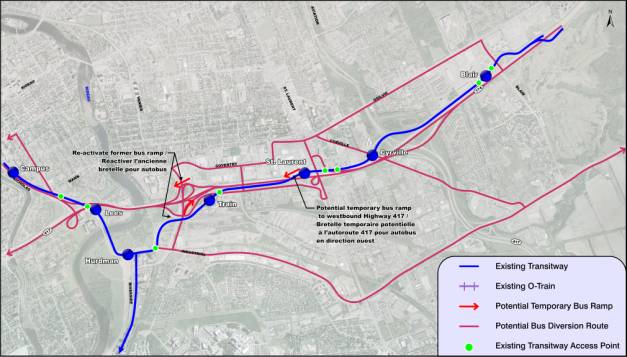
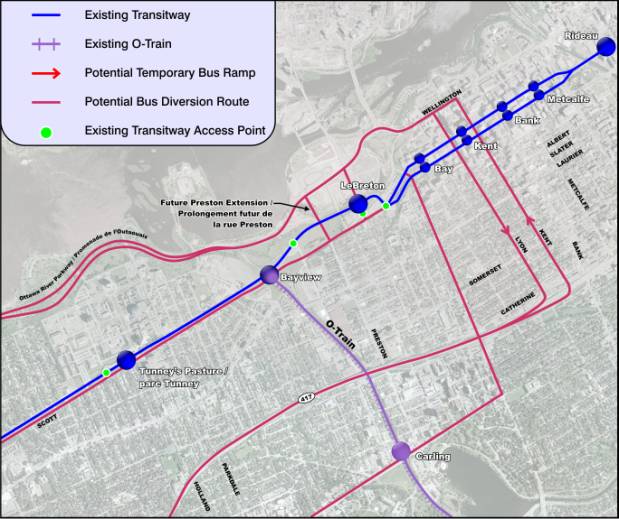
Oh, also found diversion routes in a city of Ottawa document:


Reply With Quote
     
     
  #3872  
Old Posted Jan 5, 2011, 1:40 AM
Dado's Avatar
Dado Dado is offline
National Capital Region
 
Join Date: Jul 2007
Location: Ottawa, Canada
Posts: 2,521
Quote:
Originally Posted by lrt's friend View Post
Regarding the Seattle tunnel, from what I am reading, they originally used dual powered buses that acted as trolleys inside the tunnel. In more recent years, they were actually replaced with diesel powered buses. I think a low emission bus would be workable. The Seattle bus tunnel has been in operation since 1990 and now operates with both buses and LRT. There are examples in Europe of tunnels shared by buses and LRT. The example I saw on video used dual powered buses that acted as trolleys inside the tunnel.
One could write an entire article/course project on the Seattle transit tunnel.

Basically, it was conceived of in the 1980s as a bus tunnel. At the last minute someone had the bright idea of also installing rails to make it dual-use in the future. Unfortunately, the rails were installed without the proper stray current protection so in the end they had to be removed and reinstalled. When it was in use as a bus tunnel only, dual-mode trolley buses operated in it under trolley mode. The trolley wires, however, could not be shared with LRT, so they had to be stripped out along with the rails when the tunnel was converted to genuine dual use. Now the buses that use the tunnel operate under diesel power, which probably means that not only did the rails and overhead wiring have to be replaced but so too did the ventilation system. In the future, as Seattle's LRT system expands and begins to replace more of the bus routes that head downtown, the buses will eventually be removed from the tunnel altogether.

As it is, the LRT system is subject to frequent delays from disabled buses. In the month of May 2010, the LRT system was stopped 11 times by disabled buses. If one makes the reasonable assumption that these occurred on weekdays, then that means every other day that month the LRT was subject to bus-induced delays.
__________________
Ottawa's quasi-official motto: "It can't be done"
Ottawa's quasi-official ethos: "We have a process to follow"
Reply With Quote
     
     
  #3873  
Old Posted Jan 5, 2011, 2:11 AM
Uhuniau Uhuniau is offline
Registered User
 
Join Date: Jan 2010
Posts: 9,008
Quote:
Originally Posted by acottawa View Post
I may be wrong, but I believe the Seattle tunnel uses duel power buses (i.e. they're trolley buses underground) so there is no exaust to vent. While I suppose that would be an option in Ottawa, I would think buying hundreds of new buses that can run on electricity underground would be expensive. Also, a bus tunnel would only solve the traffic light problem - its capacity would still be 3 buses pulling up to a stop every 45 seconds or so, and the buses would still have to wait for the poor passengers to scramble to wherever there bus happens to be on the platform (unless there is only one route and passengers have to transfer onto the single route, but I believe the whole reason for proposing a bus tunnel is to preserve the express routes downtown). I would also make the point that Seattle is the ONLY urban underground BRT in the world, whereas there are hundreds of rail-based systems, which may indicate something about the practicality of underground brt in urban areas.
Which is to say, the practicality of underground B"R"T period, since, with the possible exception of the Little Big Dig at Gonq School, I don't know of underground B"R"T in the burbs anywhere else.
Reply With Quote
     
     
  #3874  
Old Posted Jan 29, 2011, 9:05 PM
waterloowarrior's Avatar
waterloowarrior waterloowarrior is offline
National Capital Region
 
Join Date: Nov 2005
Location: Eastern Ontario
Posts: 9,254
Baseline - Bayshore to Prince of Wales statement of work for EA
http://ottawa.ca/calendar/ottawa/citycou...oad%20Transit%20Intensive%20Corridor.htm
Reply With Quote
     
     
  #3875  
Old Posted Feb 5, 2011, 9:13 PM
waterloowarrior's Avatar
waterloowarrior waterloowarrior is offline
National Capital Region
 
Join Date: Nov 2005
Location: Eastern Ontario
Posts: 9,254
Cumberland Transitway recommended design


The City of Ottawa has initiated the design of the Cumberland Transitway from Tenth Line Road to Frank Kenny Road.

The Cumberland Transitway was planned to address the on-going development needs within the East Urban Community. The design is for a bus rapid transit system. From east of Tenth Line Road to Frank Kenny Road, five transit stations are planned. Local stations at Esprit, Portobello, and Provence are provided with at-grade crossings of the local roadway. A grade separation and overpass structure is provided at Trim Road. Another transit station is integrated with the Millennium Park development, while a final transit station is provided as a terminus at Frank Kenny Road.

The information presented on this webpage represents the proposed preliminary design concept for the transitway corridor. Comments on the preliminary design should be sent to the City's Project Manager.
The final design phase will be commencing in February 2011

The following diagrams illustrate the recommended designs for the Cumberland Transitway from Tenth Line Road to Frank Kenny Road.


http://ottawa.ca/residents/construction/projects/cumberland_transitway_design/designs_en.html
Reply With Quote
     
     
  #3876  
Old Posted Feb 6, 2011, 4:12 AM
Cre47's Avatar
Cre47 Cre47 is offline
Awesome!
 
Join Date: Mar 2006
Location: Orleans, ON
Posts: 1,971
Should have posted this before, but STO is planning to start construction on the portions between Montcalm Station and the Gatineau River and between Montee Paiement to Lorrain Boulevard this year. The only section that would not start is the spur to Freeman Station, although by the looks it might be just a segregated station away from the Rapibus line, buses would use Jean-Proulx and St-Joseph from the Rapibus main line to Freeman. All stations will also be built this year.

There was some construction underway this week at the Montclair railway crossing, which might be Rapibus-related.
Reply With Quote
     
     
  #3877  
Old Posted Feb 15, 2011, 2:24 AM
Acajack's Avatar
Acajack Acajack is offline
Gros Méchant Loup
 
Join Date: Aug 2006
Location: Province 2, Canadian Empire
Posts: 72,949
Quote:
Originally Posted by Cre47 View Post
Should have posted this before, but STO is planning to start construction on the portions between Montcalm Station and the Gatineau River and between Montee Paiement to Lorrain Boulevard this year. The only section that would not start is the spur to Freeman Station, although by the looks it might be just a segregated station away from the Rapibus line, buses would use Jean-Proulx and St-Joseph from the Rapibus main line to Freeman. All stations will also be built this year.

There was some construction underway this week at the Montclair railway crossing, which might be Rapibus-related.
Construction seems to be continuing through the winter on the section along Maloney. The tunnel work at the Maloney-Gréber intersection for example is moving along at the moment.
Reply With Quote
     
     
  #3878  
Old Posted Mar 1, 2011, 11:34 PM
Cre47's Avatar
Cre47 Cre47 is offline
Awesome!
 
Join Date: Mar 2006
Location: Orleans, ON
Posts: 1,971
Maybe just to revive this thread:
Fast-track Ottawa LRT: councillors
CBC News
Posted: Mar 1, 2011 4:03 PM ET
Last Updated: Mar 1, 2011 4:03 PM ET

Several Ottawa councillors are urging the city to move up the completion date for its $2.1-billion light rail project.

At an LRT update meeting on Tuesday morning, councillors on the city's finance committee heard construction on the project is not even slated to begin until 2013. The completion date for the project is even further off — it's estimated the first train will be up and running in 2019.

For councillors on the city's finance committee, including Marianne Wilkinson, that's just too long to wait. "The longer we put these things off the more they're going to cost, and I have a great problem in things take so long to move forward," she said.

Coun. Rainer Bloess also expressed his frustration, claiming it took less time to dig the Rideau Canal.

Bloess, along with several other councillors, suggested moving the completion date up to 2017 to coincide with Ottawa's 150th birthday.

"If we were to set that as a target date and say we want the LRT up and running in that year in time for that celebration, how are you going to get us there?" he said.

Mayor Jim Watson said he also has concerns about the timeline, but urged his colleagues to remain realistic.

"I'm not interested in moving it forward just for the 150th anniversary," he said.

"That would be nice, but we've got to make sure we have our act together and we're not pushing the envelope too far."

Watson will now work with staff to see if the timeline can be tightened.

Staff will report back in May and council will get a look at detailed design plans — and cost estimates — in July.

http://www.cbc.ca/news/canada/ottawa/story/2011/03/01/ottawa-lrt.html

Reply With Quote
     
     
  #3879  
Old Posted Mar 2, 2011, 12:30 AM
matty14 matty14 is offline
Registered User
 
Join Date: Mar 2009
Posts: 139
Quote:
Originally Posted by Cre47 View Post
Maybe just to revive this thread:
Fast-track Ottawa LRT: councillors
CBC News
Posted: Mar 1, 2011 4:03 PM ET
Last Updated: Mar 1, 2011 4:03 PM ET

Several Ottawa councillors are urging the city to move up the completion date for its $2.1-billion light rail project.

At an LRT update meeting on Tuesday morning, councillors on the city's finance committee heard construction on the project is not even slated to begin until 2013. The completion date for the project is even further off — it's estimated the first train will be up and running in 2019.

For councillors on the city's finance committee, including Marianne Wilkinson, that's just too long to wait. "The longer we put these things off the more they're going to cost, and I have a great problem in things take so long to move forward," she said.

Coun. Rainer Bloess also expressed his frustration, claiming it took less time to dig the Rideau Canal.

Bloess, along with several other councillors, suggested moving the completion date up to 2017 to coincide with Ottawa's 150th birthday.

"If we were to set that as a target date and say we want the LRT up and running in that year in time for that celebration, how are you going to get us there?" he said.

Mayor Jim Watson said he also has concerns about the timeline, but urged his colleagues to remain realistic.

"I'm not interested in moving it forward just for the 150th anniversary," he said.

"That would be nice, but we've got to make sure we have our act together and we're not pushing the envelope too far."

Watson will now work with staff to see if the timeline can be tightened.

Staff will report back in May and council will get a look at detailed design plans — and cost estimates — in July.

http://www.cbc.ca/news/canada/ottawa/story/2011/03/01/ottawa-lrt.html

Methinks that should probably read Canada's 150th birthday. Ottawa was founded in 1827 and incorporated in 1850 (as Bytown) and incorporated as a city in 1855. Hey, at the rate we are progressing on this project, maybe it will open in time for the 200th anniversary of the founding. We can call it the Bytown Line.
Reply With Quote
     
     
  #3880  
Old Posted Mar 2, 2011, 12:36 AM
Dado's Avatar
Dado Dado is offline
National Capital Region
 
Join Date: Jul 2007
Location: Ottawa, Canada
Posts: 2,521
Never mind Bloess's comparison to the Rideau Canal. Let's find a more contemporary example.


The Channel Tunnel received approval in the UK and France in 1987.

Construction commenced in 1988. The 50 km tunnel system, with its two full tunnels and third central service tunnel, was operational 6 years later in 1994.

http://en.wikipedia.org/wiki/Channel_Tunnel
__________________
Ottawa's quasi-official motto: "It can't be done"
Ottawa's quasi-official ethos: "We have a process to follow"
Reply With Quote
     
     
This discussion thread continues

Use the page links to the lower-right to go to the next page for additional posts
 
 
Reply

Go Back   SkyscraperPage Forum > Regional Sections > Canada > Ontario > Ottawa-Gatineau > Transportation
Forum Jump


Forum Jump


All times are GMT. The time now is 1:12 PM.

     
SkyscraperPage.com - Privacy Statement - Top

Powered by vBulletin® Version 3.8.7
Copyright ©2000 - 2026, vBulletin Solutions, Inc.