HomeDiagramsDatabaseMapsForum About
     

Go Back   SkyscraperPage Forum > Regional Sections > Canada > Alberta & British Columbia > Vancouver > Transportation & Infrastructure


Reply

 
Thread Tools Display Modes
     
     
  #741  
Old Posted Jun 2, 2010, 10:36 PM
cornholio cornholio is offline
Registered User
 
Join Date: Jun 2006
Posts: 3,916
Quote:
Originally Posted by b5baxter View Post
Many jurisdictions, not just Vancouver, have used the term "pilot" to describe a project used to demonstrate an infrastructure concept that if successful can then be rolled out to other locations.

The Dunsmuir bike lanes is a pilot in that sense. It is testing an idea that could be implemented on a wider scale.

The city has always been clear that the barriers for Dunsmuir would be permanent as opposed to the barriers for Burrard which were designed to be removed if the trial resulted in major problems.

Not sure why this is so hard to understand.


The evidence is quite clear. Cities who have introduced cycling and transit infrastructure at the expense of motor vehicle infrastructure actually have lower emissions than Vancouver.

Believing that we can meet our ghg emission targets without significantly reducing motor vehicle trips is the true pie-in-the-sky dreaming.
I call BS. Generally speaking when you reduce emissions in one place you increase them even more in another, that or you lower economic growth which is really the same thing. You will again need to release more emissions in the short or long term to achieve the same level of economic growth locally, nationally or globally. When you ride your bike you contribute to waste and emissions even more then car users, if your activity was more efficient then everyone would naturally do it. Im not against biking, I bike, and obviously there is a balance we try to reach between government and the free market.

And as far a motor vehicle trips go what are you going to do once the emission rates for cars are insignificantly low to non existent. What do you think will happen to the economies of cities that have damaged their infrastructure and reduced their flexibility. Personal transportation vehicles like cars are here to stay because their efficient, and their efficient because their flexible, you can go from any point to any point at any time you need to.

Last edited by cornholio; Jun 2, 2010 at 11:33 PM.
Reply With Quote
     
     
  #742  
Old Posted Jun 2, 2010, 10:52 PM
IanS IanS is offline
Registered User
 
Join Date: Oct 2009
Posts: 364
Quote:
Originally Posted by b5baxter View Post
First of all it is not possible to measure emissions from one street and separate that from emissions from the region.

And one project can not be taken in isolation as a measure of success. It must be taken as part of an overall strategy. As long as we continue to increase motor vehicle infrastructure (eg. Gateway program) at a faster rate than cycling infrastructure emissions will likely continue to rise in the region.

Again we have to look at the evidence. Cities with lower emissions are cities that have significantly shifted modal share away from motor vehicles. I am not sure why Vancouver should be any different.
My apologies, but I'm afraid I don't understand your answer.

If it turns out that the bike lane causes an increase in travel times and congestion but does not reduce car use, it will result in an increase in pollution, right? So, if that turns out to be the case (and I'm not saying it will be), would you then be in favour of removing the lane? If the goal is to reduce pollution, a measure which results in a net increase in pollution is not very helpful. IMO, at least.
Reply With Quote
     
     
  #743  
Old Posted Jun 2, 2010, 11:43 PM
racc racc is offline
BANNED
 
Join Date: Oct 2008
Posts: 1,241
Quote:
Originally Posted by duener View Post
Absolutely! I think jaywalking should be allowed and encouraged with good road design. That is, with medians and pedestrian islands people can safely cross traffic in one direction and pause in the middle of the road. I do it all the time in London. Forcing people to only cross at crosswalks is inefficient.
Agreed. It was the automobile lobby that ran a propaganda campaign against crossing in mid block to speed up automobile traffic. They even came up with the term jaywalking to make mid block crossing sound irresponsible.
Quote:
Originally Posted by duener View Post
Granville island is a good example of cars and people mixing. Downtown could end up going the same way... i.e. a few major streets could have car traffic moving briskly while the rest could have slow car traffic mixed in with cyclists and jaywalkers.
Granville Island is just a tarted up parking lot and works no better or no worse than any other parking lot in the region. The only reason why it does not look like a normal parking lot is a lot of the parking is hidden under the buildings. I don't like cycling or walking there. It is stressful and annoying. It would be much better if most of the streets were made car free.
Reply With Quote
     
     
  #744  
Old Posted Jun 2, 2010, 11:56 PM
racc racc is offline
BANNED
 
Join Date: Oct 2008
Posts: 1,241
Quote:
Originally Posted by cornholio View Post
I call BS. Generally speaking when you reduce emissions in one place you increase them even more in another, that or you lower economic growth which is really the same thing. You will again need to release more emissions in the short or long term to achieve the same level of economic growth locally, nationally or globally. When you ride your bike you contribute to waste and emissions even more then car users, if your activity was more efficient then everyone would naturally do it. Im not against biking, I bike, and obviously there is a balance we try to reach between government and the free market.
In a region like Metro Vancouver that produces no oil or automobiles, most of the money spent on automobiles heads straight out of the regional economy. The less spend on automobiles, the more money can be spent at local business and thus stay in the local economy.

Quote:
Originally Posted by cornholio View Post
And as far a motor vehicle trips go what are you going to do once the emission rates for cars are insignificantly low to non existent. What do you think will happen to the economies of cities that have damaged their infrastructure and reduced their flexibility. Personal transportation vehicles like cars are here to stay because their efficient, and their efficient because their flexible, you can go from any point to any point at any time you need to.
Yes, cars are flexible and can be used for any trip from driving a block to get a carton of milk or across the country but they are often not the most efficient form of transportation for a given trip.

By improving transportation choices such as walking, cycling and transit, people are given more freedom and flexibility. They can then chose the form of transportation that is most efficient for a particular trip. For trips under 5 km in a city, cycling is often the fastest mode of travel Don't forget that walking and cycling are also forms of exercise so people don't have to waste time at the gym on treadmills and stationary bicycles to stay in shape.

Don't forget there are a large number of people who can't drive because they are too old, to young, too poor, have lost their licence or have a physical condition that prevents them from driving. Especially with an aging population, it is critical to have a good transit system. As well, separated bike lanes are also great for electric wheelchairs.
Reply With Quote
     
     
  #745  
Old Posted Jun 3, 2010, 12:00 AM
b5baxter b5baxter is offline
Registered User
 
Join Date: May 2008
Posts: 187
Quote:
Originally Posted by cornholio View Post
I call BS. Generally speaking when you reduce emissions in one place you increase them even more in another, that or you lower economic growth which is really the same thing.
Why? How is switching to riding a bike increasing emissions somewhere else?

Quote:
Originally Posted by cornholio View Post
You will again need to release more emissions in the short or long term to achieve the same level of economic growth locally, nationally or globally.
Why? The regions that have done the most to reduced ghg emissions have strong economic activity and there is no evidence that emissions have shifted elsewhere.

Quote:
Originally Posted by cornholio View Post
When you ride your bike you contribute to waste and emissions even more then car users,
Please explain your justification for this.

Quote:
Originally Posted by cornholio View Post
...if your activity was more efficient then everyone would naturally do it.
Not necessarily. That are many example of choices that people make that are not the most efficient. People make transportation choices based on other criteria such as perceived status or simply habit.

I certainly hope that you are not making love in the most efficient way possible.

Quote:
Originally Posted by cornholio View Post
And as far a motor vehicle trips go what are you going to do once the emission rates for cars are insignificantly low to non existent.
Live healthier, enjoy the healthier ecosystems, enjoy lower cancer rates, listen to future generations thank us for not getting the climate too out of wack, etc.

Quote:
Originally Posted by cornholio View Post
What do you think will happen to the economies of cities that have damaged their infrastructure and reduced their flexibility.
There are plenty of cities that have transit modal shares 3 times that of ours. And have cycling modal shares almost 10 times that of ours. And motor vehicles shares that are one quarter of ours. And their economies are just as healthy if not more healthy than ours.

Quote:
Originally Posted by cornholio View Post
Personal transportation vehicles like cars are here to stay because their efficient...
There different ways to measure efficiency but in almost any measure single occupancy motor vehicles are the most inefficient means of transportation.

In an urban environment cycling can be more flexible than personal auto mobiles. And if you have ever lived in a city with a really good extensive public transit system (there are many with better systems than Vancouver) you would know that it can actually be more flexible than a driving a personal car as well.

In rural areas a personal motor vehicle does offer more flexibility but it doesn't have to be that way in an urban environment.
Reply With Quote
     
     
  #746  
Old Posted Jun 3, 2010, 12:04 AM
Porfiry Porfiry is offline
Registered User
 
Join Date: May 2010
Posts: 802
Quote:
Originally Posted by aberdeen5698 View Post
Left turn lanes don't really change that. It's legal to complete a left turn if your vehicle has entered the intersection when the light changes (but of course you must still yield to traffic going straight through the intersection in the opposite direction).
Fair enough. I had no idea these types of turns were legal. Still, when you get three or four cars making the push you've got to figure that someone's out of line. And if things are so backed up, surely that's a sign that a dedicated lane and advance signal would be better for traffic flow and general safety.
Reply With Quote
     
     
  #747  
Old Posted Jun 3, 2010, 12:07 AM
b5baxter b5baxter is offline
Registered User
 
Join Date: May 2008
Posts: 187
Quote:
Originally Posted by IanS View Post
If it turns out that the bike lane causes an increase in travel times and congestion but does not reduce car use, it will result in an increase in pollution, right?
I have never made the claim that expanding a few blocks of one bike lane will suddenly lead to a measurable decrease in car use. I apologize if that was not clear.

The evidence does suggest that a strategy of increasing cycling and transit infrastructure does decrease car use and pollution. And each individual project (such as the Dunsmuir bike lane) is part of that strategy. You can't have an overall strategy without these individual projects.

At a certain point the infrastructure reaches a critical mass where people begin to shift there transportation choices. I don't think that we can say for sure that this particular project is that turning point - only that it is part of a move in the right direction.

Last edited by b5baxter; Jun 3, 2010 at 12:08 AM. Reason: typos
Reply With Quote
     
     
  #748  
Old Posted Jun 3, 2010, 9:00 AM
cabotp cabotp is offline
Registered User
 
Join Date: Mar 2009
Location: Vancouver, BC
Posts: 2,813
Quote:
Originally Posted by cornholio View Post
If someone did that to me I would put them in the hospital right in the middle of the street. that is a ultimate and cowardly sign of disrespect and its easy to bump in to someone who will take up the challenge to fight, something you likely are not wanting to happen.
I'm not condoning what I did and you or anyone else doesn't have to accept my but. But my only response is what gives the drivers of those vehicles the right to not wait for me to cross. And in the process come very close each time to running me over. If I was an old granny who took ages to cross, I could in some ways understand the driver's frustration. I've been there before. But I'm not a slow walker. In walk speed I'm very fast. So these drivers can't wait 5-10 seconds for me to cross in front of their path. When I have the right-of-way. Once I'm out of their path. I don't mind if they turn behind me. Each time this as happened. I've waited for the green man and gone to cross and each time. The driver just could not wait.

Quote:
Originally Posted by officedweller View Post
I think there are some anger issues there ...
You wouldn't want drivers doing comparable "vengence" moves on cyclists or pedestrians, would you? (i.e. stick an umbrella into bike spokes?)
Your right I probably have anger issues. I should be locked up for that.

If a pedestrian is found jaywalking or a bicyclist is found doing something they shouldn't be doing. Then you know what they do deserve an umbrella in a spokes.
Reply With Quote
     
     
  #749  
Old Posted Jun 3, 2010, 4:37 PM
city-dweller's Avatar
city-dweller city-dweller is offline
Registered User
 
Join Date: Jul 2008
Location: Vancouver
Posts: 357
Does anyone know of any resources for the proposed Hornby bike accidentally-on-purpose permenant lane trial?

I am in favour of the sidewalk - bikelane - small curb - parking - car lanes alignment. In this case there already is the space for each element. The bike lane and the car parking would switch. I believe there should be enough space as long as they maintain a oneway bikelane. The risk of motorist and cyclist collisions would be the same for park cars and opening there doors into traffic except there is the added curb too. You wouldn't even need to move the parking meters as them would still line up with the parking spots. The end of the bike curb should be solid across the last parking spot and about 2 feet deep so the drivers can see by the last parked car for bicycles and pedestrians. Since motorists are used to looking for pedestrians that direction, they will see the bicycles. It is only the bicycles that don't slow at a green that would have a risk. They should either slow down anyway or we would put those leed lights in the ground like in the coppenhagen video This bike-way will tie in nicely to the Dunsmiur bike-way as the north bound approach. I am not familiar with the south bound route.

RE: City needs province to allow bicycle lights before they can implement them. I don't get this one. If, as some of you have mentioned, the city has been asking for a while for the lights to be sanctioned, what is the hold up? I can't believe this is political issue nor a safety issue. I think the city should just install them. Its not like the province is going to sue them. I am pretty sure everyone knows what green, yellow and, red bicycle light means.
Reply With Quote
     
     
  #750  
Old Posted Jun 3, 2010, 7:59 PM
b5baxter b5baxter is offline
Registered User
 
Join Date: May 2008
Posts: 187
Quote:
Originally Posted by cornholio View Post
What do you think will happen to the economies of cities ...
With recent announcements of investment in cycling infrastructure some are predicting economic disaster if Vancouver reduces the number of light duty vehicles on the road. The table below compares transportation modal share in Vancouver with other selected cities.

All of these cities have significantly less personal car use than Vancouver. In many cases it is less than half. Are these cities suffering economically?

city country walking↓ cycling↓ public transport↓ private motor vehicle↓
Vancouver Canada 12% 4% 25% 58%
Metro Vancouver Canada 11% 2% 13% 74%
New York City US 8% 1% 54% 32%
Bern Switzerland 11% 11% 54% 24%
Zürich Switzerland 8% 5% 63% 25%
Copenhagen Denmark 6% 36% 29% 26%
Berlin Germany 30% 13% 26% 31%
Stockholm Sweden 15% 7% 43% 33%
Dresden Germany 24% 17% 21% 38%
Helsinki Finland 12% 6% 40% 41%
München Germany 9% 8% 41% 41%
Aarhus Denmark 7% 27% 19% 43%
Bilbao Spain 23% 0% 34% 43%
Frankfurt Germany 11% 7% 39% 43%
The Hague Netherlands 5% 22% 30% 43%
Amsterdam Netherlands 4% 22% 30% 44%
Madrid Spain 9% 0% 43% 48%
Hanover Germany 9% 13% 29% 49%
Bremen Germany 7% 19% 24% 50%
Hamburg Germany 8% 8% 33% 51%

Reply With Quote
     
     
  #751  
Old Posted Jun 3, 2010, 8:03 PM
tybuilding tybuilding is offline
Registered User
 
Join Date: Sep 2009
Posts: 898
Quote:
Originally Posted by b5baxter View Post
Why? How is switching to riding a bike increasing emissions somewhere else?
I don't get this one either. When I ride my bike to work I leave my car at home. I am usually beside vehicles or am on seperated paths so I don't increase idling. Is car pooling also increasing emissions somewhere else? Maybe I am eating more food, therefore the emissions from the food I eat an it's production and transportation are increasing emissions? Though people who aren't biking are often more overweight than people who are biking so they might be eating more than thier share as well. Hmm well no solution exists!

Cycling is pretty efficient. You can even carry things on your bike. You can have trailers that carry more things. You can have an electric bike so you can go further and faster. Yes 1 kWh (3412 BTU) of electricity to charge the battery for 40+ km of range with pedalling (4761 BTU) is less than the 4 L of gasoline (120,500 BTU) required for the same distance.

More people do not cycle because they do not feel safe cycling or do not think that their children will be safe. If you provide safe facilities for cycling more will cycle. At the same time cycling education should take place to educate safe cycling to people so they feel more at ease and drivers know what to expect (as unpredictable behaviour would go down). The point of this thread is to discuss infrastructure for cycling and pedestrians. I applaud the effort the city of Vancouver is making to provide safe facilities. Hopefully other communities in the GVRD also follow this lead.
Reply With Quote
     
     
  #752  
Old Posted Jun 3, 2010, 8:54 PM
IanS IanS is offline
Registered User
 
Join Date: Oct 2009
Posts: 364
Quote:
Originally Posted by b5baxter View Post
With recent announcements of investment in cycling infrastructure some are predicting economic disaster if Vancouver reduces the number of light duty vehicles on the road. The table below compares transportation modal share in Vancouver with other selected cities.

All of these cities have significantly less personal car use than Vancouver. In many cases it is less than half. Are these cities suffering economically?

city country walking↓ cycling↓ public transport↓ private motor vehicle↓
Vancouver Canada 12% 4% 25% 58%
Metro Vancouver Canada 11% 2% 13% 74%
New York City US 8% 1% 54% 32%
Bern Switzerland 11% 11% 54% 24%
Zürich Switzerland 8% 5% 63% 25%
Copenhagen Denmark 6% 36% 29% 26%
Berlin Germany 30% 13% 26% 31%
Stockholm Sweden 15% 7% 43% 33%
Dresden Germany 24% 17% 21% 38%
Helsinki Finland 12% 6% 40% 41%
München Germany 9% 8% 41% 41%
Aarhus Denmark 7% 27% 19% 43%
Bilbao Spain 23% 0% 34% 43%
Frankfurt Germany 11% 7% 39% 43%
The Hague Netherlands 5% 22% 30% 43%
Amsterdam Netherlands 4% 22% 30% 44%
Madrid Spain 9% 0% 43% 48%
Hanover Germany 9% 13% 29% 49%
Bremen Germany 7% 19% 24% 50%
Hamburg Germany 8% 8% 33% 51%

I don't think people are predicting "economic disaster" if more people ride bikes. The problems are predicted to arise as a result of increased congestion and travel time arising out of the removal of facilities for cars.
Reply With Quote
     
     
  #753  
Old Posted Jun 3, 2010, 8:56 PM
IanS IanS is offline
Registered User
 
Join Date: Oct 2009
Posts: 364
Quote:
Originally Posted by tybuilding View Post
I don't get this one either. When I ride my bike to work I leave my car at home. I am usually beside vehicles or am on seperated paths so I don't increase idling. Is car pooling also increasing emissions somewhere else?
I can't speak for the original poster, but I believe the assertion related to the increased pollution resulting from increased congestion due to the bike lane. If the bike lane does not result in a decrease in car usage, it will very likely result in an increase in travel times, which amounts to an increase in pollution etc.

Not saying that is inevitable, but it is a possibility.
Reply With Quote
     
     
  #754  
Old Posted Jun 3, 2010, 11:39 PM
racc racc is offline
BANNED
 
Join Date: Oct 2008
Posts: 1,241
Quote:
Originally Posted by IanS View Post
I can't speak for the original poster, but I believe the assertion related to the increased pollution resulting from increased congestion due to the bike lane. If the bike lane does not result in a decrease in car usage, it will very likely result in an increase in travel times, which amounts to an increase in pollution etc.

Not saying that is inevitable, but it is a possibility.
Even if there is congestion that does increase travel times for a small portion of the day, it is not certain pollution would be increased. Fuel economy is worse for higher speeds in the stop and go traffic downtown. If the lack of congestion just leads to people travelling fast between stop lights, then congestion would actually improve fuel economy and decrease pollution. As well, much of the congestion would be on the up hill sections where greater acceleration would lead to more pollution.

As more and more people drive hybrids, congestion can actually improve fuel economy as no fuel is used while the car is stopped and more fuel is used at higher speeds.
Reply With Quote
     
     
  #755  
Old Posted Jun 4, 2010, 1:01 AM
EastVanMark EastVanMark is offline
Registered User
 
Join Date: Oct 2006
Posts: 1,610
Quote:
Originally Posted by b5baxter View Post
Many jurisdictions, not just Vancouver, have used the term "pilot" to describe a project used to demonstrate an infrastructure concept that if successful can then be rolled out to other locations.

The Dunsmuir bike lanes is a pilot in that sense. It is testing an idea that could be implemented on a wider scale.

The city has always been clear that the barriers for Dunsmuir would be permanent as opposed to the barriers for Burrard which were designed to be removed if the trial resulted in major problems.

Not sure why this is so hard to understand.


The evidence is quite clear. Cities who have introduced cycling and transit infrastructure at the expense of motor vehicle infrastructure actually have lower emissions than Vancouver.

Believing that we can meet our ghg emission targets without significantly reducing motor vehicle trips is the true pie-in-the-sky dreaming.
Please provide any links showing any city using the term "permanent pilot project". Above you just described a plain old "pilot program". Not this "permanent" variety. And no, the city has been anything but clear as to not only the material of the barrier, but also to the length of its stay.

As for this alleged "clear evidence", in no place did it say that those cities in question introduced bycycle infrastructure at the expense of vehicle infrastructure. Vancouver appears to have the market cornered on that particular half-baked scheme.

You will not lower any ghg targets by continuing to remove automobile infrastructure. The theory that once you remove them that cars will simply go away has been a PROVEN failure.
Reply With Quote
     
     
  #756  
Old Posted Jun 4, 2010, 2:09 AM
racc racc is offline
BANNED
 
Join Date: Oct 2008
Posts: 1,241
Quote:
Originally Posted by EastVanMark View Post
Please provide any links showing any city using the term "permanent pilot project". Above you just described a plain old "pilot program". Not this "permanent" variety. And no, the city has been anything but clear as to not only the material of the barrier, but also to the length of its stay.

As for this alleged "clear evidence", in no place did it say that those cities in question introduced bycycle infrastructure at the expense of vehicle infrastructure. Vancouver appears to have the market cornered on that particular half-baked scheme.

You will not lower any ghg targets by continuing to remove automobile infrastructure. The theory that once you remove them that cars will simply go away has been a PROVEN failure.
Cities all over the world are reclaiming street space from the automobile. In Barcelona, for example, 53% of streets are car free and their per capita GHG emissions are only 4.2 tonnes per year, the lowest of any major city in the developed world. New York city is also reclaiming street space for bicycles and pedestrians. Many cities and towns in Europe have large car-free pedestrian zones.

Reallocating space has been shown to reduce traffic.
http://www.contextsensitivesolutions.org/content/reading/disappearing-traffic/
Quote:
Reallocating roadspace from general traffic, to improve conditions for pedestrians or cyclists or buses or on-street light rail or other high-occupancy vehicles, is often predicted to cause major traffic problems on neighbouring streets. This paper reports on two phases of research, resulting in the examination of over 70 case studies of roadspace reallocation from eleven countries, and the collation of opinions from over 200 transport professionals worldwide. The findings suggest that predictions of traffic problems are often unnecessarily alarmist, and that, given appropriate local circumstances, significant reductions in overall traffic levels can occur, with people making a far wider range of behavioural responses than has traditionally been assumed. Follow-up work has also highlighted the importance of managing how schemes are perceived by the public and reported in the media, with various lessons for avoiding problems. Finally, the findings highlight that well-designed schemes to reallocate roadspace can often contribute to a multiplicity of different policy aims and objectives.
Reply With Quote
     
     
  #757  
Old Posted Jun 4, 2010, 2:17 AM
deasine deasine is offline
Vancouver Moderator
 
Join Date: Mar 2007
Posts: 5,747
Alright time to tone it down guys. This thread is not a vehicle vs cycling thread, and such threads are not and will not be permitted on SSP. If you guys want to continue this debate, you can feel free to start PMing each other. Anymore related discussions beyond this post, you'll be guaranteed a mandatory leave for a week or two. Let's keep this thread, and other threads for that matter, focused on the development portion, not about efficiency or indecency of other modes.
Reply With Quote
     
     
  #758  
Old Posted Jun 4, 2010, 5:54 AM
Locked In's Avatar
Locked In Locked In is offline
Registered User
 
Join Date: Aug 2008
Location: Vancouver
Posts: 1,977
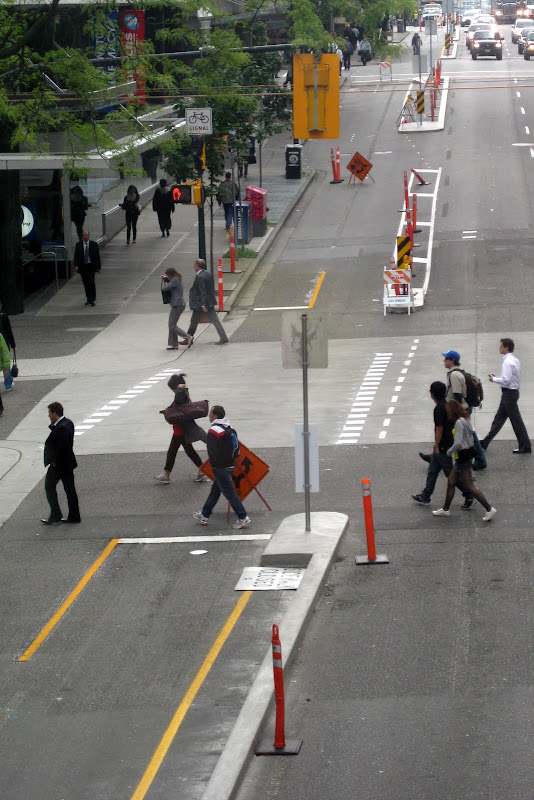
My photo, June 3.


Full Size
Reply With Quote
     
     
  #759  
Old Posted Jun 4, 2010, 6:18 PM
officedweller officedweller is offline
Registered User
 
Join Date: Jul 2001
Location: Vancouver
Posts: 41,792
Quote:
Originally Posted by Locked In View Post
Thanks for the pic.

You can see that there's no concrete curb at the alley (just past the Shpoppers Drug Mart), so a truck turning right onto Dunsmuir or turning left onto Dunsmuir from The Bay's loading dock (off pic to the right) won't have a curb to contend with - but it does seem a bit "undefined" there - maybe there'll be planters placed there??

Anyone know how the lane is signed so that right turns from southbound Beatty, Cambie, Hamilton, Richards and Howe know not to turn into the double width bike lane but to go around it (esp. at night)? Or are those movements prohibited?
Looking at the signs (typical island and hazard signs) - they may not be visible from a right angle (side street) view.
Maybe a curved dashed line marked on the roadway?
Or maybe there should be a bollard on the bike lane yellow line (but that could be hazardous for cyclists at night)?

Last edited by officedweller; Jun 4, 2010 at 6:28 PM.
Reply With Quote
     
     
  #760  
Old Posted Jun 4, 2010, 7:07 PM
tybuilding tybuilding is offline
Registered User
 
Join Date: Sep 2009
Posts: 898
Quote:
Originally Posted by officedweller View Post
Thanks for the pic.

You can see that there's no concrete curb at the alley (just past the Shpoppers Drug Mart), so a truck turning right onto Dunsmuir or turning left onto Dunsmuir from The Bay's loading dock (off pic to the right) won't have a curb to contend with - but it does seem a bit "undefined" there - maybe there'll be planters placed there??

Anyone know how the lane is signed so that right turns from southbound Beatty, Cambie, Hamilton, Richards and Howe know not to turn into the double width bike lane but to go around it (esp. at night)? Or are those movements prohibited?
Looking at the signs (typical island and hazard signs) - they may not be visible from a right angle (side street) view.
Maybe a curved dashed line marked on the roadway?
Or maybe there should be a bollard on the bike lane yellow line (but that could be hazardous for cyclists at night)?
Looks great but I am kind of surprised that the yellow centre line is not continous between the intersections. I would of expected that.
Reply With Quote
     
     
This discussion thread continues

Use the page links to the lower-right to go to the next page for additional posts
 
 
Reply

Go Back   SkyscraperPage Forum > Regional Sections > Canada > Alberta & British Columbia > Vancouver > Transportation & Infrastructure
Forum Jump


Forum Jump


All times are GMT. The time now is 9:12 PM.


Powered by vBulletin® Version 3.8.7
Copyright ©2000 - 2026, vBulletin Solutions, Inc.