Quote:
Originally Posted by c-way-dude

I do not believe that the CFL would accept a stadium that did not have at least 25000 permanent seats.
The reason that I believe a stadium could be built for less than $100 million is the fact that the Commonwealth Games stadium had an initial cost of $109 million including 15000 temporary seats. From the artist's conception, it looked like very little, if any, of the stadium was "sunken". The stadium seemed to feature 25000 permanent seats along the sidelines, with the temporary seats behind the end zones.
Money could be saved using a sunken bowl. Less support structure would be needed if the stadium were bowl or horseshoe-shaped. There would be fewer seats along the sidelines, and they would not be nearly as high. I figure something along the lines of old Varsity Stadium in Toronto ( horseshoe-shaped with about 27000 seats), or something like BC Place Stadium without the upper deck or roof (about 29000 seats). The Lions closed off the upper deck of BC Place for a few years and still were able to get by. The Argos also closed off the upper deck at SkyDome for a few years.
Any temporary seats that would have to be added to host a Grey Cup could affordably be put around the existing stadium, as the top of the stadium would be at, or just slightly above, ground level.
|
This would be the cheapest design and depending on the design I think that it could be done for far less than $100 million. A compact stadium will cost far less per seat than a massive 50,000 seat stadium since all the extra ramps and exterior walls will greatly add to the cost (a very good book on this is "Stadia" by Geraint John et al. which can be ordered from Amazon.com,
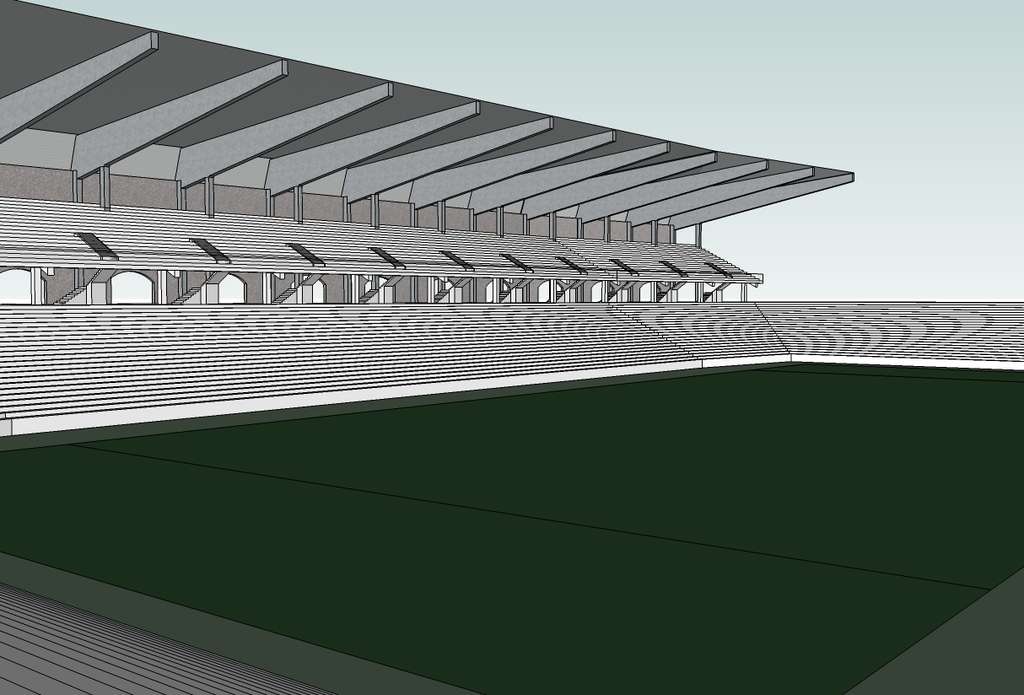
http://www.amazon.ca/gp/product/07506684...WYIK6Y9EEQB&pf_rd_r=1TDP6ZTGK8FWZYB18RFD ). A sunken bowl with 30 rows and a complete bowl would seat about 30,000. This is especially advantageous if there is a sunken location available to save excavation cost. Even without a sunken location, it is advantageous since the stadium will likely be built on top of bedrock and then loose soil is not a problem as it has been with SMU Huskies stadium. I am working on a couple more 3-D designs based on this principle (I enjoy it as a hobby and I think that it a good way to get people's opinions on a suitable stadium design). One thing that I realize from doing the 3-D model is that as the number of rows in the sunken bowl increases then the width and length of the stadium must also increase since there must be space at the top for washrooms and movement of spectators. If the site width is limited then it is better to have only 20 - 22 rows sunken and then have 14 - 16 rows raised with washrooms and concourse below the upper tier of seats. This increases the cost but in order to have the stadium in a central location it might be required. It will also provide an area for luxury and media boxes plus the required wheelchair access area. Having a 3-D conceptual models allows me to basically sit (virtually) in the 3-D model and check to see if there are obscured views in various seats.
Very detailed computer models can be drawn with every nut and bolt included. Such a detailed model can then be analysed with FEA (Finite Element Analysis) computer programs that can calculate stresses in various structural members. This would take months of work but this is something that the city could start without it costing a lot of money. They could also set up a site selection committee without it costing much money (if current city staff is used). In fact the site really needs to be selected before the detailed model can be drawn since the design will most likely depend on the site selected. (I am designing a conceptual model based on the Windsor and Young DND location which in the end might not be available). What would really give me hope for an HRM stadium (along with many thousands of other sports fans and concert-goers) would be if they selected a site and then spent the money required to purchase it.
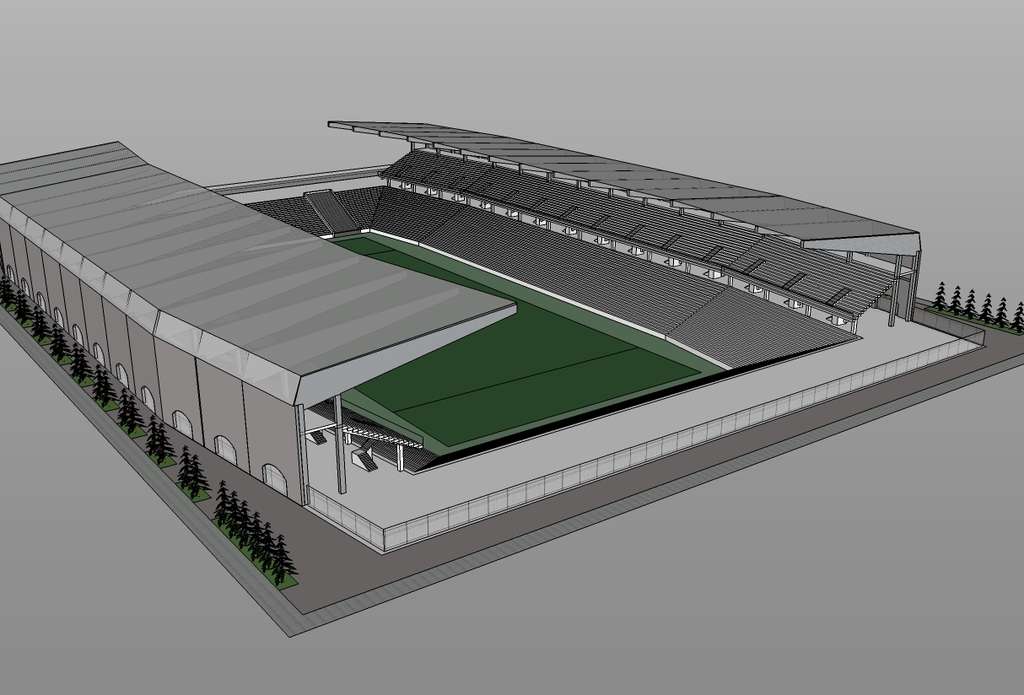
I have attached an image of a sunken bowl of 22 rows, and 16 raised on each sideline. This isn't an elaborate stadium but I think that it could be economically built. By adding some exterior precast concrete archways it is slightly more presentable. It would seat about 28,000 with room in the endzone area for about another 7 - 8,000 for large events. I have drawn it so that the field would be large enough for international soccer and a Canadian size football field. The reason for the octagonal shape is that it is more compact than an oval. The Carrier Dome has a similar octagonal shape (
http://www.webtickets.com/SeatingCharts/NewYork/CarrierDomeSyracuseOrangemen.asp ). The reason for slanting the endzone corner seats (instead of a rectangle) is to allow for easier viewing of action far down the field.
I have a question for the people who attended the CFL game at Huskies Stadium: were the end zones seats poor seats? I have drawn the stadium with the end zones complete in the lower bowl; being such a compact stadium model maybe some people would like end zone seats close to the action (you can't get any closer as far as touchdowns go).
At the top of the second tier (under the roof) there is additional room for sky boxes or another row of seats without much obstruction. In this model, the wheelchair accessible area is between the lower and upper tier of seats and would be directly accessible from street level. I have uploaded a copy of the model to Google 3D Warehouse. If anyone is interested in getting the Google Sketchup 3D model you will need the Google Setchup program to open it but you can obtain the legal free version at
http://sketchup.google.com/ . Once you have the Sketchup program, open it and then go to the download model section and search for Halifax, Nova Scotia Stadium. With the Sketchup program you can virtually walk through the model and position a camera at various points in the 3-D model. You will also be able to make changes to the model.





 Prev
Prev


 Linear Mode
