HomeDiagramsDatabaseMapsForum About
     

Go Back   SkyscraperPage Forum > Discussion Forums > Transportation


Reply

 
Thread Tools Display Modes
     
     
  #461  
Old Posted Nov 24, 2009, 5:55 PM
Bootstrap Bill Bootstrap Bill is offline
 
Join Date: Sep 2009
Posts: 366
When do they expect to begin construction on the Downtown Connector?
Reply With Quote
     
     
  #462  
Old Posted Nov 25, 2009, 6:10 PM
dktshb's Avatar
dktshb dktshb is offline
 
Join Date: Jun 2005
Posts: 5,145
I am also curious if there is a start date yet for when they're going to start construction on the streetcar down Broadway in additon to the Downtown Connector.
Reply With Quote
     
     
  #463  
Old Posted Nov 26, 2009, 4:54 PM
bmfarley's Avatar
bmfarley bmfarley is offline
 
Join Date: Nov 2005
Posts: 1,302
Quote:
Originally Posted by northbay420 View Post
just a guess: maybe people are just trying to ride it to union station and figure theyre not gonna get caught for such a short distance.

the regional connector as shown in that map posted by wonderlandpark will obviously greatly enhance service. here is a map that metro has on their website showing some interlining:


http://www.metro.net/projects_studies/connector/default.htm

it says "conceptualized" so i guess its not set in stone.

EDIT: i just realized that this map really isnt any different than the first, except for the gold line. it shows little tokyo as a possible transfer point.
That map forwards a service concept I have never heard of before; however, it's obvious when one considers the opportunities.

Prior was the following:
- Long Beach to Pasadena
- Santa Monica to East LA

This map shows the above, PLUS:
- Pasadena to east LA (Gold Line today)

Other possible services could be:
- Santa Monica to Pasadena
- East LA to Long Beach
- Long Beach to Santa Monica

Last edited by bmfarley; Nov 29, 2009 at 9:39 PM.
Reply With Quote
     
     
  #464  
Old Posted Nov 26, 2009, 5:03 PM
bmfarley's Avatar
bmfarley bmfarley is offline
 
Join Date: Nov 2005
Posts: 1,302
Quote:
Originally Posted by edluva View Post
exactly, so what's this fear about little tokyo station getting tons of transfer traffic. unless it's your destination, you're not getting off there.
Yes, is incorrect thinking from my understanding.

Anyone getting on a light-rail line at Union Station... and heading south, will go through downtown via the Connector project. If folks want to go to East LA from Union Station... those folks would need to transfer.... based on prior communications.


An LA Times piece commented on the low number of riders on the extension in the first week.... I am sure it's too early to tell what it will eventually be, but nevertheless, that is kinda telling, "Is a direct line from Pasadena to East LA really necessary?" And, "Could it be better served by the Santa Monica line running to East LA - as planned?"

Last edited by bmfarley; Nov 29, 2009 at 9:41 PM.
Reply With Quote
     
     
  #465  
Old Posted Nov 26, 2009, 11:59 PM
LosAngelesBeauty's Avatar
LosAngelesBeauty LosAngelesBeauty is offline
 
Join Date: May 2004
Posts: 6,610
Some of the lower ridership numbers from East LA are attributable to bus users who are not familiar with rail, and may be intimidated by it. For example, I talked to a lady in East LA who would not go on the new Gold Line, who insisted on riding the bus. She said "I don't do trains." Since so many in East LA are transit dependent, you would THINK more would be riding this new Gold Line by now. However, they may still be riding the buses because that's what they're used to right now.

This doesn't mean that it won't slowly change. All it takes is to ride the train once to get over the novelty and shock factor.
Reply With Quote
     
     
  #466  
Old Posted Nov 27, 2009, 7:03 PM
sopas ej's Avatar
sopas ej sopas ej is offline
 
Join Date: Jul 2007
Posts: 8,220


I wouldn't doubt that it's a cultural and generational thing, too. I figure some of them just don't wanna go beyond their own neighborhoods or try new things, and/or like you said, there are some people who for whatever reason are intimidated by the train. However on my recent last few outings on the Gold Line, I feel like I'm seeing more Latino teenagers on it, but not older Latinos. I think younger people are more "adventurous" and so are more willing to take the train and explore.

But yeah, I'm sure that the people who are intimidated by the train, once they take it, they'll be hooked.
Reply With Quote
     
     
  #467  
Old Posted Nov 28, 2009, 2:15 AM
suga suga is offline
 
Join Date: Oct 2006
Posts: 535
Quote:
Originally Posted by LosAngelesBeauty View Post
Some of the lower ridership numbers from East LA are attributable to bus users who are not familiar with rail, and may be intimidated by it. For example, I talked to a lady in East LA who would not go on the new Gold Line, who insisted on riding the bus. She said "I don't do trains." Since so many in East LA are transit dependent, you would THINK more would be riding this new Gold Line by now. However, they may still be riding the buses because that's what they're used to right now.

This doesn't mean that it won't slowly change. All it takes is to ride the train once to get over the novelty and shock factor.
It has more to do with where the bulk of latino eastsiders travel to in downtown than an aversion to rail transit. The esgl does not go directly into dtla, but curves northward to union station. The bulk of east la public transit users are going much further south to the area where all busses intersect, around broadway (which has a lot to do with its history and vibrant atmosphere) and 7th in the historic core further south.' That is also why the pasadena goldline has done a lackluster job of attracting pt dependent highland park residents and weening them off the fig bus (altho the ave 57 stop is the busiest in the system), because the fig bus goes deeeper into dtla where most latinos are headed.

plus the train is just as slow as the bus for now, and the stops are farther spaced than a bus and inconvenient, especially for elderly and disabled riders.

I still think the train will garner high ridership numbers, as the social dynamic and built environment respond to this new amenity. Fig in HP is a lot more bustling and happening now, it just took a while. Once the dt connector is operating things will be much different.
Reply With Quote
     
     
  #468  
Old Posted Nov 28, 2009, 7:30 AM
LAofAnaheim LAofAnaheim is offline
 
Join Date: Aug 2007
Posts: 761
I think suga got it right..it's not the "intimidation" factor. Heck, I talked to couple of passengers on Wednesday evening, and the GLEE has saved them 1 transfer, so they take that instead. Just like suga said...the problem is that the GLEE does not go directly to where the Eastsiders want to go..and that's the Broadway corridor in DTLA. It's not "intimidation". The 30/31, which follow the last five new stops (i.e. Little Tokyo to Indiana) are a more convenient option than taking the train.

Heck, I would love to take the Red/Orange Lines to Warner Center from DTLA, but I don't because the Commuter Express 422 is more convenient. That doesn't mean I'm intimidated..it's due to being a rationale transit user who will take the best option. Commuter Express 422 saves me 25 minutes over Red/Orange Line combination.
Reply With Quote
     
     
  #469  
Old Posted Dec 1, 2009, 2:01 AM
orulz orulz is offline
 
Join Date: Jul 2003
Posts: 592
Quote:
Originally Posted by LAofAnaheim View Post
If you read the article...Little Tokyo's concern is moreso about the visual of trains constantly rolling over 1st and Alameda...not the concern "under 2nd street". From the meeting I went to two weeks ago in the Japanese American museum (anybody here go?), Little Tokyo wants transit improvements, but totally grade seperated and primarily underground. This new proposal by the MTA sounds like they have responded to Little Tokyo's concerns.

Re-read the last sentence in the LA Times article: "The new plan is still simply a rough concept, but it has thrilled Uyeda and other members of a Little Tokyo working group, all of whom are on the community council. Last week, they and others voted to recommend approval of the new idea by the council board. "
Don't think this was already posted, but I might have missed it. Here's more on the plan.


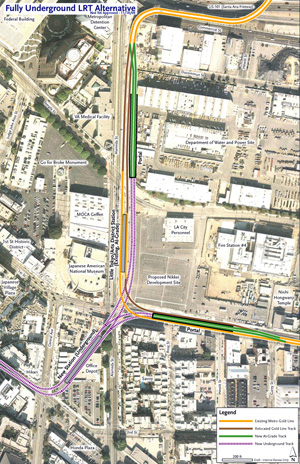
This seems fairly realistic and buildable. It would cost $200 million extra. I can see a couple downsides as implemented above, though. For one, the grade crossing at Temple is retained. Also, if someone were boarding or transferring at Little Tokyo, going towards East LA or Union Station, there are two platforms to choose from. A transferring passenger would have to choose which platform to go to for the next train, but the next train might actually go to the other platform. Reliable next train indicators could alleviate this.

I thought of another possibility to fix this: one platform for each destination, with a mezannine built over the wye where the trains interchange between tracks. Here is an illustration. The downside is that all transferring passengers would have to walk about 50 yards to make their transfer, rather than the situation under the plan above where some have to walk but some can just go cross-platform. The certainty of ALWAYS being able to catch the very next train in the direction you want to go would probably be worth the extra walk. This plan would probably cost more, and it would eliminate the existing Little Tokyo station and replace it with an underground one, which might ruffle a few feathers. It also might have other problems such as construction impacts, constructability, or operational issues that I haven't forseen as well.

Last edited by orulz; Dec 1, 2009 at 2:21 AM.
Reply With Quote
     
     
  #470  
Old Posted Dec 1, 2009, 6:14 PM
KVNBKLYN KVNBKLYN is offline
 
Join Date: Aug 2007
Posts: 347
Quote:
Originally Posted by orulz View Post
I thought of another possibility to fix this: one platform for each destination, with a mezannine built over the wye where the trains interchange between tracks. Here is an illustration. The downside is that all transferring passengers would have to walk about 50 yards to make their transfer, rather than the situation under the plan above where some have to walk but some can just go cross-platform. The certainty of ALWAYS being able to catch the very next train in the direction you want to go would probably be worth the extra walk. This plan would probably cost more, and it would eliminate the existing Little Tokyo station and replace it with an underground one, which might ruffle a few feathers. It also might have other problems such as construction impacts, constructability, or operational issues that I haven't forseen as well.
Personally, I think your idea makes the most sense. A lot of transit planning in LA seems to be based on "where can we fit this" rather than "how will people use this." Being able to wait at one platform for all trains heading in your direction is definitely a better idea from the point of a user. And having an underground transfer mezzanine would work much better than a half-outside, half-underground station where people might have to cross a busy intersection just to change trains.
Reply With Quote
     
     
  #471  
Old Posted Dec 2, 2009, 3:35 PM
202_Cyclist's Avatar
202_Cyclist 202_Cyclist is offline
 
Join Date: Feb 2009
Posts: 6,450
L.A. Mayor Antonio Villaraigosa announces electric vehicle infrastructure plan

I support the effort to promote electric vehicle use but providing free parking to the owners of these cars undermines the goals of electric vehicles--reduced energy consumption and lower emissions. Free parking lowers the cost of driving, leading to more vehicle miles traveled. This leads to more congestion and increased fuel use for the other cars on the roads and highways. Rather than providing free parking, an incentive such as an income tax rebate would be more effective for encouraging sustainable transportation.

----------------------------------------------------------------------

L.A. Mayor Antonio Villaraigosa announces electric vehicle infrastructure plan

Along with partners, the city plans to update 400 existing charging stations around the region and add 100, he says.
By Tiffany Hsu

December 2, 2009
LA Times

http://www.latimes.com/business/la-fi-electric-cars2-2009dec02,0,5318829.story

By this time next year, electric vehicles could be popping up all around Los Angeles, and the "quintessential city of sprawl" plans to be ready, Mayor Antonio Villaraigosa said Tuesday.

Along with a network of partners, the city plans to update 400 existing charging stations around the region while adding 100, Villaraigosa said. Electric vehicle owners also probably would receive tax rebates to construct home chargers and would have access to high-occupancy-vehicle lanes and preferential or free parking.

"Every year we read with consternation that we're either No. 1 in traffic congestion or No. 1 in air pollution," the mayor said during a news conference at the Los Angeles Convention Center, as workers inside prepared for the L.A. Auto Show, which starts Friday. "We realized that we needed to find new, cleaner ways to travel."

Villaraigosa painted a rosy portrait in which the newelectric vehicle infrastructure would lure battery and charging station manufacturers to Los Angeles, create masses of green jobs and reduce reliance on foreign oil.

The plan would also spur investment in local clean-tech ventures, said Linda Adams, secretary of the California Environmental Protection Agency.

City officials will attempt to streamline the permitting and inspection process for the new charging stations, according to the plan. To encourage more plug-in options, local building codes and standards could be revised, and utilities will develop a specialized customer service process to deal with electric vehicle owners.

Though not all the costs and funding sources associated with the collaboration have been finalized, Villaraigosa estimated that about $10 millionwould go to fund incentives of as much as $2,000 each for the first 5,000 residential customers looking to build home chargers. Purchasing electric vehicles for the city fleet would run an additional $6 million.

Partners in the plan include Southern California Edison Co., the Los Angeles Department of Water and Power, Nissan Motor Co., General Motors Co., Ford Motor Co. and the cities of Burbank, Pasadena, Santa Ana and Santa Monica.

The effort to construct a foundation to support electric cars is an "audacious task," Villaraigosa said. But it is crucial to prepare for the expected influx of thousands of electric vehicles, he said.

"Are we ready today? No," he said. "Are we going to be ready? We have to be. The car culture started here, and it's here that the new generation of vehicles should also begin."
Reply With Quote
     
     
  #472  
Old Posted Dec 2, 2009, 6:12 PM
JDRCRASH JDRCRASH is offline
 
Join Date: Mar 2007
Posts: 8,100
Quote:
Originally Posted by orulz View Post
This plan would probably cost more, and it would eliminate the existing Little Tokyo station and replace it with an underground one, which might ruffle a few feathers.
That shouldn't be because some might consider it a waste, because the DRC won't be built AT LEAST till 2019, 10 years after the GLEE was completed and the existing Little Tokyo station became operational.
Reply With Quote
     
     
  #473  
Old Posted Dec 4, 2009, 10:39 PM
KVNBKLYN KVNBKLYN is offline
 
Join Date: Aug 2007
Posts: 347
From http://thesource.metro.net/:

Quote:
Update on Eastside Gold Line ridership
Posted by Steve Hymon on December 3, 2009 - 10:15 am

In his daily email to employees, Metro CEO Art Leahy had this nugget about ridership in the first week on the new Eastside Gold Line:

"The Metro Gold Line Eastside Extension began revenue service on Monday, November 16, 2009. Passenger activity for the first week of operations averaged about 11,000 daily boardings. Roughly 33% of passengers rode through Union Station. The most heavily used stations were Union Station and Atlantic, followed by Little Tokyo/Arts District and Soto."

I think it’s worth noting a couple of things about this.

First, Metro’s own projections are that the new Gold Line will carry about 13,000 riders each weekday by the end of the first year of operations. To help reach that goal, Metro officials say they plan to continue aggressively marketing the line.

Second, my own experience as a former print reporter and now a Metro employee are that ridership projections are basically educated guesses. Nearly all the ones that I’ve encountered over the years have proven over time to be wrong. Some are too low, some are too high. So I tend to view one week’s worth of numbers as mildly interesting — although it’s always good to monitor trends over time.
Reply With Quote
     
     
  #474  
Old Posted Dec 4, 2009, 11:11 PM
Quixote's Avatar
Quixote Quixote is offline
 
Join Date: Apr 2006
Posts: 7,652
^ You're — kidding me, right? It turns out they have been updating the website, after all. I had The Source bookmarked under the old URL address, so I was scratching my head up until now as to why Steve and Fred hadn't provided any updates since early last week. They should've given us a heads up that the URL address was going to change.

As for the GLEE's ridership, Eastsiders are still getting acquainted with the train. That figure is still disappointing, though, as I was expecting a number much higher than that. I guess it makes sense since the line curves north to Union Station, rather than travel into the heart of Downtown. Where's that Regional Connector?
Reply With Quote
     
     
  #475  
Old Posted Dec 4, 2009, 11:16 PM
WonderlandPark's Avatar
WonderlandPark WonderlandPark is offline
 
Join Date: Mar 2006
Posts: 4,127
The El Monte Busway is being renamed into the Silver Line, this was proposed a few years back as I recall, guess it is now official:

Meet the Silver Line
New line will have frequent direct connections to downtown landmarks
By SCOTT WEBER
Updated 4:00 PM PST, Thu, Dec 3, 2009

Print Email Share Buzz up! TWITTER FACEBOOK

Gold, purple, blue, and now silver.

The Silver Line, a new bus service connecting the San Gabriel Valley and South Bay via downtown Los Angeles, will begin operating later this month, the Metropolitan Transportation Authority announced Thursday.

Starting Dec. 13, the Silver Line will operate between the El Monte Station and the Artesia Transit Center via the Harbor Transitway on the Harbor (110) Freeway and the El Monte Busway on the San Bernardino (10) Freeway.

It will have frequent, direct connections to downtown landmarks such as the Staples Center, Walt Disney Concert Hall, L.A. Convention Center, CalState Los Angeles, and more. L.A. Live, California Science Center, USC, L.A. Coliseum, and other work, school, shopping and dining centers.

It will operate every 5 to 15 minutes during rush hour. Base cash fare is $2.45 one way, $1.15 for senior/disabled cash fare during peak times, and $0.85 cents in off-peak times.

Metro Day Passes will be honored as base fare, and Metro weekly, monthly and EZ transit passes will be accepted with an additional $1.20 charge when boarding.

The Silver Line will replace the Metro Express Bus lines 444, 446/447, 484, and 490, which will be rerouted.
Reply With Quote
     
     
  #476  
Old Posted Dec 4, 2009, 11:24 PM
JDRCRASH JDRCRASH is offline
 
Join Date: Mar 2007
Posts: 8,100
Maybe they'll rename it if the El Monte to Hollywood LRT is ever built.
Reply With Quote
     
     
  #477  
Old Posted Dec 8, 2009, 5:49 AM
KVNBKLYN KVNBKLYN is offline
 
Join Date: Aug 2007
Posts: 347
Delays on the Expo Line, from the LA Times:

Quote:
Expo Line project costs and delays are ballooning

The rail line from downtown L.A. to Culver City is $220 million over budget and a year behind schedule. Officials hope to open part of the route next year.

By Ari B. Bloomekatz

December 7, 2009 | 7:22 p.m.

The Expo Line, the first rail project into the traffic-clogged Westside, is $220 million over its original budget and more than a year behind schedule, with officials saying additional delays and costs are possible.

The line was supposed to open this summer, running from downtown Los Angeles to Culver City at a cost of $640 million.

But the price tag has risen to $862 million, and transit officials say their goal for next year is to open just a portion of the route -- only as far west as Crenshaw Boulevard.

It is unclear what the ridership for such a short line would be, but it probably would be considerably less than the full run to Culver City. Officials are unsure when the Expo Line will reach Culver City or how much the total cost will be upon completion.

Richard Thorpe, chief executive of the Exposition Line Construction Authority, said that although he hopes $862.3 million will be the final price tag, the project possibly could need tens of millions of additional dollars.

The construction authority, which is building the line, receives its money through the Metropolitan Transportation Authority and has contracted with a group of construction firms to perform the work.

The firms and the construction authority are at odds over which is responsible for some of the project's delays. Depending on how that dispute is resolved, it could further raise the project's cost, officials said.

The 8.6-mile line has been touted by planners as a fast and cost-effective route for rail service to the Westside because it is being built mostly on an abandoned Southern Pacific right-of-way.

But a variety of factors have held up what was supposed to be a relatively quick project and added to the costs. Among them: construction delays where the Expo and Blue lines meet on Flower Street, the decision to add a station at USC and safety improvements required next to public schools along the route.

The problems with the Expo line come at a difficult time for the MTA, which is now trying to build new rail lines with federal money and revenues from a transportation sales tax that L.A. County voters approved last year.

MTA officials said they do not yet know how the agency will pay for more Expo Line costs if needed or whether those costs would eat into money slated for other projects, which include a subway along Wilshire Boulevard and an extension of the Gold Line east into the San Gabriel Valley.

The delays are prompting concern from communities along the route and elsewhere on the Westside, which was supposed to be a main beneficiary of the Expo line.

Westside officials said they are reconsidering how to build the western portion of the line given the problems with the first construction phase.

"The contracting process is going to be done very, very differently," said Culver City Councilman Scott Malsin, who is on the Expo Line Construction Authority board.

Officials said they lack a breakdown on what the cost increases could be, but reports from the construction authority have said that "there are a number of areas that pose significant risk to the budget."

One of the more vexing problems is occurring where the Expo and Blue lines meet near the Los Angeles Convention Center. Planners originally believed that tying the two lines together would not be a major effort.

But officials said the section was delayed initially because the design was incomplete and was delayed further when portions of the existing track needed to be replaced because of inadequate Blue Line track insulation, in addition to other changes requested by officials.

[...]

Some of the projected cost savings are now coming into question.

The project jumped from $640 million to $862.3 million because of a variety of change orders, additions and increases in material costs.

In September 2007, the MTA board approved $22.3 million for extra work on the Blue and Expo line hookup, safety enhancements and a new USC station.

MTA approved another $145 million because of increased construction costs and later approved $54 million to build an elevated station in Culver City. Thorpe said the original plan called for a temporary station in Culver City, with an elevated platform planned for later. Officials decided that it made more sense to build the elevated platform right away.

Though no specific date has been set, officials hope to have the Culver City station running by the end of 2011 or the beginning of 2012.

[...]
http://www.latimes.com/news/local/la-me-expo-line8-2009dec08,0,3319496,full.story

The tone of this article is a little misleading. An increase in costs for increased scope is not a bad thing. Skyrocketing costs for the same end product, that would be a problem. But as the author notes, the cost of the project has gone up mostly because of significant additions and improvements to the project, ie, building an elevated station at Culver City now rather than later and adding another station near USC.
Reply With Quote
     
     
  #478  
Old Posted Dec 8, 2009, 7:15 AM
electricron's Avatar
electricron electricron is offline
 
Join Date: Aug 2008
Posts: 3,616
Lightbulb

Quote:
Originally Posted by KVNBKLYN View Post
The tone of this article is a little misleading. An increase in costs for increased scope is not a bad thing. Skyrocketing costs for the same end product, that would be a problem. But as the author notes, the cost of the project has gone up mostly because of significant additions and improvements to the project, ie, building an elevated station at Culver City now rather than later and adding another station near USC.
I disagree. I'm okay with higher costs because of increased scope, but I'm not okay with the increased scope. A properly designed proposed corridor which the public voted for increase taxes shouldn't need revising. Changing the design or scope means the public didn't actually vote for the rail project they're getting.

If you saw an advertisement for a brand new car for $20,000 and all you found at the dealership were brand new cars for $25,000, you'll be complaining about the baiting and switching tactics used by the dealership. Well, isn't that the same thing Metro has done?

Taxpayers deserve better planning and designing initially.

Now, I think it is far more palatable if materials prices had increased causing the project to go over budget. It's not easy to predict what the future prices of materials will be because the economy is unpredictable. But the blueprints/building plans shouldn't be varying by much once the design is set in stone. Constantly changing the design is a sure fire way to blow any construction budget and should not be tolerated as being normal.
Reply With Quote
     
     
  #479  
Old Posted Dec 8, 2009, 9:30 AM
DJM19 DJM19 is offline
 
Join Date: Jan 2005
Posts: 2,543
The public certainly went to meetings where the plan was discussed at length (including the potential of these additional improvements), but they didn't really vote on it, or on a tax specifically for it. We do have a sales tax for select transit projects, but theres still some flexibility with it. Nothing is set in stone and voters are not being betrayed or misled (yet, anyway)
Reply With Quote
     
     
  #480  
Old Posted Dec 10, 2009, 8:14 PM
Quixote's Avatar
Quixote Quixote is offline
 
Join Date: Apr 2006
Posts: 7,652
Today's a busy day at the Metro Board of Directors meeting. The two most noteworthy items on the agenda are the Harbor Subdivision and Crenshaw Corridor. The Board just voted to carry the Harbor Subdivision into the DEIS/DEIR phase.

Green Line Extension Advances to More Study

By Steve Hymon
December 10, 2009

The Metro Board of Directors just voted to launch a draft environmental study of extending the Green Line 4.6 miles from Redondo Beach to the Torrance Regional Transit Center and to call the project the South Bay Green Line Extension.

...
Reply With Quote
     
     
This discussion thread continues

Use the page links to the lower-right to go to the next page for additional posts
 
 
Reply

Go Back   SkyscraperPage Forum > Discussion Forums > Transportation
Forum Jump


Forum Jump


All times are GMT. The time now is 5:41 AM.


Powered by vBulletin® Version 3.8.7
Copyright ©2000 - 2026, vBulletin Solutions, Inc.