HomeDiagramsDatabaseMapsForum About
     

Go Back   SkyscraperPage Forum > Discussion Forums > Transportation


Reply

 
Thread Tools Display Modes
     
     
  #301  
Old Posted Oct 16, 2009, 3:26 PM
202_Cyclist's Avatar
202_Cyclist 202_Cyclist is offline
Registered User
 
Join Date: Feb 2009
Posts: 6,445
Santa Monica to experiment with parking psychology (LA Times)

Santa Monica to experiment with parking psychology

Consultants find the city doesn't need more spaces, it needs to change how they are used. New pricing model aims to promote walking, biking or busing, freeing up prime spaces for short-term shoppers.

By Martha Groves
LA Times
9:39 PM PDT, October 14, 2009

http://www.latimes.com/news/local/la-me-parking-experiment15-2009oct15,0,2933172.story?track=rss

Embracing a bold experiment to alter human behavior, Santa Monica is poised to raise parking rates on the city's most coveted downtown spots to discourage some motorists from using them.

The idea is to get people out of their cars and end what city leaders deem an ill-advised subsidy for public parking.

By boosting rates, officials intend to make the parking closest to the congested Third Street Promenade expensive enough that some visitors will instead walk, take the bus or park in more-distant garages. If it works, the city would benefit from smoother traffic flow, reduced pollution as fewer people cruise for spaces and a better return on land developed for public parking.

"What we're saying is: 'Parking's not free in Santa Monica anymore,' " said Councilman Bobby Shriver, who advocates changing the parking rules.

Santa Monica is one of several cities -- including Los Angeles, San Francisco and Washington, D.C. -- turning to market-based pricing in an effort to keep parking lots busy with paying customers while making alternatives such as walking, cycling or taking public transit more appealing.

But critics contend the proposed changes might chase customers away, a risky prospect in a city that depends heavily on sales tax dollars.

"Because of the economic climate, any reason to choose another place is one too many," said Kathleen Rawson, chief executive of the Bayside District Corp., the public-private partnership that manages the downtown business district.

Proponents of the pricing strategy say the opposite is more likely: higher rates will mean more open parking spots, which would appeal to rushed customers. Moreover, the motorist willing to pay higher rates is probably also willing to spend more in stores or leave bigger tips.

Santa Monica arrived at the market-based pricing idea when consultants hired to evaluate the need for additional downtown parking discovered something unexpected: The city actually had plenty. The problem was that visitors and employees were vying for the most convenient spots as hundreds or thousands of other outlying or privately owned spaces sat empty.

"We don't really need more parking downtown," said Santa Monica Mayor Ken Genser. "It's the way the parking is being used that's a problem."

The study found that downtown employees were parking and reparking in structures on 2nd and 4th streets near the promenade to take advantage of the two-hours-free policy, taking away spaces from potential customers. To Shriver, the study's key revelation was that municipal structures had essentially become subsidized parking for private-sector employees.

"The city policy in its public structures can't be that everybody who works on the promenade gets a free space," he said.

Santa Monica workers and residents have mixed views.

Anne Troutman, an architect who lives near the shops and restaurants, sees higher parking fees "as a necessary and gentle step . . . along the path toward reducing our dependence on cars." But she worries about the elderly volunteers at places such as the Santa Monica Bay Woman's Club, for whom even a small increase might prove a hardship.

Hilary Kenny, a bartender who uses the municipal garages, said the current two-hours-free policy is a big selling point for visitors. Higher rates, she said, would "discourage people who want to pop in to have a drink or go to a movie." However, she said $1 for the second hour would be "not so bad."

The consultants recommended the city rebuild and expand two existing structures near the promenade but forgo building 1,000 new spaces. The city had projected that new or replacement spaces would cost about $57,000 each.

"It's shockingly expensive," said Steffen Turoff of Walker Parking Consultants, which prepared the Santa Monica report. "From an environmental and financial perspective, it's a waste to build more when so many spaces in this area sit empty even during the busiest times of the week."

Cities indeed pay dearly to create and maintain free or inexpensive parking and devote a tremendous amount of land to it. Parking experts say the cost of building above-ground parking can range from $15,000 to $30,000 per space. Subterranean spaces can cost $25,000 to $70,000 each.

"We grow up thinking that somebody else should pay for parking," said Donald Shoup, a Yale-trained economist and UCLA urban planning professor who wrote "The High Cost of Free Parking," considered by many the definitive text on the subject. "The cost doesn't go away just because the driver doesn't pay for it."

Ideally, Shoup contends, a city would charge enough so that 85% of all parking spaces were occupied at any one time. If too many spaces are vacant, the price is too high. If no spaces are available, the price is too low.

Once Santa Monica city staff recommend a plan, perhaps by late this year, the City Council is expected to raise daily and nighttime rates and monthly parking fees and charge a dollar for the second hour of parking in garages. A full day of parking would rise from $7 to $9 and on-street parking meters from $1 to $1.50 per hour. Meters might be converted to accept credit cards.

Parking rates in downtown Los Angeles are generally higher. Meters in the most congested areas run $4 an hour, comparable to off-street parking; some other meters near the central districts cost $2 an hour. Most meters, however, are $1 an hour. Municipal lots vary, from a $4 flat rate to $6 per hour.

Under an agreement with the Bayside District Corp., the city also will explore a comprehensive program to make better use of private parking lots, a centralized valet system, public-transit incentives and shuttles to and from outlying garages. Rates at the newer Main Library and Civic Center lots might be reduced.

Santa Monica's discussion reflects a vexing reality -- that parking has an "unbelievable power . . . to shape and distort cities," said Ventura City Manager Rick Cole.

"It's illegal for a car to be homeless but not for people," he said. "As a result, we devote a huge amount of extraordinarily valuable real estate to asphalt and concrete and then we give it away."

Ventura, which does not charge for street parking, plans to install meters in January, three years after it first committed to market-based pricing. "You have to break the initial barrier of charging for parking," Cole said of the delay.

He speaks from experience. As mayor of Pasadena in the early 1990s, he helped broker a deal with Old Pasadena retailers that paved the way for paid parking. All the meter revenue went into area amenities, which strengthened demand, turning Old Pasadena into a municipal cash cow.

Turoff, the consultant who managed the Santa Monica project, said it comes down to simple tradeoffs: "Do you want a free space, or do you want to be able to find a space? Are you going to substitute desirable destinations for car storage? You'd lose the attraction, but everybody could park there."

Reply With Quote
     
     
  #302  
Old Posted Oct 20, 2009, 11:17 PM
Quixote's Avatar
Quixote Quixote is offline
Inveterate Angeleno
 
Join Date: Apr 2006
Location: Los Angeles
Posts: 7,652
Mayor's Effort to Fast-Track Westside Subway Faces Challenge

By Ari B. Bloomekatz
October 20, 2009

Mayor Antonio Villaraigosa’s efforts to fast-track the long-stalled Westside subway faced a challenge Tuesday when a bipartisan group of congressional representatives said the current plan is unlikely to get immediate federal funding.

Villaraigosa has been pushing to have the subway completed in 10 years, more than 15 years earlier than current estimates.

At his urging, the Metropolitan Transportation Authority board agreed to submit the subway expansion, as well as a plan to build a light-rail link through downtown, as the county’s two projects to compete against a national pool of federal funding.

But the 14 members of Congress who signed a letter released today said those two programs don’t have a good shot at immediately getting federal funding. Further, they said that L.A. County risks not get anything from the federal New Starts program unless it adds other regional rail proposals, including an extension of the Gold Line in the San Gabriel Valley and a rail line down Crenshaw Boulevard in South L.A. and the South Bay.

“We are very concerned that Los Angeles County is not positioning itself well to receive its fair share of New Starts funding in the near- and long-term,” the delegation wrote. “Metro’s current plan puts the County at risk of being out of the New Starts funding queue for several years, perhaps for the entire surface transportation reauthorization bill.”

The letter was signed by Reps. Adam Schiff (D-Burbank), David Dreier (R-San Dimas), Maxine Waters (D-Los Angeles), Jane Harman (D-Venice) and Diane Watson (D-Los Angeles), among others. The letter underscores a regional battle underway on the MTA board over which transit projects to pursue and how best to receive federal funding for those projects.

Villaraigosa, L.A. County Supervisor Zev Yaroslavsky and others are pushing to make the Westside a top priority. Officials have been trying to build the line for decades but have faced numerous barriers, including the estimated $5-billion or more price tag.

Other officials, however, have questioned the logic of only pursuing federal funding for the Westside extension and the regional connector, and say those projects – particularly the subway – are aimed at only pleasing one region while others are made to wait or build projects that are not as favorable.

For example, Los Angeles County Supervisor Mark Ridley-Thomas wants the Crenshaw/South Bay Transit Corridor to be built using light rail, not bus, and said that next month the MTA board will vote on which of the two options to implement. If that project, like the Westside subway, pursues federal funding, the light rail would be more plausible and it would even be possible to build the rail underground in some parts.

In response to the letter, Ridley-Thomas said that it means “that no one plan should dominate. No one rail line should dominate.”
Reply With Quote
     
     
  #303  
Old Posted Oct 21, 2009, 12:33 AM
Bootstrap Bill Bootstrap Bill is offline
Registered User
 
Join Date: Sep 2009
Posts: 366
24 hour rail service?

I understand the need for maintenance is keeping Metro (and others) from operating rail service 24/7.

Is daily maintenance really necessary? Could they get by with every other day? if so, they could operate shuttle service on a single track. The frequency of service might be once every hour or two, but it would be better than no service at all.

Why can't this work?
Reply With Quote
     
     
  #304  
Old Posted Oct 21, 2009, 1:41 AM
OhioGuy OhioGuy is offline
Registered User
 
Join Date: Jul 2004
Location: DC
Posts: 7,777
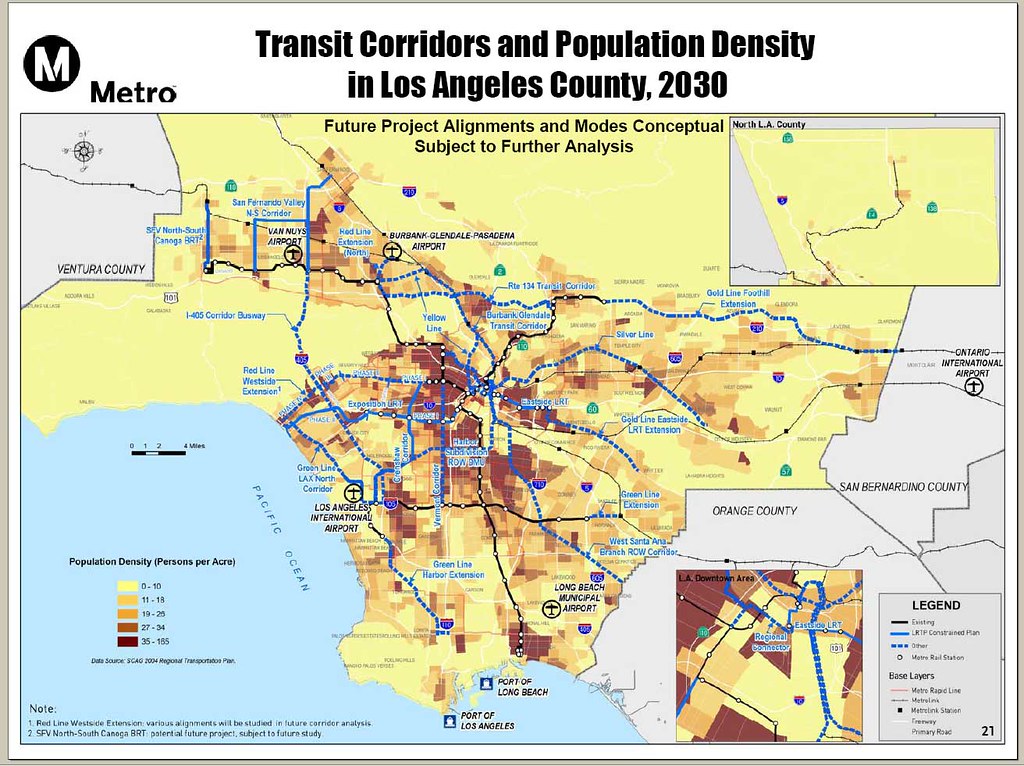
While I assume other versions of this map have probably been posted in this thread (I don't feel like sifting through it at the moment), I thought I'd post the "future" transit map that was posted on Curbed LA.

Reply With Quote
     
     
  #305  
Old Posted Oct 21, 2009, 2:06 AM
Quixote's Avatar
Quixote Quixote is offline
Inveterate Angeleno
 
Join Date: Apr 2006
Location: Los Angeles
Posts: 7,652
^ That map isn't complete. This is a better representation of Metro's long-term plans. Note, it doesn't include the colloquially named Pink Line, the refined Harbor Subdivision route, or the potential Crenshaw extension farther north.

Reply With Quote
     
     
  #306  
Old Posted Oct 21, 2009, 2:25 AM
dktshb's Avatar
dktshb dktshb is offline
Environmental Sabotage
 
Join Date: Jun 2005
Location: San Francisco/ Los Angeles/ Tahoe
Posts: 5,145
I think the Red Line needs to extend west there and meet up with the Purple line around La Cienega or Wilshire/Santa Monica. I don't see any plans for it to do that on that map. Otherwise, I would be in hog heaven if that map was reality now.
Reply With Quote
     
     
  #307  
Old Posted Oct 21, 2009, 2:56 AM
Bootstrap Bill Bootstrap Bill is offline
Registered User
 
Join Date: Sep 2009
Posts: 366
Quote:
Originally Posted by dktshb View Post
I think the Red Line needs to extend west there and meet up with the Purple line around La Cienega or Wilshire/Santa Monica. I don't see any plans for it to do that on that map. Otherwise, I would be in hog heaven if that map was reality now.
I'd make a few more changes to this dream system.

1. The Blue Line will turn 20 next year. It's almost at capacity. Plus, each trip takes nearly an hour. I think it's time to consider replacing the Blue Line with a subway. If possible, divert the line so that it serves Long Beach Airport/Boeing/Long Beach City College and the Lakewood Center mall.

2. Since the Green Line is totally grade separated, why not make it heavy rail, compatible with Red Line trains and connected it to the Blue Line subway described in 1.

3. The Purple Line should continue beyond Santa Monica and end at LAX. That would give a single seat subway ride from Downtown L.A. to LAX.

4.Green Line to Knott's Berry Farm, Disneyland/Anaheim Artic, maybe even John Wayne Airport (at OC's expense, of course...)

5. Red Line to Anaheim Artic and John Wayne Airport (elevated service, along I5). Again, at OC's expense. Easy access to Disneyland plus another regional airport.

6. Another downtown subway, maybe along Broadway?
Reply With Quote
     
     
  #308  
Old Posted Oct 21, 2009, 10:54 AM
202_Cyclist's Avatar
202_Cyclist 202_Cyclist is offline
Registered User
 
Join Date: Feb 2009
Posts: 6,445
Bootstrap_Bill:
Quote:
The Blue Line will turn 20 next year. It's almost at capacity. Plus, each trip takes nearly an hour. I think it's time to consider replacing the Blue Line with a subway. If possible, divert the line so that it serves Long Beach Airport/Boeing/Long Beach City College and the Lakewood Center mall.
There are only 41 flights per day (I think approximately 3M annual passengers) at LGB. I think this is probably insufficient activity to justify a costly extension of the Blue Line and a new station there.

Quote:
4.Green Line to Knott's Berry Farm, Disneyland/Anaheim Artic, maybe even John Wayne Airport (at OC's expense, of course...)
Is there planning for any type of local rail project such as this after OC nixed the CenterLine project a few years ago (http://74.125.113.132/search?q=cache-v-d079ECAJ:www.fta.dot.gov/documents/Orange1AA.doc+orange+county+AND+center+line&cd=6&hl=en&ct=clnk&gl=us)
Reply With Quote
     
     
  #309  
Old Posted Oct 21, 2009, 4:34 PM
Bootstrap Bill Bootstrap Bill is offline
Registered User
 
Join Date: Sep 2009
Posts: 366
Quote:
Originally Posted by 202_Cyclist View Post
Bootstrap_Bill:


There are only 41 flights per day (I think approximately 3M annual passengers) at LGB. I think this is probably insufficient activity to justify a costly extension of the Blue Line and a new station there.


Is there planning for any type of local rail project such as this after OC nixed the CenterLine project a few years ago (http://74.125.113.132/search?q=cache-v-d079ECAJ:www.fta.dot.gov/documents/Orange1AA.doc+orange+county+AND+center+line&cd=6&hl=en&ct=clnk&gl=us)
In my dream system, Long Beach airport would be served by a future Blue Line replacement subway, which would also serve Long Beach City College and Boeing, as well as the businesses surrounding the Long Beach Airport. That could be a significant number of people another 20 years.

Maybe the followup to the current Measure M could fund rail expansion into Orange County. I don't see this happening for at least another 20 to 30 years.
Reply With Quote
     
     
  #310  
Old Posted Oct 21, 2009, 5:15 PM
JDRCRASH JDRCRASH is offline
Registered User
 
Join Date: Mar 2007
Location: San Gabriel Valley
Posts: 8,100
One thing that I'd like to see changed is the "Yellow Line". It needs to continue on Glendale/Brand Blvd to Downtown Glendale, go west on Glenoaks to the Burbank Metrolink station, and finally, use the ROW to Lankershim Red Line, and ultimately, if it is converted to LRT, connect with the Orange Line.

As for Orange County, OCTA needs to be in charge of the Monorail system and make it a county wide system with lines to John Wayne airport with an extension to UC Irvine, Cal State Fullerton, Newport Beach, Buena Park, Fullerton (Metrolink station), Tustin, and Huntington Beach.

And all of these lines need to converge through a "connector at the Anaheim HSR station, as shown in the HSR renders.
Reply With Quote
     
     
  #311  
Old Posted Oct 22, 2009, 7:22 AM
LAdude's Avatar
LAdude LAdude is offline
Registered User
 
Join Date: Jul 2008
Posts: 18
Wow I can't believe there are politicians in LA County that are so shortsighted! There goes seeing a subway in the westside sometime before I turn 50. If the San Gabriel Valley and South Los Angeles politicians oppose asking for federal money, would this jeopordize the region from getting any Federal New Starts funding whatsoever??
Reply With Quote
     
     
  #312  
Old Posted Oct 22, 2009, 2:25 PM
202_Cyclist's Avatar
202_Cyclist 202_Cyclist is offline
Registered User
 
Join Date: Feb 2009
Posts: 6,445
Two transit editorials in the LA Times

Here are two transit editorials in the LA Times. One is from the Times editorial board and the second is from Reps. Chu, Schiff, and Dreier.


The right track;
Parochialism by L.A. County members of Congress could derail the Wilshire
Boulevard subway.

October 22, 2009
Los Angeles Times


Measure R, last year's ballot initiative raising L.A. County's sales tax to
fund transit improvements, was nearly defeated by politicians squabbling over
more money for their districts. Voters, fortunately, were wiser than their
representatives, and the measure prevailed -- but the parade of parochialism
isn't over. Rather than working as a team to secure federal funding, members of Congress from across the county are promoting hometown projects in a way that could end up derailing the far more worthy Wilshire Boulevard subway.

Fourteen members of Congress signed a letter Tuesday to the board of the
Metropolitan Transportation Authority, which meets today to vote on a plan
laying out spending priorities for the coming decades. The letter's aim was to
persuade the board to seek federal New Starts transit funds for three projects on the drawing board: the Gold Line's Foothill extension from Pasadena toward Claremont, another branch of the Gold Line from East L.A. toward Whittier, and a new light-rail line down Crenshaw Boulevard. Last month, the board unanimously opted not to pursue federal money for any of those projects, instead naming the Wilshire subway and a related project that better connects rail lines passing through downtown L.A as its priorities.

The MTA board's decision was logical. The downtown and Wilshire projects are in the densest part of the county, and their potential ridership dwarfs that of the other three. That makes them L.A.'s strongest entries in the fierce national competition for funding.

The letter's signatories argue that the money game is all about timing. The
subway won't be ready to collect federal money for at least five years, while
the other projects, most notably the Foothill extension, could be ready much
earlier. Why not try to drum up some cash for the Gold and Crenshaw lines now, and go for subway money later? The answer is that the federal government seldom funds more than one project in a city at a time; if the Gold Line were already being funded in, say, 2015, there would be little chance the subway would be funded. Moreover, the other three projects don't actually need federal funds -- all of them can be built with local money (albeit not as quickly, and perhaps not extending as far). The subway, though, cannot; without federal matching funds, there isn't enough sales-tax money to extend it. In other words, if the letter's signatories get their way, it will probably kill the subway and the downtown connector.

Local members of Congress would rather bring home the bacon for their
constituents than do what's best for the region -- which helps explain why L.A. has the nation's


Get federal funding for transit on track

There are several projects that could be left behind because the Metropolitan Transportation Authority is only focusing on two longer-range transit proposals.

By Judy Chu, David Dreier and Adam Schiff

LA Times
October 22, 2009

With the passage of Measure R last November, Los Angeles County's citizens made a $40-billion investment in transportation infrastructure that will create jobs, increase mobility to centers of commerce and neighborhoods, and make the region a more attractive destination. Voters overwhelmingly approved a sales-tax increase because they understood how much work needs to be done to stimulate our economy and reduce congestion. Now we need to leverage Measure R funds with a fair share of federal funding.

Despite our disproportionately large need, the county has received significantly less federal funding for transit projects than other metropolitan areas. Measure R cannot fully fund the many projects our county needs. We need federal funds to expand the pot, complete the vision and at the same time help the county's hard-hit economy.

Unfortunately, the Metropolitan Transportation Authority is putting many parts of the region at risk of being left behind by limiting the county's long-range federal "asks" to just two projects -- the Westside subway extension and light rail downtown to connect the Red, Purple, Blue and Gold lines. These are two crucial projects, but it is highly unlikely that federal funding can be allocated to them quickly. It usually takes seven to 10 years from the beginning of the application process for a subway or light-rail transit project to become eligible for federal dollars. In the meantime, the county should be making use of federal funds for other important projects, but in order to do that, the MTA has to include them in its federal funding request.

Along with a bipartisan group of 11 other Southern California members of Congress, we believe that these three projects could be ready to go in the short term:

* The Gold Line extension project east of Pasadena, from Azusa to Montclair. It is far enough along in development to receive federal transit funds before the Westside subway or the light-rail project downtown.

* The Crenshaw/South Bay Transit Corridor, a rail line that would connect Los Angeles International Airport with the Green Line and the Expo Line under construction between downtown and Culver City.

* The Gold Line extension from East L.A. to South El Monte or Whittier, an area that is expected to experience 30% population growth over the next 20 years.

Proponents of the current plan on the MTA board believe that, if we expand our current federal plan, it will pit projects against each other and none may be funded. We disagree. Requesting funds for multiple projects will bring more money into more parts of the county, and sooner rather than later. Other regions have been able to get federal funding for multiple projects and carry them out; we believe Southern California has the will and workforce ready to do so also.

At a time when unemployment is at a record high in our region, we must maximize the dollars coming into the county for good-paying jobs and needed infrastructure by being united as a region and in Washington. The only way that can work is if we do not close doors on some projects at the expense of others. Southern Californians need them all.
Reply With Quote
     
     
  #313  
Old Posted Oct 22, 2009, 8:42 PM
202_Cyclist's Avatar
202_Cyclist 202_Cyclist is offline
Registered User
 
Join Date: Feb 2009
Posts: 6,445
The 'Transport Politic' blog has an interesting article about the funding debate for the various rail extensions and investments in LA County: http://www.thetransportpolitic.com/2009/...omes-first/comment-page-1/#comment-11938
Reply With Quote
     
     
  #314  
Old Posted Oct 22, 2009, 9:56 PM
Quixote's Avatar
Quixote Quixote is offline
Inveterate Angeleno
 
Join Date: Apr 2006
Location: Los Angeles
Posts: 7,652
Metro Board Approves 2009 Long Range Transportation Plan, a 30-Year Blueprint for Transportation Development

October 22, 2009

The Los Angeles County Metropolitan Transportation Authority (Metro) Board of Directors has approved the 2009 Long Range Transportation Plan (LRTP) that will guide transportation development in the county through the year 2040, a period in which the county is expected to experience unprecedented growth.

The population of Los Angeles County is projected to grow by almost 3 million people over the next 30 years. The Long Range Transportation Plan (LRTP) examines the impacts this growth will have on the mobility of the county, which includes increasing demand on streets, highways, buses and trains, and it recommends what can be done to address those impacts within anticipated revenues.

The LRTP also includes new funding resources that include monies generated by the passage of Measure R, a new half-cent sales tax for LA County as well as federal stimulus dollars that will flow to the region under the American Recovery and Reinvestment Act of 2009 (ARRA).

The LRTP anticipates the collection and distribution of $298 billion countywide through FY2040 from all local, state, and federal transportation funding sources. The funds will be used for transit services, highway maintenance, and for the development of numerous transit and highway transportation improvement projects all over Los Angeles County.

Countywide bus and rail operations accounts for $106.5 billion (36%) of the uses forecasted by the plan and bus and rail capital uses account for $57.6 billion (19%) of the plan. Highway maintenance and improvements make up $94.4 billion (32%). Debt service accounts for $26.9 billion (9%) of the plan and other uses $12.6 billion (4%).

Some components of the recommended plan’s transportation program include:

Completion of the Eastside light rail project
Completion of the Exposition Light Rail project to Culver City
Phase II Exposition light rail to Santa Monica
Wilshire Boulevard Bus Rapid transit
Downtown Regional Connector (Blue & Gold Line connection)
The Crenshaw Corridor Transit project
San Fernando Valley North/South Metro Orange Line Canoga Extension
San Fernando Valley East North/South Rapidways
Eastside Light Rail Access (Pedestrian & Bicycle link)
Gold Line Foothill Light Rail Extension (Segment including vehicles & yard)
Green Line Extension to LAX
Westside Subway extension to Fairfax/Century City/Westwood
Gold Line Eastside Extension
Green Line Extension Redondo Beach Station to South Bay Corridor
San Fernando Valley I-405 Corridor Connection
West Santa Ana Branch Corridor
California High Speed Rail (Los Angeles County)

Some examples of highway projects in the LRTP include:

I-405 northbound carpool lane from I-10 to US-101
I-405 carpool lanes from SR 90 to I-10
I-5/State Route 126 interchange reconstruction phase I & II
SR-60 carpool lanes from I-605 to Brea Canyon Road
I-5/SR-14 carpool lane direct connector
I-5 carpool lanes from SR-118 to SR-170
I-5 carpool lanes from SR-134 to SR-170
I-10 carpool lanes from I-605 to Puente Ave & from Puente to Citrus avenues
I-5 Carmenita Road interchange improvements
I-5 carpool and mixed flow lanes from I-605 to Orange County Line
I-710 South and Route 710 North Gap Closure projects
Other highway improvements in various parts of the County

The LRTP also encourages more ridesharing, walking and bike riding, telecommuting and improved management of truck traffic and goods movement.

The LRTP is built on strategic financial projections of revenues from federal, state and local taxes and subsidies, as well as revenues from passenger fares, advertising, real estate rentals and other sources.

The approval of the 2009 LRTP does not constitute final Board action on individual projects. Projects will return to the Board for further action at key milestones in the planning, environmental and project development process. The LRTP document itself will be made available for public distribution in Fall 2009.

Metro Board approval of the Long Range Transportation Plan means the plan will now be submitted to the Southern California Association of Governments (SCAG), the designated planning organization for a six-county region, for inclusion in SCAG’s Regional Transportation Plan (RTP).

The RTP demonstrates how Los Angeles, Orange, Ventura, Riverside, San Bernardino and Imperial counties will meet federal mandates, particularly air quality requirements. Only projects and programs included in the RTP are eligible for federal funding.
Reply With Quote
     
     
  #315  
Old Posted Oct 22, 2009, 11:10 PM
Quixote's Avatar
Quixote Quixote is offline
Inveterate Angeleno
 
Join Date: Apr 2006
Location: Los Angeles
Posts: 7,652
A new bookmark to add...

The Source is LA's newest transportation blog, providing frequent news and updates.
Reply With Quote
     
     
  #316  
Old Posted Oct 22, 2009, 11:19 PM
Quixote's Avatar
Quixote Quixote is offline
Inveterate Angeleno
 
Join Date: Apr 2006
Location: Los Angeles
Posts: 7,652
Quote:
Originally Posted by 202_Cyclist View Post
The 'Transport Politic' blog has an interesting article about the funding debate for the various rail extensions and investments in LA County: http://www.thetransportpolitic.com/2009/...omes-first/comment-page-1/#comment-11938
It also has an interesting map. It still isn't entirely accurate, but it gives a good idea of Metro's overall long-term plans.


Last edited by Quixote; Oct 24, 2009 at 7:11 AM. Reason: Replaced map with newer version.
Reply With Quote
     
     
  #317  
Old Posted Oct 23, 2009, 12:13 AM
OhioGuy OhioGuy is offline
Registered User
 
Join Date: Jul 2004
Location: DC
Posts: 7,777
^^^ If LA looked like that right now, I'd definitely be more interested in relocating there. That's not to say I wouldn't be open to the opportunity to live there now, but that would make the city so much more enticing. Too bad I'll be around 60 years old before it's finally built out.

So did the board make any firm commitments on what they'll be seeking first? The Wilshire subway and downtown connector? Or did they cave into pressure to but it on the back burner and push the gold line extension & Crenshaw line up to the front?
Reply With Quote
     
     
  #318  
Old Posted Oct 23, 2009, 1:06 AM
LosAngelesSportsFan's Avatar
LosAngelesSportsFan LosAngelesSportsFan is offline
Registered User
 
Join Date: Oct 2004
Location: Los Angeles
Posts: 7,904
Fantastic news today regarding the LRTP and the agreements about federal funding. Great find on the map West! The glaring omissions are Glendale and Burbank. we need lines there as well.

The Source is by Steve Hymon, who used to be the blogger at the LA Times transportation blog.
Reply With Quote
     
     
  #319  
Old Posted Oct 23, 2009, 1:16 AM
Quixote's Avatar
Quixote Quixote is offline
Inveterate Angeleno
 
Join Date: Apr 2006
Location: Los Angeles
Posts: 7,652
Quote:
Originally Posted by OhioGuy View Post
^^^ If LA looked like that right now, I'd definitely be more interested in relocating there. That's not to say I wouldn't be open to the opportunity to live there now, but that would make the city so much more enticing. Too bad I'll be around 60 years old before it's finally built out.

So did the board make any firm commitments on what they'll be seeking first? The Wilshire subway and downtown connector? Or did they cave into pressure to but it on the back burner and push the gold line extension & Crenshaw line up to the front?
We'll quickly realize that there won't be enough funds to build out the full LRTP, prompting us to pass another transit tax measure. That was the whole premise of drafting the Measure R plan.

I doubt the Board reversed their decision to pursue New Starts funds for the Westside Subway and Regional Connector; they're the two most cost-effective projects by far and will create a domino effect in terms of planning. Crenshaw and both Gold Line extensions will have improved cost-effectiveness ratings with the Regional Connector, but they will most likely be paid for through local money. Crenshaw would probably be cost-effective enough to throw into the lap of the Feds if it included the northern extension, but that study isn't far along enough. That —.

None of this intra-county quarreling would be happening if it weren't for the —-backward policies of the FTA. A local transportation agency should be able to enter into an FFGA any year it wants. It's great that we're seeing SGV politicians fighting for their fair share of the pot, even if it is short-sighted. Wow, fighting for transit in LA; you know we're in a different era.

Last edited by Quixote; Oct 23, 2009 at 1:27 AM.
Reply With Quote
     
     
  #320  
Old Posted Oct 23, 2009, 5:35 AM
glowrock's Avatar
glowrock glowrock is offline
Becoming Chicago-fied!
 
Join Date: Dec 2002
Location: Chicago (West Avondale)
Posts: 19,443
Quote:
Originally Posted by LosAngelesSportsFan View Post
Fantastic news today regarding the LRTP and the agreements about federal funding. Great find on the map West! The glaring omissions are Glendale and Burbank. we need lines there as well.

The Source is by Steve Hymon, who used to be the blogger at the LA Times transportation blog.
Or Metrolink can just be expanded in terms of service from Burbank-Bob Hope Airport to Union Station. That might be feasible, without additional infrastructure other than some new rolling stock...

Aaron (Glowrock)
Reply With Quote
     
     
This discussion thread continues

Use the page links to the lower-right to go to the next page for additional posts
 
 
Reply

Go Back   SkyscraperPage Forum > Discussion Forums > Transportation
Forum Jump


Forum Jump


All times are GMT. The time now is 3:07 PM.


Powered by vBulletin® Version 3.8.7
Copyright ©2000 - 2026, vBulletin Solutions, Inc.