HomeDiagramsDatabaseMapsForum About
     

Go Back   SkyscraperPage Forum > Regional Sections > United States > Southwest


Reply

 
Thread Tools Display Modes
     
     
  #1241  
Old Posted Oct 19, 2009, 8:22 AM
kaneui kaneui is offline
Registered User
 
Join Date: Sep 2005
Posts: 1,561
The city may finally be adopting a development agreement template to avoid the big missteps of the past several years such as the Presidio Terrace, The Post, and Downtown Development Corporation proposals:


Building outline a useful step for city, developers
Our view: A 'preliminary development agreement outline' will offer clarity
ARIZONA DAILY STAR
10.16.2009

It's about time. The city of Tucson is putting together a standard template to sort out the benefits, costs and repercussions of future deals with private investors — in advance of negotiating the deals. City Manager Mike Letcher presented the details of a "preliminary development agreement outline" to the City Council on Wednesday. The council endorsed the proposal; developers and neighborhoods will also be asked for feedback on the plan. It seems like a no-brainer, but Tucson has had no such process for vetting deals. This system is front-loaded, which means certain questions would have to be addressed — including budget impacts — and then cleared by the City Council before any deal is negotiated.

In the past, development deals were negotiated from scratch. "This will be good for the city because it will set clear parameters for deals," said Glenn Lyons, the chief executive of the Downtown Tucson Partnership, who's been working with the city on development deals. "And it's good for developers because it's a predictable process and they'll know the rules. They won't have to waste their time and money."

We all remember the most egregious deals with developers that turned out badly for the city:

• A 2006 deal with a developer who planned to build a seven-story condominium north of City Hall went south when the developer couldn't get financing. The city-owned land is still undeveloped.

• A century-old building was torn down in 2004 to make way for another condominium project on East Congress Street between Stone and Scott avenues. The city paid $500,000 to demolish George Pusch's 19th-century building and clean up the lot, and sold most of the block to Bourn Partners for $100. So far, nothing has been built and the city's agreement with the developer was structured so that the city cannot reclaim the block.

• Several variations of a deal to redevelop parts of the eastern end of downtown in exchange for city-owned land failed to get through the City Council because of impacts on the Rialto Theatre that weren't adequately addressed in the deal. Eventually the frustrated developers, Don Martin and Scott Stiteler, walked away from negotiations.

The preliminary development agreement outline starts by asking if the deal will benefit the city: "Why are we interested in doing this? What are the economic benefits?" It lists the "due diligence" items that must be satisfied before any agreement is negotiated, including signed financial commitments by funders, an economic-impact analysis and whether other agreements might be affected. It asks what city commitments would be required and their specific costs. And it asks what commitments the city will require from the private investor, including possible green building, preservation of open space and historic preservation.

The preliminary agreement terms would be reviewed by city departments and others affected by the plan. The City Council would approve a detailed preliminary agreement before any actual development agreement is negotiated. "In the past, deals were staff-driven and brought to the council," Letcher told us. "Now the council will direct the framework. We'll think through all the elements rather than do it on the fly." On the fly didn't work out well. The preliminary development agreement process should open discussions among all parties and repair cracks before they become chasms, so negotiations move forward.
Reply With Quote
     
     
  #1242  
Old Posted Oct 21, 2009, 12:44 AM
kaneui kaneui is offline
Registered User
 
Join Date: Sep 2005
Posts: 1,561

(render: DLR Group)


‘Rock, water and light’ inspire TCC lobby design
October 20, 2009
by Teya Vitu
http://www.downtowntucson.org/

A new main entrance is in the works at the southeast corner of the Tucson Convention Center. Demolition work started Oct. 1 on the Church Avenue side of the TCC, and the new entrance should start taking shape toward the end of November, said Kurt Wadlington, project director for Sundt Construction. The new main lobby will replace the Grand Lobby at the TCC’s northwest corner, off Granada Avenue. A 26-story Sheraton Tucson Convention Center Headquarters Hotel is destined to partially sit on the site of the current lobby.

The new main entrance will give a hint of design features based on “rock, water and light” that will be in place throughout the TCC and hotel, said Gary Worthy, design leader at DLR group, the architect for the convention center and hotel project. “(The east entrance) is just the first phase of where the project is going,” Worthy said. The new main entrance will have a 20-by-100-foot glass curtain wall that slants inward in relation to the TCC. A triangle-shaped roof will project outward to create a covered area for cars to pull up, said Ken Martin, a DLR architect. Worthy describes the slanting angles as “fractured geometry.” They match the penthouse that will slant out at an angle at the top level of the hotel.

The 8,000-square-foot lobby will have a capacity of about 400 people to allow for large gatherings and provide exhibition space, Worth said. The $4.3 million new TCC entrance will be paid for with a $12 million certificate of participation the city intends to sell the last week of October. That COP will also fund the TCC expansion on the west end, said Sylvia Amparano, deputy finance director. The new main entrance should be completed in February to allow construction to start on the hotel in March or April, after the gem show leaves town. The 525-room hotel is expected to open in summer 2012.
Reply With Quote
     
     
  #1243  
Old Posted Oct 21, 2009, 7:28 PM
kaneui kaneui is offline
Registered User
 
Join Date: Sep 2005
Posts: 1,561

(photo: Downtown Tucsonan)


Marquee day
Screening Room façade centerpiece goes up
http://www.downtowntucson.org/

The new Screening Room marquee was hoisted into place on Oct. 20 by workers from Addisigns. The lighted marquee is the centerpiece of a design by Ibarra Rosano Design Architects, which gives the Screening Room a 1930s look. The redesign of the theater at 127 E. Congress St. was part of the city’s Façade Improvement Program, overseen by Downtown Tucson Partnership. The Screening Room will celebrate its new look with a “Light Up the Marquee” event beginning at 6 p.m. Oct. 30. Cocktails and live music both inside and outside the venue will be punctuated by the lighting of the marquee at 7 p.m. by Mayor Bob Walkup.


For more info. on The Screening Room: http://www.azmac.org/scroom/
Reply With Quote
     
     
  #1244  
Old Posted Oct 22, 2009, 3:45 AM
kaneui kaneui is offline
Registered User
 
Join Date: Sep 2005
Posts: 1,561
Although less well-known than San Xavier Mission or St. Augustine Cathedral, the Benedictine Monastery on Country Club is a handsome example of Tucson's religious architecture. From a current Tucson Weekly article, here is an excerpt discussing the ongoing restoration efforts for the 1940 Roy Place-designed, Spanish Renaissance-style structure:


(photo: Benedictine Monastery)


Tucson's Benedictine Monastery offers rose-colored serenity in the heart of the city
by Irene Messina
Tucson Weekly
October 21, 2009

...While other sisters work on Spirit & Life, a 105-year-old publication, make custom-sewn and hand-embroidered liturgical garb, or colorful religious icons mounted on solid walnut, Sister Joan coordinates the maintenance and restoration efforts of the 87,000 square-foot structure. Originally designed by architect Roy Place, the monastery is in need of significant renovation. A fundraising campaign is underway to raise $1 million for three main areas: Spanish tile roof repairs, heating and cooling upgrades and electrical work. Sister Joan explained that when the monastery was built, six air handlers were placed in the attic. This system barely functioned in 2004. So far, three of the units have been taken out and roof repairs have followed.

Some eco-friendly work has been completed, including the installation of two solar panels, a greywater collection system and energy-efficient lighting. But more work is needed, and a benefit for repairs and preservation takes place at 3 and 7 p.m., Saturday, Nov. 21, at the monastery. The Tucson Arizona Boys Chorus and Danish pianist Torsten Juul-Borre will perform.


For more information: http://www.tucsonmonastery.com/
Reply With Quote
     
     
  #1245  
Old Posted Oct 22, 2009, 4:10 AM
Locofresh55's Avatar
Locofresh55 Locofresh55 is offline
Todo para la familia
 
Join Date: Apr 2007
Location: Back in Tucson
Posts: 494
Quote:
Originally Posted by kaneui View Post

(render: DLR Group)


‘Rock, water and light’ inspire TCC lobby design
October 20, 2009
by Teya Vitu
http://www.downtowntucson.org/

A new main entrance is in the works at the southeast corner of the Tucson Convention Center. Demolition work started Oct. 1 on the Church Avenue side of the TCC, and the new entrance should start taking shape toward the end of November, said Kurt Wadlington, project director for Sundt Construction. The new main lobby will replace the Grand Lobby at the TCC’s northwest corner, off Granada Avenue. A 26-story Sheraton Tucson Convention Center Headquarters Hotel is destined to partially sit on the site of the current lobby.

The new main entrance will give a hint of design features based on “rock, water and light” that will be in place throughout the TCC and hotel, said Gary Worthy, design leader at DLR group, the architect for the convention center and hotel project. “(The east entrance) is just the first phase of where the project is going,” Worthy said. The new main entrance will have a 20-by-100-foot glass curtain wall that slants inward in relation to the TCC. A triangle-shaped roof will project outward to create a covered area for cars to pull up, said Ken Martin, a DLR architect. Worthy describes the slanting angles as “fractured geometry.” They match the penthouse that will slant out at an angle at the top level of the hotel.

The 8,000-square-foot lobby will have a capacity of about 400 people to allow for large gatherings and provide exhibition space, Worth said. The $4.3 million new TCC entrance will be paid for with a $12 million certificate of participation the city intends to sell the last week of October. That COP will also fund the TCC expansion on the west end, said Sylvia Amparano, deputy finance director. The new main entrance should be completed in February to allow construction to start on the hotel in March or April, after the gem show leaves town. The 525-room hotel is expected to open in summer 2012.

I like how they have the UniSource Energy Tower far off when in reality it wouldn't be situated at that location. It would just peeking over the Sheraton slightly east. That rendering just wanted to show how tall the Hotel will be I know. The new entrance will be nice I think but they should try to expand the streets around the convention center....mainly Church avenue. There are too many cars lined up when you have an event like Disney on Ice or some concert. George lopez is coming to Tucson on Saturday and you know "la Raza" will all be there so it will be crazy.
Reply With Quote
     
     
  #1246  
Old Posted Oct 22, 2009, 4:34 AM
kaneui kaneui is offline
Registered User
 
Join Date: Sep 2005
Posts: 1,561
Quote:
Originally Posted by Locofresh55 View Post
The new entrance will be nice I think but they should try to expand the streets around the convention center....mainly Church avenue. There are too many cars lined up when you have an event like Disney on Ice or some concert. George lopez is coming to Tucson on Saturday and you know "la Raza" will all be there so it will be crazy.
If you look at the site plan for the proposed TCC expansion/Sheraton hotel on the Tucson project list, you'll see that there will be entrances/exits to the new 4-level, 1,160-space parking structure from both Cushing and Granada, which should alleviate the current surface parking congestion at the TCC and arena. (And eventually, a fair number of residents and UA students should be using the new streetcar to get there, which will have a stop right in front of the hotel.)
Reply With Quote
     
     
  #1247  
Old Posted Oct 22, 2009, 7:31 PM
kaneui kaneui is offline
Registered User
 
Join Date: Sep 2005
Posts: 1,561
New pocket parks are turning vacant dirt lots into recreational and green spaces for local neighborhoods:


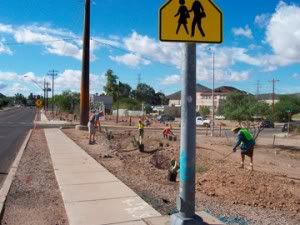
Volunteers and crew work to beautify a small park near Barrio Anita.
(photo: Diana Rhoades)


Second pocket park adds green to vacant Barrio Anita lot
October 22, 2009
by Teya Vitu
http://www.downtowntucson.org/

Desert greenery planted in early October, by Barrio Anita residents brought visual relief to a bleak vacant lot at Main and Davis avenues. The 15 desert ironwood, velvet mesquite, desert willow and blue palo verde trees along with dozens of various cacti instantly created a pocket park at the entryway to the Barrio Anita Neighborhood.

It’s the second of four pocket parks in the works by City Councilwoman Regina Romero’s office. In July, a terraced rock garden with desert landscaping covered a vacant sliver at Silverbell Road and Congress Street. Two more pocket parks are in the works for Los Reales Road in the Elvira Neighborhood near Interstate 19 and Sixth Avenue. “Every neighborhood wants a park, bar none,” said Diana Rhoades, Romero’s aide. “We constantly get requests.” These four pocket park stem from the September 2008 Park(ing) Day event, where 92 downtown metered parking spaces were converted into car-length “parks.” Romero and Rhoades took over a parking space outside City Hall and followed through with Park(ing) Day’s mandate: to fill the need for more urban parks and open spaces.

Pocket parks are very small and typically have no facilities and are not maintained. This one in Barrio Anita was planted around the Bike Church that was erected in August with bicycle frames and wheels. This mini park contrasts with Oury Park a block away. “We need a change in the neighborhood,” said Sheila Rosovich, who lives across the street. “We’re looking forward to really making this a park area. Oury is a recreational park. This is more of a barrio park, a neighborhood park.”

All four pocket park properties are Tucson Department of Transportation rights-of-way. The trees were supplied by Tucson Clean & Beautiful’s Trees for Tucson program. The city will use $7,000 in federal Highway User Revenue Funds to water the vegetation for one year. “Then they are on their own,” Rhoades said. Nearby Dunbar/Spring resident Brad Lancaster, author of “Rainwater Harvesting for Drylands and Beyond,” took charge of the park’s landscape design. “I’ve always wanted to see this moonscape converted into something productive,” Lancaster said.
Reply With Quote
     
     
  #1248  
Old Posted Oct 23, 2009, 9:15 AM
oliveurban's Avatar
oliveurban oliveurban is offline
Registered User
 
Join Date: Feb 2004
Posts: 2,907

(Lisa Beth Earle/ Arizona Daily Wildcat)

Architecture college proposes downtown UA campus
By Yael Schusterman
Arizona Daily Wildcat
October 22, 2009
http://wildcat.arizona.edu/news/architecture-college-proposes-downtown-ua-campus-1.796265

Members of the Tucson community, in partnership with the College of Architecture and Landscape Architecture, have drafted a proposal describing the creation of a downtown UA campus.

The proposal is very preliminary and does not constitute any official action, officials said, but the aim would be to build a so-called “communiversity” between the UA and downtown.

The proposal was released by Janice Cervelli, the dean of the College of Architecture and Landscape Architecture, and documented a “collection of interested parties looking to create more of a presence for the university downtown,” she said.

A major component of the planning process is trying to get an understanding of what the educational needs of downtown are and matching those needs to those of the UA, she said.

Cervelli cited her own college as an example, saying it would be beneficial to relocate downtown because of the college’s expertise in urban design, which could help in the re-development efforts of downtown Tucson.

The proposal describes the downtown campus as a “center for learning” that would integrate support from the city, the county and the university to “more fully engage the knowledge economy.”

Although officials said many sites are being considered, the proposal calls special attention to the historic Roy Place building at 44-60 W. Stone Ave., near Pennington Street. According to the proposal, Pima County — the building’s owner and landlord — is offering several floors of the building for the university’s use.

Financial challenges in this year’s unstable budget climate will influence the project’s speed and development, she said.

ASU’s downtown Phoenix campus has become a good example to learn from, Cervelli noted. Debra Friedman, dean of the College of Public Programs at ASU, said that developing the downtown Phoenix campus took about three years.
In order to establish the Phoenix campus, the city agreed to bring a bond before the voters of the city to see whether or not they wanted to invest in it, she explained.

Phoenix voters proposed to issue a bond in March 2005 for $233 million — the largest investment in the city, Friedman said.

“Downtown Tucson is in need of some vitalization — which applied to Phoenix as well — so the city was interested in establishing a downtown Phoenix campus as part of the revitalization,” she said.

After the bond passed, ASU colleges moved to the downtown campus and 3,500 students were present on opening day. Now, there are about 7,000 students and it has become the “campus of choice,” she said.

Dean of the UA Outreach College Mike Proctor said he has attended a series of discussions about the proposal led by Cervelli.

“My sense is that people want to explore what the possibilities are and learn more about what that involves — that is where the stage is at,” Proctor said.

Cervelli said that no deadline has been set for finalizing the proposal, but by the end of this academic year, planners should have a better idea of what the possibilities are.
Reply With Quote
     
     
  #1249  
Old Posted Oct 23, 2009, 9:17 AM
oliveurban's Avatar
oliveurban oliveurban is offline
Registered User
 
Join Date: Feb 2004
Posts: 2,907
Quote:
Originally Posted by kaneui View Post

Volunteers and crew work to beautify a small park near Barrio Anita.
(photo: Diana Rhoades)


Second pocket park adds green to vacant Barrio Anita lot
October 22, 2009
by Teya Vitu
http://www.downtowntucson.org/

Desert greenery planted in early October, by Barrio Anita residents brought visual relief to a bleak vacant lot at Main and Davis avenues. The 15 desert ironwood, velvet mesquite, desert willow and blue palo verde trees along with dozens of various cacti instantly created a pocket park at the entryway to the Barrio Anita Neighborhood.

It’s the second of four pocket parks in the works by City Councilwoman Regina Romero’s office. In July, a terraced rock garden with desert landscaping covered a vacant sliver at Silverbell Road and Congress Street. Two more pocket parks are in the works for Los Reales Road in the Elvira Neighborhood near Interstate 19 and Sixth Avenue. “Every neighborhood wants a park, bar none,” said Diana Rhoades, Romero’s aide. “We constantly get requests.” These four pocket park stem from the September 2008 Park(ing) Day event, where 92 downtown metered parking spaces were converted into car-length “parks.” Romero and Rhoades took over a parking space outside City Hall and followed through with Park(ing) Day’s mandate: to fill the need for more urban parks and open spaces.

Pocket parks are very small and typically have no facilities and are not maintained. This one in Barrio Anita was planted around the Bike Church that was erected in August with bicycle frames and wheels. This mini park contrasts with Oury Park a block away. “We need a change in the neighborhood,” said Sheila Rosovich, who lives across the street. “We’re looking forward to really making this a park area. Oury is a recreational park. This is more of a barrio park, a neighborhood park.”

All four pocket park properties are Tucson Department of Transportation rights-of-way. The trees were supplied by Tucson Clean & Beautiful’s Trees for Tucson program. The city will use $7,000 in federal Highway User Revenue Funds to water the vegetation for one year. “Then they are on their own,” Rhoades said. Nearby Dunbar/Spring resident Brad Lancaster, author of “Rainwater Harvesting for Drylands and Beyond,” took charge of the park’s landscape design. “I’ve always wanted to see this moonscape converted into something productive,” Lancaster said.
Would love to see more of this in Phoenix.
Reply With Quote
     
     
  #1250  
Old Posted Oct 24, 2009, 1:34 AM
kaneui kaneui is offline
Registered User
 
Join Date: Sep 2005
Posts: 1,561
With 2009 arrivals down 17% from last year and projected to decline further in 2010, TIA traffic isn't expected to return to 2008 levels for at least another six years:


TIA's iconic 1958 Control Tower, expected to be replaced
in the next few years.
(photo: twomets)


Tucson's airport looks to slower, steady growth
By David Hatfield
Inside Tucson Business
October 23, 2009

Airline passenger totals at Tucson International Airport are down nearly 17 percent this year giving businesses and economic development people reason to ask: Can it get much worse? Yes, according to a new forecast from the Boyd Group, an industry consulting firm based in Evergreen, Colo. It’s another one of those cases where it will get worse before it gets better. But the drop won’t be nearly as precipitous; less than 2 percent. The Boyd Group’s forecast is that the number of enplaned (departing) passengers at the airport this year will total about 1.75 million, then drop to about 1.73 million next year before it starts to rebound. Those numbers are even smaller than the 1.76 million enplaned passengers the airport saw in 2002 and 2003 in the aftermath of the Sept. 11, 2001, terrorist attacks. Boyd’s forecast doesn’t see Tucson getting back 2008 levels — when there were 2.1 million enplaned passengers — until at least 2015.

It’s not a unique situation to Tucson, Boyd insists. Further, there’s not a lot Tucson can do about it he says. “It’s not about the local economy or people in Tucson wearing out the carpet at the airport waiting for planes,” he said. “It’s about access to Tucson from the rest of the world and what strategies airlines are going to use to react to the economy and their own situations.” Boyd says that a person coming from, say, Albany, N.Y., or most any other place in the world can get to Tucson today just as they’ve been able to to do in the past. And most likely they still can choose from as many or more options as ever before.

The man whose job it is to attract and keep air service at Tucson International says Boyd may be right. Alex Kovach, director of air service development for the Tucson Airport Authority, says Tucson was spoiled by a “growth spurt” from 2007 to 2008. “There was a period there where we were one of the 10 fastest growing airports in the country,” Kovach said. Through a combination of negative economic issues that weren’t unique to Tucson, that came to a halt in 2008 when three airlines — JetBlue, ExpressJet and Aeroméxico — ended all service and five other non-stop destinations were dropped by the eight airlines still operating at the airport. “The economy took its toll on every airport,” Kovach said. Tucson has now returned to a slower growth path, he said. Don’t expect a quick return of longer distance non-stop flights to places such as the New York area, Washington, D.C., or Charlotte, N.C., Kovach says. The economics don’t pencil out considering fuel costs and keeping a plane tied up for the longer amount of time it takes to fly those greater distances. Instead, he said, the airport will remain focused on maintaining and improving service where demand has shown it can be supported.

Kovach also says all was not lost as a result of the airlines cuts. “We created awareness for a lot of customers who see this as an easy airport to use,” he said. That is borne out by passengers who are filling planes to and from like they never have before and that plays an important role as airlines consider their route plans. Both Boyd and Kovach say that Tucson could be in line for more rapid growth in airline service if the recovery from the recession picks up steam faster than economists’ are forecasting. And Kovach doesn’t rule out that there might be some service that could be added. “I can still make the case for new service to certain places,” he said.


Airport brochures online
The Tucson Airport Authority has put its two latest brochures online. One highlights the cost advantages and other reasons to fly from Tucson International Airport and the other is an eight-page history of how air flight has affected Tucson, the airport authority and the development of both Tucson International Airport and Ryan Airfield.

Both brochures can be downloaded from the authority’s website — www.tucsonairport.org — click on “current news” then “brochures.”

Continental’s new alliance
A significant change for international business travelers takes effect Tuesday (Oct. 27) when Continental Airlines officially joins the Star Alliance whose partner airlines include United, US Airways, Air Canada, Air New Zealand, Lufthansa, Scandinavian, Singapore and Thai Airways. Up until Oct. 24, Continental had been part of SkyTeam that included Delta, Northwest and others. The new alliance means the possibility that Tucsonans could connect to more flights across the Pacific using United and Continental through Los Angeles, San Francisco and Honolulu.

Last edited by kaneui; Oct 24, 2009 at 8:35 AM.
Reply With Quote
     
     
  #1251  
Old Posted Oct 24, 2009, 2:42 AM
kaneui kaneui is offline
Registered User
 
Join Date: Sep 2005
Posts: 1,561
The completion of Oro Valley's new Sanofi-aventis Research Center is a boost for Tucson's quest to become a major biotech hub:


Oro Valley is home to Sanofi-aventis' new $61 million facility, where scientists search
for new pharmaceuticals.
(photo: Randy Metcalf)


New research center in OV
Sanofi-aventis gets to work in $61M facility

By Dave Perry
The Explorer
October-21-2009

Sanofi-aventis, the international pharmaceutical giant with 15,000 employees in the United States, is settling into its new Tucson Research Center, a gleaming structure in Oro Valley's Innovation Park that is an investment of more than $60 million. It also represents an investment in science, company officials say. "Our scientists are creative, productive, passionate people," said site director Beth Koch. "The company wanted to give them the ability to grow. At the previous site (on Hanley Boulevard), there was no more growth. The scientists really got us here. They're so creative, so productive."

"I kept telling the scientists here that money's tough to get for any capital projects," said John Cocco, senior project engineering manager from the Sanofi-aventis office in Bridgewater, N.J. For Sanofi-aventis to "spend money here, in Tucson, the company saw something, and in my mind, they saw the scientists." Those scientists perform experiments with compounds and biological substances to identify interactions, and search for "leads" that could result in new pharmaceutical products. Many of the scientists in Oro Valley have been with the company for years, and they come from all over the world.

At Hanley Boulevard, Sanofi-aventis was "running out of space" in more than one building. Koch looked to lease more space, and nothing was the right location or fit. Senior Sanofi-aventis leaders visited, recognized the value of the Tucson scientific activity, and gave the go-ahead to build a research center. The search began for land. Sanofi-Aventis bought the Innovation Park parcel, 11.54 acres with 9.5 buildable acres, in June 2007. "It was perfect," Koch said. It helped, she said, "that the technical park is named Innovation Park," with the promise of more biotechnology, and with Ventana Medical Systems as a neighbor. Formal approval to construct soon followed. Engineers and designers began to create a facility with the "needs of the scientists and associates" in mind, Koch said. "What came first was sitting down with the scientists and saying 'what do you want?' What's essential for their work? We couldn't do everything, we had to prioritize. But we met almost all of their needs."

At Hanley Boulevard, Sanofi-aventis operated a "research building," Koch said. On Innovation Park Drive, "we've built a research center." "I've never seen a scientific group be as much a part of the project," Cocco said. "They've been committed, involved, they've been fun." Labs are equipped the way scientists want them. Chemistry laboratories, instrument rooms, chemical storage, shipping and receiving are on the first floor, with biology laboratories, biology automation and analytics on the second floor. People meet in the center "to encourage interaction, for people to sit and talk about science," Koch said. "Interacting is what makes the difference here." The compound collection (see page 5) spans both floors, and there is a chemical "dumb waiter" moving chemicals from one floor to the next. Mechanical systems and the data center are in the basement. Cocco praises architects and engineers from Kling Stubbins, experienced in creating laboratories. "They had a lot of suggestions," he said. "It's almost like two separate buildings," with 30,000 square feet of office space on one wing, 80,000 feet of laboratory space on the other, Cocco said.

"A key on the design and construction was safety," Koch said. Sanofi-aventis used a "red dot" schedule, with meetings about specific tasks, and walk-throughs before "whatever the hazardous construction task was going to be." Sanofi-Aventis is "a leader in that whole area of safety awareness," Cocco said. "Our proudest achievement is we had no serious accidents on this project. It was on time and on budget. He was grateful for the support of town officials. "They didn't cut us any slack," he said. "The town had our best interests at heart. They had inspectors here every day. If it didn't look right, they came right to us."

Moving the Sanofi-aventis scientific laboratory from its Hanley Boulevard location to Innovation Park was no simple task. It was "a three- to four-week process for everything to get in here," Koch said. Yet, at its finish, scientists and employees packed up personal items on a Friday at the former location, and opened boxes that Monday in new quarters. Koch said moving contractors did an "excellent job," with great attention to the details of safety and environmental effect.


Sanofi-aventis Research Center

2090 E. Innovation Park Drive, Oro Valley

110,350 square feet

Total project cost, to include land, engineering, architecture and design -- $61 million.

Building construction – approximately $40 million.

Public art investment – approximately $400,000.

Last edited by kaneui; Oct 24, 2009 at 7:30 PM.
Reply With Quote
     
     
  #1252  
Old Posted Oct 26, 2009, 2:56 AM
kaneui kaneui is offline
Registered User
 
Join Date: Sep 2005
Posts: 1,561
As elsewhere, the economic downturn will favor infill development in Tucson, as plunging home prices have curtailed most low-end home building on the metro's periphery:


Constuction on a 160-acre parcel is being developed for new homes near Soldier
Trail and Tanque Verde. With a lot of land available and low home prices, many
land parcels have become worthless, with a few exceptions like the foothills.
(photo: David Sanders)


In downturn, raw land for homes now dead weight
Even developed lots, homes on city edge form 'ring of death'

By Josh Brodesky
ARIZONA DAILY STAR
10.25.2009

These are hard times for land in Tucson. Land values soared in the boom when analysts projected growth across the valley, with the metro area stretching southeast to Benson and north across the Pinal County line. But the growth slowed and sputtered, and values plummeted in the bust. While land certainly has an intrinsic value — after all, no one is making any more of it, as the old saying goes — in today's market undeveloped land is often considered worthless, even carrying a negative value to develop because of the costs of adding infrastructure and maintaining the property. "The market is not there for development at this point. You have a situation where you can buy developed property for less than it costs to develop," said John McIlwain, a senior resident fellow with the Urban Land Institute. "It's a reflection of the extremely depressed property prices we have around the country."

In the most basic sense, the issue is one of supply and demand. There are thousands of lots across the valley ready for homes, but few people are buying. Some are finished lots at the far edges of town where growth was once projected but now won't reach for years; others are part of a massive backlog of undeveloped lots — roughly 23,000 — that have been platted for housing. At some point, demand will pick up and the values of these lots will begin to improve, but a number of analysts don't expect that to happen until 2012. The fallout is what Will White of the Land Advisors Organization says will be a "total reorganization of land ownership" across the valley as projects downsize and change, timelines are extended and some developers walk away from properties. "We thought we knew in 2005 every piece of land and how it was going to be planned and developed, and who was going to be doing that," White said. "It's only taken four years for that to change."

"The ring of death"
In builder parlance, the drive-to-qualify ring is the invisible circle around a city where homes become affordable for the starter buyer. These are the cookie-cutter and tract homes found at the edges of town, and between 2004 and 2006 when the median new home price for Pima County skyrocketed from $175,059 to $255,074, that circle was expanding fast and furious. Land couldn't be bought fast enough, and projects became big — very, very big. "Our permits were at all-time highs and with that came the need for bigger projects," White said. "What we saw before, the home prices were rising so high, so it made sense to keep going out a little bit farther and farther and farther because the homes became more affordable." But as foreclosures have flooded the market, and unemployment has followed, the median price of a new home has plummeted, hitting $185,000 last month, numbers from local housing analyst John L. Strobeck show. All of that downward pressure has pushed the drive-to-qualify ring back toward the city center, reflecting greater affordability. Why drive to Pinal County if you can now afford a home on the northwest side? "The focus is back in the metro area," White said. "And also maybe smaller projects that everyone can get their arms around a little more."

This shift has turned the old drive-to-qualify ring into what developer Jim Campbell calls "the ring of death" where building has ostensibly stopped and plenty of finished lots (and unfinished projects) remain. This ring includes places like Star Valley on the southwest side and Gladden Farms in Marana. Not surprisingly, foreclosure rates are higher in the outskirts, too. In Marana, one of every 74 homes received some kind of foreclosure filing as of September, numbers from the foreclosure tracking service RealtyTrac show. In Vail, the number was one of 54 homes; and in Sahuarita, it was one of 56 homes. But in the city of Tucson, RealtyTrac shows a foreclosure rate in September of one of every 340 homes, with the rate getting worse toward the city's southern edges.

To Campbell, the biggest fallout of this "ring of death" is that it colors the entire market. There are areas like the northeast side and certain infill projects where land supply is quite limited and values have remained relatively strong, he said. But the thousands of vacant lots out there simply overshadow those niches, making it impossible to get financing for a quality piece of land. "It doesn't matter if there are a thousand lots in Star Valley. That doesn't impact northeast Tucson. If you are talking about finished lots or platted lots in the middle of the city, they are definitely worth more than lots in northern Marana," Campbell said of niche markets. But even in those stronger locations, there is just no financing available. "You can't find money for raw land. And you also can't find money to finish the platted lots which are out there," Campbell said. "What they (the banks) are assuming is there are plenty of finished lots even though most of them, if not all of them, are way out there in the ring of death."

The long road back
A few projects and deals are moving forward in Tucson, but these are mostly smaller projects serving niche markets or land deals that came at good prices and were bought with cash or hard money loans — and these projects still come with plenty of risk. Campbell has two small infill projects on the east side, for example. Developer Chris Kemmerly of Miramonte Homes recently purchased 112 lots at Dove Mountain on the far northwest side for $4.76 million. Developer Michael Carlier is moving dirt on Rancho Soldados, a gated community on the far northeast side with lots starting at $259,000. The high-end home market has been soft, but Carlier said he can go forward in this market because he is serving a specific niche. "There has not been a gated community built (in the area) in years," he said. So far, he's had about a half-dozen lot reservations, a fairly strong start.

But he also has a lengthy timeline on the project: four years to build out. And that's how long it may take for things to rebound. Going forward, no one is sure how foreclosures and unemployment will continue to affect the slump. About the only sure thing out there is that no one is making any new land. "The bottom line is, there is a limited amount of land, and there is a limited amount of good land," said developer Don Diamond, no stranger to economic cycles. "It will come back, and it will be worth good money. Everything is fine," he said. "It's my fifth business cycle since 1962. . . . It's going to be coming back slower. Nothing is going to happen in the next two or three years. But slowly, but surely, the good stuff is being absorbed."


From boom to bust
The slowdown in building permits says it all about new-home construction.

Year 2001 2002 2003 2004 2005 2006 2007 2008 2009*

Permits 6,887 7,493 8,511 9,560 11,762 8,578 5,044 3,108 1,800 - 2000*

* Projected numbers for the year.

SOURCE: The Southern Arizona Housing Market Letter, John L. Strobeck

Last edited by kaneui; Nov 13, 2009 at 1:52 AM.
Reply With Quote
     
     
  #1253  
Old Posted Oct 26, 2009, 3:33 AM
kaneui kaneui is offline
Registered User
 
Join Date: Sep 2005
Posts: 1,561
With supercenters half their usual size, Wal-Mart is planning to expand local market share with a number of new stores, including one possibly at El Con Mall:


By going smaller, Wal-Mart avoids city's big-box law
By Josh Brodesky
ARIZONA DAILY STAR
10.25.2009

The Walmarts are coming. Expect to see more and more Walmarts in town as the discount retailer makes a push into the Tucson market with a smaller store that will slide right underneath the city's big-box ordinance. First on the list is a 91,000-square-foot store at the southeast corner of Golf Links and Houghton. Wal-Mart Stores Inc. is in negotiations with developer David Williamson about the site and will soon submit a development plan to the city. The store would be about half the size of one of the company's traditional supercenters — those massive mega-stores where you can buy clothes, groceries, tech gadgets, change your tires and get lost all in one place. "The site at Golf Links and Houghton is a location that we are interested in," said Delia Garcia, a Wal-Mart spokeswoman. "It's a grocery store. General merchandise and grocery to provide that value and convenience to our Tucson customers."

Garcia danced around calling the store a "supercenter," saying it technically is because it will have groceries and general merchandise, but it's also much smaller than other such stores. So instead, she described the project as "more of a really localized neighborhood kind of shopping experience." OK. All I can picture is asphalt. You can bet other similar-sized stores are in the works, too. Valencia and Alvernon and El Con Mall are two contenders for smaller Walmarts that would glide underneath the big-box ordinance and its rules for stores 100,000 square feet or larger. Garcia acknowledged the interest in both sites, but couldn't say anything further. "At Alvernon as you mentioned, there is an opportunity there, potentially," she said. "There is a lot of speculation about El Con. We would be interested in serving that community."

On a local level, Wal-Mart needs the locations. Its store at Speedway and Kolb, which preceded the 1999 big-box ordinance, is extremely busy and stressed. There are plenty of Walmart customers who either fight through traffic to get to that location or turn around and head to Benson — yes, Benson — to buy their stuff. "We know that customers from the southeast area are traveling to Benson and Green Valley and some are even going all the way over to Marana," Garcia said. But this expansion push also comes at a time when Wal-Mart is rolling out smaller "neighborhood market" grocery stores. Squeezed out of metro markets with big-box ordinances and looking to reshape its brand, Wal-Mart has turned to the smaller store as a way to gain market share, recent news reports have said.

"Wal-Mart does have a PR problem. Internal studies show 8 to 10 percent of Americans won't shop there for political reasons," said Nelson Lichtenstein, a history professor at the University of California, Santa Barbara, who has written several books on the giant retailer. "Wal-Mart has been stymied in the last five years. It has not moved (substantially) into coastal California, Boston, New York or Chicago." As a side note, Lichtenstein's recent (and critical) book, "The Retail Revolution: How Wal-Mart created a Brave New World of Business," is a must-read for those interested in Wal-Mart's evolution from a discount shop in northwestern Arkansas to the world's largest retailer.

Lichtenstein said he's often wondered why Wal-Mart hadn't pursued the smaller-store concept simply as a way to get into certain metro markets. "Wal-Mart has never figured out the smaller store," he said. Well, here we are: downsized supercenters. "I know it would certainly generate a lot of potential interest in the area from potential customers, and the city would benefit from potential taxes from the site," City Councilwoman Shirley Scott said of the prospect of this new, smaller Walmart in her ward. The smaller stores are coming. We'll see if much opposition to the politically charged retailer follows.


DID YOU KNOW
Tucson's big-box ordinance dates back to 1999 when Wal-Mart was considering a supercenter at Midtown's El Con Mall. Neighborhood activists fought the plan back, leading to the City Council's passage of the law. The ordinance says supercenters of 100,000 square feet or more must restrict grocery sections to 10 percent of the floor's space. It also requires additional public hearings, lengthens the planning process and gives the council the final say on the proposed stores.
Reply With Quote
     
     
  #1254  
Old Posted Oct 26, 2009, 8:08 PM
kaneui kaneui is offline
Registered User
 
Join Date: Sep 2005
Posts: 1,561
A large percentage of new commercial projects built today seek some level of LEED certification, which addresses various aspects of sustainability and conservation:


One hundred-year-old wood was used within the bench,
which makes up a portion of the public art at Sanofi-aventis in Oro Valley.


The rarely seen eastern side of Sanofi-aventis reflects the Pusch Ridge
portion of the Santa Catalina Mountains.
(photos: Randy Metcalf)


Energetically, Sanofi-aventis goes for gold
New research center already a 'silver' building, according to green standards

By Dave Perry
The Explorer
October-21-2009

The new Sanofi-aventis Research Center in Oro Valley has enough points to be certified at the "silver" level for Leadership in Environmental and Energy Design by the U.S. Green Building Council. Sanofi-aventis wants to go for the gold. "The company's very committed to sustainability," said John Cocco, senior engineering project manager for Sanofi-aventis. "It goes with our core philosophy;" namely, to be environmentally sensitive, and not negatively "impact the next generation." Cocco points out that, of all buildings in the U.S. that are LEED certified, 2 percent are laboratories. Sanofi-aventis has two of those laboratories. "A laboratory is a very difficult achievement," Cocco said, because of the demands posed by air handling and other challenges in an environment where scientific experimentation is taking place. And, Cocco said, "LEED drives you to energy efficiency." That means a company has to "commit dollars." In the long term, such investment saves money on energy. "Our design will save 21-1/2 percent energy over a similar building, a conventional laboratory building," Cocco said.

The Sanofi-aventis Research Center is designed to recover energy from air before it is exhausted, helping to cool or heat the building. It has highly efficient chillers and boilers, a solar hot water system that preheats hot water, and a building "envelope" with good sunlight capture, moisture seal and reflection values to minimize energy consumption. Urinals are water-less. Faucets are motion-activated. A storage tank collects condensate from air handlers for re-use. There are trench drains at each end of both the chemistry and biology laboratories so that, should the sprinkler system be activated, water would be captured in a concrete vault for testing before it is discharged from the site. The landscape plantings are adapted to the desert.

Because Sanofi-aventis is an international company, 'we were able to draw on our colleagues in France" and elsewhere for ideas on building design and efficiency, Cocco said. As an example, the building is cooled through "chilled beam" technology, with cold water running through ceiling beams and settling into rooms, rather than cold air being blown through ducts. It is "a very energy-efficient way of cooling," Cocco said. With conventional cooling, a building the size of the Sanofi-Aventis center would require movement of 33,000 cubic feet per minute of cooled air. With chilled beams, the need is 13,000 cubic feet per minute. "I was a little 🞵🞵🞵-shy at first," Cocco said. "I'd never done one. In Europe they use it all the time. This works beautifully. It reduces energy consumption tremendously, and there are fewer drafts than with traditional air conditioning. I will do this in every building I do."

Chilled beams were a new experience as well for Brett Helm, the project executive for DPR Construction Inc., which built the facility. "It's just like an old radiator," except that it's cooling rather than heating, Helm said. "You don't have fans pushing air. With the amount of energy you save, the return on investment is fairly quick." Chilled beams are up high in the building, and cool air falls. "Architect KlingStubbins of Philadelphia is "excellent" with LEED certification, Cocco said. "They did a good job on designing this exterior. All that plays into LEED." The environment was a consideration throughout the construction process. DPR Construction "agreed they would help keep track of waste," Cocco continued. "They found somebody who could recycle cut, used pieces of drywall." Nearly 800 tons of material was recycled from the construction site.
Reply With Quote
     
     
  #1255  
Old Posted Oct 27, 2009, 5:32 AM
kaneui kaneui is offline
Registered User
 
Join Date: Sep 2005
Posts: 1,561
A new 7,000 sq.ft. sports bar with both American and Asian food, slated to open downtown at 5th Ave. and Congress St. in the fall of 2010, will require the eviction of several existing tenants according to building owner Scott Stiteler:


Kwang C. An announces plans for his
new Downtown restaurant, An Congress,
at a press conference Monday.


An Congress is expected to take up several storefronts
along Congress between Fifth and Arizona Avenues.
(photos: Downtown Tucsonan)


Former Sakura owner An to open Downtown eatery
October 26, 2009
by Teya Vitu
http://www.downtowntucson.org/

The owner of the Great Wall of China restaurant and former owner of a pair of Sakura restaurants will now put his energies Downtown. Kwang C. An announced Monday that he plans to build An Congress at the southwest corner of Congress Street and Fifth Avenue. He hopes to start construction in March and feed the sports crowd in September or October 2010. “Tucson is my hometown,” said An, a 35-year resident. “I like to help Downtown to grow.”

An said his establishment ­– that he describes as “kind of a sports bar” – will have 6,500-7,000 square feet. It will feature sports television, a bar, American food and Asian food. The restaurant also will have rooftop seating. The restaurant will be designed by Miguel Fuentevilla of FORS Architecture+Interiors. Fuentevilla designed An’s Sakura West restaurant on Oracle Road, 14 Sam Fox restaurants and North restaurant at La Encantada. An Congress will bring 125 new jobs to Downtown, An said.

An said he does not yet know how many storefronts he will occupy west of and including Tooley’s Café, 278 E. Congress St. These include Works, Central Arts Gallery, Preen, Rocket Gallery and Metropolis: The Salon on Congress. The properties are all owned by Scott Stiteler, who also owns the One North Fifth Apartments across Congress and has half ownership in the Rialto Block across Fifth Street. An Congress was originally slated for the Rialto Block, but the restaurant was moved across Fifth Street.

Preen owner Emilie Marchand said nobody has told her An Congress may include her storefront. The Preen boutique has weathered Fourth Avenue Underpass closures nearly the full two years the store has been open. “I don’t like the idea of getting kicked out of my space at all,” Marchand said. “To get kicked out would be disappointing.” Stiteler said the plan had been to notify all the tenants Monday morning of the An Congress announcement, but he said apparently not all were told ahead of time. Stiteler said he would assist in relocating tenants. “I do wish each person was notified,” Stiteler said “I’m going to work with all these people. Even though the leases are month to month, we won’t move anybody out for six months.”
Reply With Quote
     
     
  #1256  
Old Posted Oct 29, 2009, 4:29 AM
kaneui kaneui is offline
Registered User
 
Join Date: Sep 2005
Posts: 1,561
Enterprising students are employing more Pedi-cabs to transport pedestrians between UA campus, 4th Avenue and downtown:


(photo: David Olsen)


Pedi-Cabs are Pretty Cool
By Jim Lipson
Zocalo Tucson magazine
October 2, 2009

Take a stroll down Fourth Avenue on a weekend night and you'll have a hard time believing we're in any kind of economic slump. The bars are overflowing, many merchants are open late, and there is a constant flow of people walking back and forth through the new underpass, going in and out of a bustling downtown. One relatively new wrinkle to this scene is reflected through the advent of the Pedi-Cab, that funky rickshaw type of contraption attached to the back of a bicycle.

Pedi-cabs have been a fixture in downtown Phoenix for many years and so it's no surprise a couple of enterprising Phoenix based companies are trying to establish a foothold here in Tucson. However, they have been met by a number of fiercely independent owner/operators, many of whom consider the avenue their turf. Wesley is one such character. "I'm top dog around here. I've been doing this for almost two years and I've got the best stereo," he exclaims as his iPod blasts techno-funk from a couple of invisible Bose speakers. A machine shop mechanic who works part-time for the Ordinary Bike Shop, Wesley, like all of the Pedi-cabs, works strictly for tips. "I can still make as much money on a Saturday night as any good bartender. But it's hard work, especially when you're pedaling uphill or going against the wind."

As we go for a ride down University towards Fourth Avenue it's clear the Pedi-cab has a novel appeal, attracting hoots and hollers, especially from those who appear to have been drinking. "Yeah, they think it's cute and everyone wants a free ride. I'll do that later at night for people who are working. They deserve a break." On this Saturday night Wesley has made several runs to and from Arizona Stadium where the UA football team has just dispensed with NAU. "It's completely different on football nights when there is a lot of money to be made." However, there are no guarantees. And there have been times, Wesley said, when he's taken passengers as far as the Doubletree Hotel or to A-Mountain.

Uri is a completely different cabbie with a completely different experience. This same night is his first. He is not an owner/operator but is renting his rig from one of those Phoenix companies. "I saw an ad on Craig's List. It costs me $25 to rent the bike and I've already had about 20 fares." Uri doesn't have a stereo but he has been passing out free energy drinks kept in a cooler underneath the carriage. Like big city cabbies or bartenders he has also experienced the therapeutic role people of his ilk are sometimes thrust into. "I rode by this one girl who was just sobbing. I came back and offered her a ride. Turns out she had just been dumped by her boyfriend. I think I helped her to feel a little better."

Like Uri, Michael is also a full-time student. Studying to be a substance abuse counselor, he is quite comfortable in his role of pseudo street counselor. "Talking to people who are distressed or frustrated, that comes with the territory." He is also unabashed about taking a safety first approach. "I've been asked to do things like race or break traffic laws and I'll just turn down the fare. I take this responsibility seriously." While it's not quite like riding in a horse drawn carriage through New York's Central Park, there is a novelty to this experience that cannot be denied. As long as the entrepreneurial spirit continues to thrive within the university community, we can only expect the Pedi-cab phenomenon to grow.
Reply With Quote
     
     
  #1257  
Old Posted Oct 29, 2009, 10:10 PM
kaneui kaneui is offline
Registered User
 
Join Date: Sep 2005
Posts: 1,561
Over the next few months, Luke Cusack will be opening A Steak in the Neighborhood, Gino's Giant Slice pizza, and an upscale nightclub called Sapphire, adding to the growing list of new businesses downtown:


Get a preview of Steak in the Neighborhood tomorrow
October 29, 2009
by Teya Vitu
http://www.downtowntucson.org/

A Steak in the Neighborhood restaurant, 135 E. Congress St., plans to open for one day Oct. 30 in conjunction with celebrations that day next door for the new façade at the Screening Room, 127 E. Congress St. Owner Luke Cusack said Steak will just have hors d’oeuvres and cocktails that day, and then open for real in mid-November. “Anything with filet mignon” and “world cuisine” is how he describes what Steak in the Neighborhood will serve. That could be Thai food, beef stroganoff, Mexican or a cheese steak. “This will be high-quality food you can get out of the door quickly,” Cusack said. Hours will be 11 a.m. to 3 p.m. Monday to Friday, and 5 or 6 p.m. to 1 or 2 a.m. Friday and Saturday.

One the other side of the Screening Room, Cusack has his corporate offices upstairs for Congress Street Clubs LLC, and downstairs he intends to open a Gino’s Giant Slice pizza joint, 125 E. Congress St., in about four months. Next door to Gino’s, Cusack on July 23 opened Zen Rock, 111-121 E. Congress St., which features rock mash-up and contemporary dance. He said Zen Rock is doing “fantastic,” and Mia Schnaible, marketing director at the Screening Room, agrees. “All my kids say that’s the place to go on Thursdays,” Schnaible said about Screening Room staff. Zen Rock is slated for city subsidized façade renovations in the same program that Screening Room is using. The city funds up to half the façade work.

The look of that stretch of Congress between Sixth and Scott avenues is getting redefined almost overnight with Cusack’s three properties sandwiched with the Screening Room. “It’s like a light switch,” Schnaible said of the drastic changes quickly coming to the 100 block of Congress. West of Scott, at 61 E. Congress, Cusack expects to open the Sapphire nightclub in later November. He only manages Sapphire, which he describes as “more of a chill environment, much more upscale than Zen Rock.”

Cusack, chief executive at Congress Street Clubs, is in partnership with brothers Mike and Todd Johnson for the four Downtown projects. Separately, Cusack made his name in Tucson the past 12 years with Pearl (formerly The Keys) nightclub on Wetmore Road. Cusack said Downtown is worth the chance. He believes creating a critical mass with four establishments is important to achieve success. “Business is all about risks,” he said. “The (Downtown) rents are extremely low right now. You’re looking at 25 percent of the rest of town. Those that are going to be successful five years from now are starting now. I’ll either be doing decently or sitting on a street corner.”
Reply With Quote
     
     
  #1258  
Old Posted Oct 30, 2009, 6:19 PM
BrandonJXN's Avatar
BrandonJXN BrandonJXN is offline
Ascension
 
Join Date: Nov 2004
Location: Riverside, California
Posts: 5,420
Now we need more places to live in downtown. Someone needs to make it happen.
__________________
Washed Out
Reply With Quote
     
     
  #1259  
Old Posted Oct 30, 2009, 7:16 PM
kaneui kaneui is offline
Registered User
 
Join Date: Sep 2005
Posts: 1,561
Quote:
Originally Posted by ThreeHundred View Post
Now we need more places to live in downtown. Someone needs to make it happen.

The luxury condo proposals are obviously a bust, but the best bet for the near future is affordable housing on the east end of downtown:


1. The Flats at Julian Drew, a low-end condo conversion of 53 units at Broadway and 5th;

2. A 5-story apartment building at Depot Plaza, once the MLK apts. are finished;

3. Plaza Centro just east of the Rialto will have three apartment/condo buildings with 150+ units.


West of I-10 will be Monier Brickyard - 3 stories with 62 condos/lofts above retail (and more units planned at the Convento District across the street). The defunct 44 Broadway condo project will be sold at auction in November, and hopefully will be built out as residential. Of course, the big challenge now is financing, which is very tight and in short supply.
Reply With Quote
     
     
  #1260  
Old Posted Oct 31, 2009, 1:48 AM
kaneui kaneui is offline
Registered User
 
Join Date: Sep 2005
Posts: 1,561

Solar City workers install a panel onto the ground-mounted
system at Davis-Monthan Air Force Base.
(photo: Actus Lend Lease)


Davis-Monthan AFB to have nation's largest solar-powered community
By Joe Pangburn
Inside Tucson Business
October 30, 2009

What’s being called the nation’s largest solar-powered community is being developed on Davis-Monthan Air Force Base. Developer Actus Lend Lease, SolarCity, Tucson Electric Power, National Bank of Arizona and US Bancorp Community Development Corporation are combining to install the solar power system in the Soaring Heights Community on the base. The system is expected to produce more than 10 million kilowatt hours of electricity annually—sufficient to provide an estimated 75 percent of the residents’ energy use next year—and could eventually offset 100 percent of Soaring Heights Communities’ electricity use. The installation will include 6 megawatts of solar capacity in a combination of a ground-mounted photovoltaic system and rooftop solar systems that will be installed on about 900 residences.

National Bank of Arizona will own the 45,000-panel ground-mounted system, which will account for more than 3.3 megawatts of solar capacity. The balance of the system will consist of 36,000 panels in the rooftop arrays. The rooftop systems are being financed within an existing SolarCity fund, which was financed by US Bancorp Community Development Corporation earlier this year. The solar systems are being designed and installed by SolarCity and interconnected by TEP. The entire project represents an estimated increase of more than 15 percent over Arizona’s current grid-tied solar capacity. Collectively, the installation should offset more than 570 million pounds of carbon dioxide over its lifetime, which is the equivalent of taking 50,000 cars off the road for a year. “We are very excited about the Soaring Heights Communities project because it allows us to leverage our background and expertise in renewable energy initiatives as they relate to community development,” said Dale Connor, managing director for Actus Lend Lease. “We look forward to working closely with our partners and the Department of Defense to set a standard for sustainable living here in Arizona and throughout the country.”

SolarCity began installing 1,000 photovoltaic modules earlier this month on previously vacant land near the Soaring Heights Communities. Homes in the community have been selected for solar installations based on their specific location and suitability for solar panels. Most of the homes selected for solar system installations are new dwellings built to the energy efficiency standards of TEP’s Guarantee Home Program, though some are existing homes.

SolarCity, which is headquartered in Foster City, Calif., is outfitting the solar power systems with monitors to measure solar electricity production and the performance of the ground-mounted arrays against the rooftop arrays. The monitors are designed to ensure the system performs as predicted and help track how such arrays might interact with development of the smart grid. “Soaring Heights Communities is truly a solar city, and our largest installation to date,” said Lyndon Rive, CEO of SolarCity. “We expect this project to be a springboard for additional clean power development in Arizona, one of the best locations for solar in the world.”
Reply With Quote
     
     
This discussion thread continues

Use the page links to the lower-right to go to the next page for additional posts
 
 
Reply

Go Back   SkyscraperPage Forum > Regional Sections > United States > Southwest
Forum Jump


Forum Jump


All times are GMT. The time now is 11:19 PM.


Powered by vBulletin® Version 3.8.7
Copyright ©2000 - 2026, vBulletin Solutions, Inc.