HomeDiagramsDatabaseMapsForum About
     

Go Back   SkyscraperPage Forum > Regional Sections > United States > Mountain West


Reply

 
Thread Tools Display Modes
     
     
  #701  
Old Posted Feb 2, 2009, 6:51 PM
Octavian Octavian is offline
Registered User
 
Join Date: Aug 2005
Posts: 1,023
denver and the west
RTD needs 56 properties for DIA line

5 residential
By Jeffrey Leib
The Denver Post
Posted: 02/02/2009 12:30:00 AM MST
Updated: 02/02/2009 10:13:56 AM MST

Planners of the $1.7 billion FasTracks commuter train to Denver International Airport say the project needs to acquire 56 full commercial and residential properties for rail stations and the track alignment.

All but five of the properties needed are operated as commercial or industrial businesses, according to a draft environmental impact statement produced by the Regional Transportation District.

The five residential properties are needed for construction of the east-corridor train line's Colorado station, which will be just west of Colorado Boulevard near East 42nd Avenue in Denver.

The 24-mile-long commuter-rail line will run from Union Station in the Blake Street corridor to East 40th Avenue, then east paralleling Union Pacific Railroad freight tracks and Smith Road. The line then follows Peña Boulevard north to DIA.

RTD plans to have east-corridor train stations at 38th and Blake streets; Colorado Boulevard; Central Park Boulevard and Smith Road in the Stapleton area; Peoria Street and Smith Road; and East 40th Avenue and Airport Boulevard in the Gateway area.

In addition to needing 56 complete properties for the DIA train line, RTD will need portions of 44 other industrial and commercial properties for rail stations and portions of 14 nonresidential properties for the track alignment, according to the environmental document.

RTD typically tries to acquire properties for transit purposes through negotiated purchases from landowners. When such negotiations fail to produce a deal, the agency can take the land through eminent domain. RTD says it will pay fair market value for such purchases.

Property owners along the east-corridor rail line and others interested in the project will have a chance to comment on the draft environmental study at two public meetings scheduled for early next month.

To view the draft study and get information on the public meetings, go to www.eastcorridor.com.

RTD is hoping that the DIA train and the Gold Line train to Arvada/Wheat Ridge will be financed, built and operated by a consortium of private companies that will bring at least $1 billion in private financing to the project. RTD also hopes the federal government will contribute another $1 billion to this FasTracks project led by private companies.

Construction of the DIA train line is scheduled to begin in 2011, and it is to open in 2015.

Jeffrey Leib: 303-954-1645 or [email protected]

Last edited by Octavian; Feb 2, 2009 at 9:34 PM.
Reply With Quote
     
     
  #702  
Old Posted Feb 2, 2009, 8:05 PM
Fritzdude Fritzdude is offline
Registered User
 
Join Date: Jun 2008
Posts: 1,013
True - the East Line will consist of approximately 24 miles of track, but I wonder how many "new" lines of track will officially be needed to complete this route. By my calculations - nearly half of this track is already in place - since they're just using the current rail line that follows Smith Road until just east of Chambers Road, correct? At this point - a new line will veer to the north in order to create a proposed stop at 40th and Airport Road, which is on the north side of I-70 and near the first time the train actaully crosses the Interstate.

http://www.rtd-fastracks.com/media/maps/index.html

As you're headed toward DIA, after this last stop at 40th and Airport Road, the route goes north and east to various degrees until it eventually arrives at DIA. However, as I remember back to my Geometry classes, the quickest route between two locations is a straight line and this is anything but a straight line. I bet you could shave off at least 2 miles from the track (and considerable time) if the tracks just went straight to DIA from this point. Heck, these are empty fields; there's nothing in it's way so why does the train have to follow the traffic?

At a price tag of $1.7 billion for the DIA leg of Fast-Tracks, it would seem they could do this for a lot less money.
Reply With Quote
     
     
  #703  
Old Posted Feb 2, 2009, 8:15 PM
wong21fr's Avatar
wong21fr wong21fr is offline
Reluctant Hobbesian
 
Join Date: Feb 2002
Location: Denver
Posts: 13,123
Aren't they using the rail line alignment but building their own set of tracks? It seems like they would have to.

Also, the East Corridor uses Pena Blvd ROW for the alignment as it's cheaper that way and perserves future development options in those empty fields.
__________________
"You don't strike, you just go to work everyday and do your job real half-ass. That's the American way!" -Homer Simpson

All of us who are concerned for peace and triumph of reason and justice must be keenly aware how small an influence reason and honest good will exert upon events in the political field. ~Albert Einstein

Reply With Quote
     
     
  #704  
Old Posted Feb 2, 2009, 8:33 PM
Octavian Octavian is offline
Registered User
 
Join Date: Aug 2005
Posts: 1,023
Wong, you are correct on both counts. Look at the environmental impact statement they released on jan 30 to see the latest plans at eastcorridor.com
Reply With Quote
     
     
  #705  
Old Posted Feb 2, 2009, 9:29 PM
FrancoRey's Avatar
FrancoRey FrancoRey is offline
Stay Thirsty.
 
Join Date: Sep 2006
Location: Denver, CO
Posts: 2,831
Repetitive question: What's the latest plan for the East Line train? EMU or DMU...
__________________
Denver's getting infill like it's 1999...
Reply With Quote
     
     
  #706  
Old Posted Feb 2, 2009, 9:31 PM
Octavian Octavian is offline
Registered User
 
Join Date: Aug 2005
Posts: 1,023
Quote:
Originally Posted by FrancoRey View Post
Repetitive question: What's the latest plan for the East Line train? EMU or DMU...
EMU
Reply With Quote
     
     
  #707  
Old Posted Feb 2, 2009, 11:08 PM
electricron's Avatar
electricron electricron is offline
Registered User
 
Join Date: Aug 2008
Location: Granbury, Texas
Posts: 3,614
Lightbulb

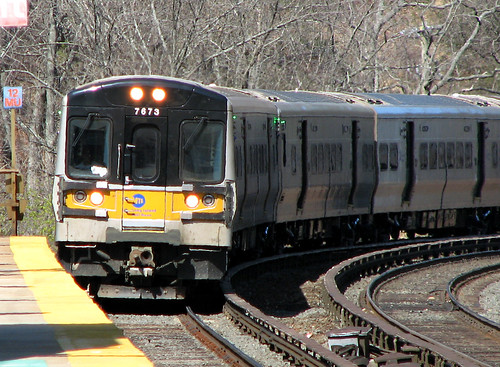
FRA compliant EMUs too.

The UP will not allow non-FRA complaint trains in their ROW.

So, you'll have to look at what LIRR and NJT uses for examples of pre-existing FRA compliant EMUs

LIRR EMU


NJT EMU
Reply With Quote
     
     
  #708  
Old Posted Feb 2, 2009, 11:29 PM
SnyderBock's Avatar
SnyderBock SnyderBock is offline
Robotic Construction
 
Join Date: Sep 2006
Posts: 3,833
Things I Noticed:

-Technology selected is still EMU and it will have it's own track constructed for the entire route. The only Union Pacific ROW is a small parcel recently purchased outright by RTD for a station, not tracks. For much of teh route, RTD's ROW will be parallel to UP's ROW, but RTD was unable to actually purchase UP ROW for this project. UP would not come down to fair market value for their ROW. Instead, RTD will purchase it's own ROW for teh rail line. FRA-compliant EMU's will not be required.

-There are a couple significant relocations of Smith Road around the south end of the Colorado (BLVD) Station and Peoria (Street) Station. Both seem to work well and reduce road crossings; increasing pedestrian access.

-There is a significant elevated stretch. After Chambers Road, just before Airport Blvd., the rail line goes above grade for a significant stretch of elevated rail. The line will go above grade, swing north/northeastward and stay elevated over Union Pacific Railroad, Airport Blvd., a corner of a parcel of private land, E. 32nd Av., N. Pagosa St., I-70 on ramp and I-70 before lowering back down to grade level for it's approach into the 40th/Airport Station.

-Approaching DIA, the rail line will go below grade, under westbound Pena Blvd. (open trench or subway is unknown), remain below grade and pass under eastbound Pena Blvd., then under the relocated DIA loop road and end with a below grade, stub end station which I presume will be covered by the new terminal. Also in this new terminal near the EMU platforms, will be platforms for the extended Airport subway tram. The flow of people between the EMU platforms and the Airport Tram platforms will include security check lines and also have baggage check-in and baggage pick-up facilities.
__________________
Automation Is Still the Future
Reply With Quote
     
     
  #709  
Old Posted Feb 3, 2009, 4:48 AM
Octavian Octavian is offline
Registered User
 
Join Date: Aug 2005
Posts: 1,023
Snyder, RTD is using lots of UP right of way, just not close to Union Station. UP requires that vehicles using their ROW be FRA compliant even if they don't share track.

Also, I don't think the DIA station is underground for the same reasons that the commuter rail tracks at Union Station aren't underground. The trains will terminate on DIA level 1.

Mayors request FasTracks cuts
By Kevin Flynn, Rocky Mountain News (Contact)
Published February 2, 2009 at 9:11 p.m.

Metro mayors want RTD to chip away at the FasTracks budget deficit before they consider how much of a tax increase they might have to ask from voters to build the whole program.
Reply With Quote
     
     
  #710  
Old Posted Feb 3, 2009, 11:43 AM
SnyderBock's Avatar
SnyderBock SnyderBock is offline
Robotic Construction
 
Join Date: Sep 2006
Posts: 3,833
RTD is creating it's own ROW for the project, not using existing UP ROW. It's not just near Union Station they won't be using UP ROW, RTD was unable to buy the vast majority of the UP ROW it needed. What little they did buy, is being used for a station.

Also, I got the info about the DIA station being below grade from the DEIS. It clearly describes the line going UNDER Pena and the loop road and immediately after that the platform begins. There was also reference in the report to level one being slightly below grade. The issue with the stub end station being below grade at Union Station, doesn't appear to apply here, since it is only slightly below grade and the below grade descent is well before the station platforms. I'm thinking it will be an open trench approach and that the new terminal will be excavated out so that level one is even with both the commuter rail platforms and the extended airport subway tram.
__________________
Automation Is Still the Future
Reply With Quote
     
     
  #711  
Old Posted Feb 3, 2009, 10:17 PM
wong21fr's Avatar
wong21fr wong21fr is offline
Reluctant Hobbesian
 
Join Date: Feb 2002
Location: Denver
Posts: 13,123
From the DIES:

Quote:
UPRR Track Relocation
In some sections along the UPRR corridor mainline freight track will be relocated to
accommodate both the commuter rail and freight rail in the available ROW or with minimal
additional property requirements. The mainline freight track will be relocated (shifted slightly to
the north) between the TOFC yard and Dahlia Street. UPRR storage tracks will be
reconstructed at various locations between Colorado Boulevard and Sable Boulevard. UPRR
track relocations are discussed in more detail in Chapter 4, Transportation Systems.
It's not directly in the UP ROW but adjacent to it and will still require FRA compliance.
__________________
"You don't strike, you just go to work everyday and do your job real half-ass. That's the American way!" -Homer Simpson

All of us who are concerned for peace and triumph of reason and justice must be keenly aware how small an influence reason and honest good will exert upon events in the political field. ~Albert Einstein

Reply With Quote
     
     
  #712  
Old Posted Feb 3, 2009, 10:58 PM
SnyderBock's Avatar
SnyderBock SnyderBock is offline
Robotic Construction
 
Join Date: Sep 2006
Posts: 3,833
That is how I interpreted it as well, except for I was under the impression from the DEIS that if the distance between the freight lines and the commuter rail at all points was no closer than 35 feet, FRA compliance would not be required. I also interpreted it as saying those freight reloctions would be sufficient to minimize property acquisition and also maintain that 35 foot buffer, leaving the door open for choosing non-FRA compliant EMU's, if so recommended as the favorite. In other words, they might be leaving the door open on both options at this point in time (FRA compliant & non-FRA Compliant EMU's). Perhaps I am mistaken, but we shall find out before too much longer.
__________________
Automation Is Still the Future
Reply With Quote
     
     
  #713  
Old Posted Feb 4, 2009, 9:55 AM
electricron's Avatar
electricron electricron is offline
Registered User
 
Join Date: Aug 2008
Location: Granbury, Texas
Posts: 3,614
Lightbulb

If they don't lay tracks in the UP ROW, they should be able to use lighter non-FRA compliant trains. SMART has some information about the availability of both compliant and non-compliant DMU vehicles. Many of these light non-compliant DMUs can be EMUs too.

Here's the link:
http://www.sonomamarintrain.org/userfiles/file/SMART-14JAN09_Revised.pdf
Reply With Quote
     
     
  #714  
Old Posted Feb 4, 2009, 6:56 PM
The Dirt The Dirt is offline
Registered User
 
Join Date: Dec 2007
Posts: 3,215
So, why didn't RTD use commuter rail for the existing corridors? It just seems weird to me that all of the existing lines (plus West) are Light Rail and everything going north and east are Commuter Rail. It just makes it seem like 2 disparate systems.
Reply With Quote
     
     
  #715  
Old Posted Feb 4, 2009, 11:03 PM
Octavian Octavian is offline
Registered User
 
Join Date: Aug 2005
Posts: 1,023
The commuter rail lines operate over distances that require a higher top speed. Light rail works better on lines with lots of stops because they have better acceleration.

In other news, I don't believe the NW line will ever get built. RTD is over budget and now banking on a theoretical technology. They've achieved nothing in the past 4 years. Follow the link to see why:

January 2, 2009 3:39 PM
Another blow to RTD FasTracks Northwest Rail

Colorado Railcar, a Fort Lupton company, was the only manufacturer of the U.S.-approved diesel-powered passenger cars that RTD planned to use on the 41-mile Northwest Rail Corridor for FasTracks.

"Was" is the operative word. Colorado Railcar ceased operations two days before Christmas and as of earlier this week it closed up shop.
Reply With Quote
     
     
  #716  
Old Posted Feb 5, 2009, 12:27 AM
SnyderBock's Avatar
SnyderBock SnyderBock is offline
Robotic Construction
 
Join Date: Sep 2006
Posts: 3,833
Eliminate the NW Rail, because there is no longer an existing, approved, viable technology for operating on those existing rail lines and no funds for upgrading them to electric. $900 million is now gone from the FasTracks estimated cost.

What about Longmont? Well Boulder would still be getting the BRT, so why not run some of those very buses making the BRT run between Denver and Boulder, run all the way to Longmont on an express bus stretch with only one stop between the two cities?

What about the communities which would have been served by the rail? Why not run a circulator bus from their location, to the nearest US-36 BRT station? Feed those BRT stations with other bus routes and synchronize the transfers (like on the SE Corridor).

Plus, if the Front Range High Speed Rail ever gets funded (it's only a matter of time), superior rail service would result. If Boulder is already served by BRT and Commuter Rail, how would it win over support for a high speed rail line to go through there too? Three modes of mass transit for Boulder to Denver? No, not gonna happen.

-Cut NW Rail, save $900 million.
-Build maintenance facility at Fox Street location, save $100 million

That drops FasTracks estimated cost from $7.9 billion, to $6.9 billion, of which RTD has funding or expects funding for $5.8 billion. Also, a PPP with the Gold and DIA commuter rail lines should bring in ~$1 billion in private money. That bumps projected FasTracks available funds to $6.8 billion, leaving only a $100 million shortfall.
__________________
Automation Is Still the Future
Reply With Quote
     
     
  #717  
Old Posted Feb 5, 2009, 12:32 AM
Octavian Octavian is offline
Registered User
 
Join Date: Aug 2005
Posts: 1,023
RTD's $5.8 billion dollar revenue estimate includes the $1 billion in private money they expect. So even if you do that, you're still a billion short.
Reply With Quote
     
     
  #718  
Old Posted Feb 5, 2009, 12:37 AM
SnyderBock's Avatar
SnyderBock SnyderBock is offline
Robotic Construction
 
Join Date: Sep 2006
Posts: 3,833
Not if they do this too:

I read today, that simply extending the 0.1% stadium district sales tax (which expires in 2012), so this tax is collected for an additional 10 years (or longer if needed) and applied to FasTracks, it could generate as much as $1 billion for FasTracks. A simple extension of an existing and very small sales tax might be far more favorable with voters, than a new FasTracks bailout tax.
__________________
Automation Is Still the Future
Reply With Quote
     
     
  #719  
Old Posted Feb 5, 2009, 4:41 AM
electricron's Avatar
electricron electricron is offline
Registered User
 
Join Date: Aug 2008
Location: Granbury, Texas
Posts: 3,614
Lightbulb

Quote:
Originally Posted by The Dirt View Post
So, why didn't RTD use commuter rail for the existing corridors? It just seems weird to me that all of the existing lines (plus West) are Light Rail and everything going north and east are Commuter Rail. It just makes it seem like 2 disparate systems.
Light rail is best for distances radially out from downtown areas up to 15 to 20 miles. The north and northwest lines distances are too long for light rail.

FasTracks North Corridor is 18 miles.
FasTracks Northwest Corridor is 41 miles.
FasTracks West Corridor is 12.1 miles.
FasTracks East Corridor is 23.6 miles.
FasTracks Gold Corridor is 12.6 miles.
Central Corridor was 5.3 miles
Southeast Corridor was 19.1 miles extension of the Central Corridor.
Southwest Corridor was 6.7 miles extension of the Central Corridor.

Light Rail often gets far more shorter headways than commuter rail corridors. Light rail headways can be as low as 4 minutes or so during rush hours, while commuter rail headways rarely drop below 20 minutes. So the projected number of passengers can also effect which train model to use.
Reply With Quote
     
     
  #720  
Old Posted Feb 5, 2009, 8:56 AM
SnyderBock's Avatar
SnyderBock SnyderBock is offline
Robotic Construction
 
Join Date: Sep 2006
Posts: 3,833
RTD's FasTracks EMU commuter rail line are going to have peak time headways of 7.5 minutes and off peak of either 15 minutes or 30 minutes (depending on which line and section of the line).

Peak headways:
7.5 / 15 minutes

Off-peak headways:
15 / 30 minutes

But those are far better headways than most all other commuter rail lines in the nation. ElectricRon is correct with his statement, but it doesn't actually apply to the FasTracks commuter rail lines, unless they actually build the NW Corridor (it would apply to that corridor).

But light rail was eliminated from the Airport line in the final elimination, because it was over 20 miles long, didn't have very many stations along the line (light rail is best for a lot of stops, commuter rail is better for fewer stops and higher speeds between stops) and also EMU's will provide more room for luggage, as people will use it to get to and from the Airport. Also, it was originally thought the east line would be running inside UP ROW.

The North line was within the 15-20 mile range best for light rail, but it's also inside existing freight ROW. Back when teh SW Light Rail was built, that was ok, but now the railroads won't allow non-FRA compliant trains in their ROW (because of lawsuit). Now I thought Colorado passed a law taking liability away from the railroads, so they could allow light rail in their ROW's, but the railroads have been extremely resistant to FasTracks, almost to the point they consider RTD to be a competitor to them, even though they don't provide passenger service anymore. New ridership projections and the fact FRA-compliant DMU's don't exist anymore, means the North Metro will likely be EMU now (meaning another cost increase from teh $7.9 billion estimate--another reason to do away with the NW DMU line to save all the other lines).
__________________
Automation Is Still the Future

Last edited by SnyderBock; Feb 5, 2009 at 9:08 AM.
Reply With Quote
     
     
This discussion thread continues

Use the page links to the lower-right to go to the next page for additional posts
 
 
Reply

Go Back   SkyscraperPage Forum > Regional Sections > United States > Mountain West
Forum Jump


Forum Jump


All times are GMT. The time now is 12:02 PM.


Powered by vBulletin® Version 3.8.7
Copyright ©2000 - 2026, vBulletin Solutions, Inc.