Quote:
Originally Posted by pattali

Do you have some news about the construction worker ?  (Nyguy's News from november 14th 2008) |
No word...
http://www.nytimes.com/2008/11/19/business/19concrete.html
Byproducts Becoming Cornerstones
By ALEC APPELBAUM
November 18, 2008
To create what is being billed as one of the world’s most environmentally conscientious skyscrapers, the building’s developer, the Durst Organization, encouraged its architects to tap waste from some of the world’s dirtiest industries.
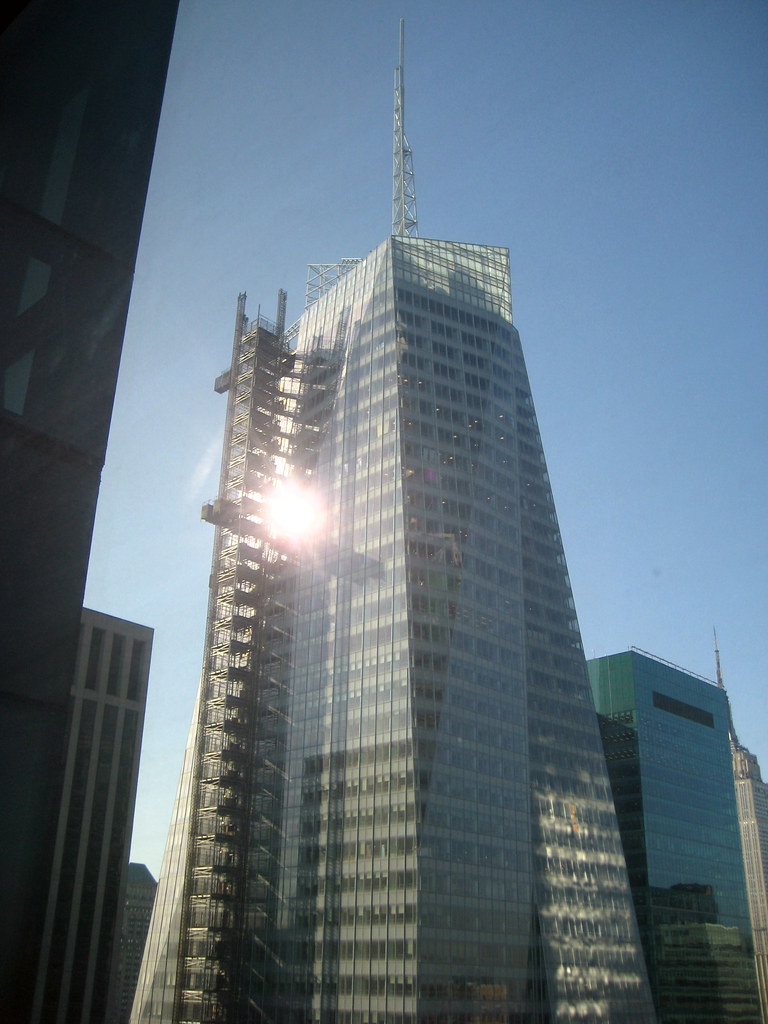
The concrete used at One Bryant Park, the angled 54-story tower that opened this year at 42nd Street and the Avenue of the Americas in Manhattan, used 45 percent less cement than would normally be used, replaced by slag from steel mills.
The green-minded Durst Organization opened Four Times Square, the Condé Nast Building, in 1999 as a showcase for environmentally responsible techniques, recalled the company’s co-president, Jody Durst.
To that end, the developer specified using coal ash in the building’s columns. The company wanted to use as much recycled material as it could, Mr. Durst recalled, but the skeptical contractors limited its use to columns rather than floors.
The material held up so well there, however, that Durst also used slag for the Helena, a 600-unit apartment tower on West 57th Street in Manhattan, which opened in 2005.
By the end of that project, Mr. Durst said, contractors had come around. “I think we paid a premium, but by the end of the job the contractor said he liked the way it handled,” Mr. Durst recalled. “The strength properties were superior.” The developer’s standard procedure now includes ordering slag or coal ash for concrete.
The two byproducts differ in availability and characteristics. Slag, which is left over in blast furnaces when steel is made, can make up more of the concrete mix than ash without requiring extra chemicals, but it is harder to obtain locally. (Developers like to buy supplies locally to reduce travel times and to gain points in the LEED rating system, which certifies a building’s environmental friendliness.) Slag also tends to have a lighter color than ash. Ash’s quality can vary more, but testing techniques now generally make it as reliable as slag.
Either material makes concrete stronger, explained Christian Meyer, a civil engineering professor at Columbia, by reducing the effect of heat on the integrity of the concrete. Portland cement requires more water, and the resulting concrete may become hotter in warm weather and be more susceptible to cracking. It is also more likely to harden in a mixing truck while a driver sits in traffic on a hot day, making it impossible to pour at the construction site, said Bob Mannino of Pinnacle Construction, Durst’s concrete contractor at One Bryant Park.
Compared with portland cement, slag is denser and is up to 15 percent stronger, said Dave Weber, executive director of the Slag Cement Association. “In mass concrete, for the base of a building, it can comprise up to 80 percent of the mix.”
The stronger concrete helps developers meet big-city building codes, which now require higher strength to withstand potential terrorist attacks or disasters.
The Freedom Tower at ground zero and a nearby Forest City Ratner condominium, Beekman Tower, are among prominent developments using recycled material.
The greater solidity also lets developers make thinner walls, allowing for more rentable square feet, according to the architect John Cetra. Mr. Cetra’s firm, Cetra/Ruddy, decided to use slag in a condominium building called One Madison Park, which is nearing completion on 23rd Street. Like Mr. Durst, he expects to use slag or ash in all urban projects from now on.
“It doesn’t add anything to the cost,” Mr. Cetra said. “And it’s used more and more in high-performance concrete, which we like using because it means the structure can be slimmed down a bit so we can conserve space.”
As more developers are recognizing the materials’ versatility, supply networks reaching from smelters and coal-fired power plants to concrete makers have been growing. “Most electric utilities have an agreement with a marketer for storage in domes or silos, and on a daily basis trucks will come get it because the power plant needs to clear out the ash,” said Dave Goss, executive director of the American Coal Ash Association.
Utilities own ash and sell it to concrete mixing companies. Big concrete companies like France’s Lafarge and independent specialists also own and manage stocks of ash and slag, said Mr. Goss. There are several ways that such companies agree to sell, store and share profits from the material.
Growing demand for the recycled material has caused it to become costlier. With America’s relatively few steel mills oversubscribed, said Professor Meyer, some contractors are importing slag from Italy for their projects.
Mr. Weber of the Slag Cement Association said trade groups and academics are working on developing “ternary blends” that mix slag, ash and other materials for lower transport and processing costs.
More research into concrete’s environmental cost will probably change the industry further in the next 10 years. Even if ash or slag cement become universal, concrete will exact a big toll on the environment, said Professor Meyer, because up to three-quarters of it is aggregated sand or stone, which consumes lots of energy in production. Finding recycled material for aggregate will be the industry’s next challenge.
The most promising contender, Professor Meyer said, is construction debris. At Denver International Airport, which opened in 1995, roadbeds contain concrete from the former Stapleton Airport, he said. So, depending on research into the strength of debris and its chemical reaction with other ingredients, concrete — a 2,000-year-old material — may soon involve recycling buildings that have been around for only a few decades.
 Jody Durst, co-president of the Durst Organization, used 45 percent less cement in some of the concrete of One Bryant Park, a tower in Midtown Manhattan.




 Prev
Prev


 _
_


 Linear Mode
