HomeDiagramsDatabaseMapsForum About
     

Go Back   SkyscraperPage Forum > Regional Sections > United States > Southwest


Reply

 
Thread Tools Display Modes
     
     
  #701  
Old Posted Sep 1, 2008, 1:14 AM
kaneui kaneui is offline
Registered User
 
Join Date: Sep 2005
Posts: 1,561
Another casualty of the housing downturn, local developer Mike Teufel's Pathway company had been a partner with Bert Lopez' HSL Properties to redevelop the Santa Rita Hotel downtown (still shuttered with no plans on the horizon):
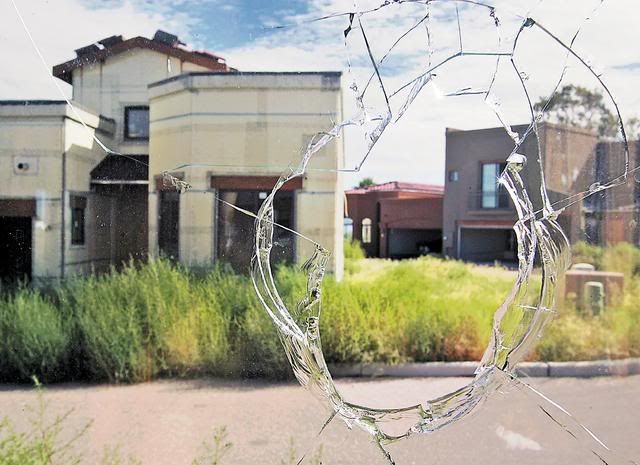


A shattered window opens on to a scene of abandonment and neglect at Aldea del Rey, an unfinished Pathway project on the Southeast Side.
(photo: Arizona Daily Star)


Buyers, investors left in lurch as builder fails
Once-acclaimed Pathway abandons big projects across city
By Christie Smythe
ARIZONA DAILY STAR
08.31.2008

At the peak of his success, developer Michael F. Teufel had acclaimed projects all over Tucson, earning praise for innovative designs and community accolades for business growth. Then things went bad. Now, Pathway projects across Tucson sit unfinished or with residents complaining of poor workmanship. While Teufel blames the downturn in the housing market, others blame him.

A Southeast Side town-home complex, Aldea del Rey, is blemished by partially built homes overgrown with weeds. Another project, Sky Ranch in Marana, shows scars from cracking stucco on many houses. Two Midtown condominium developments, Placita Escondida and Stone Crossing, remain incomplete, with fencing up around vacant buildings. At a Pathway custom-home project in a posh Catalina Foothills development, at least two lots were abandoned by the builder after no work except hole-digging. In cases where homes are unfinished, buyers say they lost from tens of thousands to hundreds of thousands of dollars in upfront payments. Other buyers whose homes were completed have laundry lists of repairs, including leaking windows, ceiling fans with no switches and hot tubs that don't heat up. "I think they bit off more than they could chew," said Sky Ranch buyer Lucia Zegarski, who is dealing with stucco cracks.

Although the company hasn't filed for bankruptcy, it has effectively collapsed in the past year. "Pathway is going to go out of business," Teufel said. In a brief telephone interview, he blamed the housing slowdown. But many builders and developers have suffered through the housing slowdown without generating the same volume of complaints. Nearly 40 complaints against Pathway have been filed with the state Registrar of Contractors in the last few years, an unusually high number, said agency spokesman Brian Livingston. Pathway's license was suspended by the registrar in May. More than two dozen lawsuits have also been filed against Teufel or Pathway by home buyers, subcontractors, lenders and investors — some of whom allege Teufel either stole funds or shifted assets to avoid payment. A few projects have been taken out of Teufel's hands and placed under court-appointed control.

Meanwhile, people who bought homes from Teufel are finding they have limited recourse. Buyers who filed lawsuits are giving up, assuming Pathway has no money to cover any judgment they might win against the company. Payouts from a state recovery fund, available to those who filed complaints with the Registrar of Contractors, are capped at $200,000 per licensee, Livingston said. Each of the roughly 40 complaints seeks from thousands to hundreds of thousands of dollars. "Hopefully, there will be some funds available when we get the claims submitted," said Larry Aronow, who paid $512,000 for a home that needs about $50,000 in repairs.

100 homes at a time
Founded as a custom home-builder in 1993, Pathway Developments took off in the early 2000s, said Mark Mansheim, the company's former chief operating officer. Mansheim worked for Pathway from 2000 to 2005 and watched the company grow from handling just a handful of homes to developing as many as 100 at a time. "There weren't enough hours in the day to keep up with the work," Mansheim said. He described Teufel as "a great visionary" and "very charismatic."

Rapid expansion earned the company a Wells Fargo Copper Cactus Award in 2003. The company handled both residential and commercial projects. In 2004, Teufel pitched an ambitious $40 million renovation of Downtown's Santa Rita Hotel, but it fell through. The growth became difficult to juggle, Mansheim said. Disagreements between Teufel and his wife, Jennifer, who later divorced, also disrupted the work environment, he said. Ultimately, "I couldn't handle the stress anymore," Mansheim said.

Complaints pile up
In 2006, complaints and lawsuits against Pathway over construction delays and poor workmanship started to accumulate. One buyer, Preston Schrader, paid $38,000 in deposits to Pathway in 2005 for a home and waited for more than a year without seeing construction begin. Finally, he filed suit, hoping to recover the deposit. But he ended up losing in arbitration because the contract did not specify when work would start, Schrader said. Judy Westin filed a complaint about her unfinished Aldea del Rey town home after trying numerous times to contact Pathway. The property is partially built and "growing tumbleweeds all around it," said Westin, who lives in Tennessee.
"Of course, we would just like to have the money back that we put down," Westin said. "It's very sad."

A real estate agent who represented Pathway, Scott Niles, said the developer fell behind in the boom, then hit the brunt of the slowdown. "The market was so quick," he said. Then "everything kind of fell off a cliff." Several other Pathway buyers were reluctant to discuss their complaints for a news story because they feared being sued by Teufel. Teufel said he is "working out a plan" to pay back people harmed by his company's failure but declined to provide details. "I don't know what the plan is at this second," he said.

Questions of fraud
Two suits against Pathway came from investors in high-end projects in Stone Canyon and Sabino Estates. After hiring a forensic accountant, the groups alleged that Teufel took about $5 million from the partnerships. Steven Russo, an attorney who manages both groups, said he is surprised "no investor group stepped forward and sought to raise any criminal complaints" against Teufel for fraud. Russo is hoping to recover the funds through litigation.

In January, National Bank of Arizona sued Teufel for defaults on $6.5 million in loans, alleging that he transferred assets to Jennifer Teufel and to his father, Michael P. Teufel. Other banks have sued Teufel for more than $14 million in unpaid loans. Russo said he suspects Teufel has not filed for bankruptcy protection because he has assets he does not want to disclose in court. Teufel denied that claim but declined to answer whether he is planning a bankruptcy filing. Bankruptcy provides for either an orderly liquidation or reorganization of a company and gives filers relief from pending lawsuits and creditor claims.

A certified bankruptcy attorney unaffiliated with Pathway, Randy Nussbaum of Scottsdale, said corporations in financial distress might decline to file bankruptcy if they cannot afford the filing costs or if they have information they do not want to reveal in federal court. Companies must be candid about their finances or else face penalties for perjury, he said.

Uncertain future
Some of Teufel's developments may wind up in the hands of a former business partner, HSL Properties. HSL Executive Vice President Omar Mireles said his company is buying Pathway's defaulted loans and might take possession of the properties after they enter foreclosure. He declined to specify properties except Midtown developments Stone Crossing and Placita Escondida, which are being transferred to HSL after they were placed under court supervision by a lender. HSL, the owner of the Santa Rita Hotel property Downtown, also took back that redevelopment project last year after Pathway abandoned it. As difficult as things might be for buyers of unfinished homes, Teufel indicated his future also looks grim. "It's just a sad situation for me," he said softly. "I don't have any future plans."

Reply With Quote
     
     
  #702  
Old Posted Sep 3, 2008, 5:09 PM
atbg8654 atbg8654 is offline
Registered User
 
Join Date: Aug 2007
Posts: 49
I worked on this project when i was a junior at UA...cool to see its finally underway! More details on it go here http://www.uatechpark.org/static/index.cfm?action=group&contentID=72

Work under way on South Side bioscience park, retail development
After much delay, work is started on bioscience park, mixed-use site


By Dan Sullivan
ARIZONA DAILY STAR

09.03.2008

After months of delays and abundant controversy, work is finally under way on a new biosciences park and mixed-use development at East 36th Street and South Kino Parkway.

Work on The Bridges, a 357- acre development that includes the planned Arizona Bioscience Park, a housing development and commercial and retail centers, has begun with the start of a major flood-control project by the Pima County Regional Flood Control District.

"It's the first step to development," said Bruce Wright, associate vice president for economic development at the University of Arizona.
Wright said the flood-control system may take eight to 12 months to complete.

The site's infrastructure will be "development ready" by January 2010, he said.Pima County Flood Control is undertaking a massive earth-moving project that will eventually pipe floodwater under Interstate 10, away from the bioscience park and flood-prone neighborhoods to the west.

The UA has also recently started an application process with the U.S. Department of Commerce to secure funds to improve on-site infrastructure at the biosciences park.

The planned first phase of the bioscience park will include the first six buildings in the southern part of the property, including the main anchor building of a planned hotel and conference center, a five-level parking garage and four multi-tenant office buildings including laboratory space.

The mixed-use project is a collaboration of the UA, Eastbourne Investments Ltd. and its partner, Idaho-based Retail West Properties; and KB Homes.
Backers say the park will create high-tech job opportunities and new educational opportunities with a proposed bioscience high school. The UA says the park is needed to boost commercialization of new technologies and development of new companies.

The project would be the city's largest infill project and the first big urban-core development to mix homes, stores and jobs on a single spot.
But the development has had its share of controversy.

The biggest issue has been a provision in the city's ordinance restricting "big-box" retail development, limiting grocery space to no more than 10 percent of floor space in the stores. After months of political wrangling, the City Council waived the 10 percent grocery restriction in April 2007 to allow for a big-box store — possibly a Wal-Mart — at the site.
Democratic councilman Steve Leal said he is happy to see progress but wishes it had happened sooner.

The development, including the retail center, would alleviate the added burden brought by the economic downturn, Leal said. "We have to maintain our momentum and partnership and surface out of this troubled economy," he said.

John Bremond, regional vice president for KB Homes, said his company is pursuing its housing plans at The Bridges along with other active projects despite the real-estate downturn. "We expect the housing market will recover, and we hope to be a part as it recovers," he said. The project was made possible by a land swap finalized in August 2007 in which 132 acres owned by the UA Science and Technology Park at I-10 and South Rita Road were traded to KB Homes for 65 acres at the bioscience park site on South Kino Parkway.

Officials of Eastbourne Investments, the Bridges partner in charge of retail development, did not return calls seeking comment. But the UA's Wright said, "Eastbourne is moving forward aggressively."

Raphael Gruener, director of technology initiatives at the UA tech park, said the project will help the UA make up a 500,000-square foot deficit in office and lab space. Gruener said the park also will be an important resource to help commercialize intellectual property generated by UA researchers.
Reply With Quote
     
     
  #703  
Old Posted Sep 4, 2008, 3:35 AM
Rive85's Avatar
Rive85 Rive85 is offline
Registered User
 
Join Date: Aug 2007
Location: Tucson, AZ
Posts: 43
i drove past this the other and saw tractors leveling the desert. i got excited to finally see this project get started...i hope its not a wal mart that gets built there...lol
Reply With Quote
     
     
  #704  
Old Posted Sep 5, 2008, 4:49 AM
kaneui kaneui is offline
Registered User
 
Join Date: Sep 2005
Posts: 1,561
Greg Shelko wants to line up an arena operator even before an RFQ goes out for the arena design/construction. However, I remember Garfield Traub--selected as the convention center hotel developer--saying a year or so ago that they have already been chosen by the city as the contractor for the arena, and will take legal action to defend that position. (Of course, given Rio Nuevo's history, no one should be surprised by any of these convoluted steps.)


City in talks with firm to operate new downtown arena
by TEYA VITU
Tucson Citizen
08.29.2008

Rio Nuevo Director Greg Shelko is negotiating with an undisclosed company to operate the Tucson Arena once it is built. Four companies responded in the past 60 days to a request for qualifications to operate the arena. Shelko interviewed two firms this week and chose to negotiate with one. He expects to announce the operator by mid-September.

Shelko is working with the city's procurement department, which turns to Chapter 28-18(4) of the Tucson Procurement Code not to disclose publicly who submitted proposals until the project is awarded. "It's standard operating procedure for us," said Mark Neihart, director of the city procurement department. Shelko and Jaret Barr, City Manager Mike Hein's assistant overseeing the arena project, want to reveal the company. Shelko routinely reveals all proposals, but this time falls under the procurement department's rules because it is facilitating the negotiations.

Shelko wants to sign an arena operator before shopping for a design-build team. "The intent is to find an operator first to get the building program right," said Shelko, referring to how the arena will be used. Shelko will issue a request for qualifications in mid-September for design-build firms that want to design the $130 million arena and build it. He anticipates giving potential applicants 30 to 45 days to respond. "Our goal," he said, "is to start construction of the arena after the gem show in 2010."
Reply With Quote
     
     
  #705  
Old Posted Sep 5, 2008, 5:04 AM
kaneui kaneui is offline
Registered User
 
Join Date: Sep 2005
Posts: 1,561
The only downtown condo development under construction has come to a halt, as the developers look for a partner with deep pockets to finish the project or buy it outright:


Long Realty's Susan Cassidy and her husband, Tom, are in charge of finding buyers for the new condo lofts at 44 E. Broadway.
(photo: Tucson Citizen)


44 Broadway construction stops
Owner of downtown condo project seeks new partner or buyer

byTEYA VITU
Tucson Citizen
09.05.2008

Construction has stopped at 44 Broadway Lofts unless general partner James LeBeau finds a financial partner or can sell the former federal courthouse annex for $6 million. The stoppage comes as the six-story 1979 concrete structure at 44 E. Broadway has its entire front facade torn away. LeBeau said his minority partners don't want to put more money into the project and neither does he. "I'm not going to spend any more money until I find a partner or sell it," LeBeau said. "We're just tired of doing this by ourselves. We just want somebody to carry the burden."

LeBeau said the project has cost about $5 million so far and the total estimated cost is $13 million. He's looking for investors to fill the $8 million gap or buy it outright for $6 million. He said the project had no Rio Nuevo subsidies and is privately financed.

The 44 Broadway project is a 30-unit luxury loft complex with 18-foot floor-to-ceiling and wall-to-wall windows on one side. It also includes four penthouse lofts. The design also calls for a street-level restaurant and a swimming pool above the restaurant. A three-month delay in construction of the condo sales office concerned LeBeau. He said he was worried that more construction delays could imperil the project or inconvenience condo buyers. "I want to be able to deliver in a timely fashion once people go under contract," LeBeau said.

His construction loan with Bank of the West requires him to sell 50 percent of the condos ahead of time to complete the loan. He said he would rather have cash up front "so we can go faster" rather than wait on buyers to purchase the first 15 condos. LeBeau acquired the building 3 1/2 years ago and survived a series of partnerships. Construction didn't start until he partnered earlier this year with Jobax, a Phoenix general contractor that came up with a new design with Asian influences.
Reply With Quote
     
     
  #706  
Old Posted Sep 9, 2008, 4:45 AM
kaneui kaneui is offline
Registered User
 
Join Date: Sep 2005
Posts: 1,561
Councilwoman Nina Trasoff suggests a parking solution that will allow Madden Media to relocate their headquarters to the MacArthur Building downtown:


Madden moving downtown
Media group buys MacArthur Building from the city

by TEYA VITU
Tucson Citizen
09.09.2008

A triangle-shaped parking lot across from the city-owned, triangle-shaped MacArthur Building, 345 E. Toole Ave., provided the solution to reach agreement to sell the 1907 building to Madden Media for $1.7 million. The city, Downtown Tucson Partnership and Madden Media Chief Executive Kevin Madden late Friday worked out parking issues that had earlier broken off negotiations Aug. 20, said Glenn Lyons, the partnership's chief executive who negotiated on behalf of the city.

Madden hopes to move his 80 employees downtown from 1650 E. Fort Lowell Road by July. Madden publishes Tucson Home and Tucson Guide magazines as well as the Metropolitan Tucson Convention & Visitors Bureau's visitors guide and has online marketing campaigns in 37 states.

Madden agreed to pay $10 per space per month for 55 to 60 parking spaces on a paved triangle bounded by Pennington Street, Toole Avenue and Sixth Avenue. Currently used as a TICET shuttle stop, the plot is across Pennington from the MacArthur Building. The deal also involves 15 spaces in the Pennington Street Garage for $30 per space per month rather than the market-rate monthly $85 per space. Both parking arrangements are for 10 years. Lyons recommended ending negotiations with Madden on Aug. 20 after Madden insisted on paying $30 per space for 75 stalls for 30 years in the Pennington Street Garage.

Madden called City Manager Mike Hein and City Councilwoman Nina Trasoff to reopen negotiations. Trasoff suggested the shuttle stop triangle, which used to be a parking lot for city employees. "From the very beginning, parking was the No. 1 concern," Madden said. "It's proximity. Is it affordable and is it safe?" But Madden warned that parking will be an issue any time the city wants to woo a larger employer downtown, and the city may not have a potential lot available across the street. "Here's a question they should answer and the world should know," Madden said. "What's the strategy for the next Madden Media that wants to go downtown? The answer can't be, 'You have to want to be downtown.' " Trasoff answered: "We work with them on a case-by-case basis to see what the needs are and our ability to meet their needs."

The sale still requires City Council approval, which Lyons anticipates Sept. 30 or Oct. 7. Madden said he gave consideration to the Foothills Mall and Wilmot Road for relocation but settled on downtown because of its central location for his employees, who live as far out as Continental Ranch on the Northwest Side and Vail on the Southeast Side. Trasoff said Madden Media will give downtown a national company. "I think it's tremendously important," Trasoff said. "It's a homegrown company and it's known nationally. They made a choice to be downtown."
Reply With Quote
     
     
  #707  
Old Posted Sep 9, 2008, 6:04 AM
ScottsdaleDevil ScottsdaleDevil is offline
Registered User
 
Join Date: Jul 2008
Posts: 8
Quote:
Originally Posted by kaneui View Post
While Tucson twiddles its thumbs, its northwest suburbs are aggressively courting its cultural attractions--Marana is contemplating a new MLB spring training complex, while Oro Valley could snag a Tucson Museum of Art satellite:


A 600-acre parcel now dominated by two gravel pits is the proposed site for a mixed-use development that would include a new baseball complex for spring training.
(photo: Jim Davis / Arizona Daily Star)


Site of 2 gravel pits in Marana area proposed for spring-training complex
Development could have 2-team stadium, 16-field practice facility, hotel, golf course

By Brian J. Pedersen
ARIZONA DAILY STAR
08.07.2008

The impending departure of the Chicago White Sox has left spring training baseball in Tucson in a hole. But a local developer is proposing to use an actual hole in the ground to stop the major-league migration out of town by building a new baseball complex on the Northwest Side. A 600-acre parcel west of Interstate 10, between Orange Grove and Sunset roads — now dominated by two gravel pits — could be the perfect spot for a mixed-use development that would include a two-team baseball stadium and a 16-field practice facility, developer David Graham said he believes. The development would also include a resort hotel and an 18-hole golf course built into a pit that is still being mined by property owner CPC Southwest Materials Inc.

Local officials and community leaders would like to recruit more teams to Tucson, but their efforts have been hampered by the lack of facilities. "I'm a great believer in turning something ugly into something beautiful," said Graham, who is operating under the name of Orange Sunset Management LLC. "Both of those pits are not the nicest things to look at. The owners would like to do something with those two holes in the ground. " Graham, who was the creative force behind converting a former gravel pit at Continental Ranch into what is now the Pines Golf Club at Marana, said building baseball fields in a 20-foot-deep pit will allow the slopes of the pit to be incorporated into the design as natural viewing areas for spectators.

The site is on land currently within Marana, unincorporated Pima County and Tucson, going from north to south respectively. Graham said he believes this is a plus for the project because it would require all three entities to be involved in the planning. "This is a regional problem that requires a regional solution," said Graham, noting he has had informal discussions with officials from each government. "All three jurisdictions are aware of this project at varying levels," he said.

A regional effort to keep spring-training baseball alive in Southern Arizona has been under way since November 2006, when the White Sox announced they were breaking their lease at Tucson Electric Park to move into a new two-team complex in Glendale in 2009 or 2010. In April, the Pima County Board of Supervisors approved the formation of the Pima County Sports and Tourism Authority. The group, made up of local business and community leaders, has been looking for ways to keep the Arizona Diamondbacks and the Colorado Rockies from following the White Sox out of town, in addition to seeking additional major-league teams to train here. That group is trying to get the state Legislature to pass a bill authorizing a county election on a sales tax to fund renovations to TEP and Hi Corbett Field and for the construction of new facilities.

A bill was introduced late in the last legislative session but was not brought up for a vote. The gravel pit location is the second potential stadium site proposed by private developers. The first, identified in March, was suggested for northwest of the I-10/Tangerine Road interchange on land owned by Colorado-based MSP Properties, though owner Marcus Palkowitsch said no formal plans for a stadium exist. "We haven't put any pen to paper," Palkowitsch said. Although both proposed sites fall either partially or entirely within Marana, that doesn't mean Marana is the only place with options for a new stadium, Sports and Tourism Authority Chairman Tom Tracy said. It just means private landowners in that area have been the first to come forward with ideas.

"At some point, after our funding is in place, we're going to reach out to any and all people who would like to make a proposal," said Tracy, who spoke to the Marana Town Council Tuesday night during a special meeting to discuss spring training. "We are excited that Marana wants to be a part of the solution." Marana's extensive freeway frontage, much of which is still undeveloped, makes the town an ideal spot for a baseball complex, Marana Mayor Ed Honea said. "It's really about location," Honea said. "Spring training teams like the idea of being on I-10. You can drive from Tempe to Tangerine Road in an hour and 15 minutes." The Orange Grove/Sunset project could be done as early as 2011, Graham said, assuming all agreements needed for the development were in place by the end of this year or early in 2009. That includes getting the Regional Transportation Authority to move up its timetable for extending Sunset west from I-10 to Silverbell Road and building a bridge over the Santa Cruz River. That project is currently slated to begin no earlier than 2017.

Graham's development would also likely require bank protection work to be done on parts of the Santa Cruz and Rillito rivers and the Cañada del Oro Wash, all of which run through the property. Graham said no formal talks have occurred on that subject. "That's one of the items on the list," he said. The county is aware of the gravel pit idea, but no formal presentation has been made to county officials, County Administrator Chuck Huckelberry said. Huckelberry said he doesn't know whether the project is a viable option. "Anything is possible," Huckelberry said. "I just view it as another development proposal right now." City of Tucson officials did not return calls made by the Star for comment.


Oro Valley courts Tucson Museum of Art
By Lourdes Medrano
ARIZONA DAILY STAR
08.07.2008

Oro Valley officials are working on an incentive package that might entice the Tucson Museum of Art to expand to the town. "We've identified six sites, some public, some private," said Town Manager David Andrews, who declined to divulge the locations. "We just need to look at the feasibility of those and determine what the museum of art's level of interest might be." On Friday, Mayor Paul Loomis, Andrews, other town officials and area business leaders met with Robert Knight, the museum's executive director. Knight plans to make a formal presentation to the Town Council at its Sept. 3 regular meeting, said Oro Valley spokeswoman Mary Davis.

Museum officials also have visited Marana, but the town does not have a proposal in the works, said spokesman Rodney Campbell. Although it's premature to talk about specific plans to attract the museum, Andrews said, one option may be for the town to provide land to the museum while the private sector makes its own contribution. "It could be that the private sector might want to put together some funding and then buy a private parcel," he said. The museum would be a great community entity and a boost to preservation arts projects such as Steam Pump Ranch, he said. The private sector would benefit, he said, because the more amenities a community has, the greater its chances of recruiting and retaining employees.

Knight was traveling and could not be reached to comment. But museum spokeswoman Meredith Hayes said Oro Valley is one of several sites museum officials are considering. The museum has outgrown its Downtown location, where parking and directional signs have been long-standing concerns, Hayes said. "What we've been doing is looking at expansion opportunities," she said. "We've got opportunities with a number of major collections that could be given to the museum, and we need space to display those."

Hayes said that in May the museum's board of trustees directed Knight to continue working with the city to resolve some of the issues affecting the Downtown location, as well as look toward long-term expansion. "There could be even a satellite location out there," she said of expanding to the Northwest Side. No immediate decisions are expected in September, when Knight reports his findings to the board, she said. "We've got so many options on the table that it behooves us to really look at each one of those options and find out what is best for the museum and for the community as a whole," Hayes said.


Any word on if this is going to happen? With the I-10 improvements getting from Tucson to Phx is even easier. I think it would be a shame to see spring training leave Tucson. I talked to someone in the DBacks organization and they said they want to be in Tucson. Lure a few more teams from FLA and Arizona will become the Spring Training capital!
Reply With Quote
     
     
  #708  
Old Posted Sep 10, 2008, 3:53 AM
Locofresh55's Avatar
Locofresh55 Locofresh55 is offline
Todo para la familia
 
Join Date: Apr 2007
Location: Back in Tucson
Posts: 494
Yeah.....we need to keep baseball in Tucson.....but not with TEP sitting on AJO way. We lost the Sidewinders already and the Golden Baseball League just announced that a Tucson team (named the Toros) would play @ Hi Corbett Field instead of TEP. The CHI white Sox most likely are gone and the Rockies are saying if Hi Corbett isn't fixed then they will possibly try and leave. Supposedly Surprise is looking to add two more teams for Spring training. BUT DAMN PEOPLE IN TUCSON need to stop complaining about teams leaving if they are not showing UP!!!

I'm saying right now I will go to a Tucson Toros game and hold up a sign that says "LETS KEEP BASEBALL IN TUCSON!!! SPRING TRAINING RULES!!!!".
Reply With Quote
     
     
  #709  
Old Posted Sep 10, 2008, 6:50 AM
NIXPHX77's Avatar
NIXPHX77 NIXPHX77 is offline
this could have been...
 
Join Date: Aug 2007
Location: Phoenix
Posts: 471
i would love to see tucson build a downtown ballpark for
spring training and the return of a aaa team someday.
(maybe share the facilities w/ the U of A.)
Reply With Quote
     
     
  #710  
Old Posted Sep 12, 2008, 5:44 AM
kaneui kaneui is offline
Registered User
 
Join Date: Sep 2005
Posts: 1,561

How much will you have to pay to visit this brand-new UA science center?
(rendering: University of Arizona)


Museum Money
The UA's soon-to-be-built science center looks for ways to balance the books

By DAVE DEVINE
Tucson Weekly
September 11, 2008

The University of Arizona's downtown science center is slated for a 2012 grand opening. But will higher anticipated admission charges prevent many Tucsonans from visiting? Currently, the space-focused Flandrau planetarium on campus charges $7.50, while the Arizona State Museum (ASM) at Park Avenue and University Boulevard suggests a $3 donation. But a business plan prepared last year for a new combined facility, to be located near the Santa Cruz River, recommends considerably steeper prices.

For the project to break even financially, the report suggests an adult entry fee in 2012 of more than $10 for the science center and $7 for the museum. On top of these ticket costs, an additional $8 would be charged for both the center's giant-screen theater and its digital planetarium. A combined ticket featuring the science facility and one of these attractions would be $16, while to get into all three, a visitor would have to pay almost $23. Thus, to visit everything, including the ASM, the cost could run close to $30. "The project needs to be (financially) self-sufficient," declares Robert Smith of the UA's Facilities Design and Construction Department. "The project will break even."

Through Rio Nuevo downtown redevelopment money, Tucson taxpayers are footing the bill for the $130 million building, which will have 125,000 square feet of total space. The science center is expected to draw 340,000 visitors annually, while the ASM could attract 121,000. Multipriced tickets similar to those recommended in Tucson are common at many museums. For example, the Arizona Science Center in Phoenix, which has 40,000 square feet of space, charges adults $9 plus $8 for entry to its IMAX theater, and another $8 for the planetarium. Nashville, Tenn.'s Adventure Science Center has 111,000 square feet and charges $11 for adult admission. The center then adds $6 for entry to the planetarium, and $5 for a ride in a flight simulator.

An exception to this multipriced ticket philosophy is the Tech Museum of Innovation in San Jose, Calif. Its 132,000-square-foot facility opened a decade ago and attracted less than 400,000 people a year until more free events, combined with a blockbuster show in 2007, shot the figure above 625,000. According to spokeswoman Lisa Croel, the museum has shown a profit the last two years. The all-ages entry fee is $8, which includes one IMAX presentation, but not access to the occasional blockbuster exhibit. Croel believes this simple approach to pricing has its advantages. "Up to a couple of years ago," she says, "we had multitickets, but then got away from that. It's helped with our attendance."

Whatever the final decision on ticket pricing is in Tucson, the university also has another financial dilemma ahead of it: Campus officials need to figure out how to cover a $60 million short-term construction-funding gap. When the City Council recently divided up all the available Rio Nuevo money, they allocated the science center's final $60 million to be available in 2014. The last construction payment from the city, therefore, won't come until two years after the building is opened. That same delay, according to Rio Nuevo director Greg Shelko, was taken with several other downtown projects. "To fully fund everybody (immediately) would have precluded some projects," Shelko says. "So this was a way to almost fully fund everyone instead of having winners and losers." For the science center and the ASM, Smith indicates this funding situation presents monetary challenges. "We'll have to have some gap financing," he states, "but we're not in a position of having to delay the project or throw in the towel."

Architectural plans for the science center/ASM are now being prepared, and a public meeting to review the design should be held by the end of October. Construction is then anticipated to start by next summer. The appearance of the building certainly won't be anything like the controversial "rainbow bridge" concept considered a few years ago. Instead, Smith says, "The design will reflect its use and grow from the forms and materials that have come from the area."

That area along the riverbed of the Santa Cruz and near the base of "A" Mountain/Sentinel Peak has been occupied for 4,000 years. Smith believes it is "one of the finest locations in Southern Arizona," not only for the university facility, but also for what it will add to a visitor's experience. "You'll be able to see centuries of history in one place," Smith says of the Science Center, the ASM, the Arizona Historical Society museum, the Tucson Origins project and other attractions to be built in close proximity to one another. "It will set Tucson apart from any other place, because no one else has (that history)."

The exhibits for both the science center and the ASM are now being developed, and Smith says they will allow for interaction with the visitor. "It will really be a multimedia approach for an interactive experience," he offers. Smith adds that the exhibits will allow university community members a place to display what they are working on. "Whether it's the Phoenix Mars Lander or global warming, we don't have to start from scratch in developing things," he says. While planning for the science center and ASM has been a time-consuming process, Smith is excited about the future. "With all the Rio Nuevo museums planning to open in 2012," he observes, "it could be a magical year. I can't wait to get started."
Reply With Quote
     
     
  #711  
Old Posted Sep 12, 2008, 6:40 AM
NIXPHX77's Avatar
NIXPHX77 NIXPHX77 is offline
this could have been...
 
Join Date: Aug 2007
Location: Phoenix
Posts: 471
are both entities going to be housed in one bldg?
i hope not.
that seems odd for such different destinations.
Reply With Quote
     
     
  #712  
Old Posted Sep 12, 2008, 7:37 AM
kaneui kaneui is offline
Registered User
 
Join Date: Sep 2005
Posts: 1,561
Quote:
Originally Posted by NIXPHX77 View Post
are both entities going to be housed in one bldg?
i hope not.
that seems odd for such different destinations.
I believe the most recent plans included a shared entry/lobby for the two museums (as shown in the render) as a way to lower construction costs. There will also be several other cultural attractions built on adjacent parcels, including a new Children's Museum, the reconstructed Convento and Gardens, and a cultural plaza, all to be part of a major cultural hub and visitor destination within Rio Nuevo, serviced by the new streetcar line.

And now that the city has approved the sale of bonds to get the initial construction going on all of these projects, most of them should be built (or at least under construction) by 2012, in time for Arizona's statehood centennial.
Reply With Quote
     
     
  #713  
Old Posted Sep 12, 2008, 8:30 AM
kaneui kaneui is offline
Registered User
 
Join Date: Sep 2005
Posts: 1,561
Arts group wants to acquire warehouses, create arts area
by TEYA VITU
Tucson Citizen
09.11.2008

The Warehouse Arts Management Organization intends to move forward with its effort to acquire nearly 30 state-owned warehouses to create a downtown arts district. WAMO invited people from arts organizations and downtown neighborhoods to an update meeting Wednesday at the Dunbar-Spring Auditorium to lay out the game plan for the next six to nine months to acquire and restore the warehouses along Toole Avenue and Sixth Street. In the next week, WAMO President Susan — expects to find out where talks stand between the Arizona Department of Transportation and the city of Tucson to transfer the warehouses - many rented by artists - from the state to the city and then ultimately to WAMO. "We want affordable arts spaces in perpetuity," — said.

The goal is for WAMO or for a land trust or a community development corporation created by WAMO to own the buildings to keep rents affordable for living/working space, studios, rehearsal areas, cafés, art shops and other artistic uses, she said. WAMO will work with Williams & Dame Development of Portland, Ore., and Peach Properties of Tucson over the next six to nine months to assess each of the warehouses, determine the cost to rehabilitate each one, put together a financing plan, and figure out the best use of each warehouse.

Williams & Dame was among the big players in creating the Pearl District near downtown Portland, Ore., out of a rundown warehouse district and abandoned railyard. The firm last month opened its first Tucson project for residents, One North Fifth Apartments in the former Martin Luther King Jr. Apartments, 1 N. Fifth Ave. "What we learned in Portland is that artists are often priced out of the market," said Matt Brown, project manager at Williams & Dame. Brown said Williams & Dame will use lessons learned in its Pearl District work to strengthen Tucson's arts district rather than drive away artists.

WAMO's board of directors has met twice a month for the last six months to discuss various issues that will come into play to develop the arts district, research other districts and determine how to include public input in the planning process. The Wednesday community meeting was the first effort to garner comments via comment cards given to each attendee. The event involved residents from the Dunbar-Spring, Iron Horse, El Presidio and Barrio Anita neighborhoods as well as people from Fourth Avenue and a number of arts organizations. More than 50 people attended. "The great part, with this economy, is it's a great time to plan," Brown said.
Reply With Quote
     
     
  #714  
Old Posted Sep 14, 2008, 5:59 PM
Rive85's Avatar
Rive85 Rive85 is offline
Registered User
 
Join Date: Aug 2007
Location: Tucson, AZ
Posts: 43
Lightbulb City arena plans advance with operator pick on tap

City arena plans advance with operator pick on tap
By Rob O'Dell
Arizona Daily Star
Tucson, Arizona | Published: 09.14.2008


Tucson's push for a new Downtown arena will gain renewed vigor this month, as the city is closing in on deciding on a company to operate it and will soon launch a search for a company to build it.
The city is now in negotiations with two operators before choosing one to run the day-to-day business of the arena: securing shows and tenants, running concessions and handling general upkeep. The operator would take either a fee or a percentage of the profit.
Next, the city will release a request for proposals to build the Downtown arena, which the City Council has mandated will not cost more than $130 million.
The city is looking for an arena in the 9,500- to 11,000-seat range that would cost less than that cap.
The council had previously approved a 12,300-seat arena designed to resemble a desert tortoise. But council support for that plan evaporated after an updated financial analysis showed the cost had grown from the $130 million originally approved by the council to $196 million. The arena would have been built by a Texas-based developer, Garfield Traub.
Garfield Traub is free to submit plans along with everyone else to develop a new arena, said Jaret Barr, an assistant to City Manager Mike Hein. The city expects to start its search for an arena builder before the end of the month, Barr said.
"Competition is a good thing . . . to get the best deal possible," Barr said.
The city didn't stick with Garfield Traub because the company wants to be the developer of the arena, rather than the contractor that would build it. Garfield Traub's previous plans had it overseeing a contractor that would actually build the arena.
Barr said that setup means "an extra layer of fees," and Tucson would rather hire just an architect and a contractor who would actually build the arena itself.
Some in the community, such as Tucson Convention Center Commissioner Michael Crawford, have criticized the city for not continuing to use Garfield Traub on the project, contending the arena could be built sooner if the city didn't solicit new bids.
Hein said the goal is to break ground on the new arena in March 2010.
That's just as fast as Garfield Traub could do it, Barr said.
But first, the city must select an arena operator, a process run by the city's Procurement Department.
The city won't release the names of the two operators who were selected as finalists out of the four companies that responded in the competitive bidding process. It also won't release the names of the three-member panel that is selecting the operator.
Members of the City Manager's Office were required to sign confidentiality agreements promising they would not disclose information about the search.
Procurement Director Mark Neihart said the city selected a process designed to limit any outside influence or pressure on the decision.
Because the Procurement Department doesn't handle development agreements, Neihart said the selection of the arena builder will not follow the same process as the selection of an operator.
Reply With Quote
     
     
  #715  
Old Posted Sep 16, 2008, 7:20 AM
kaneui kaneui is offline
Registered User
 
Join Date: Sep 2005
Posts: 1,561
The city is searching for a yet another developer for its lot at 301 W. Paseo Redondo--the site of Peggy Noonan's failed Presidio Terrace project. However, this time Tucson wants 30-40 apartments, and will only be soliciting developers with experience building downtown housing:


Wanted: new developer for Presidio Terrace
by TEYA VITU
Tucson Citizen
09.15.2008

The 20-plus year epic to develop 301 W. Paseo Redondo - better known as Presidio Terrace - enters a new chapter this fall as the Downtown Tucson Partnership seeks a new developer. The partnership plans to put out a request for developer qualifications in November to find a developer with experience in building downtown housing projects, Executive Director Glenn Lyons said.Qualified developers will then be asked for a proposal in March to build 30 to 40 apartments or townhomes on the parking lot behind Tucson Water at Paseo Redondo between Main and Granada avenues.

Lyons anticipates the selection committee could pick a favored proposal by April and bring it to the City Council in May. If all goes well, a development agreement could be in place in August 2009. "If we don't get a decent proposal, we'll put the brakes on," he said. Lyons will present the status of the 301 Paseo Redondo project at 5 p.m. Wednesday at the City Council's Rio Nuevo subcommittee meeting in the Apache Room at the Tucson Convention Center, 260 S. Church Ave.

The city owns the land and has had no success building anything on the 1.1-acre plot since the 1980s. The land currently serves as a Tucson Museum of Art parking lot. Developer Peggy Noonan and the city went through a drawn out development process for the past four years, but the city pulled the plug on the development agreement in November, citing that Noonan did not live up to Rio Nuevo expectations with financing, marketing and design issues.

Noonan had proposed a seven-story, 101-unit luxury condo complex that stirred up height controversy within the El Presidio Neighborhood to the north. Lyons proposes assembling a selection committee with two El Presidio residents, one appointed by the Tucson Museum of Art, one with development experience chosen by the partnership and one appointed by City Councilwoman Regina Romero.
Reply With Quote
     
     
  #716  
Old Posted Sep 16, 2008, 7:36 AM
BTinSF BTinSF is offline
BANNED
 
Join Date: Jun 2006
Location: San Francisco & Tucson
Posts: 24,071
Tucson amazes me sometimes. In a metro of a million people, such drama over a building with 40 apartments.
Reply With Quote
     
     
  #717  
Old Posted Sep 16, 2008, 5:51 PM
PHX4EVER's Avatar
PHX4EVER PHX4EVER is offline
Registered User
 
Join Date: Jul 2008
Posts: 34
I took few pics on 09/15/08 while driving on I-10 thru tucson with my phone cam.Sorry for bad quality


Reply With Quote
     
     
  #718  
Old Posted Sep 21, 2008, 2:33 AM
kaneui kaneui is offline
Registered User
 
Join Date: Sep 2005
Posts: 1,561
The Mercado District of Menlo Park on downtown's west side, whose sustainable design features have won various awards, is slowly taking shape. Rammed Earth Development is building 50 of the initial 99 residences, the most of the six developers involved in the project. (And if the $360k-800k prices seem a bit steep, an adjoining neighborhood being built by the Gadsden Company on 14 acres across Avenida del Convento will feature numerous "affordable" and "work force" housing units, probably in the $125k-275k range.)


Mercado District progress photo - Sept. 2


Mercado San Agustin construction - Sept. 2
(photos: Tucson Artisan Builders)


Rendering of the walkway (paseo) that will be part of Rammed Earth Development’s new project on downtown’s Westside.
(render: Rammed Earth Development)


New mixed-use development west of downtown features 'eclectic barrio' look
By Ed Egger
Inside Tucson Business
September 19, 2008

Downtown Tucson’s westside is getting more private development - a mixed-use neighborhood that inter-mingles customized Spanish-style two-story homes with retail shops, all tied together by a Mexican stone walkway giving what is described as a "Mexican-barrio-eclectic" look.

The development in the Mercado District is the inspiration of the two partners of Rammed Earth Development Inc., a Tucson-based builder specializing in the design and construction of hand-crafted masonry homes. Company president Tom Wuelpern also is serving as designer and project manager of the new development. His partner, Jeff Scheffman, is managing other projects the company is doing, including one soon to start in Scottsdale. Among the company’s past projects is Miraval, whose flagship resort in Tucson has consistently been rated as the No. 1 destination by SpaFinder magazine, Travel + Lesisure, Zagat Survey and Conde Nast Traveler.

Both phases of Rammed Earth Development’s Mercado District project are part of a planned area development specific to the Mercado District allowing for intermixing residential and commercial, according to Josh Conzemius of Realty Executives, which is marketing the project. Homes in the project range from $360,000 to over $800,000 in price. The last two homes sold have been in the $800,000+ category, Wuelpern said. He described the development as "a social vision that has a regional flare."

So far, the first phase includes six lots with two-story homes already completed, another lot with a home under construction, an eighth lot with construction about to begin on another home and four remaining lots. The first phase also includes a plaza not unlike those found in Mexican villages. Wuelpern said the second phase will include 14 lots, both retail and residential, with seven of those lots already reserved. Buyers of the retail space are all local — no chains — and include a Mexican bakery, a patio restaurant, possibly a wine shop and Mexican antique dealer, an art gallery and a delicatessen. Hispanics are among retailers buying there.

The second-phase project will have owners who are building a retail business on the first floor with living space above it, much like towns in Mexico, which are more integrated, Wuelpern said. "Our buyers are people who want to live downtown and take advantage of everything downtown," he said. "They will have all of their social and commercial needs met in one spot and their neighborhood will be connected via the streetcar all the way to University Medical Center." Wuelpern said buyers attracted to the development include physicians, lawyers and college professors. "Each of our buyers is a special person — they tend to be world travelers who have seen villages like this in Europe and Latin America. They see the once-in-a-lifetime potential of buying into this community. Wuelpern said his subdivision is "the only one in Tucson that doesn’t have foreclosures and where homes are appraising at their sales prices."

He argues it’s the safest place in the Tucson region to build right now. Once the community is built out in a few years, Wuelpern believes it will be a tourist attraction in its own right — the kind of hidden little place visitors will like to discover and enjoy. "It’s not a closed community," he said. "It will be a draw — a destination." He pointed out there is a large existing neighborhood west, north and south of the new development, and it also should be attractive to visitors from Sonora. "We aren’t building just another subdivision," Wuelpern said. "We want what we build today to be cherished 50 years from now. We are building a future historic district."

Wuelpern’s firm redeveloped Barrio Santa Rosa, one of 15 neighborhoods around downtown, back in 1998 when that community was deteriorating and experiencing an out-flux of residents. "It now has a dramatically improved quality of life," he said, adding that he currently lives in the neighborhood and has his business office there. From that project, he said, he learned a lot about what it takes to create a cohesive, diverse community. But he’s so excited about his new project that he plans to move there when it’s completed. Estimating that between $1 billion and $2 billion is being invested in the area west of downtown, he said, "This is all private money. It’s diversity without government intervention."


For more info.: http://www.mercadodistrict.com/, http://www.rammedearth.com/mercado.html, http://www.mercadosanagustin.com/

And here's a short video with Tom Wuelpern: http://tv.azpm.org/kuat/segments/2008/8/6/kuat-mercado-district/
Reply With Quote
     
     
  #719  
Old Posted Sep 28, 2008, 6:49 AM
kaneui kaneui is offline
Registered User
 
Join Date: Sep 2005
Posts: 1,561
Hotel at UA tech park gets regents' blessing
By Aaron Mackey
ARIZONA DAILY STAR
09.27.2008

FLAGSTAFF — The UA will build a hotel and conference center on Tucson's Southeast Side at its Science and Technology Park under a proposal approved Friday by regents. The 123-room hotel, which UA leaders say is crucial to the development of the technology park, will include a 7,400-square-foot conference center and cost roughly $23 million to build.

Officials said it will be the only hotel within seven miles of the University of Arizona Science and Technology Park and will allow companies there to use much-needed conference rooms and lodging. A non-profit company will be created by the UA, University Hotel Corp., to manage the overall project, with Legacy Hospitality LLC of Nevada operating the hotel. Legacy manages hotels worldwide, including several Hilton Garden Inns and Holiday Inns, says its Web site.

But even as UA officials touted the potential profit the hotel could bring, one regent voted against the proposal over concerns the bonds used to finance the project would hurt the university in the long run. Regent Anne Mariucci opposed the project and the bonds because she said it counts against the UA's debt finance ratio established by the state. The project might not be necessary at this time, she added. "Can we afford to do something with that precious capacity of our debt ceilings?" Mariucci asked. "I think it calls again into question the strategic feasibility of the project and what this hotel is doing for us."

However, UA officials said whether the debt actually counts against the UA's bottom line is an open question. The project is being managed by a corporation, and the tech park has authority to finance projects independent of the UA. Therefore, it's the university's position the project doesn't count against its debt, said Bruce Wright, associate vice president for economic development. Wright also argued that the hotel would not be used just by the companies in the tech park but also by visitors to Southeast Side neighborhoods. "It's the fastest-growing region in that area," he said. "This will be a really important community asset."

Construction on the project would begin in June with an anticipated opening in September 2010. In its first year, the hotel would charge an average rate of $119 per night with a projected occupancy rate of close to 70 percent, the regents were told. UA President Robert Shelton said the hotel will be a welcome addition. "Having a hotel and conference center at the park will be essential to further development there," he said. "We believe that this project will not only be viable but will enhance revenues at the UA."
Reply With Quote
     
     
  #720  
Old Posted Oct 2, 2008, 7:02 AM
kaneui kaneui is offline
Registered User
 
Join Date: Sep 2005
Posts: 1,561
Although no significant state funding for new transportation projects may be available anytime soon, the USDOT is providing $1M towards an initial EIS to study passenger rail service between Phoenix and Tucson:


$1M to study Tucson-Phoenix rail
THE ASSOCIATED PRESS
October 1, 2008

PHOENIX — The federal government is giving $1 million to Arizona to launch a study of proposed new passenger rail service between Phoenix and Tucson, but whether the state can come up with a matching $1 million is a question mark. The odds appear even slimmer against the state coming up with the projected $600 million cost to actually launch the rail service between the state's two most populous cities, at least in the near future. That's because Arizona faces yet another budget crunch and because a sweeping measure to finance transportation systems never made it on the state's Nov. 4 general election ballot. "There's no committed funds at this time but it's something the agency is actively investigating," Arizona Department of Transportation spokesman Timothy Tait said of the money needed for the study.

State officials plan to confer with Maricopa County and Pima County regional planning officials to discuss possible funding for the study, Tait said. "It may be a joint effort." The U.S. Department of Transportation announced the $1 million grant award for starting an environmental impact statement on so-called "Sun Corridor" service that would generally follow the Union Pacific's existing freight tracks. Central and Southern Arizona are becoming increasingly urbanized with development of former agricultural and desert areas around and between Phoenix and Tucson. Most travel between the two cities is by auto on Interstate 10, but that route is increasingly congested by both regional and long-distance traffic despite widening projects.

Whether the UP rail route between Phoenix and Tucson would be available for use by passenger trains is questionable. The rail route includes UP's Phoenix branch, which splits off from a UP main line near Eloy in Pinal County before going through Tempe and other southeastern suburbs. The main line is crowded with trains carrying freight from California ports, and the railroad says it needs its Phoenix branch to deliver freight to business customers. According to a description of the Arizona project, it could include upgrading existing track and building new track either in current or along new corridors, with as many as 15 new stations and improvements of numerous grade crossings. Implementation costs are estimated at $600 million plus $34 million annually for operations.

The transportation funding initiative supported by Gov. Janet Napolitano and business leaders envisioned new intercity rail service along with highway construction and transit improvements. But that proposal's funding stream disappeared when an initiative measure for a one-cent increase in the state sales tax didn't qualify for the ballot because of a lack of valid voter signatures on petitions. Tait, ADOT's community relations manager, said the department has identified the intercity rail as an important element of Arizona's future transportation system. "Even when times are tough, we can't lose our ability to focus on the future," he said. "We know the needs aren't going away." It's up to policymakers to decide where the money would come from, he added.
Reply With Quote
     
     
This discussion thread continues

Use the page links to the lower-right to go to the next page for additional posts
 
 
Reply

Go Back   SkyscraperPage Forum > Regional Sections > United States > Southwest
Forum Jump


Forum Jump


All times are GMT. The time now is 9:35 AM.


Powered by vBulletin® Version 3.8.7
Copyright ©2000 - 2026, vBulletin Solutions, Inc.

