From Downtown News:
No Impact Yet From City Housing Plans
Though Downtown and 'Air Rights' Ordinances Moved Slowly in First Year, Officials Expect Greater Future Returns
by Anna Scott
DOWNTOWN LOS ANGELES - Last year, the City Council adopted two housing ordinances expected to pave the way for more high-rises, additional affordable units and denser projects in the Central City, along with $200 million in public benefit funds.
One year later, however, Downtown has yet to see any impact from the measures, largely due to the ongoing housing slump. While officials are hopeful that the work will eventually pay off, no one can say for sure.
Only two proposed projects have used the Transfer of Floor Rights (TFAR) Ordinance since the Council adopted it in May 2007, after much fanfare and one unexpected mayoral veto. The ordinance allows Downtown Los Angeles developers to purchase "unused" space above the Convention Center, with revenues from the sale of the "air rights" going into a public benefits fund that can be used for any number of local causes.
One project has utilized the other measure, the so-called Downtown Ordinance, which was approved last August. Expected to urbanize design standards for the Central City while encouraging density, height and affordable housing inclusions, the ordinance allows developers to boost the size of their projects up to 35% if they make between 15% and 25% of their units affordable housing.
Both ordinances aim to streamline the city approval process for new housing projects by standardizing allowances that have been granted to developers on a case-by-case basis for years.
Despite the minimal response so far, officials said it is too soon to judge how fruitful the measures will be in the long term.
"We are all very aware of the sensitivity of the real estate market right now," said Ninth District Councilwoman Jan Perry, who represents much of Downtown and championed both ordinances. "The same factors that are affecting Downtown are affecting greater L.A. But I felt it was necessary to put these in place for the future, to make sure we have a framework in place as the market rebounds."
Taller, Denser
The first fully approved project to make use of the TFAR Ordinance was the Houk Development Company's $1.3 billion proposed Park Fifth complex at Olive and Fifth streets.
Approved by the Council in May, Park Fifth would be the tallest residential project west of Chicago, with a 76-story and a 44-story tower housing 790 condominiums and a 212-room hotel. In the works for years, Park Fifth had already been granted height variances by the time the TFAR ordinance was passed. Still, project manager Rich Marr said the measure was beneficial.
"TFAR was a lot more streamlined and easier to work with, so it did help improve the process," said Marr. "I can't say it materially changed our work, but it did make it somewhat easier, and for a new project coming along it makes it much easier."
In exchange for the air rights to 692,888 additional square feet of space, Park Fifth developers will provide approximately $17.7 million in public benefits, split between built-in public amenities (such as a renovation of Pershing Square immediately south of the project) and payments to local nonprofits, including the Skid Row Housing Trust and Downtown Women's Center. The developers have until April 2010 to pay for the transfer or the agreement with the city will expire.
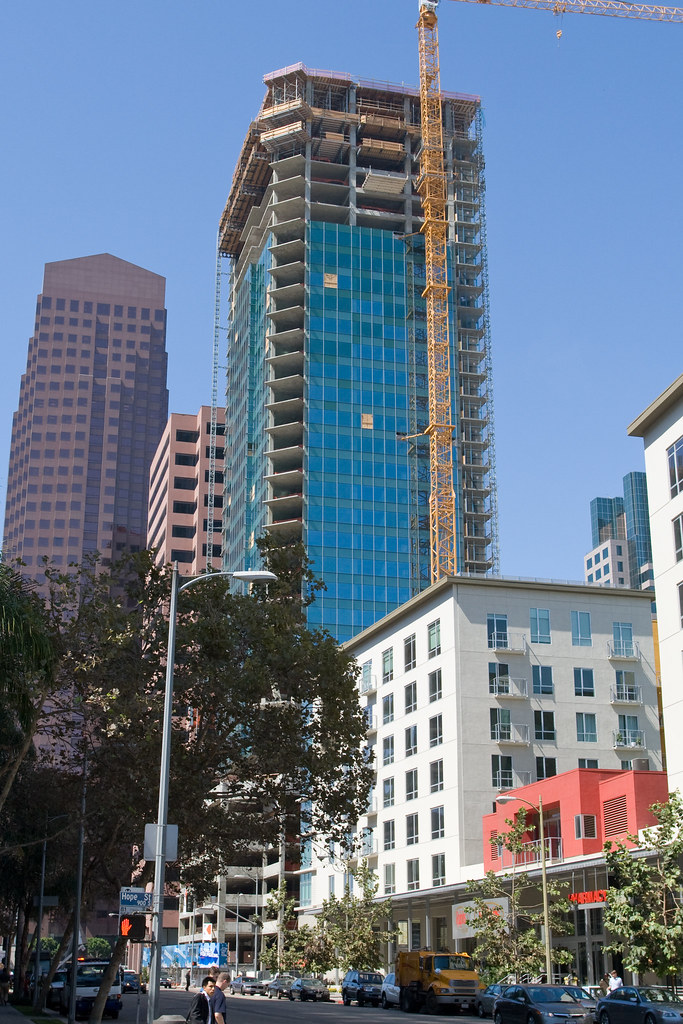
The second project to make use of the TFAR ordinance is a proposed 29-story, 159-unit high-rise at 1133 S. Hope St., which is still in the entitlement process. In exchange for 50,000 additional square feet, the Vancouver-based Amacon Group paid a $250,000 transfer fee along with approximately $992,000 in public benefit funds, which went toward the Skid Row Housing Trust's under-construction New Carver Apartments.
A third project from the McGregor Co., also expected to use TFAR, is still in the planning stage.
(another project?)
Both Park Fifth and the Amacon development have experienced schedule delays. Marr said he expects his project to break ground early next year, while an Amacon official said that 1133 S. Hope St. will start construction in approximately a year.
Also still in the approval phase is a five-story condominium project, planned for a current parking lot on the northeast corner of 14th and Olive streets, which will utilize the Downtown Ordinance. The project, which would include 150 one- to three-bedroom units and contain a 20% affordable housing component, is being developed by California Landmark in partnership with financing company CityView.
"The way it's helping this project is by allowing a larger number of units," said Con Howe, the former city planning director and managing director of the CityView Los Angeles Fund. "We actually could have made the units even smaller, but we wanted to have a range of sizes."
Cycles
With just a few projects off the ground, timing has been the main factor behind the TFAR and Downtown ordinances' slow start, say observers.
"They just hit the market at the wrong time," said attorney John Whitaker, who represented developers in helping to craft the TFAR ordinance. TFAR, he noted, "took the City Council almost three years to get passed. By then, we almost missed the market."
Had the Downtown and TFAR ordinances been passed earlier, said IDS Real Estate Group Senior Vice President Patrick Spillane, his firm likely would have used one or both of them while planning its proposed mega-development Metropolis, one block north of L.A. Live. Although long delayed, it is slated to break ground next year.
"The city spent a couple of years working those ordinances through the pipeline," he said. If not for the floundering housing market, "The city would've seen a tremendously greater amount of use out of them." Still, he predicts that in the long run, the measures will pay dividends for Downtown.
City officials agree.
"I guess because of the economy, things haven't really worked out," said Karen Yamamoto, a senior planner in the Downtown region for the Community Redevelopment Agency. "But as it gets better, more people will come in. We have had a handful of inquiries in the last year, so there is interest out there."
Contact Anna Scott at
[email protected].





 Prev
Prev


 ): This is the most confusing thing ever. Also, the heat is making us cranky. First off, a spokesperson in Assemblyman Bill Emmerson's office says that since it was a "tie vote," it'll be voted on again. And it could be voted on again as soon as next week. Or it could take weeks before it comes up for vote again.




 Linear Mode
