HomeDiagramsDatabaseMapsForum About
     

Go Back   SkyscraperPage Forum > Regional Sections > United States > Texas & Southcentral > Austin


Reply

 
Thread Tools Display Modes
     
     
  #921  
Old Posted Sep 14, 2008, 9:34 AM
Saddle Man Saddle Man is offline
Registered User
 
Join Date: Aug 2005
Posts: 1,149
You tell them Mike.
Reply With Quote
     
     
  #922  
Old Posted Sep 15, 2008, 12:09 AM
electricron's Avatar
electricron electricron is offline
Registered User
 
Join Date: Aug 2008
Location: Granbury, Texas
Posts: 3,611
Lightbulb

Quote:
Originally Posted by M1EK View Post
Electricron is repeating the same nonsense fed people by Dave Dobbs and Lyndon Henry - that stringing up electric wire somehow makes Airport Boulevard the CBD. We're still stuck with rail from nowhere to nowhere - which even when cheap isn't worth the cost.
I've never suggested stringing electric wire down Airport Blvd.
I have suggested sending commuter rail to the Airport near Airport Blvd., but not on it.

I'm not against light rail, I enjoy riding light rail in Dallas on mostly exclusive right of ways. But I'm not impressed at sending light rail down city streets, except in the CBD where most of the street can be made exclusive for light tail.

Finding 10 mile long corridors in Austin not placed in city streets isn't easy. There's just a few non-street corridors available. Dart hasn't had as many train-car accidents as Metro, mainly because Dart uses existing railroad corridors as much as possible, or run on exclusive lanes in city streets.

The rail lines Austin has proposed down Lamar, Guadalupe, Congress, Riverside, or Manor run in shared lanes in city streets. There aren't center medians in these streets to run exclusive rail lines. So, it's not going to make much difference if CapMetro builds light rail over streetcar trains. In fact, streetcars are better at sharing lanes in city streets.

The few non city street corridors that's available in the Austin area should be used for commuter rail. Think of them as express trains, bypassing many streetcar stops. The regional rail trains that Austin can build have stations 2 to 3 miles apart. Streetcars, if not having stops every two to three blocks, will have 3 to 4 stops every mile. Between the two train technologies, a great overall transit system can be built in Austin.

Dart's lines using railroad right of ways average 35,000 passengers a day each. Dart's building a third line today, called the Green line, which is predicted to average 35,000 passenger a day too.

I'll admit the existing CapMetro downtown station doesn't cover as much as downtown Austin as it should. But, I have heard that Austin plans on extending the line further into downtown Austin in the future, potentially to an Intermodal Facility. When that is done, the cheaper commuter rail system will be much better. I'm willing to wait on further developments, to see what arises.

A transit system isn't built all at once. One train line doesn't make a transit system. As I've written time and time again, it's built rail line by rail line, train station by train station, bus line by bus line, bus stop by bus stop, etc.
Reply With Quote
     
     
  #923  
Old Posted Sep 15, 2008, 1:19 PM
M1EK's Avatar
M1EK M1EK is offline
Registered User
 
Join Date: Jul 2006
Posts: 2,194
electricron, once again with the misleading.

Nobody's suggested finding a 10-mile corridor for street rail in Austin. The 2000 starter line went from Lamar/Airport down Lamar, then Guadalupe (by UT), then Congress (by the Capitol), then terminating downtown - in the part of downtown people actually work in, of course. That's exactly the kind of thing DART did - run on rail right-of-way until they had to switch to street ROW to get where they needed to go instead of trying to convince people that Airport Boulevard is the CBD.

And you can't build a rail system from the outside in. People who won't ride good express buses today will not ride shuttle buses the last leg to their office.

Finally, yet one more instance of you either not knowing what you're talking about or purposefully misleading: the 2000 LRT plan had exclusively reserved guideway. (Lamar/Guadalupe would have been rebuilt to support rail running in its own lanes as it does in Dallas).
Reply With Quote
     
     
  #924  
Old Posted Sep 16, 2008, 1:55 AM
electricron's Avatar
electricron electricron is offline
Registered User
 
Join Date: Aug 2008
Location: Granbury, Texas
Posts: 3,611
Lightbulb

Quote:
Originally Posted by M1EK View Post
electricron, once again with the misleading.

Nobody's suggested finding a 10-mile corridor for street rail in Austin. The 2000 starter line went from Lamar/Airport down Lamar, then Guadalupe (by UT), then Congress (by the Capitol), then terminating downtown - in the part of downtown people actually work in, of course. That's exactly the kind of thing DART did - run on rail right-of-way until they had to switch to street ROW to get where they needed to go instead of trying to convince people that Airport Boulevard is the CBD.

And you can't build a rail system from the outside in. People who won't ride good express buses today will not ride shuttle buses the last leg to their office.

Finally, yet one more instance of you either not knowing what you're talking about or purposefully misleading: the 2000 LRT plan had exclusively reserved guideway. (Lamar/Guadalupe would have been rebuilt to support rail running in its own lanes as it does in Dallas).
I'll agree, you can't build rail systems from the outside in. The CapMetro line starts downtown and reaches Leander, 31 to 32 miles away.

Dart's downtown corridor is down one street, not even through the middle of downtown on Main Street geographically. It's skewed north, where most of the new skyscrapers are. A new line through downtown is proposed skewed south of the city center, being built 15 years after the first CBD line. Dart didn't build just the CBD completely first, then extend the lines outward. Dart half finished the CBD, proceeded to extend the lines outward, then came back to the CBD.

Dart's initial line back in 1996, just 20 miles long, along two lines, had a ridership around 9,000 riders a day. As both lines extended, ridership grew because it reached more people. Today, extended out 20 miles to the north and 8 miles south, along just two lines, ridership is 70,000 passengers a day. By 2012, Dart will double the lines and the're predicting to double the ridership again to 140,000 passengers a day.

If Dart never reached the suburbs, or was still building to reach them, I doubt it would have as much ridership. It is important to reach the suburbs if you really want a "Regional" transit agency.

While you may wish to build up the inner city first, then extend out to the suburbs, you're not building a "Regional" system, and will lose the tax support from the suburbs. CapMetro's original light rail plan was voted down because it didn't reach the suburbs. It's regional rail plan survived a vote because it did. Don't forget that important lesson!

What good is a rail system just downtown just reaching the surrounding neighborhoods after you had to drive all the way downtown to catch the train. The train not only has to be downtown, but it has to reach the suburbs to do much good at reducing traffic.

If commuter rail is affordable for Austin, then that's what they should do, especially along existing rail right of ways. That's very cheap and easy to implement. I'm not suggesting abandoning downtown, as I really believe you need to do both commuter rail and downtown rail projects. I also believe they should build to as many suburbs they can, east, north, west, and south along existing rail and street corridors.

And from what I've read, that's CapMetro plans. Downtown and the surrounding neighborhoods via streetcars, and reaching the suburbs with commuter rail.

Reply With Quote
     
     
  #925  
Old Posted Sep 16, 2008, 2:38 PM
M1EK's Avatar
M1EK M1EK is offline
Registered User
 
Join Date: Jul 2006
Posts: 2,194
Quote:
Originally Posted by electricron View Post
I'll agree, you can't build rail systems from the outside in. The CapMetro line starts downtown and reaches Leander, 31 to 32 miles away.
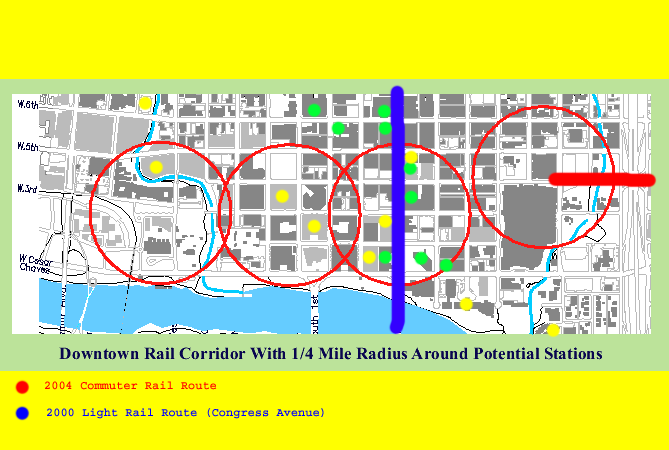
Only by the most misleading possible definition could this be remotely held as truth. The ONE stop downtown is on the far right edge of this picture; major activity centers (residential and office) are colored dots. And of course this doesn't address UT or the Capitol or the part of downtown north of 6th (far more colored dots even farther away from the train station).


This ISN'T what DART did. What DART did was what we would have done in 2000 - run rail in the street past the major close-in activity centers and then heading out to the burbs. 2 of the 3 major activity centers are completely missed by commuter rail, and the third is only served for people willing to walk more than the norm for rail starts.

Here's how Leander commuter rail passengers will get to their final destination. Note DOWNTOWN label on one of the shuttle buses. This image is from PRO-COMMUTER-RAIL mailers. This is how you can tell the system's most definitely NOT being built from the "inside out" but rather from the "outside in". DART didn't need special shuttle buses to bring people the last leg of their trip to their offices downtown.


Again, folks, you're being willfully misled by people hiding behind the cloak of anonymity.
Reply With Quote
     
     
  #926  
Old Posted Sep 16, 2008, 6:06 PM
nixcity's Avatar
nixcity nixcity is offline
Registered User
 
Join Date: Jul 2006
Location: Austin, TX.
Posts: 768
I know this has been covered before, but what is stopping the line from being extended to at least Congress? It seems like that short distance could make a huge difference, at that point you would have a more attractive connect to get up to the capitol or UT or back the other way across the river.
Reply With Quote
     
     
  #927  
Old Posted Sep 16, 2008, 6:30 PM
M1EK's Avatar
M1EK M1EK is offline
Registered User
 
Join Date: Jul 2006
Posts: 2,194
1. Technical reasons: The DMU is porky and can't make turns and doesn't operate well with cars (last bit my personal opinion). You could get to Brazos/4th, but effectively not any farther (don't want to cross Congress just to have to terminate two blocks west of there - not worth the disruption).

2. Political reasons: Capital Metro sold this as "running on existing track" even though they had to realign up north a bit. Their leadership hate light rail - they don't want to do anything which confuses it with commuter rail; although one of their employees is doing the opposite (misidentifying this commuter line as light rail).

3. More political reasons: They're having a lot of trouble right now with the FRA/FTA getting their waiver - the feds are asking the right kinds of questions "is this light rail or is it heavy rail?"; Capital Metro wants it to be one answer sometimes (we're heavy enough to require nothing more than a time-of-day waiver!) and the other when it's inconvenient (we're light enough to share a section of 4th street with cars!). Any changes at this point would make this tightrope act even more difficult.

The attractiveness of the connect is largely irrelevant in this discussion - as soon as you require a transfer, even from commuter rail to reserved-guideway streetcar, you will immediately lose a large chunk of your prospective riders. Period. Neither the current nor the closer terminus makes any difference here.
Reply With Quote
     
     
  #928  
Old Posted Sep 16, 2008, 11:31 PM
electricron's Avatar
electricron electricron is offline
Registered User
 
Join Date: Aug 2008
Location: Granbury, Texas
Posts: 3,611
Lightbulb

I'll agree DMUs will not share streets with other vehicles well. But what's wrong with making 4th Street transit only? It's a straight line to the proposed future Intermodal Center just east of 3rd and Lamar. Yes, it would have to cross Congress and every other street downtown. Isn't that exactly what both Dart and Metro do downtown? As for being one block away on 4th instead of 3rd, that's not that far to walk between trains.

The proposed streetcar will take passengers to the State Capital and University of Texas, and probably further north on Guadalupe in the future.

By the way, here's a few photos of Stadler DMUs running down city streets.
NJT river line:


If the train doesn't have to make a sharp turn, it can go down city streets.

Here's some videos showing the same thing:

http://www.youtube.com/watch?v=vsPSupIucgw

http://www.youtube.com/watch?v=tY6uh5R8Br8

http://www.youtube.com/watch?v=jtUqzd3AkdE

http://www.youtube.com/watch?v=6wU9dsW7F6w

Last edited by electricron; Sep 16, 2008 at 11:42 PM.
Reply With Quote
     
     
  #929  
Old Posted Sep 16, 2008, 11:45 PM
alexjon's Avatar
alexjon alexjon is offline
Bears of antiquity
 
Join Date: Dec 2005
Location: Downtown/First Hill, Seattle, WA
Posts: 8,161
Colorado Railcar DMUs will cross Canyon/TV Highway and Farmington via Lombard in Beaverton, OR starting this fall.
__________________
"The United States is in no way founded upon the Christian religion." -- George Washington & John Adams in a diplomatic message to Malta
Reply With Quote
     
     
  #930  
Old Posted Sep 17, 2008, 4:50 AM
electricron's Avatar
electricron electricron is offline
Registered User
 
Join Date: Aug 2008
Location: Granbury, Texas
Posts: 3,611
Lightbulb

Quote:
Originally Posted by M1EK View Post
Only by the most misleading possible definition could this be remotely held as truth. The ONE stop downtown is on the far right edge of this picture; major activity centers (residential and office) are colored dots. And of course this doesn't address UT or the Capitol or the part of downtown north of 6th (far more colored dots even farther away from the train station).


This ISN'T what DART did. What DART did was what we would have done in 2000 - run rail in the street past the major close-in activity centers and then heading out to the burbs. 2 of the 3 major activity centers are completely missed by commuter rail, and the third is only served for people willing to walk more than the norm for rail starts.

Here's how Leander commuter rail passengers will get to their final destination. Note DOWNTOWN label on one of the shuttle buses. This image is from PRO-COMMUTER-RAIL mailers. This is how you can tell the system's most definitely NOT being built from the "inside out" but rather from the "outside in". DART didn't need special shuttle buses to bring people the last leg of their trip to their offices downtown.


Again, folks, you're being willfully misled by people hiding behind the cloak of anonymity.
Look at those target circles for your stations, with just a radius of two blocks from the center station. Then look at Dart's downtown map, where office building are three, four, five, six, yes even seven blocks from the downtown stations. Dallas City Hall is 7 blocks from Akard station.

Will everyone walk that far? No. Will half? Yes.


The new, D2 line being planned, but the route not fixed yet, may shorten the walk much. But Dart's lines have been in placed a dozen years already, and it will be at least another five years before the D2 line will be built. That's 17 years, and there are buses downtown, which people do use.

Small presentation of Dart's D2 corridor:
http://www.dart.org/about/expansion/...sapril2008.pdf
Reply With Quote
     
     
  #931  
Old Posted Sep 17, 2008, 1:23 PM
M1EK's Avatar
M1EK M1EK is offline
Registered User
 
Join Date: Jul 2006
Posts: 2,194
The point is that DART's first line was within the quarter-mile walking radius for a large number of office workers. Our first line will be within the quarter-mile walking radius for essentially zero office workers.

The fact that you keep trying to hide this makes me ask, yet again, who the hell are you and why do you want to mislead people here?
Reply With Quote
     
     
  #932  
Old Posted Sep 17, 2008, 3:37 PM
alexjon's Avatar
alexjon alexjon is offline
Bears of antiquity
 
Join Date: Dec 2005
Location: Downtown/First Hill, Seattle, WA
Posts: 8,161
10,000 people ride the Sounder each day, trips to the core of the CBD are about .6 miles and can be up to 1.6 miles if travelling to Belltown (as several people at work do).

Thousands more ride the Ferry system and trips to the core of the CBD are about .7 miles and can be up to 1.4 miles (shorter due to the geography) as several people at work do. Quite a large number of people travel from the terminal to the eastside as well.

This is uphill, too, as both King Street Station and the Ferry Terminal are at the bottom of major hills. I believe KSS is at about 40' ASL and the Ferry Terminal at 12' ASL. To get up to Madison and 4th, the change of elevation from the Ferry Terminal is about 120' in a little over 4 blocks.
__________________
"The United States is in no way founded upon the Christian religion." -- George Washington & John Adams in a diplomatic message to Malta
Reply With Quote
     
     
  #933  
Old Posted Sep 17, 2008, 3:59 PM
M1EK's Avatar
M1EK M1EK is offline
Registered User
 
Join Date: Jul 2006
Posts: 2,194
Seattle is a much different city to walk around in than is Austin. I'd take a rainy day there over a hot summer day here any day of the week. And you've got a lot more stuff relatively near the ferry/train stations than we do next to our commuter rail endpoint. (Yes, I've spent a few days walking around downtown Seattle).

The key is that the ferry passengers, at least, have no other real option - the no-ferry drive option is, what, like an extra hour of driving in traffic? (or 10 or 15 bucks to put the car on the boat itself). Yeah, people will walk half a mile if it will save an hour of driving or . Is that a realistic lesson to take to other cities?

And, by the way, the Sounder ridership is pretty minimal for what it is (reserved guideway that penetrates a much stronger downtown than ours from a long ways off). That's not much of a counter-argument.
Reply With Quote
     
     
  #934  
Old Posted Sep 17, 2008, 4:15 PM
alexjon's Avatar
alexjon alexjon is offline
Bears of antiquity
 
Join Date: Dec 2005
Location: Downtown/First Hill, Seattle, WA
Posts: 8,161
Quote:
Originally Posted by M1EK View Post
Seattle is a much different city to walk around in than is Austin. I'd take a rainy day there over a hot summer day here any day of the week. And you've got a lot more stuff relatively near the ferry/train stations than we do next to our commuter rail endpoint. (Yes, I've spent a few days walking around downtown Seattle).

And, by the way, the Sounder ridership is pretty minimal for what it is (reserved guideway that penetrates a much stronger downtown than ours from a long ways off). That's not much of a counter-argument.
Considering the amount of rain and clouds, the wind of the bay and the sheer amount of hills, I'd say Austin has it easier. Of course, in regard to the Sounder and Ferry Terminal's amenities, if you want to pop in for a drink before work or you really want to take in some touristy sights before clocking in, that's good.

The Sounder does what it does with the limited number of BNSF schedule slots they can take (it's not ST's tracks). For the south corridor, they hit seated capacity on most runs already and for the north corridor, their last northbound run is always to seated capacity with others nearing that capacity. They also boosted ridership over last year by 37%.

Quote:
The key is that the ferry passengers, at least, have no other real option - the no-ferry drive option is, what, like an extra hour of driving in traffic? (or 10 or 15 bucks to put the car on the boat itself). Yeah, people will walk half a mile if it will save an hour of driving or . Is that a realistic lesson to take to other cities?
Plenty of people drive onto the ferries, too. The realistic lesson (one you seem to deny vigorously) is that there is no single mode of transportation that works and that each city if it should hope to accomodate transit riders would be smart to implement more than just the bus + train method.

For example, in Seattle, we have:
-Sounder: 10,000 riders daily
-SLU Streetcar: 1,400 riders daily
-Metro King County Transit: 350,000 riders daily
-Sound Transit Express: 47,000 riders daily
-West Seattle Water Taxi: 1,000 riders daily
-Ferries to Seattle: 25,000 riders daily
__________________
"The United States is in no way founded upon the Christian religion." -- George Washington & John Adams in a diplomatic message to Malta

Last edited by alexjon; Sep 17, 2008 at 4:34 PM.
Reply With Quote
     
     
  #935  
Old Posted Sep 17, 2008, 6:12 PM
M1EK's Avatar
M1EK M1EK is offline
Registered User
 
Join Date: Jul 2006
Posts: 2,194
I'm not denying anything vigorously other than that commuter rail + bus transfer isn't going to attract a lot of people who weren't predisposed to take the bus anyways (and we already have much better bus service straight to those destinations).

In Sounder's case, the commuter rail is a very different beast - going straight into downtown Seattle, far closer to some major employment centers than anything Austin's line hits.

And in the ferry's case, those people's other options (other than the long-ish walk for some) are to pay a LOT of money (10-15 bucks) to drive their car on the ferry, or spend a LOT more time driving the long way - neither scenario is remotely applicable here. We have to compete against CHEAP driving that DOESN'T take an hour more time each way than the transit alternative.
Reply With Quote
     
     
  #936  
Old Posted Sep 17, 2008, 6:42 PM
alexjon's Avatar
alexjon alexjon is offline
Bears of antiquity
 
Join Date: Dec 2005
Location: Downtown/First Hill, Seattle, WA
Posts: 8,161
Quote:
Originally Posted by M1EK View Post
I'm not denying anything vigorously other than that commuter rail + bus transfer isn't going to attract a lot of people who weren't predisposed to take the bus anyways (and we already have much better bus service straight to those destinations).
The Lakewood/Tacoma/Seattle buses go straight into downtown, further than the Sounder. They take 6,011 riders a day, compared to the nearly 9500 on the Sounder from Tacoma to Seattle, which stops half a mile from the south end of the CBD. In fact, the Tacoma - Seattle express bus stops in almost on the Columbia Center's doorstep.

Quote:
In Sounder's case, the commuter rail is a very different beast - going straight into downtown Seattle, far closer to some major employment centers than anything Austin's line hits.
It is half a mile, as I said, from the base of the Columbia center. It's also at the bottom of a hill and crosses several strange intersections. The tracks are also at the bottom of stairs. Half a mile from the commuter rail station in Austin puts you at 8th and Congress. Add another 2 tenths of a mile and you're practically at the Capitol. On flat ground, I might add. That's beyond the bulk of office space that downtown Austin holds (isn't the Frost Bank Tower around a quarter of a mile away?). It's almost a mile to the center of the main office space in Seattle.

Quote:
And in the ferry's case, those people's other options (other than the long-ish walk for some) are to pay a LOT of money (10-15 bucks) to drive their car on the ferry, or spend a LOT more time driving the long way - neither scenario is remotely applicable here. We have to compete against CHEAP driving that DOESN'T take an hour more time each way than the transit alternative.
In good traffic, It's 1h15m from Bremerton to Seattle on the Ferry or 1h21m if crossing through Tacoma. It would also be cheaper unless gas prices spiked above $4.00 or more, given average fuel economy.
__________________
"The United States is in no way founded upon the Christian religion." -- George Washington & John Adams in a diplomatic message to Malta
Reply With Quote
     
     
  #937  
Old Posted Sep 17, 2008, 7:14 PM
paulsjv paulsjv is offline
Registered User
 
Join Date: Jun 2007
Posts: 520
I don't know about you all but I can't wait for the day to have a ferry across Town Lake! Now that would be awesome!
Reply With Quote
     
     
  #938  
Old Posted Sep 17, 2008, 8:01 PM
M1EK's Avatar
M1EK M1EK is offline
Registered User
 
Join Date: Jul 2006
Posts: 2,194
Quote:
Originally Posted by alexjon View Post
The Lakewood/Tacoma/Seattle buses go straight into downtown, further than the Sounder.[...]
And they aren't perfect analogues because they don't pick up as far out as the Sounder does, right?

Look, I get it - but it's a lot more expensive to park in Seattle than it is in Austin, and your ferry comparison just shot right around the "traffic" issue. You also have to separate out the transit-dependent (willfully or not) from the choice commuters in your comparison. And you have to adjust for the relative size of CBD employment (Seattle's being larger).

In our case, traffic is bad but still not slower than the rail+bus alternative; parking is free for many and cheap for most; there's an express bus alternative that picks up in the same exact locations out in the burbs and takes people straight to their offices; and it's a LOT less enjoyable to walk here than in Seattle for a large chunk of the year.

If the view you present was remotely realistic, Capital Metro would have bought enough trains to carry more than 2000 (at standing-room-only) per day.
Reply With Quote
     
     
  #939  
Old Posted Sep 17, 2008, 8:45 PM
alexjon's Avatar
alexjon alexjon is offline
Bears of antiquity
 
Join Date: Dec 2005
Location: Downtown/First Hill, Seattle, WA
Posts: 8,161
Quote:
Originally Posted by M1EK View Post
And they aren't perfect analogues because they don't pick up as far out as the Sounder does, right?
http://www.soundtransit.org/x1349.xml

Quote:
Look, I get it - but it's a lot more expensive to park in Seattle than it is in Austin,
For monthly, perhaps-- but on average, first hour parking in Seattle and Austin are on-par. Employers also subsidize parking heavily in many instances.

Quote:
and your ferry comparison just shot right around the "traffic" issue.
Traffic isn't that bad until you reach the bottlenecks inside the city, which can be avoided in several ways. What I also didn't include in the Ferry comparison is waiting for a scheduled ferry, walking to your destination from the ferry and the time it takes to load and off-load a ferry.

Quote:
You also have to separate out the transit-dependent (willfully or not) from the choice commuters in your comparison. And you have to adjust for the relative size of CBD employment (Seattle's being larger).
Percentage-wise, 22% of Seattle commuters that work downtown use transit at the peak travel times. This was in 2005, prior to the recent increase in transit use in this city.

Quote:
In our case, traffic is bad but still not slower than the rail+bus alternative;
How would LRT be better, then?

Quote:
parking is free for many and cheap for most;
Austin is the most expensive city for parking in Texas.

Quote:
there's an express bus alternative that picks up in the same exact locations out in the burbs and takes people straight to their offices;
Please see my mention of the Tacoma Dome station.

Quote:
and it's a LOT less enjoyable to walk here than in Seattle for a large chunk of the year.
Have you ever walked up hill both ways in the 80s and high humidity? The rain? Snow? If I remember correctly, central Austin is fairly flat. My home is at 220' ASL, the hill/bench I cross is at about 400' ASL, work is at about 120' ASL. Due to regrading, these changes in elevation happen over the span of two blocks or so. Actually, going up Olive from MLK to 26th is a change from around 100' ASL to 220' ASL in 3 blocks.

Quote:
If the view you present was remotely realistic, Capital Metro would have bought enough trains to carry more than 2000 (at standing-room-only) per day.
It is realistic, and from my perspective using you as the typical transit user in Austin, it seems that making accomodations for 2,000 riders is like trying to swat a fly with a missle.
__________________
"The United States is in no way founded upon the Christian religion." -- George Washington & John Adams in a diplomatic message to Malta
Reply With Quote
     
     
  #940  
Old Posted Sep 17, 2008, 9:07 PM
M1EK's Avatar
M1EK M1EK is offline
Registered User
 
Join Date: Jul 2006
Posts: 2,194
Quote:
Originally Posted by alexjon View Post
How would LRT be better, then?
We keep coming back to this. Are you not aware that the 2000 line projected 46,000 riders per day - and that was before the Triangle filled up (half with UT students) and before all the downtown high-rises now under construction (lots of people working at UT and the Capitol)? That it would have dropped off passengers on the front door of UT and the Capitol and gone right through the heart of downtown? And still hit the same exact park-and-rides in the suburbs as does commuter rail (obvious if you know they shared the same alignment from Lamar/Airport northwestwards; but I'm beginning to think you don't).

Dude, the Feds loved it. The Feds. This wasn't naive optimism - the skeptics looked at it and said it would clearly and obviously work - we had a better starting alignment than Dallas or Houston in terms of employment density, and they did just fine.

You really have to let this crap about possible ridership here being low die. You have no idea.
Reply With Quote
     
     
This discussion thread continues

Use the page links to the lower-right to go to the next page for additional posts
 
 
Reply

Go Back   SkyscraperPage Forum > Regional Sections > United States > Texas & Southcentral > Austin
Forum Jump


Forum Jump


All times are GMT. The time now is 11:55 PM.

     
SkyscraperPage.com - Privacy Statement - Top

Powered by vBulletin® Version 3.8.7
Copyright ©2000 - 2026, vBulletin Solutions, Inc.