Sorry to keep shooting off the old cannon, but I asked for a more substantive response, and now that markbarbera's given it, I feel bound to respond.
Quote:
Originally Posted by markbarbera

My point is not simply that Market Street is the A6. My point is, prior to its pedestrianisation, Market Street in Manchester was a main road through that city which handled traffic in a fashion very similar to King Street. I was asked to provide an example of a successful pedestrianisation of a road that had the same function as King Street in Hamilton, which is what I did. Yet you refused to concede that point's validity because you 'think' Market Street is not similar to King Street. Well, I have been along Market Street in Manchester, both pedestrianised and non-pedestrianised. In fact, the similarities are uncanny.
|
This is a much better argument. You've fleshed things quite a bit. I still think you're making some dubious claims, though ...
Quote:
|
Moreover, the existing conditions surrounding Market Street's conversion were strikingly similar to King Street. Market Street was a retail area that went into decline during the early 80's, much due to the fact that the retail outlets chose to relocate inside Arndale Centre, an indoor shopping centre perceived as a more desireable downtown retail location compared to an outdoor location on a high-traffic road. Visits to the downtown core were being negatively impacted by the recession. While population density supported higher order transit, the only available transit system was in the form of bus service. During the same time in Hamilton, the retail along King Street was relocating into newly constructed Jackson Square because it was perceived as a more desireable downtown location. Its public transit system too was limited to bus service, even though traffic was (and still is) at a level that could support higher-order transit. The stories are indeed quite similar.
|
These are interesting parallels, but the truth of the matter is that the retail on Market Street was well in decline well before the advent of the Arndale Centre. The whole British economy had been in the — since the 70s, with former industrial powerhouses like Manchester and Birmingham being hit the hardest. Consumer retail was similarly hurt, with major retailers, including Harrods, repeatedly changing hands and/or going through corporate reorganizations to adjust to the new reality. Major shopping centres (like the Arndales) were seen as a means of reinvigorating consumer retail. They were not built to compete with the high street, per se, but rather were a tacit acknowledgment by planners and developers that the high street as an economic institution was probably dead. (Ultimately they were wrong, but that is neither here nor there.) Regardless of whether pedestrianisation was contemplated in the past, when Market Street was actually pedestrianized, this was done as part of a joint effort between Manchester City Council and Prudential (the owner of the Arndale) to comprehensively redevelop the city's commercial core with Arndale as the centrepiece. Market Street, in its current incarnation, is thus only one component of a much broader redevelopment of Manchester's city centre. It does not, in the broader scheme of things, compete with the Arndale, but is rather a complement to it - and in reality, its success is only an extension of the redeveloped Arndale's success (for the success of the Arndale is at the heart of the success central Manchester generally). The pedestrianisation of Market Street was not the catalyst for Manchester's upswing in economic fortune. It was an effect more than it was a cause (although no doubt it has helped to solidify Manchester's current prosperity). If the pedestrianisation scheme had been attempted without the comprehensive redevelopment of the Arndale, I suspect it would have failed. But then again, the city by this time already had so many affluent residents living in its centre that the pedestrianisation might have been able to stand on its own two feet. This is something Hamilton certainly does not have now.
Quote:
|
Come the 90's, the parallels in the two cities diverge. Both cities are suffering from economic decline during this time. Hamilton decided to do nothing and ride the storm out. Manchester decided to be more proactive and adopts a multi-pronged downtown revitalization initiative. They obtain funding to initiate an ambitious LRT system and they secure thier role as host of the 2002 COmmonwealth Games. They decide to divert the A6 and pedestrianise Market Street. Granted, the IRA bombing of Marks and Spencer accelerated the process and expanded it to inlude the reconstruction of Arndale. However, the Market Street pedestrianisation was a project considered long before the bombing. Post-pedestrianisation, automobile traffic was easily managed by alternate routes, and the newly constructed Metrolink LRT system brought a whole new wave of pedestrian traffic to the area. The pedestrianisation was a complete success.
|
Actually, Manchester economically was quite ahead of Hamilton by the 90s. Certainly it was, on the surface, still rather depressed, but it had begun the transition phase to a modern knowledge/service based economy (its manufacturing base having already eroded) while Hamilton, for good or ill, was still almost wholly reliant on heavy industry. The nub is that while British manufacturing had been comprehensively hollowed out over the prior three decades, Hamilton still had reason to rely on its heavy manufacturers during this time. The North American automotive industry went through one final (and on the surface, quite glorious) boom, which directly fed Hamilton's steel makers and kept unemployment low even if the downtown was languishing. The view in North America, though, was that the suburbs would house most of society's wealth in the future and that the downtowns of secondary cities without major financial sectors would almost ineluctably decay - consequently, attempts at downtown urban renewal in cities like Hamilton were either half-assed or grossly short sighted. This was never the view in Europe, where car dependency was never as easy an option as in North America, and the hollowing out of urban centres was taken much more seriously at a national level. So, in the long and short of things, it wasn't just a question of Manchester being more "proactive". Manchester's city council had to act differently because the nature of the city itself and its economy were different. It was never as car-dependent as Hamilton and never had so many of its citizens with disposible income living contentedly at its far fringes. Moreover, it has also traditionally hosted the third largest legal-financial sector in the UK (after London and Scotland), which has largely remained in the city centre and kept a sizeable population of affluent citizens in the vicinity. Considering this, and the importance of Manchester's economy regionally, a better comparison to the city might be Montreal or Vancouver - but certainly not Hamilton. Another point of contrast is that Manchester has always been the focal point of a region of millions. It has always been the place where northerners go to shop and do business, much as Toronto is for southern Ontario. Manchester and its shops have always been a destination; Hamilton's never have been and perhaps never will be (if only by virtue of the fact that Hamilton's status within southern Ontario is perpetually and profoundly secondary to Toronto's). As you've been to Market Street and the Arndale, you no doubt noticed that a great many of the shoppers were not Mancs.
Quote:
|
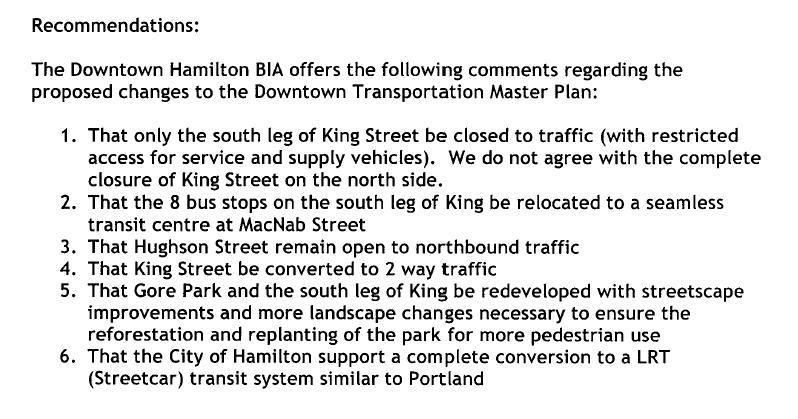
Today, Hamilton has many of the same infrastructure opportunities that Manchester had in the 90's. Higher-order transit is about to be implemented, and downtown will be the hub for the two main routes. King Street can be redesigned in the same manner as Market Street was in Manchester. In other words, the pedestrian-only section can be serviced directly by these transit lines, and can therefore be designed to funnel the additional pedestrian traffic in the same manner as Manchester's Market Street handles the pedestrian flow of those using the Metrolink. Businesses along this stretch will benefit greatly as these transit users walk past these shops, and the pedestrian zone will promote prolonged visits and can host civic events, much like Market Street in Manchester does. Just as automobile traffic to downtown Manchester was unhindered by the pedestrianisation, the many underused alternate routes in downtown will not make this pedestrianisation any kind of hinderence to automobile traffic.
|
No, King Street can't be designed in the same manner that Market Street was because the economic and demographic conditions are not yet there to support it (see above). Implementing LRT is undoubtedly a first step in reurbanizing Hamilton. Complete pedestrianisation may very well be a logical progression at one point in the future. I gladly acknowledge Hamilton's infrastructural opportunities, but if the LRT were implemented tomorrow, who do you think it would serve? Almost exclusively: students and people with minimal disposible income. These demographics, as hard as they might try, simply would not be able to support the sort of economic rejuvenation you expect as a result of pedestrianisation. The wealth in this city is concentrated almost exclusively on the fringes, such as to be effectively segregated from the city proper. LRT will not magically integrate this wealth back into the city. It will surely do a lot to attract newcomers to downtown Hamilton, and may in the long term convince educated Hamiltonians who might otherwise leave the city to stay (and perhaps even to live downtown). But the truth of the matter is that there is virtually nothing there to keep them as it is, and I seriously question the value of a pedestrianised King Street as an incentive in itself. I'll say it again (because I can't seem to make the point stick): I am not opposed to pedestrianisation in principle. I think it will possibly prove an excellent option in the long or even medium term. I think before it will be a viable option, however, the downtown needs to become host to a large urban population with disposible income. I do not think pedestrianisation has been proven as a reliable catalyst for economic rejuvenation.





 Prev
Prev




 Linear Mode
