December 20, 2007, 10:46 am
Freedom, Set in Special Concrete
By David W. Dunlap
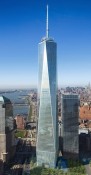
The Freedom Tower construction site at 1 World Trade Center in Lower Manhattan. Just about every element at ground zero generates heat. Even the concrete.
With walls up to 5 feet 10 inches thick, the core of the 1 World Trade Center project (also called Freedom Tower) requires tremendous amounts of concrete; so much that the chemical process by which the concrete takes form and hardens — starting from a mixture of cement, aggregate and water — actually creates its own considerable heat.
If temperatures at the center of the concrete pour are above 160 degrees, or if there is a difference in temperature of more than 35 degrees between the inside and outside, it can lead to stress and deterioration.
“That’s a major challenge in a project like this,” said Michael J. Mennella, executive vice president of the Tishman Construction Corporation of New York, which is managing construction of the Freedom Tower for the Port Authority of New York and New Jersey.
So it was news when the commissioners of the Port Authority were told on Tuesday that an extremely high-strength concrete formula had been used successfully for the first time in New York City, as part of the Freedom Tower project. This concrete has a strength under compression calculated at 14,000 pounds per square inch. (The highest strength previously used in a New York skyscraper had a rating of 12,000 pounds per square inch. A house might use concrete with a strength of 2,000 pounds per square inch.)
A steel column bears the words “Freedom Tower” and is partially encased in concrete.

The formula was devised by a company called iCrete and employed at the Freedom Tower by the Quadrozzi Concrete Company, a subcontractor.
“To get this kind of strength in concrete, you usually have to increase the amount of cement,” said Tony Arnold, president of iCrete. “We reduced the amount of cement.”
That in turn lowered the temperature of the chemical reaction. It incidentally helped reduce carbon dioxide emissions during production of the cement. The iCrete formula also uses byproducts of steel fabrication known as slag and fly ash. About 700 cubic yards were poured Tuesday atop an earlier pour of 630 cubic yards, Mr. Mennella said.
“You’re not going to find too many places in the world with walls this thick,” Mr. Mennella said as he looked over the twin cores of the Freedom Tower, still far below street level but now on the way up. “This is one of them.”
You also will not find any other place in the world with a steel column bearing the words “Freedom Tower.” This column was set in place exactly a year ago as part of Gov. George E. Pataki’s last official visit to the trade center site. It is now partly encased in concrete and says simply, “Freedom.”




 Prev
Prev


 Linear Mode
