| |
 Posted Nov 24, 2007, 9:49 PM
|
 |
Registered User
|
|
Join Date: Jan 2007
Location: Governor's Park/Capitol Hill, Denver
Posts: 2,618
|
|
 Phoenix - Part Two by DenverAztec
Part two of some of the photos I shot on some recent business trips to the naturally beautiful city of Phoenix. I included in this second thread a few shots of Montezuma’s Castle, Sedona and a small village called Tlaquepaque within Sedona. I hope you enjoy the tour!
Here is a bit of history with some of the historic structures:
Arizona Capitol Building, James Riley Gordon – Architect, dedicated as Arizona's capitol in 1901. It's now a museum with state business conducted in building surrounding it. The completed building cost $135,000. The original Capitol Building was placed on the National Register of Historic Places in 1974. The restoration of the building to its 1912 appearance was completed in 1981 at a cost of just under $4 million dollars. The style is one of the five classes of the Ionic Grecian architecture.
 Winged Victory is a weather vane. She holds the torch of liberty in her right hand, and her left hand presents a victory wreath. The statue which adorns the copper dome of the Arizona State Capitol has been referred to as the Goddess of Liberty, Statue of Justice, Madame de Vaunte and more recently Winged Victory. The name Winged Victory has evolved because of her resemblance to the Greek statue of the same name. The only noticeable difference is Arizona’s statue has both arms intact and a head. Winged Victory is a zinc statue that was cast in Ohio and purchased by Arizona Territory for $160 in 1898.
 Father Eusebio Francisco Kino “Padre on Horseback”, From 1687 until his death in 1711, the Jesuit missionary Father Kino established over 20 missions in what are today northern Mexico and southern Arizona. Kino was noteworthy for the good relations he established with the indigenous peoples among whom he worked. He treated the Pima Indians with respect and learned their language. He was the first to prove that Baja California was a peninsula, not an island. He established the foundation for modern agriculture and livestock raising.
 Department of Agriculture Building on Adams near the State Capitol, built in 1929. Up along the roofline you will find that the building is ringed with swastikas. It is actually an ancient symbol that was in the building's original blueprints from 1929, before the Nazis adopted the symbol. It was originally a Native American symbol that has been around for literally thousands of year. The Heard Museum in Phoenix has pottery from around the year 900 with the same symbol on it. It simply means the cycles of the seasons, the four cycles of life. It means all the good things about life, the balance of life.
 U.S.S. Arizona anchor and Signal Mast, In memory of the men who gave their lives on December 7, 1941 on the battleship U.S.S. Arizona during the attack on Pearl Harbor, the anchor and mast from the ship were dedicated in 1976 in this park in front of the Capitol Building.


 Korean War Veterans Memorial.
 A few homes off on North Central


 The Rosson House, 115 N. Sixth St. - Designed in 1894 by Phoenix Architect A.P. Petit, this house is a Victorian style. The house, listed in the National Register of Historic Places, is part of Heritage Square, which is a downtown display of homes from the original townsite of Phoenix. This 2,800 square foot Eastlake-style Victorian home features ten rooms and five fireplaces.
 Professional Building, 137 N. Central Ave. - provided centrally located medical offices for the first time in Phoenix. It was built in 1931. This is the largest limestone-sheathed building in Arizona and is an Art Deco/Modern Style skyscraper. The top story was added in 1958.


 The Central Phoenix Library, May 20, 1995, the New Central Library at 1221 N. Central Ave. is dedicated.


 Sheraton Downtown Phoenix Hotel, close to external construction completion, Height: 360 feet, Floors: 31, Opening: October 2008, Location: NWC of 3rd Street & Van Buren Street, Owner: City of Phoenix, Architect: Arquitectonica (Miami, Florida). Though there is much controversy amongst Phoenicians with respect to the appeal of this building, it may be too early to have a concluding decision until it is actually complete. Currently, it looks like a very large warehouse circa 1970.


 Fry Building, northwest corner of Second and Washington streets - is the earliest known intact commercial building in Phoenix. This two-story building was built in 1885. In 1904, the north addition of the Fry Building was erected and the storefronts were remodeled in 1950. Currently, home to Majerle’s sports bar (named after Dan Majerle who played for the Phoenix Suns in the 80s), and a decent place for burgers plus close to the U.S. Airways Center.
Fry Building, northwest corner of Second and Washington streets - is the earliest known intact commercial building in Phoenix. This two-story building was built in 1885. In 1904, the north addition of the Fry Building was erected and the storefronts were remodeled in 1950. Currently, home to Majerle’s sports bar (named after Dan Majerle who played for the Phoenix Suns in the 80s), and a decent place for burgers plus close to the U.S. Airways Center.   


 Historic City Hall/Maricopa County Courthouse, 125 W. Washington St. - was completed in 1928. The courthouse has a combination of Art Deco, Modern, Spanish Colonial Revival and Renaissance motifs.

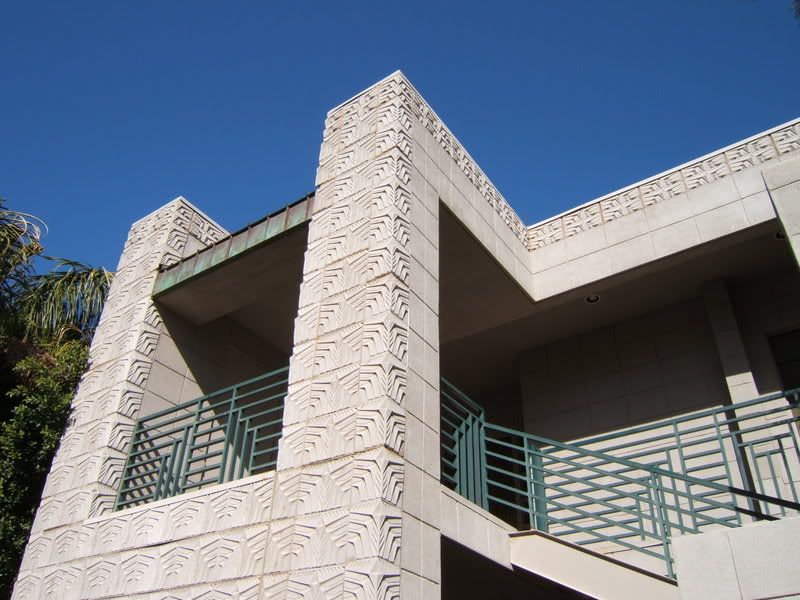
 Arizona Biltmore Resort and Spa, Architect Albert Chase McArthur, built in 1929, McArthur studied with Frank Lloyd Wright between 1907 and 1909 and indeed Wright’s influence on the Biltmore’s design is palpable. McArthur used the textile-block system that Wright had developed in southern California. Wright did on-site consulting for four months in 1928 related to the masonry construction. The two architects are a study in contrast with the famous and outspoken Wright being self taught and never licensed as an architect in Arizona. The more soft spoken McArthur was Harvard trained in architecture, mathematics, engineering, and music. McArthur obtained an architect's license in Arizona, number 338, in 1925, the year he arrived in Phoenix to begin his practice.




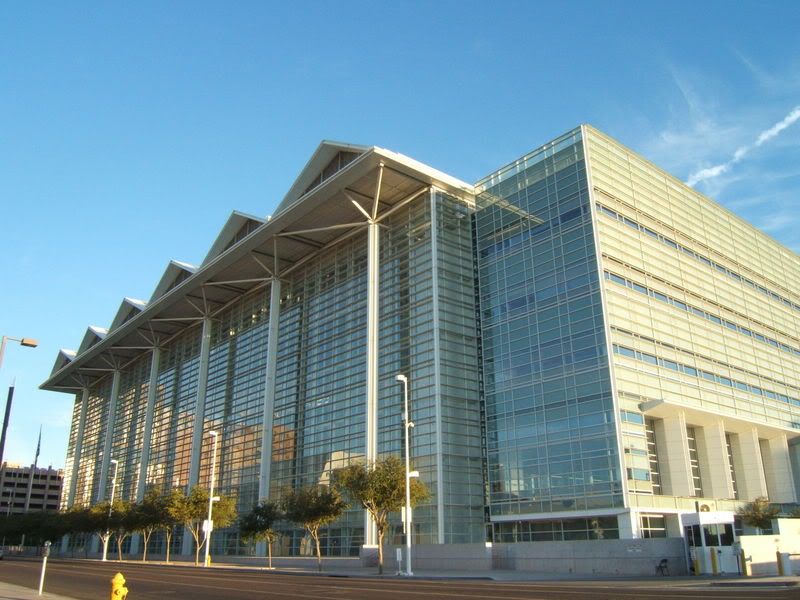
 Sandra Day O'Connor United States Courthouse at 401 West Washington Street is named after the former Supreme Court justice. Designed by architect Richard Meier with local executive architects of Langdon Wilson Architecture. The courthouse is in Meier's signature monochrome style. Standing twelve stories with no public parking it encompasses more than 550,000 square feet (51,000 m²), the public atrium features a dramatic 12 story glass curtain-wall on the north face. The Phoenix courthouse has been plagued with climate-control problems with its evaporative cooling system. Atrium temperatures have been known to reach 100 degrees Fahrenheit in the summer, and the ceiling is open to dust storms.
Sandra Day O'Connor United States Courthouse at 401 West Washington Street is named after the former Supreme Court justice. Designed by architect Richard Meier with local executive architects of Langdon Wilson Architecture. The courthouse is in Meier's signature monochrome style. Standing twelve stories with no public parking it encompasses more than 550,000 square feet (51,000 m²), the public atrium features a dramatic 12 story glass curtain-wall on the north face. The Phoenix courthouse has been plagued with climate-control problems with its evaporative cooling system. Atrium temperatures have been known to reach 100 degrees Fahrenheit in the summer, and the ceiling is open to dust storms.    

 Let’s get on the I-17 and head north out of town about 90 minutes to the Sedona area:

 “Feed Me Seymour!” (the killer plant, Audri Two’s line in ‘The Little Shop of Horrors’)

 Montezuma’s Castle, inhabited by the Northern Sinagua (Spanish for “without water”) about 1125, Above-ground masonry dwellings, abandoned in the early 1400s with no clear reason why. Named after Montezuma because the dwellings were originally thought to have been built by the Aztec’s, but the Aztec’s never made it this far north.

 Sedona, originally founded in 1902, the town was incorporated into a city in 1988. Sedona’s main attraction is its stunning array of red sandstone formations, the Red Rocks of Sedona. The formations appear to glow in brilliant orange and red when illuminated by the rising or setting sun. The Red Rocks form a breathtaking backdrop for everything from spiritual pursuits to the hundreds of hiking and mountain biking trails. Among the rock formations is one that closely resembles the character Snoopy (from the popular Peanuts comic strip) lying on top of his doghouse. Another nearby rock is said to resemble Lucy, also from Peanuts. Other landmark rock formations include Coffeepot Rock, Bell Rock, Cathedral Rock, the Mittens, the Cow Pies, and the Rabbit ears.

 The Chapel of the Holy Cross is an iconic Catholic chapel built into the mesas of Sedona, Arizona, designed by architect and sculptor Marguerite Brunswig Staude, a student of Frank Lloyd Wright. The construction supervisor was Fred Courkos, who built the chapel in 18 months at a cost of US$300,000. The chapel was completed in 1957. The American Institute of Architects gave the Chapel its Award of Honor in 1957. In the sculptor's words, “Though Catholic in faith, as a work of art the Chapel has a universal appeal. Its doors will ever be open to one and all, regardless of creed, that God may come to life in the souls of all men and be a living reality.”


 Mansion in Sedona, excess at it's best

 Tlaquepaque, is a shopping and dining village within Sedona. Tlaquepaque, meaning the "best of everything," has been a Sedona landmark since the 1970's. Its vine covered stucco walls, cobble-stoned walkways and magnificent arched entryways give you the feeling that Tlaquepaque has been here for centuries. Contains over 40 specialty shops and exclusive art galleries.


 Above Jerome (Jerome deserves a thread of it's own, very cool ghost town)
 Road back to Phoenix

 Roosevelt Neighborhood and Historic Home tour


 “Yes, I would like to take a picture of the kitchen without you in it!”


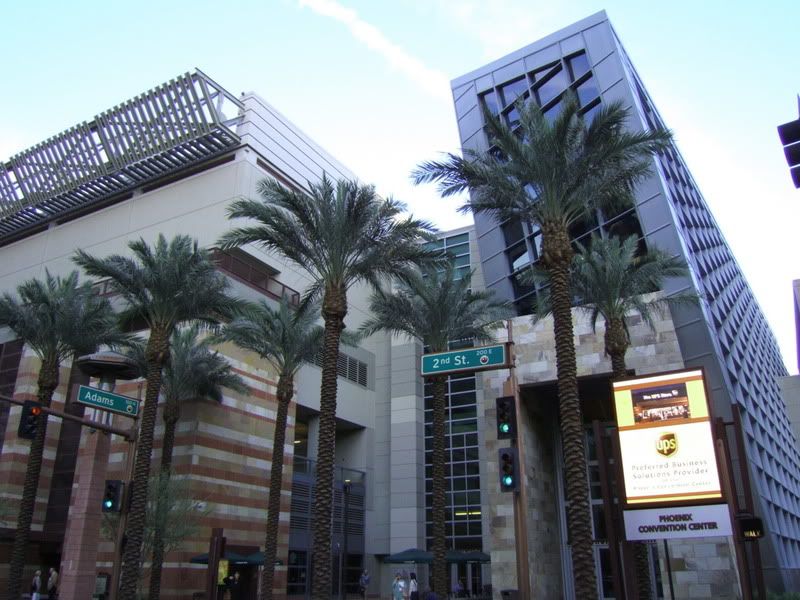
 Phoenix Convention Center

 Evans House with Office of Tourism in background, On January 25, 1893 the Arizona Republican reported, "Mrs. J. M. Evans is building a handsome $6,000 brick residence on Washington Street opposite the Neahr Plaza." When completed the house was to exhibit numerous details of high quality. The most obvious was a round porch topped by a shingled "onion-dome" roof. Less noticeable features included a bay window, arched dormers, elaborate brick chimneys, and carved wooden window frames.
 Carnegie Public Library building (now know as the Carnegie Center) and the back side, it is one of thousands of public library buildings throughout the United States, funded by industrialist and philanthropist Andrew Carnegie in the early 1900’s. After construction, the Carnegie Library building then served as the Phoenix Public Library from 1908 until 1953. After 1953, the building was used as a recreation hall, social service center, storage facility, and a transition place for the homeless. The building was added to the National Registry of Historic Places in 1974, and in 1985 the State began leasing it from the city of Phoenix. Major restoration then took place at a cost of $1.3 million, and the building reopened in early 1987 as the Arizona Hall of Fame Museum. In 2001 the building was closed due to ceiling safety concerns, reopening in 2003. The Arizona State Library, Archives and Public Records then used the building as a library reference center and for museum exhibit, storage and office space until late 2005. Today, the Carnegie Center is home to Library Development Division staff of the Arizona State Library and is a multi-use facility, with programs and services continuing to evolve.

 Modern condos and town-homes off of Roosevelt


 From the plane


 Saint Mary's Basilica was founded in 1881 and staffed by the Franciscan Friars since 1895. The church was completed in 1914, dedicated in 1915, and declared a National Historic Site in 1978. The oldest catholic parish in the greater Phoenix, Arizona area, Saint Mary’s Basilica is home to Arizona's largest stained glass windows collection. The church's Spanish Mission structure supports four domes spanning the length of the Basilica.


 Construction of the 44 Monroe Building (34 stories)


 Historic Phoenix City Hall


 Good Night Phoenix!
 If you missed thread one it can be found by clicking the link below:
http://forum.skyscraperpage.com/showthread.php?t=141386
Ciao Bello!
If you missed thread one it can be found by clicking the link below:
http://forum.skyscraperpage.com/showthread.php?t=141386
Ciao Bello! 
Last edited by denveraztec; Nov 24, 2007 at 10:04 PM.
|
|
|





 Prev
Prev


 Fantastic Job!


 Linear Mode
