
Finally, I've been looking for an update on our magnificant Capitol building. Can't wait to tour the finished product.
Glimpses, following photo's by Francisco Kjolseth/The Salt Lake Tribune
Amid dust and protective sheeting, artisans in hard hats scurry to finish
By Rebecca Walsh
The Salt Lake Tribune
Article Launched: 01/23/2007 01:10:28 AM MST

Construction crews begin to lay down the new floor on the first level rotunda which will eventually become the governor portrait room.

The governor's ceremonial office keeps its original ceiling as numerous other renovations continue at the Utah State Capitol

Looking East toward the supreme court, construction crews begin to dissasemble the scafforlding that once filled the entire space within the Utah Capitol. With the upper rotunda nearly completely repainted, definite changes are taking place with the project scheduled to be completed in one more year.

A recent Capitol tour reveals the progress that's been made along with areas that still have a ways to go, including the house of representatives undergoing painting and restoration.

A construction worker applies plaster to the ceilings near the East atrium as work continues at the Utah Capitol currently undergoing seismic reinforcements and updates.

Facing West toward the house of representatives, construction crews begin to dissasemble the scaffolding which once filled the entire atrium at the Utah State Capitol. The seismic updates are scheduled to be completed in one year with the grand opening on Jan. 4, 2008.

Nearing completion, the supreme courts paint and gold leaf details have been updated as work contiunes on the Utah Capitol.

Restoration of decorative pillars, seen here in the house of representatives and seismic updating of the Utah Capitol continues with a planned grand opening on Jan. 4, 2008.

A gold leaf ornament is intricate and detailed. (Francisco Kjolseth/The Salt Lake Tribune)

David Hart, Capitol architect for the state, points out the ceiling elements of the gold room as its renovation nears completion. The grand opening of the state Capitol is set for Jan. 4, 2008. (Francisco Kjolseth/The Salt Lake Tribune

Details in gold leaf have been updated on top of the Supreme Court's entrance at the Capitol as work continues with a year left to go. (Francisco Kjolseth/The Salt Lake Tribune)
The changes inside Utah's Capitol are subtle.
Glimpses of the freshly de-grimed murals that circle the Rotunda are visible through a network of scaffolding. Watery winter sunlight filters through cleaned skylights in the east and west atriums, highlighting new baby blue and pink paint. Plaster patching snakes over all the ceilings like a spider web.
Lower levels of the building still look like something out of "The Lord of the Rings," with puddles of standing water, the occasional flare of a welder's torch and fluffy piles of concrete dust kicked up in the frigid air.
But upstairs, hints of the Victorian gilt that adorned the seat of state government when it first opened in 1916 are starting to reappear.
After three years of demolition and Port-o-Potties and Visqueen sheeting, the Capitol is starting to look more like itself - albeit a more mahogany and mauve version of itself.
"You'll see colors you've never seen before," says Dave Marshall, general superintendent for Jacobsen-Hunt, the construction firms overseeing the rebuilding project.
In one year, the building will reopen to elected leaders and the public. In the meantime, the work of filling in the gutted granite shell is starting in earnest.
"It's changing so fast that every time I come in, something's different," says Capitol Architect David Hart.
To the eye, the transformation is more gradual. Windows still are blocked with plywood and plastic. A village of 70 subcontractors' trailers clusters south of the building in the dirt. The center of the first floor is a precarious hole.
The Capitol closed in the summer of 2004 to allow construction crews to shore it up to withstand an earthquake and, at the same time, reverse years of utilitarian and historically clumsy remodeling projects, returning the building to its genteel glory.
The $200 million seismic retrofit and restoration project is at its peak, with 350 workers toiling in the building, screwing in metal lathe and Sheetrock, slathering plaster mud on new walls and delicately filling divots in the marble-veneered walls with a mixture of rock dust and cement.
In the basement, crews are installing the last of 280 base isolators - giant sliders that will allow the building to sway two feet side to side, but intact, in a temblor. In March, the building will be cut free from its old footings and allowed to rest on the isolators.
Until then, the most delicate work of the entire project - decorative painting and restoration of the murals - goes on in a fine cloud of dust.
"Right now, dust is the enemy," Hart says. "I'll feel much better when the scaffolding is down and the dust is gone."
Art restorer Carmen Bria climbed up and down 12 flights of scaffolding in 90-degree heat for six weeks last summer as part of a crew that de-grimed, "in-painted" and repaired water damage and a hole in Father Escalante's ear - at times lying on their stomachs - before revarnishing the murals that encircle the Capitol rotunda.
Preservationists, including Bria, from the Denver-based Western Center of the Conservation of Fine Arts will return to Utah in February to restore a mural in the Senate gallery. Artists from the center have worked in the Colorado and Oklahoma capitols as well as several post offices.
"We've never worn hard hats before," Bria says. "It's just an incredibly complex project to try to coordinate."
The whole building smells of paint. Painting and mural restoration is about $2.8 million of the project budget and nearly every surface in the building will get a new coat. The Supreme Court Chamber's gold paint and leafing have been replaced. The walls are a deep plum color - rather than the blues and taupes more modern tastes dictated. Trim in the historic Gold Room is being painted a light lavender - it looks creamy against the surrounding color scheme.
Work in the Senate and House chambers is on a different schedule. The House's old pink and green color scheme is evident. And water damage still mars the ceiling of the Senate. Crews are stripping the iron scrollwork railings in the galleries and applying gold leaf. And painters are beginning decorative painting of the plasterwork.
While work chugs on inside the building, furniture restorers, carpenters and artists have been commissioned to create the trappings that will fill the chambers and offices.
Two Utah artists have been selected to paint murals for pendentives above the doors in the House and Senate chambers. Both Cache Valley painters have been sworn to secrecy about the subjects, but they are expected to be scenes from Utah's history. Legislative leaders want to unveil the paintings during public open houses next fall.
David Koch is painting two 8-by-10-foot murals for the House in his parents' garage - the only space large enough to do the work.
"It's the biggest painting that I've done to date," Koch says. He's thrilled at the idea his art will join works by Utah artists Lee Green Richards and H.L.A. (Harry) Culmer.
"To be included in that group is just a little bit daunting to me," Koch says. "It would be a milestone for any artist to have a work in a government building. It's historically significant."

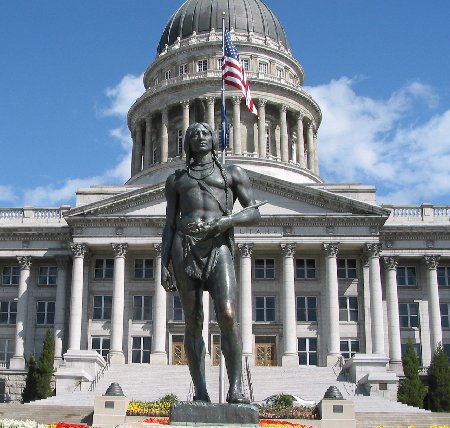
At the Utah Capitol, a seismic fault adjacent to
the site motivated a major effort to reinforce this
iconic structure. Base isolation, allowing
approximately 30 inches of lateralmovement
(and the consequent stiffening of the building),
in turn provided the excuse for a complete overhaul. Photo courtesy of Schooley Caldwell Associates





 Prev
Prev



 Is Utah's success too much for economy?


 Leading Cancer Center Christened


 Linear Mode
