HomeDiagramsDatabaseMapsForum About
     

Go Back   SkyscraperPage Forum > Discussion Forums > City Discussions


Reply

 
Thread Tools Display Modes
     
     
  #1  
Old Posted Oct 2, 2026, 1:40 PM
fleonzo fleonzo is offline
 
Join Date: Jun 2003
Posts: 913
Ranked:The World’s Strongest City Economies by 2050


Source: Oxford Economics - Global Cities Index 2026
https://www.visualcapitalist.com/ranked-the-worlds-largest-city-economies-in-2050/

Today’s Biggest City Economies
In 2025, five cities generated more than $1 trillion in annual GDP. New York ranked first at $2.6 trillion, followed by Tokyo at $1.5 trillion and Los Angeles at $1.4 trillion.

Rank City Country GDP (2025)
1 New York U.S. $2.60T
2 Tokyo Japan $1.50T
3 Los Angeles. U.S. $1.42T
4 London UK $1.16T
5 Paris France $1.03T
6 Seoul South Korea. $970B
7 Chicago U.S. $970B
8 Dallas U.S. $840B
9 San Francisco U.S. $840B
10 Houston U.S. $800B
11 Washington, DC U.S. $780B
12 Shanghai China $780B

Together, New York, Tokyo, and Los Angeles generated roughly $5.5 trillion in GDP, putting their combined economic output on the scale of the world’s largest national economies.

By 2050, the scale shifts dramatically: every city in the projected top 12 is expected to exceed $2 trillion in annual GDP.

Asian Megacities Climb the Global Rankings
By 2050, China is projected to have three cities in the global top 10, compared with none in 2025. U.S. cities remain prominent, but some of the largest GDP gains are expected in Asia.

Rank City Country GDP (2050)

1 New York U.S. $6.39T
2 Los Angeles U.S. $3.62T
3 Shanghai China $3.26T
4 Tokyo Japan $3.25T
5 London UK $3.17T
6 Beijing China $2.63T
7 San Francisco U.S. $2.49T
8 Dallas U.S. $2.44T
9 Shenzhen China $2.43T
10 Chicago U.S. $2.42T
11 Seoul South Korea $2.41T
12 Paris France $2.34T


Last edited by fleonzo; Oct 2, 2026 at 2:22 PM.
Reply With Quote
     
     
  #2  
Old Posted Oct 2, 2026, 3:45 PM
New Brisavoine New Brisavoine is offline
 
Join Date: Nov 2007
Posts: 5,349
Quote:
Originally Posted by fleonzo View Post

Source: Oxford Economics - Global Cities Index 2026
https://www.visualcapitalist.com/ranked-the-worlds-largest-city-economies-in-2050/

Today’s Biggest City Economies
In 2025, five cities generated more than $1 trillion in annual GDP. New York ranked first at $2.6 trillion, followed by Tokyo at $1.5 trillion and Los Angeles at $1.4 trillion.

Rank City Country GDP (2025)
1 New York U.S. $2.60T
2 Tokyo Japan $1.50T
3 Los Angeles. U.S. $1.42T
4 London UK $1.16T
5 Paris France $1.03T
6 Seoul South Korea. $970B
7 Chicago U.S. $970B
8 Dallas U.S. $840B
9 San Francisco U.S. $840B
10 Houston U.S. $800B
11 Washington, DC U.S. $780B
12 Shanghai China $780B
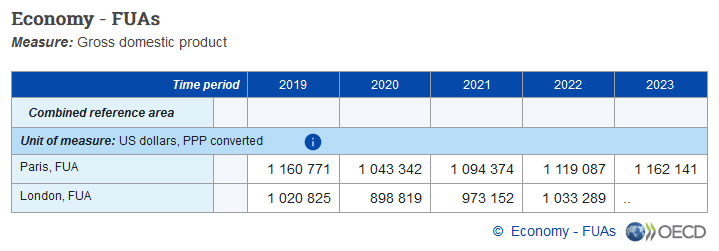
Oxford Economics placing London slightly ahead of Paris, now THAT is a surprise!

In the real world, using an internationally homogeneous definition of metro areas:


Quote:
Originally Posted by fleonzo View Post
By 2050, the scale shifts dramatically: every city in the projected top 12 is expected to exceed $2 trillion in annual GDP.

Asian Megacities Climb the Global Rankings
By 2050, China is projected to have three cities in the global top 10, compared with none in 2025. U.S. cities remain prominent, but some of the largest GDP gains are expected in Asia.

Rank City Country GDP (2050)

1 New York U.S. $6.39T
2 Los Angeles U.S. $3.62T
3 Shanghai China $3.26T
4 Tokyo Japan $3.25T
5 London UK $3.17T
6 Beijing China $2.63T
7 San Francisco U.S. $2.49T
8 Dallas U.S. $2.44T
9 Shenzhen China $2.43T
10 Chicago U.S. $2.42T
11 Seoul South Korea $2.41T
12 Paris France $2.34T

They should be bold post estimates for the year 2500. Or even the 31st century.

I also admire how the British always hype their capital city, imagining that its economy is going to grow 50% more than Paris until 2050 despite Brexit and other ailments. Some things never change!
Reply With Quote
     
     
  #3  
Old Posted Oct 2, 2026, 4:01 PM
mhays mhays is online now
 
Join Date: Jul 2001
Posts: 21,307
This is wildly speculative, though the organization gives more effort than the standard magazine-type list. In particular, a few points seem especially important to what cities rise by 2050:

1. Countries with minicule birth rates and low immigration will have major headwinds, such as China, Japan, and South Korea.

2. The US is handing off or flubbing its central role in many functions and sectors, which are now building replacements and work-arounds elsewhere. Britain is doing somthing similar with Brexit. Much of this effect will be permanent. Some international cities will boom as a result.

3. Shipping lanes might be permanently at risk and/or tolled (with drones exponentially increasing risk), making oil and certain other goods more expensive. That will hurt poorer countries (with risk of famine) and high-use countries like the US. Efficiencies (such as compact cities and transit) and alternative power supplies will help some places excel.

4. Climate will continue to influence movement. Hot places will generally get hotter. Some places will need especially large infrastructure investment to protect against rising seas, with major variation depending on topography and soil types.
Reply With Quote
     
     
  #4  
Old Posted Oct 2, 2026, 5:10 PM
DCReid DCReid is online now
 
Join Date: Jun 2012
Posts: 1,572
Quote:
Originally Posted by mhays View Post
This is wildly speculative, though the organization gives more effort than the standard magazine-type list. In particular, a few points seem especially important to what cities rise by 2050:

1. Countries with minicule birth rates and low immigration will have major headwinds, such as China, Japan, and South Korea.

2. The US is handing off or flubbing its central role in many functions and sectors, which are now building replacements and work-arounds elsewhere. Britain is doing somthing similar with Brexit. Much of this effect will be permanent. Some international cities will boom as a result.

3. Shipping lanes might be permanently at risk and/or tolled (with drones exponentially increasing risk), making oil and certain other goods more expensive. That will hurt poorer countries (with risk of famine) and high-use countries like the US. Efficiencies (such as compact cities and transit) and alternative power supplies will help some places excel.

4. Climate will continue to influence movement. Hot places will generally get hotter. Some places will need especially large infrastructure investment to protect against rising seas, with major variation depending on topography and soil types.
I agree. It's like if this came out in 1970 or even 1980, possibly no Chinese cities would be on the list except for Hong Kong, which was controlled by the UK at the time and has been eclipsed by mainland China cities. Also, I see no Indian cities and would bet that one Indian city may rise to the top 12. There's always a problem with extrapolating current trends well into the future. Even (or especially) in business, things change dramatically; just look at companies that were the biggest in 1980 and compare it to now -- even companies in the tech industry (IBM and Intel, for example).
Reply With Quote
     
     
  #5  
Old Posted Oct 2, 2026, 5:36 PM
Yuri's Avatar
Yuri Yuri is online now
 
Join Date: Sep 2008
Posts: 6,435
We can't predict GDP growth for the next quarter, let alone for 2050.
Reply With Quote
     
     
  #6  
Old Posted Oct 2, 2026, 5:56 PM
iheartthed iheartthed is online now
 
Join Date: Oct 2009
Posts: 12,217
Quote:
Originally Posted by DCReid View Post
I agree. It's like if this came out in 1970 or even 1980, possibly no Chinese cities would be on the list except for Hong Kong, which was controlled by the UK at the time and has been eclipsed by mainland China cities. Also, I see no Indian cities and would bet that one Indian city may rise to the top 12. There's always a problem with extrapolating current trends well into the future. Even (or especially) in business, things change dramatically; just look at companies that were the biggest in 1980 and compare it to now -- even companies in the tech industry (IBM and Intel, for example).
Japan was supposed to have overtaken the U.S. economy now according to projections made in the 1970s and 1980s.
Reply With Quote
     
     
  #7  
Old Posted Oct 2, 2026, 6:00 PM
sentinel's Avatar
sentinel sentinel is offline
 
Join Date: Oct 2004
Posts: 4,821
Speculative lists like this are just wonderful exercises in futility. Thanks for the amusing post.
Reply With Quote
     
     
  #8  
Old Posted Oct 2, 2026, 6:26 PM
The North One's Avatar
The North One The North One is offline
 
Join Date: Sep 2009
Posts: 5,921
lol they can't even accurately measure economies right now. Predicting 2050 is a joke.
Reply With Quote
     
     
  #9  
Old Posted Oct 2, 2026, 6:30 PM
twinpeaks twinpeaks is offline
 
Join Date: Nov 2006
Posts: 263
Quote:
Originally Posted by fleonzo View Post

Source: Oxford Economics - Global Cities Index 2026
https://www.visualcapitalist.com/ranked-the-worlds-largest-city-economies-in-2050/

Today’s Biggest City Economies
In 2025, five cities generated more than $1 trillion in annual GDP. New York ranked first at $2.6 trillion, followed by Tokyo at $1.5 trillion and Los Angeles at $1.4 trillion.

Rank City Country GDP (2025)
1 New York U.S. $2.60T
2 Tokyo Japan $1.50T
3 Los Angeles. U.S. $1.42T
4 London UK $1.16T
5 Paris France $1.03T
6 Seoul South Korea. $970B
7 Chicago U.S. $970B
8 Dallas U.S. $840B
9 San Francisco U.S. $840B
10 Houston U.S. $800B
11 Washington, DC U.S. $780B
12 Shanghai China $780B

Together, New York, Tokyo, and Los Angeles generated roughly $5.5 trillion in GDP, putting their combined economic output on the scale of the world’s largest national economies.

By 2050, the scale shifts dramatically: every city in the projected top 12 is expected to exceed $2 trillion in annual GDP.

Asian Megacities Climb the Global Rankings
By 2050, China is projected to have three cities in the global top 10, compared with none in 2025. U.S. cities remain prominent, but some of the largest GDP gains are expected in Asia.

Rank City Country GDP (2050)

1 New York U.S. $6.39T
2 Los Angeles U.S. $3.62T
3 Shanghai China $3.26T
4 Tokyo Japan $3.25T
5 London UK $3.17T
6 Beijing China $2.63T
7 San Francisco U.S. $2.49T
8 Dallas U.S. $2.44T
9 Shenzhen China $2.43T
10 Chicago U.S. $2.42T
11 Seoul South Korea $2.41T
12 Paris France $2.34T
San Francisco seems low, is San Jose separated from the metro?
Reply With Quote
     
     
  #10  
Old Posted Oct 2, 2026, 6:38 PM
fleonzo fleonzo is offline
 
Join Date: Jun 2003
Posts: 913
Quote:
Originally Posted by Yuri View Post
We can't predict GDP growth for the next quarter, let alone for 2050.
Pretty much true...
Reply With Quote
     
     
  #11  
Old Posted Oct 2, 2026, 7:03 PM
JManc's Avatar
JManc JManc is offline
 
Join Date: Feb 2003
Posts: 23,167
Quote:
Originally Posted by twinpeaks View Post
San Francisco seems low, is San Jose separated from the metro?
Yes as they are technically two separate regions even if they function as one.
Reply With Quote
     
     
  #12  
Old Posted Oct 2, 2026, 7:10 PM
sopas ej's Avatar
sopas ej sopas ej is offline
 
Join Date: Jul 2007
Posts: 8,214
Quote:
Originally Posted by iheartthed View Post
Japan was supposed to have overtaken the U.S. economy now according to projections made in the 1970s and 1980s.
Yes; as a teen during the 1980s, I remember hearing a lot about this. The 1980s was the peak of Japan's economic strength.

When I was 16 in 1986, my family and I went on a trip to Tokyo. Back then, the exchange rate was 149 yen = US $1.00.

Somewhat paradoxically, even though the Japanese economy started its decline in the 1990s, that's when the yen was its strongest against the US dollar; I think in the mid-1990s, 80 yen equaled 1 US dollar.

As of today, the exchange rate is 157.81 yen = US $1.00.
Reply With Quote
     
     
  #13  
Old Posted Oct 2, 2026, 7:49 PM
Yuri's Avatar
Yuri Yuri is online now
 
Join Date: Sep 2008
Posts: 6,435
Quote:
Originally Posted by sopas ej View Post
Yes; as a teen during the 1980s, I remember hearing a lot about this. The 1980s was the peak of Japan's economic strength.

When I was 16 in 1986, my family and I went on a trip to Tokyo. Back then, the exchange rate was 149 yen = US $1.00.

Somewhat paradoxically, even though the Japanese economy started its decline in the 1990s, that's when the yen was its strongest against the US dollar; I think in the mid-1990s, 80 yen equaled 1 US dollar.

As of today, the exchange rate is 157.81 yen = US $1.00.
The US engineered Japanese decline with the Plaza Accord. Post-War the US was that: spreading misery throughout the world, allies and enemies alike.
Reply With Quote
     
     
  #14  
Old Posted Oct 2, 2026, 7:50 PM
Wigs's Avatar
Wigs Wigs is online now
 
Join Date: Nov 2003
Posts: 16,718
Quote:
Originally Posted by Yuri View Post
We can't predict GDP growth for the next quarter, let alone for 2050.
Most useless list I've seen on SSP in a while
Reply With Quote
     
     
  #15  
Old Posted Oct 2, 2026, 7:58 PM
38 Geary 38 Geary is online now
 
Join Date: Jan 2012
Posts: 11,891
Quote:
Originally Posted by JManc View Post
Yes as they are technically two separate regions even if they function as one.
I guess the question then is, by 2050, will they be technically considered one?
Reply With Quote
     
     
  #16  
Old Posted Oct 2, 2026, 8:10 PM
mhays mhays is online now
 
Join Date: Jul 2001
Posts: 21,307
Further, will one agency's opinion continue to matter to so many people. I combine the two (along with the two LA MSAs) for any realistic analysis. So do a lot of others, whether transit planners, media companies, sports teams, employers, commercial real estate cos, etc.

SSP often gets caught up in the idea of "official" designations for points that are often mostly subjective.
Reply With Quote
     
     
  #17  
Old Posted Oct 2, 2026, 9:49 PM
mousquet's Avatar
mousquet mousquet is offline
 
Join Date: Jan 2011
Posts: 5,143
Quote:
Originally Posted by New Brisavoine View Post
They should be bold post estimates for the year 2500. Or even the 31st century.

I also admire how the British always hype their capital city, imagining that its economy is going to grow 50% more than Paris until 2050 despite Brexit and other ailments. Some things never change!
I must admit that made me laugh too.
You know, the English like old tradition a lot, so they're still in the old rivalry.
But in France, no one but you cares any longer.

In the French media, they most often compare the French economy to those of Germany, the US or Switzerland to really hurt us and say - see what we've come down to...
They hardly ever mention the British, cause they don't care.
Reply With Quote
     
     
  #18  
Old Posted Oct 2, 2026, 10:10 PM
JManc's Avatar
JManc JManc is offline
 
Join Date: Feb 2003
Posts: 23,167
Quote:
Originally Posted by 38 Geary View Post
I guess the question then is, by 2050, will they be technically considered one?
I would hope so. Should have been merged years ago.
Reply With Quote
     
     
  #19  
Old Posted Oct 2, 2026, 10:24 PM
sopas ej's Avatar
sopas ej sopas ej is offline
 
Join Date: Jul 2007
Posts: 8,214
Quote:
Originally Posted by JManc View Post
I would hope so. Should have been merged years ago.
It's that ding-dang commuting rule. 25% of a workforce has to commute into a neighboring county, or something.

Looking it up myself, less than 3% of workers living in San Francisco County commute into Santa Clara County, and less than 2% of workers in the San Jose Metro Area commute into the San Francisco Metro Area. 87% of the workforce in Santa Clara County also work in Santa Clara County.

So there you go. So, does one really rely on the other?

In SoCal, 20% of Inland Empire workers commute into Los Angeles County, obviously just under the 25% threshold to be considered one metro area.
Reply With Quote
     
     
  #20  
Old Posted Oct 2, 2026, 10:35 PM
JManc's Avatar
JManc JManc is offline
 
Join Date: Feb 2003
Posts: 23,167
Quote:
Originally Posted by sopas ej View Post
It's that ding-dang commuting rule. 25% of a workforce has to commute into a neighboring county, or something.

Looking it up myself, less than 3% of workers living in San Francisco County commute into Santa Clara County, and less than 2% of workers in the San Jose Metro Area commute into the San Francisco Metro Area. 87% of the workforce in Santa Clara County also work in Santa Clara County.

So there you go. So, does one really rely on the other?

In SoCal, 20% of Inland Empire workers commute into Los Angeles County, obviously just under the 25% threshold to be considered one metro area.
I lived and worked in Alameda County; half my coworkers lived there or SF proper or Santa Clara County. A few weirdos came in from San Mateo County. It's so multimodal that I don't think you can use SF or SJ proper as defining areas.
Reply With Quote
     
     
This discussion thread continues

Use the page links to the lower-right to go to the next page for additional posts
 
 
Reply

Go Back   SkyscraperPage Forum > Discussion Forums > City Discussions
Forum Jump


Forum Jump


All times are GMT. The time now is 8:38 PM.


Powered by vBulletin® Version 3.8.7
Copyright ©2000 - 2026, vBulletin Solutions, Inc.