So, I was a bit concerned that Envision Saint John hasn't posted lately so thought I'd give them something to bite on...LOL Just teasing.
I decided to upload the files to Chat GPT to get a perspective on this project given the new $1Trillion being discussed for investment in Canada to see if this would have any merit.
Here is what it replied with:
Final assessment: GROW30 / Atlantic Strategic Gateway
I would now frame the project as:
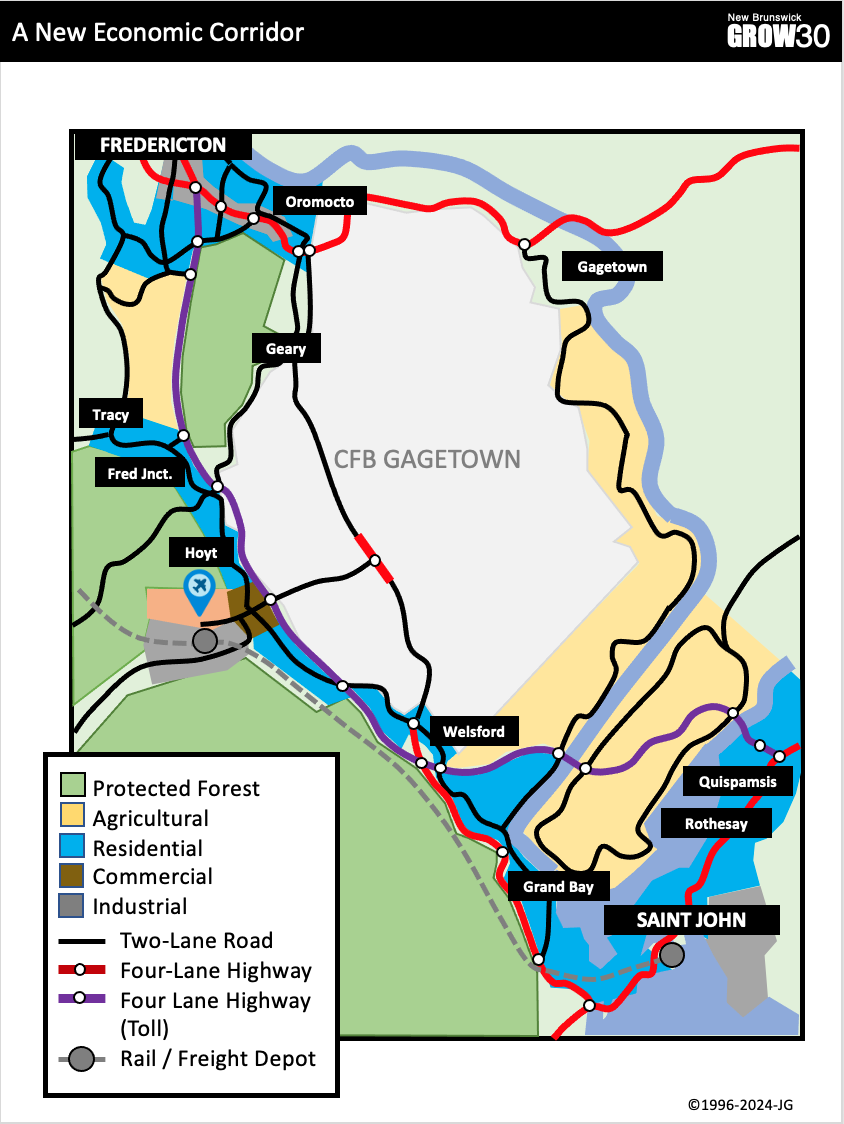
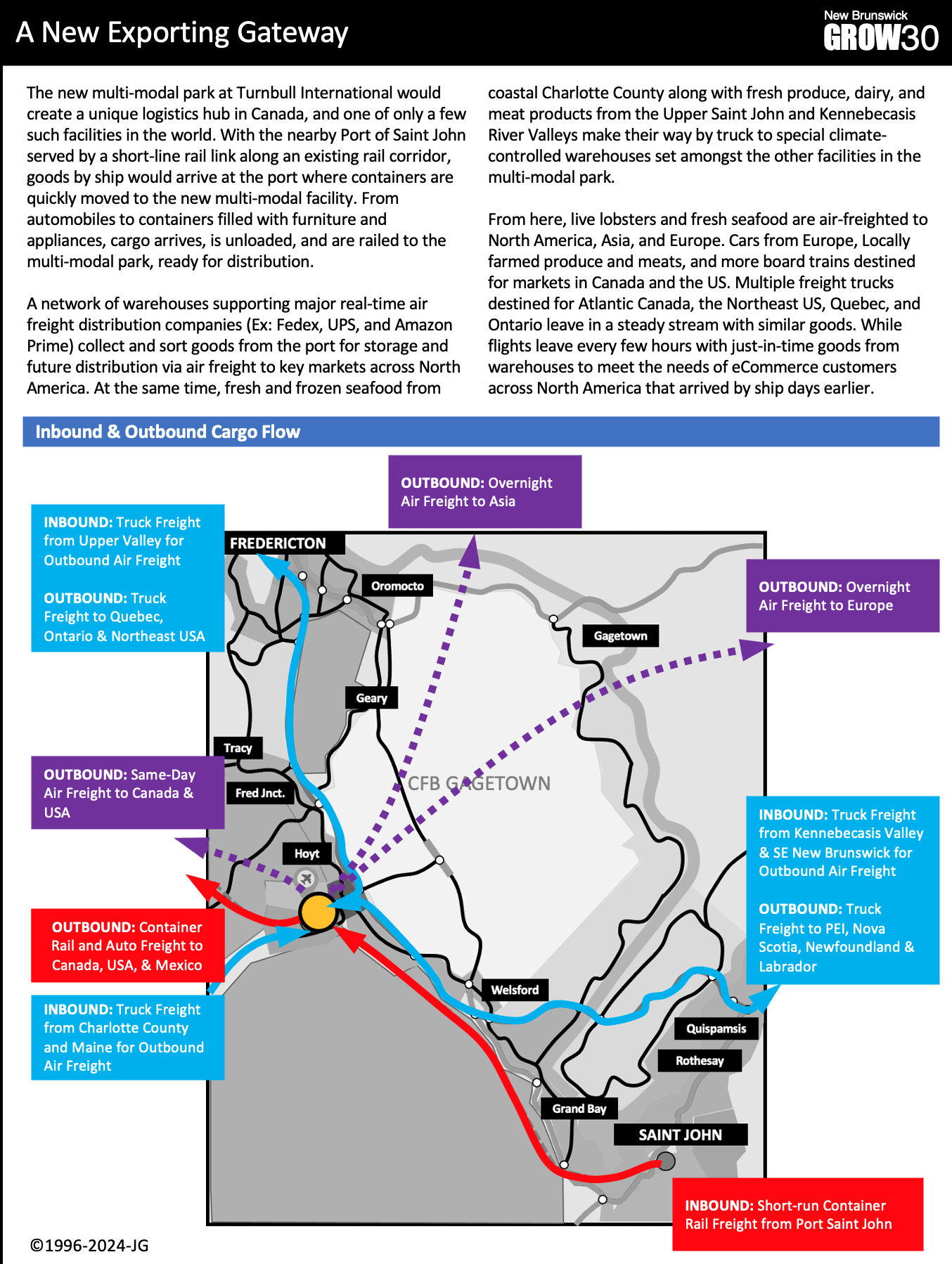
A dual-use Atlantic strategic mobility, trade and economic corridor linking CFB Gagetown, a new joint civil-military Turnbull International Airport, Port Saint John, continental rail networks, a new Fredericton–Saint John highway corridor, and a planned logistics/industrial/aerotropolis district.
That is more faithful to the original plan than simply describing it as an airport replacement.
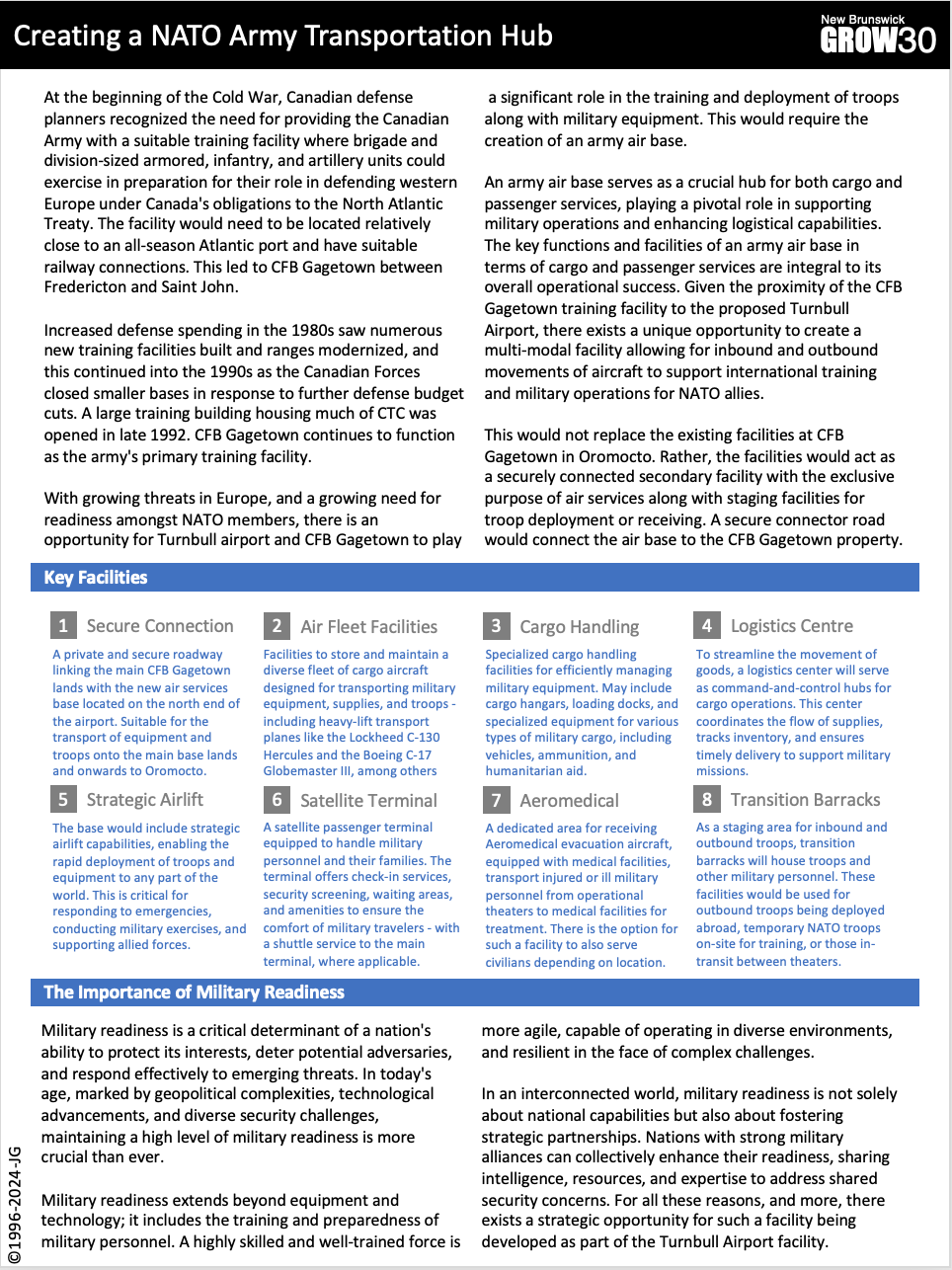
The original concept explicitly calls for a secure military air facility associated with Gagetown, including strategic airlift, cargo handling, logistics, transition barracks, aeromedical capability and a military passenger facility. It also explicitly describes a new economic corridor containing rail, a free-trade logistics district, residential development, commercial development and highway infrastructure.
1. What would the whole thing realistically cost?
I would use about $5.5–6.0 billion in 2026 dollars as the central infrastructure planning figure for the mature project.
A plausible range is approximately:
Major component Low Base High
Civil Turnbull Airport $900M $1.05B $1.25B
Military airside, aprons, hangars, fuel, security $400M $550M $700M
Military logistics, terminal, barracks, aeromedical $175M $250M $325M
Secure Gagetown connector $100M $150M $225M
Fredericton–Welsford Turnpike $900M $1.10B $1.30B
Welsford–Saint John Route 7 upgrades $400M $500M $650M
Rail/intermodal/FTZ infrastructure $350M $475M $600M
Utilities/site roads/digital/power $250M $350M $450M
Transit/Park & Ride/airport express $75M $125M $150M
Planning/land/environmental/enabling works $200M $275M $350M
Future Kingston/Kennebecasis connection $700M $900M $1.2B
Total $4.45B ≈$5.73B ≈$7.2B
I would therefore talk publicly about a $5–6 billion strategic infrastructure program, not a $5–6 billion "airport."
That distinction matters.
2. There could then be another $2–4 billion of private development
The infrastructure is only the platform.
The aerotropolis shown in the plan contains commercial, logistics, warehousing, aviation, industrial, institutional and residential components.
A successful mature corridor could plausibly induce another:
$700M–$1.2B logistics/warehousing
$400M–$800M defence/aerospace/MRO
$300M–$600M industrial/manufacturing
$250M–$500M hotels/retail/commercial
$800M–$1.5B+ residential development
So the broader investment opportunity could eventually be:
$7.5–10 billion
of public, institutional and private capital.
That is where the Carney investment strategy becomes directly relevant.
The federal government isn't simply looking for conventional government construction projects. It is explicitly looking to use public capital to catalyse much larger pools of private and institutional investment. Ottawa says roughly $280B of public capital and incentives are intended to enable more than $1T of total investment.
GROW30 is potentially a textbook example of that structure.
3. Who could actually pay?
This is where I think the concept becomes much more plausible than a simple $5.7B provincial megaproject.
I would structure it into several investment classes.
Federal defence — approximately $1.0–1.4B
DND could logically finance:
military apron and strategic-airlift facilities;
hangars;
military fuel/storage;
cargo handling;
military terminal;
transition barracks;
aeromedical infrastructure;
secure Gagetown link;
military logistics facilities;
relevant shared airfield infrastructure.
This is particularly credible now because Canada is committed to a NATO pathway toward 5% of GDP in defence and defence-related expenditure by 2035, and the federal government explicitly identifies airports, ports and other dual-use infrastructure as eligible types of defence/security-related investment.
And Gagetown itself is already receiving more than $1B of new federal investment, including $871M for the range/training area and $172M for ground-based air defence.
So there is already a strategic federal commitment to making Gagetown more capable.
Federal infrastructure/trade/economic programs — $1.0–1.4B
This could cover portions of:
common runway infrastructure;
rail/intermodal infrastructure;
highway access;
FTZ enabling infrastructure;
utilities;
port connectivity;
strategic trade corridors.
This is very similar to how Ottawa is currently thinking about integrated economic corridors. The Labrador Trough, for example, is being advanced as an integrated combination of power, mining, transportation infrastructure, rail and export networks, with federal financing used to unlock much larger private investment.
That's arguably the closest contemporary policy analogue to what GROW30 is proposing.
Province of New Brunswick — $750M–$1.1B
NB's role could reasonably include:
land assembly;
provincial road components;
Route 7;
servicing;
planning/zoning;
transit;
some shared Turnpike contribution;
economic-development incentives.
And critically, this would be spread over perhaps 15–20 years, not paid upfront.
That could mean average provincial capital commitments around $50–75M annually during the principal buildout period.
That is substantial but very different from NB somehow borrowing $6B itself.
Institutional/private infrastructure investors — $500M–$900M
This is where Carney's current $1T strategy becomes particularly relevant.
Potential investment classes include:
toll-road concession debt/equity;
airport infrastructure debt;
logistics-property investment;
utility infrastructure;
industrial land development;
rail terminals;
warehouses.
Investors don't finance national-security benefits out of generosity.
They invest in contracted, regulated or user-fee cash flows.
So the government would need to structure investable pieces:
Turnpike concession
airport long-term debt
logistics real estate
warehouse leases
utility concessions
industrial development JV
rather than asking a pension fund to invest in "GROW30."
That is how this becomes institutional-grade.
Railways / Port / logistics operators — $300M–$600M
Potentially:
CPKC
CSX/NB Southern
CN
Port Saint John operators
cargo/logistics companies
warehouse developers
The original plan explicitly positions the intermodal yard as supporting the rail networks connected to Port Saint John.
Private aerotropolis development — $2–4B
This should largely be private capital:
defence contractors;
MRO;
hotels;
commercial space;
warehousing;
retail;
industrial property;
residential developers.
Government creates the conditions.
The private sector develops the actual economic district.
4. Illustrative base-case capital stack
For a $5.7B infrastructure program, I would test something around:
Funding source Approx.
DND / defence capital $1.25B
Federal infrastructure/trade $1.20B
Province of NB $950M
Institutional/P3 financing $650M
Airport/aviation financing $400M
Port/rail/logistics investors $500M
Other public/utilities/municipal $300M
Private enabling/infrastructure development $450M
Total $5.70B
Then layer on perhaps another $2.5B of purely private commercial/industrial/residential development.
So:
Public-sector infrastructure
~$3.7B
Institutional/P3/commercial infrastructure
~$2.0B
Subsequent private development
~$2.5B+
Total economic investment
~$8.2B+
That is exactly the kind of public-private leverage Ottawa's $1T investment agenda is trying to achieve.
5. What economic return might that produce?
This needs to be separated into economic return and financial return.
They're not the same.
Permanent employment
I would retain:
Low: ~3,500 incremental jobs
Base: ~6,500
Strong: ~10,000+
The original plan itself estimated approximately 3,500 jobs before the contemporary defence-industrial opportunity was fully considered.
My base employment composition would look roughly like:
Activity Jobs
Airport/civil aviation 900
Defence/DND operations 750
Defence industry/MRO 900
Rail/logistics/warehousing 2,000
Manufacturing/industrial 800
Commercial/services 750
Institutional/health/training 400
Total ~6,500
There is significant upside if a genuine defence-industry cluster develops.
Canada's defence industry already contributes nearly $10B of GDP and supports more than 81,000 jobs, and Ottawa is explicitly trying to expand domestic defence supply chains.
6. Annual GDP impact
I would use:
Scenario Mature incremental GDP/year
Conservative $350–450M
Base $750–900M
Strong $1.2–1.5B
My preferred central estimate is:
~$825M in additional annual NB GDP
once the corridor is mature.
That's roughly the right order of magnitude for 6,000–7,000 well-paying direct jobs plus supply-chain and induced effects.
And it excludes construction GDP during the buildout.
7. Construction impact
An $8B total investment program spread over perhaps 15 years would itself be enormous for New Brunswick.
I'd roughly estimate:
35,000–50,000 person-years of construction and supply-chain employment
over the full development period.
Not 50,000 simultaneous jobs.
Rather, for example, 3,000 people working for ten years = 30,000 person-years.
It would create sustained work across:
engineering, construction, road building, heavy civil, electrical, utilities, aviation, rail, steel, concrete, architecture and professional services.
8. Population and housing impact
At a base 6,500 incremental jobs, I would expect approximately:
15,000–22,000 additional residents
associated directly or indirectly with the corridor over time.
At the high scenario:
25,000–35,000
is plausible.
That implies perhaps:
6,000–9,000 additional dwellings in the base case, potentially substantially more in the high case.
The original plan's land-use structure becomes important here because it intentionally tries to channel that growth into planned nodes rather than simply generating uncontrolled rural sprawl.
That is a significant advantage.
9. Government revenue
A mature $825M incremental economy could plausibly produce approximately:
$180–230M/year in total government revenues
across federal, provincial and municipal levels.
Of that, something like:
$90–130M/year
could plausibly accrue to NB and local governments.
These are planning estimates and require a formal tax-impact model.
But they illustrate something important.
If NB ultimately invests roughly $950M over 15–20 years and the mature corridor produces perhaps $100M/year of provincial/local revenue, the provincial fiscal economics become much more attractive.
You would not literally describe that as a ten-year "payback" because timing, operating expenditures and financing matter.
But economically, the investment is no longer outlandish.
10. Thirty-year economic return
My final scenario view would be:
Conservative Base Strong
Core infrastructure $4.5B $5.7B $7.2B
Additional private development $1.0B $2.5B $4.0B+
Total investment $5.5B $8.2B $11B+
Permanent jobs 3,500 6,500 10,000+
Mature GDP/year $400M $825M $1.35B
30-year incremental GDP* ~$8B ~$16–18B $25B+
Mature annual govt revenue ~$100M ~$200M ~$300M+
Indicative economic BCR <1 ~1.1–1.3 ~1.4–1.6+
*Broad order-of-magnitude cumulative impact incorporating ramp-up, not simply mature GDP × 30.
And I want to emphasize one thing:
The BCR does not capture the full military value.
How do you assign a market price to:
faster Canadian troop deployment;
NATO reinforcement capability;
strategic redundancy;
a secure Atlantic logistics gateway;
disaster response;
aeromedical evacuation;
allied training capability?
You can quantify some of it.
But a significant portion is a public-good defence benefit.
So a civilian-economic BCR above 1.0 is actually a fairly powerful outcome for a project with a major defence function.
11. Why the $1 trillion Carney strategy matters
This may be the single biggest difference between launching this concept in 2015 and launching it in 2026.
Carney's strategy is explicitly trying to attract $1T of total investment over five years, with government capital used to unlock much larger amounts of private capital.
The current summit is reportedly presenting investors with opportunities across:
infrastructure;
energy;
defence;
transportation;
industrial development;
AI/data infrastructure.
GROW30 crosses three particularly attractive categories simultaneously:
National defence
Canada is planning approximately half a trillion dollars of defence investment over the coming decade.
Trade infrastructure
Port + rail + highway + airport.
Investable infrastructure
Toll road + airport + logistics property + utilities + industrial real estate.
That's very different from trying to persuade investors to fund a small regional airport.
12. Could GROW30 itself attract international institutional money?
Yes — but only after restructuring it into bankable assets.
A BlackRock, Brookfield, Macquarie, pension fund or sovereign wealth fund isn't going to buy "economic development."
They might invest in:
The Turnpike concession
because there is a predictable toll revenue stream.
Turnbull terminal/parking infrastructure
because it generates passenger and commercial revenue.
Industrial/logistics real estate
because companies sign 20-year leases.
Warehousing
because income is contracted.
Energy/utilities
because revenues can be regulated or contracted.
Defence-industry facilities
if backed by long-term DND or supplier leases.
That's how I would design this from day one.
Government takes the risk investors won't take:
land, approvals, defence infrastructure, major roads and strategic public assets.
Private capital takes the risk it can price:
leases, tolls, regulated revenue and commercial development.
13. I would therefore split GROW30 into four investable projects
Rather than pitching one enormous $5.7B proposal:
Project A — Turnbull Strategic Mobility Airport
~$1.8–2.0B
DND + federal + airport authority + institutional financing.
Project B — Atlantic Strategic Logistics Hub
~$700M–1.0B
Rail + logistics + warehousing + Port Saint John + private capital.
Project C — New Brunswick Turnpike
~$1.5–2.0B including later connections
Federal + NB + infrastructure fund/P3 concession.
Project D — Turnbull Economic Development District
$2–4B private capital
Defence firms + logistics + commercial + residential.
Suddenly the project becomes much easier to understand and finance.
14. The project could also potentially fit the Major Projects Office model
The federal government is now referring integrated economic corridors to the Major Projects Office.
The Labrador Trough project is particularly instructive because Ottawa explicitly describes it as:
electricity + mining + transportation infrastructure + processing + export networks
being developed as a single integrated economic corridor.
That is remarkably similar conceptually to:
defence + port + airport + rail + highway + logistics + industrial development.
If GROW30 gained provincial backing and DND interest, I would seriously explore positioning the Atlantic Strategic Gateway as an MPO-level integrated corridor project rather than putting each road, airport and railway through an independent policy process.
My final verdict
I would now put the project in this category:
Economically plausible, strategically compelling, but conditional on federal defence participation and private investment.
I would not recommend that New Brunswick independently build a $5.7B airport/highway scheme.
I would recommend that New Brunswick pursue a $20–30M federal-provincial feasibility and development program immediately to determine whether the defence and logistics thesis survives detailed engineering and commercial market testing.
If DND concludes that strategic air access adjacent to Gagetown has genuine national value, then my view becomes substantially stronger.
Under the base scenario:
$5.7B strategic infrastructure
$2.5B private development
= ~$8.2B total investment
producing roughly:
6,500 permanent jobs
15,000–22,000 additional residents
$825M annual incremental GDP
~$200M annual government revenue
$16–18B of incremental GDP over 30 years
and a national strategic defence capability that isn't fully captured by those numbers.
And NB itself might need to contribute only around:
$750M–$1.1B over 15–20 years
if the federal government, DND, infrastructure investors, railways, airport financing and private developers take the logical portions of the investment.
That is the critical conclusion.
This isn't really a $6B expenditure by New Brunswick. It is potentially an $8–10B nation-building investment opportunity located in New Brunswick, of which the province might be responsible for roughly 10–15%.
Given that Ottawa is right now attempting to catalyse $1T of investment into projects with exactly these characteristics, the timing for testing the concept may be better than at any point since it was conceived.
If this were mine, the next document I would produce would no longer be called GROW30 Airport Strategy. I would turn it into a concise investment memorandum titled something like “Atlantic Strategic Gateway: A Dual-Use Defence, Trade and Growth Corridor for Canada” — probably 12–15 pages — with the $5.7B capital stack, $8B+ investment opportunity, DND case, Port Saint John case, economic returns and specific institutional investment opportunities laid out exactly as a federal minister, pension fund or Major Projects Office team would expect to see them.





 Prev
Prev





 Linear Mode
