Quote:
Originally Posted by jd3189

But then again, there are white people in Haiti even to this day, so who know, it may have been consensual.
|
"Consensual" is a modern concept. Even White women often didn't choose who they would have to spend the rest of their lifetime in bed with. Or think of the Chinese concubines. They had as little choice as Black female slaves.
Quote:
Originally Posted by jd3189
For the European breakdown, it was 4% English, which is strange since Haiti got its independence from France.
|
Which proves that these DNA tests shouldn't be taken too seriously.
In any case, if you have Haitian ancestry, you can probably find your ancestors as far back as the 18th century. Haiti has experienced many revolutions and destruction, but the French colonial authorities, like in all French colonies, kept 3 copies of each baptism, marriage, burial register: 1 for the parish, 1 for the local court, and a 3rd one that was sent to Paris. The 3rd copy was preserved from revolutions and tropical humidity + insects. They are still stored by the French state, which has digitalized them and made them available online.
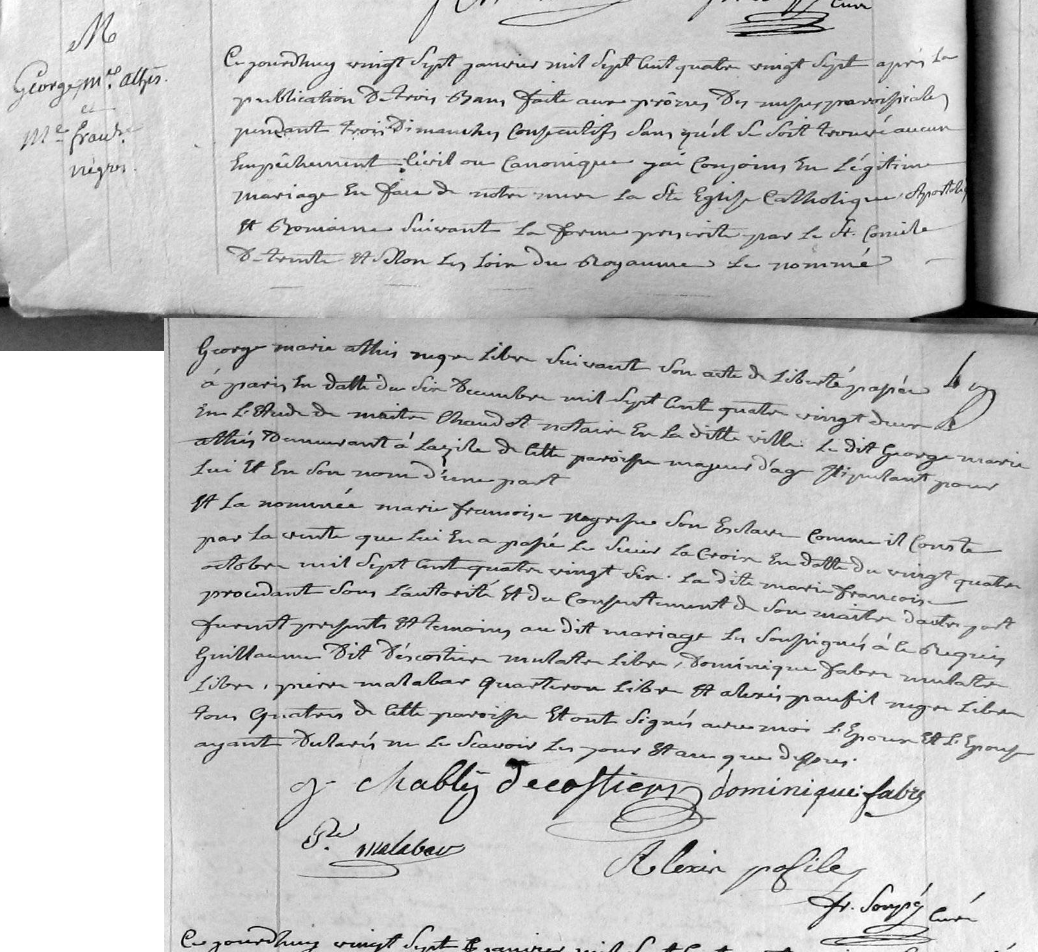
For example, opening the parish register from Anse-à-Veau ("Calf Cove", literally), Saint-Domingue (Haiti), year 1787, I find this marriage certificate (which illustrates the complexity of colonial society in Saint-Domingue).
This is what it says: "Today January 27, 1787, after the publication of three banns during the sermons of the parish masses on three consecutive Sundays, after having found no civil or canonical impediment, I have joined in mariage before our Holy Mother the Roman Catholic and Apostolic Church, in the form prescribed by the Holy Council of Trent and according to the laws of the kingdom, the individual called Georges Marie Athis, free negro according to his deed of manumission passed in Paris on December 6, 1782 in the notary office of Mr. Chaudet, public notary in the said city, the said Georges Marie Athis residing in the asylum of this parish, over the age of majority, stipulating for himself and in his name, of the one part,
And the individual called Marie Françoise, negro woman, his slave, as appears in the sale contract with Mr. Lacroix who sold her to him on October 24, 1786, the said Marie Françoise proceeding under the authority and with the consent of her master [= Mr. Athis], of the other part.
Were present and witnesses to the said marriage the undersigned so asked [to sign]: Guillaume, alias d'Escostier, free mulatto [= half Black, half White], Dominique Fabre, free mulatto, Pierre Malabas, free quarteron [= 1/4 Black, 3/4 White], and Alexis Paufil, free negro [= 100% Black], the four of them from this parish. And they have signed with me, the groom and the bride having declared they did not know [how to sign], on the aforesaid day and year."
The free Black guy signed "Pofile", but the priest spelled it "Paufil" (which is more literary).





 Prev
Prev











 Turns out my partner was right! I even have some body hair; most east Asians have very little body hair and bone straight hair on their heads (luckily even though I have over 9% Chinese ancestry DNA, I don't have that Chinese porcupine hair haha).


 Linear Mode
