HomeDiagramsDatabaseMapsForum About
     

Go Back   SkyscraperPage Forum > Regional Sections > Canada


Reply

 
Thread Tools Display Modes
     
     
  #4221  
Old Posted Aug 14, 2026, 8:23 AM
Nite's Avatar
Nite Nite is offline
Registered User
 
Join Date: Dec 2007
Location: Toronto
Posts: 3,382
Quote:
Originally Posted by Nouvellecosse View Post
^ I was surprised when I saw that because somehow I thought the tunneling had barely started.
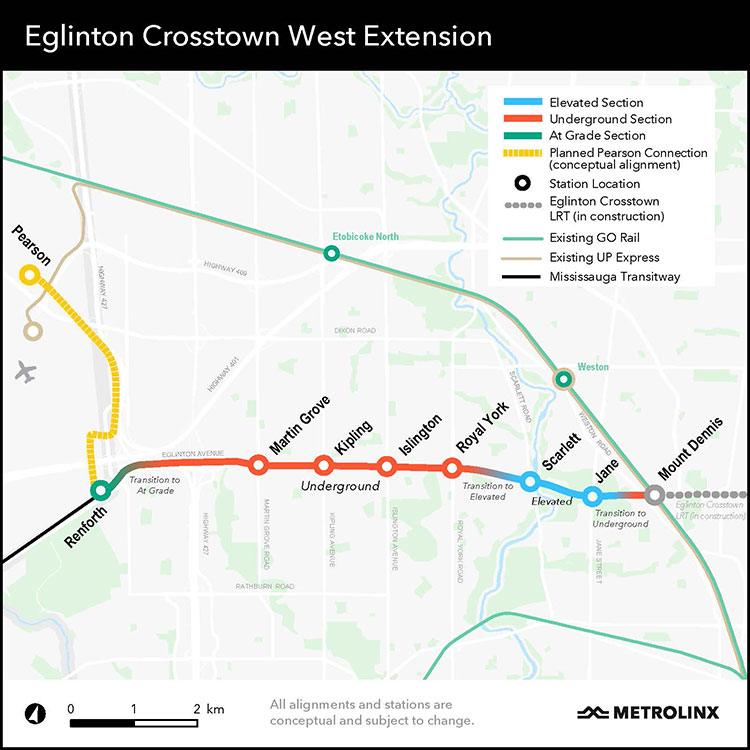
The majority (6.3km) of tunneling with TBM's Rexy and Renny was completed in June 2024.
The video is talking about the second 500m tunnel which was mined and started 1.5 years ago.

Western Segment (6.3km) (Scarlett Road to Renforth Drive) Tunneling from April 2022 to June 2024 (TBMs)
Eastern Segment (0.5km) (Mount Dennis Station to Jane Street) Tunneling from April 2025 to August 2026 (Minned)

There is no reason why both underground sections, elevated section and the stations could not have been done concurrently and greatly reduce the time of construction.
Building the stations is the most time consuming part of any transit construction and ideally should be what is started first. The station official started excavation in July 2026, 4 years after tunneling began, and will not be completed until 2031.

If they started on the stations as the same time as the TBM (April 2022) then this extension could have opened in 2027


Last edited by Nite; Aug 14, 2026 at 8:41 AM.
Reply With Quote
     
     
  #4222  
Old Posted Aug 14, 2026, 2:55 PM
hipster duck's Avatar
hipster duck hipster duck is offline
Registered User
 
Join Date: Oct 2014
Location: Toronto
Posts: 4,912
In other Toronto transit news, the cost of the Ontario Line has ballooned to $34 billion and it will almost certainly go higher. This includes 30 years of operations and maintenance, and is not really an apples-to-apples comparison with budgets for transit projects in other places, but this is still outrageous. This is more than half the cost of the entire Grand Paris Express, which is 200km of the same technology tunnelled through just as challenging an environment.

https://www.cbc.ca/news/canada/toronto/ontario-line-cost-triples-projection-9.7303077

I can't see how a capital project that's $20-30 billion over budget doesn't affect other provincial plans down the line. The projects that already have their contracts signed are probably safe, but I wouldn't be surprised if anything else that's in the planning phase is in jeopardy because of this, including GO electrification/expansion and the Sheppard subway.
Reply With Quote
     
     
  #4223  
Old Posted Aug 14, 2026, 4:35 PM
SFUVancouver's Avatar
SFUVancouver SFUVancouver is offline
Registered User
 
Join Date: Dec 2006
Location: Hamilton
Posts: 6,694
When the government approves and funds a capital project that capitalizes decades of operation and maintenance in its cost, is the government actually allocating funds for the operational phase, or just the capital construction costs? I imagine the latter, with the former being used to make a go/no-go decision about the project and committing to fund construction. Furthermore, if it is the latter, have we ever seen official breakdowns of capital vs operating costs? That would seem highly relevant. I imagine that AI could do yeoman's service by reviewing the Canada Gazette and its provincial equivalents to actually discern the release by funds by the treasury.
__________________
VANCOUVER | Beautiful, Multicultural | Canada's Pacific Metropolis
Reply With Quote
     
     
  #4224  
Old Posted Aug 14, 2026, 5:11 PM
someone123's Avatar
someone123 someone123 is offline
hähnchenbrüstfiletstüc
 
Join Date: Nov 2001
Location: Vancouver
Posts: 35,882
Quote:
Originally Posted by hipster duck View Post
In other Toronto transit news, the cost of the Ontario Line has ballooned to $34 billion and it will almost certainly go higher. This includes 30 years of operations and maintenance, and is not really an apples-to-apples comparison with budgets for transit projects in other places, but this is still outrageous. This is more than half the cost of the entire Grand Paris Express, which is 200km of the same technology tunnelled through just as challenging an environment.
It doesn't seem to pass the sniff test, but then again I am not sure what ultimately causes these huge ballooning costs.

In the 2010s the US was hitting costs like this for projects like the 2nd Ave subway in NYC, but Canada was still more reasonable. There were stories about corruption, like nonexistent unionized workers getting paid hundreds of thousands of dollars a year in overtime for work that wasn't real. I'd like to think that in Canada it has more to do with inflation and bureaucratic rules than that sort of base corruption, but in the end it still means less infrastructure and a higher tax burden. I think Canadians need to accept that the trend of adding more red tape is unsustainable, but we don't seem to be close to that kind of consensus.
Reply With Quote
     
     
  #4225  
Old Posted Aug 14, 2026, 5:32 PM
niwell's Avatar
niwell niwell is online now
sick transit, gloria
 
Join Date: Nov 2004
Location: Roncesvalles, Toronto
Posts: 11,630
It is egregious, though I would note that the ~$10B cited as the original cost was never a real number. Also interesting that the portion of the Ontario line contract for the Pape alignment is projected to be about the same cost per km ($1.4B) as the Blue Line extension in Montreal.

This is a North American (and to a somewhat lesser extent Anglosphere) problem.
__________________
Check out my pics of Johannesburg
Reply With Quote
     
     
  #4226  
Old Posted Aug 14, 2026, 5:40 PM
someone123's Avatar
someone123 someone123 is offline
hähnchenbrüstfiletstüc
 
Join Date: Nov 2001
Location: Vancouver
Posts: 35,882
Quote:
Originally Posted by niwell View Post
This is a North American (and to a somewhat lesser extent Anglosphere) problem.
But we didn't have it as bad 10-20 years ago, and not all English-speaking countries were impacted in the same way at the same time.

I do suspect there's a cultural and legal basis for this wide trend, and that it relates to politics and law. In politics we have tended to focus on expanding rules to avoid risk and cater to increasingly niche groups (which isn't necessarily bad, but can impose costs). Common law and institutions tend to cause the accretion of entitlements and rules over time.

Maybe we had this problem since the 19th century or earlier, but it was covered up by stronger technological and economic progress. If waste grows at 1%, 1.5% economic growth may be seen as good while 0.5% eventually precipitates a crisis.
Reply With Quote
     
     
  #4227  
Old Posted Aug 14, 2026, 5:43 PM
Glow Fun City's Avatar
Glow Fun City Glow Fun City is online now
deadhead raver Jew
 
Join Date: Jul 2025
Location: Vancouver
Posts: 337
Quote:
Originally Posted by niwell View Post
It is egregious, though I would note that the ~$10B cited as the original cost was never a real number. Also interesting that the portion of the Ontario line contract for the Pape alignment is projected to be about the same cost per km ($1.4B) as the Blue Line extension in Montreal.

This is a North American (and to a somewhat lesser extent Anglosphere) problem.
Is it? Seems to be more of an Ontario problem.

Vancouver's Broadway SkyTrain (subway) is coming in at around $600 million per kilometre. Just under $3 billion for 5.7 km of bored tunnel (mostly bedrock) with 6 underground stations

The Surrey-Langley SkyTrain is around $375 million per kilometre. $6 billion for 16 km elevated track with 8 stations.

I really wish the federal government would give more transit funding out west, since it seems like we can do much more with it.
__________________
Don’t tell me this town ain’t got no heart
You just gotta poke around…
Reply With Quote
     
     
  #4228  
Old Posted Aug 14, 2026, 5:59 PM
Innsertnamehere's Avatar
Innsertnamehere Innsertnamehere is online now
Registered User
 
Join Date: Jan 2010
Location: Hamilton
Posts: 12,865
vancouver on a per capita basis already has a far larger system than Toronto.
Reply With Quote
     
     
  #4229  
Old Posted Aug 14, 2026, 6:00 PM
someone123's Avatar
someone123 someone123 is offline
hähnchenbrüstfiletstüc
 
Join Date: Nov 2001
Location: Vancouver
Posts: 35,882
I think that Broadway number is just capital costs. It's not as bad but it's about the same price as an inflation-adjusted Canada Line. The value for dollar has gotten worse in Vancouver transit projects.

Furthermore the timelines are worse and they are only going to Arbutus.
Reply With Quote
     
     
  #4230  
Old Posted Aug 14, 2026, 6:09 PM
Nouvellecosse's Avatar
Nouvellecosse Nouvellecosse is online now
Volatile Pacivist
 
Join Date: Aug 2005
Location: Nova Scotia
Posts: 11,304
There's also a difference between comparing light metro and heavy metro since there can be a big cost and capacity gap. Not as much with the Ontario line which will have shorter trains than line 1 and 2, but if we're comparing the entire systems, we have to remember that size has more dimensions than just route length. One must also remember that a system which reaches much farther into the suburbs playing the role of both metro and commuter rail can't be compared effectively to a metro. GO is substantially larger and with most lines more frequent than the WCE.
__________________
"The reasonable man adapts himself to the world; the unreasonable one persists in trying to adapt the world to himself. Therefore all progress depends on the unreasonable man." - George Bernard Shaw
Don't ask people not to debate a topic. Just stop making debatable assertions. Problem solved.
Reply With Quote
     
     
  #4231  
Old Posted Aug 14, 2026, 6:51 PM
niwell's Avatar
niwell niwell is online now
sick transit, gloria
 
Join Date: Nov 2004
Location: Roncesvalles, Toronto
Posts: 11,630
Quote:
Originally Posted by someone123 View Post
But we didn't have it as bad 10-20 years ago, and not all English-speaking countries were impacted in the same way at the same time.
.
Yes, sorry I should have added that it's a relatively new and growing problem, which extends to infrastructure beyond transit (though probably not to the same extent). The Yonge-University extension to Vaughan was about $370M per km IIRC. Which adjusted for inflation is still far less than newer construction.
__________________
Check out my pics of Johannesburg
Reply With Quote
     
     
  #4232  
Old Posted Aug 18, 2026, 8:02 PM
SteelTown's Avatar
SteelTown SteelTown is offline
It's Hammer Time
 
Join Date: Mar 2004
Location: Hamilton
Posts: 20,376
And the street closure, for LRT, begins. Hamilton's Main and Ottawa intersection to close for 4 months.


Source: Mayor Andrea Horwath @ https://bsky.app/profile/mayorandreahorwath.bsky.social
Reply With Quote
     
     
  #4233  
Old Posted Aug 19, 2026, 9:02 PM
MonkeyRonin's Avatar
MonkeyRonin MonkeyRonin is offline
¥ ¥ ¥
 
Join Date: Sep 2006
Location: Vancouver
Posts: 10,636
Quote:
Originally Posted by Innsertnamehere View Post
vancouver on a per capita basis already has a far larger system than Toronto.
Sort of... the Skytrain's length of 80km (101km incl. u/c) is certainly "per capita" larger than the TTC subway & LRT's 102km (143km incl. u/c). But they're also fundamentally different systems, with the Skytrain doing a sort of double duty as both a metro and a long-distance commuter system.

Compared to the TTC, the Skytrain is more effective at servicing the outer suburbs, but less effective when it comes to travelling within the city. But that's where something like the 532km GO system comes into play, which is far more comprehensive than the single line, 69km Westcoast Express. And then there are the 83km of streetcar lines in Toronto's core, which don't exist at all in Vancouver.

Basically, either city's transportation network is not directly comparable. For a city of Vancouver's size, the Skytrain is more or less sufficient as a one-size-fits-all backbone of the system; but a city of Toronto's scale requires a more layered approach, with light rail & streetcars for local trips, subway for medium distance trips within the city, and commuter rail for longer distance trips from the suburbs.
__________________
Reply With Quote
     
     
  #4234  
Old Posted Aug 19, 2026, 10:22 PM
LeftCoaster's Avatar
LeftCoaster LeftCoaster is offline
Moderator
 
Join Date: Nov 2005
Location: Toroncouver
Posts: 13,141
I would disagree with that. Vancouver's approach does not work as a one size fits all anymore. The Expo line is bursting, it takes too long from Surrey and beyond, and the West Coast Express is ineffective since it is too limited.

Vancouver going forward needs to start thinking like a bigger city and introduce proper commuter rail to the south of the Fraser to lessen the load on the Skytrain and allow it to function more like a Metro, that is more needed now.

When the Skytrain was built it was fine because at the time Vancouver was about the size Calgary is today, and it did its job well. Now with the Lower Mainland passing 3.5 million, heading to 4, a more comprehensive approach to moving people over larger distances is required.

Fortunately for Vancouver its geography is relative simple this way and one (albiet expensive) multipurpose commuter rail line right down the middle of the valley will solve so many of the problems. We just need the 10bln to fund it....
Reply With Quote
     
     
  #4235  
Old Posted Aug 19, 2026, 11:12 PM
someone123's Avatar
someone123 someone123 is offline
hähnchenbrüstfiletstüc
 
Join Date: Nov 2001
Location: Vancouver
Posts: 35,882
Quote:
Originally Posted by LeftCoaster View Post
I would disagree with that. Vancouver's approach does not work as a one size fits all anymore. The Expo line is bursting, it takes too long from Surrey and beyond, and the West Coast Express is ineffective since it is too limited.

Vancouver going forward needs to start thinking like a bigger city and introduce proper commuter rail to the south of the Fraser to lessen the load on the Skytrain and allow it to function more like a Metro, that is more needed now.
Very true.

The Langley SkyTrain extension already seems to strain the scale of the system. It'll be something like a 65 minute trip to Waterfront with 27 stops. This is to go about 40 km, including over a portion of farmland that open to development. You could argue that most people won't do the full length, which is probably true, but in principle it should be practical to get from DT Vancouver to an outer suburb quickly.

I would also argue Vancouver doesn't have great inner city coverage and this is becoming more and more painful as the downtown grows and becomes more congested. For some trips, like starting in the West End and going to the other side of False Creek, you can wait 35 mins to go around 4 km.

I think the idea that smaller cities don't need, can't use, or can't support a mix of transit is usually overstated. Some very small European cities have a mix. It has more to do with how the city is developed and what mix is most effective. And in Canada transit just isn't funded enough in most cases.
Reply With Quote
     
     
  #4236  
Old Posted Aug 19, 2026, 11:47 PM
nname nname is offline
Registered User
 
Join Date: Aug 2005
Posts: 5,087
The average volume graph from the 2025 TSPR report is quite consistently flat between Commercial-Broadway and Edmonds/Lougheed, meaning there are as many people leaving the train and as entering. This is more typical of real Metro system than Commuter system. Though the volume do starting to fall off east of that.

For Evergreen extension, there were much less change for the segment around Renfrew and the downtown segment, while the volume for the segments east of Brentwood saw a bigger increase. But may be that's because there's WCE so less people taking it to download compared to Burnaby/East Van. Not sure what would the effect be for the Langley extension.
Reply With Quote
     
     
  #4237  
Old Posted Aug 20, 2026, 1:05 AM
someone123's Avatar
someone123 someone123 is offline
hähnchenbrüstfiletstüc
 
Join Date: Nov 2001
Location: Vancouver
Posts: 35,882
There's a chicken and egg nature to measuring these travel patterns though. In part they're shaped by the travel costs imposed by existing infrastructure and it's hard to measure the demand that would be there with a different system.

My impression is it's increasingly hard for people to travel around metro Vancouver and people will live more and more in some portion of the region.
Reply With Quote
     
     
  #4238  
Old Posted Aug 20, 2026, 1:31 AM
casper's Avatar
casper casper is offline
Registered User
 
Join Date: Nov 2011
Location: Victoria
Posts: 12,834
For Vancouver (and BC in general) I think we need to do a phase of projects that are relatively low-cost and leverage existing disused infrastructure.

Take WestCoast express. Add one or two Chilliwack to Abbotsford origin trains that cross over in Mission and follow the main route back into downtown Vancouver.

The old BC Rail valley line from Chilliwack to Abbotsford, through Surrey could be refurbished at fairly low cost. Yes, it is not an optimal route, however with recent zoning that encourages higher density around train stations it could stimulate growth. Perhaps a diesel service inspired by the O-train in Ottawa.

There is also the old Arbutus CP line that is now owned by the city. That would be idea for either an underground LRT that continues along the Fraser to New West. That stretch around South West Marine drive has fairly high density.

What is key to make all of this work is the provincial governments new zoning rules that automatically force higher density around transit hubs.
Reply With Quote
     
     
  #4239  
Old Posted Aug 20, 2026, 2:01 AM
Changing City's Avatar
Changing City Changing City is online now
Registered User
 
Join Date: Nov 2016
Posts: 8,243
Quote:
Originally Posted by casper View Post
For Vancouver (and BC in general) I think we need to do a phase of projects that are relatively low-cost and leverage existing disused infrastructure.

Take WestCoast express. Add one or two Chilliwack to Abbotsford origin trains that cross over in Mission and follow the main route back into downtown Vancouver.

The old BC Rail valley line from Chilliwack to Abbotsford, through Surrey could be refurbished at fairly low cost. Yes, it is not an optimal route, however with recent zoning that encourages higher density around train stations it could stimulate growth. Perhaps a diesel service inspired by the O-train in Ottawa.

There is also the old Arbutus CP line that is now owned by the city. That would be idea for either an underground LRT that continues along the Fraser to New West. That stretch around South West Marine drive has fairly high density.

What is key to make all of this work is the provincial governments new zoning rules that automatically force higher density around transit hubs.
There isn't sufficient funding to complete the SkyTrain to UBC. The idea of building another transit line along Arbutus to New Westminster is pure fantasy in any meaningful time frame. And the idea of a BC Rail line service faces problems of sharing the tracks with an anticipated significant increase in freight traffic, with the expansion of the Roberts Bank container port. There was a fairly comprehensive study a few years ago that found a need for significant capital outlay to initiate a service for relatively modest potential ridership.
__________________
Contemporary Vancouver development blog, https://changingcitybook.wordpress.com/ Then and now Vancouver blog https://changingvancouver.wordpress.com/
Reply With Quote
     
     
  #4240  
Old Posted Aug 20, 2026, 4:55 PM
hipster duck's Avatar
hipster duck hipster duck is offline
Registered User
 
Join Date: Oct 2014
Location: Toronto
Posts: 4,912
Most mainline railways, or even abandoned rail rights of way, don't go anywhere close to trip generators in Metro Vancouver, and are often windy, taking a long route to travel a path that's relatively easy by car. In many cases, they're in low-lying floodplains that can't be developed into dense TOD. They also cross major bodies of water over ancient railway bridges that would be very expensive to replace. This is all before you consider that these lines are owned by private freight railways who call the shots in terms of scheduling. Commuter rail doesn't have a lot of promise in Vancouver.

Instead, Translink should make a more comprehensive express bus system using coaches rather than regular city buses. It already has some of these lines, like the 555 between Lougheed and Carvolth Exchange in Langley, but the system is not very legible. It should have separate branding, a separate map, blanket the region more, and have frequent, clockface schedules where buses meet up at the various suburban transit exchanges to facilitate easy transfers.
Reply With Quote
     
     
This discussion thread continues

Use the page links to the lower-right to go to the next page for additional posts
 
 
Reply

Go Back   SkyscraperPage Forum > Regional Sections > Canada
Forum Jump


Forum Jump


All times are GMT. The time now is 8:55 PM.


Powered by vBulletin® Version 3.8.7
Copyright ©2000 - 2026, vBulletin Solutions, Inc.