HomeDiagramsDatabaseMapsForum About
     

Go Back   SkyscraperPage Forum > Discussion Forums > City Discussions


Reply

 
Thread Tools Display Modes
     
     
  #1521  
Old Posted Aug 7, 2026, 5:50 PM
Docere Docere is online now
Registered User
 
Join Date: Jul 2014
Posts: 9,062
Are people really trying to prove that New York has more people in an area the size of Greater London? Like...of course there is, as NYC is half the size and basically the same population.

I think it's nonsensical to start going into Nassau County to "prove" that point though. Yes London is less dense, but it's more of a "big Queens" in terms of density. Even a rather "suburban" borough like Barnet is more analogous to Queens than to Long Islan.
Reply With Quote
     
     
  #1522  
Old Posted Aug 7, 2026, 6:56 PM
New Brisavoine New Brisavoine is offline
Registered User
 
Join Date: Nov 2007
Posts: 5,286
Quote:
Originally Posted by New Brisavoine View Post
Here is the result from the 2020 census. Compared to Greater London and to similar area in Paris, at the same date (April 1, 2020). All maps are at the same scale. We can notice that the suburban municipalities around NYC are as small (land wise) as the suburban municipalities in Greater Paris.

Between April 1, 2010 and April 1, 2020, the 1,572 km² of New York registered an increase of 915,000 people, whereas the 1,572 km² of Greater London registered an increase of 841,100 people, and the 1,572 km² of Paris registered an increase of 283,800 people (but there is a sharp difference between the City of Paris, which registered a population decline of 102,700 people during this period, and the 239 suburban municipalities colored pink, which registered a population increase of 386,300 people).
And here is with Tokyo. Between 2010 and 2020, the 1,578 km² of Tokyo registered an increase of 1,237,300 people

__________________
New Axa – New Brisavoine
Reply With Quote
     
     
  #1523  
Old Posted Aug 7, 2026, 9:38 PM
New Brisavoine New Brisavoine is offline
Registered User
 
Join Date: Nov 2007
Posts: 5,286
The main difference between Tokyo and NY/Paris, but also London, is how the Japanese manage density.

In the maps above, the central area of Tokyo (6 wards of Chiyoda, Chuo, Minato, Shinjuku, Bunkyo, and Shibuya), which has a land area of 87 km² (exactly the same as the land area of City of Paris minus the two bois), has a population density of just 15,263 inh. per km².

In comparison, the City of Paris (minus the two bois), over the same territory of 87 km², has a population density of 24,631 inh. per km². And Manhattan, over a land area of 58 km² (excluding the uninhabited outlying islands), has a population density of 29,324 inh. per km².

Tokyo manages to pack twice the population of Paris and 55% more people than New York in the overall pink territory because outside those central 87 km², the population density in the rest of the 1,578 km² of Tokyo is 11,832 inh. per km². In comparison, for the 1,572 km² of Paris, the population density outside the central 87 km² is only 4,892 inh. per km². For the 1,573 km² of New York, the population density outside of Manhattan is only 6,963 inh. per km².

The central area of London has population densities lower than the central area of Tokyo. The 5 central boroughs of Hammersmith and Fulham, Kensington and Chelsea, Westminster, Camden, and Islington, plus the City of London have a land area of 89 km², almost the same as the 6 central wards of Tokyo. Within that area of 89 km² in London, the population density is only 11,046 inh. per km² (vs 15,263 inh. per km² in Tokyo). Outside of those central 89 km², the population density in the other London boroughs is much lower than in the rest of the pink area of Tokyo, with only 5,326 inh. per km² (vs 11,832 inh. per km² in Tokyo). That's why Greater London has less than half the population in a similar area of Tokyo.
__________________
New Axa – New Brisavoine
Reply With Quote
     
     
  #1524  
Old Posted Aug 15, 2026, 4:16 PM
New Brisavoine New Brisavoine is offline
Registered User
 
Join Date: Nov 2007
Posts: 5,286
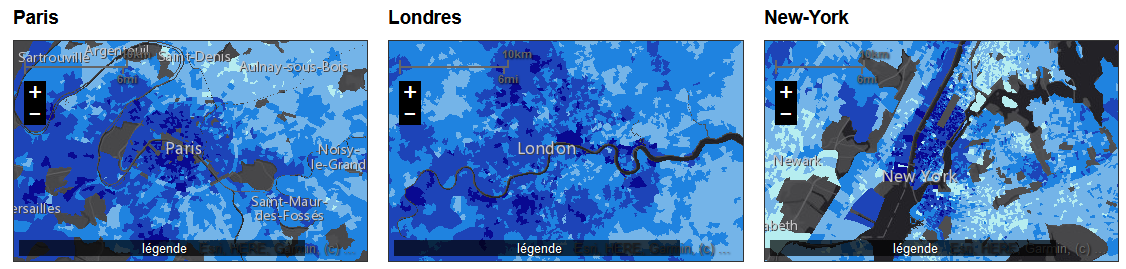
Population density in Paris, London, and New York. Maps are at the same scale.


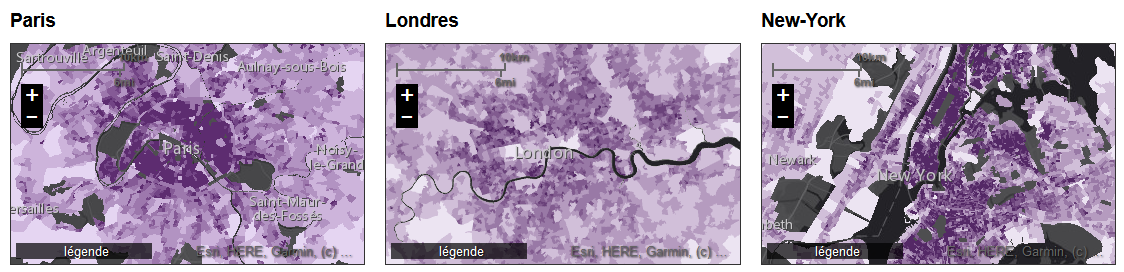
Percentage of the population under 15 y/o:


Percentage of the population who live alone:


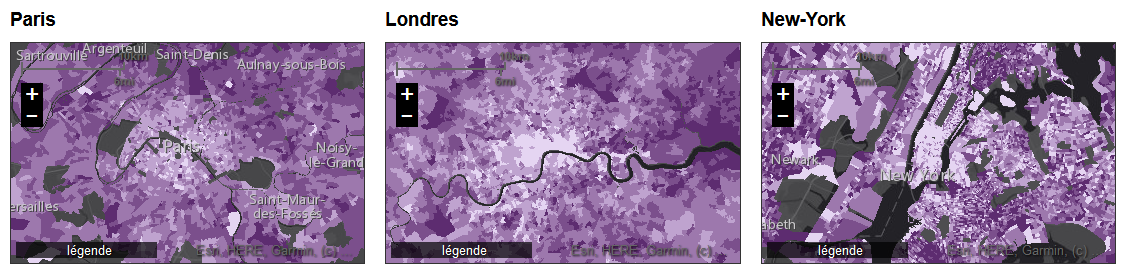
Percentage of the population who own their dwelling. Remarkably few people seem to be owning their dwellings in NYC.


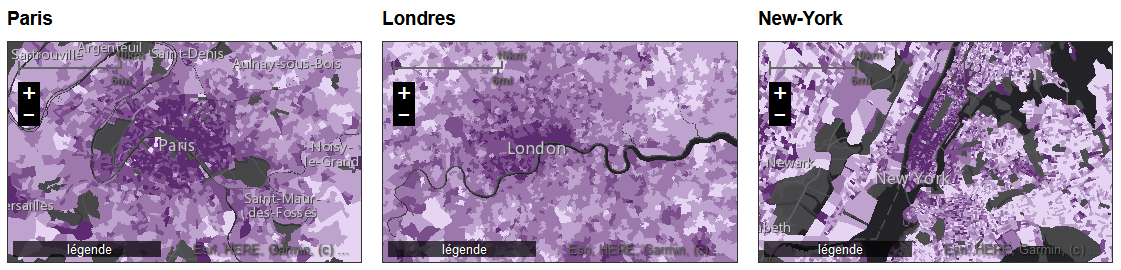
Percentage of the population with a degree higher than a high-school degree:


Number of cars per household:


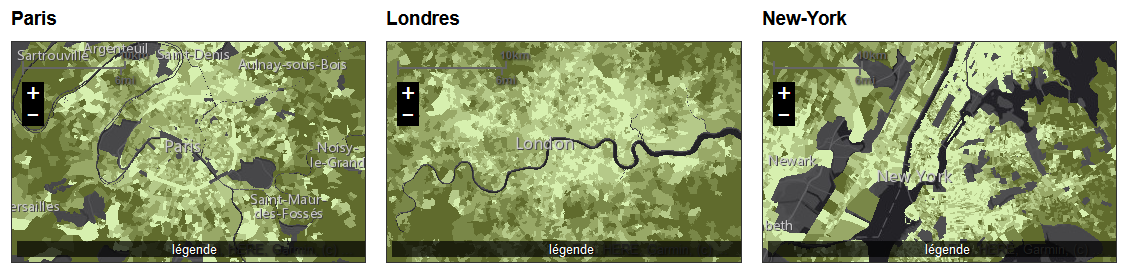
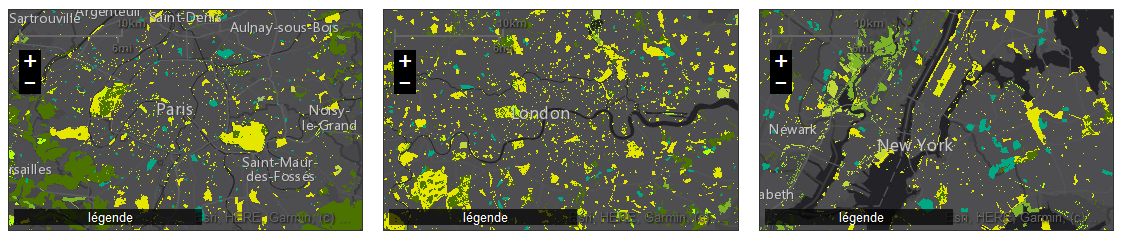
Parks, gardens, and forests. This debunks the myth that Paris has few parks. What's interesting here is parks and woods in London are more spread across the urban area, whereas in Paris and New York they are more concentrated.

__________________
New Axa – New Brisavoine
Reply With Quote
     
     
  #1525  
Old Posted Aug 16, 2026, 3:44 PM
New Brisavoine New Brisavoine is offline
Registered User
 
Join Date: Nov 2007
Posts: 5,286
Population decline accelerates in Germany. According to the latest figures published by the German statistical office, in the 1 year between April 1, 2025 and April 1, 2026, Germany's population went from 83,517,030 to 83,363,232. That's a population decline of 153,798 people in one year. Net migration is not high enough anymore to compensate for the large excess of deaths over births.
__________________
New Axa – New Brisavoine
Reply With Quote
     
     
  #1526  
Old Posted Aug 17, 2026, 1:12 PM
Yuri's Avatar
Yuri Yuri is online now
Registered User
 
Join Date: Sep 2008
Posts: 6,204
Japan lost 3.1 million people between 2020 and 2025 census ("only" 950k between 2015-2020). It's a 600k people loss every year.

And as immigration is slowing down fast in Europe, they'll join Japan very soon. Sweden, if I'm not mistaken, is already posting negative migration.
__________________
London - São Paulo - Rio de Janeiro - Londrina - Frankfurt
Reply With Quote
     
     
  #1527  
Old Posted Aug 17, 2026, 2:51 PM
Tom In Chicago's Avatar
Tom In Chicago Tom In Chicago is offline
Moderator
 
Join Date: Jul 2001
Location: Sick City
Posts: 7,596
^They spelled London wrong. . .

. . .
__________________
Tom in Chicago
. . .
Near the day of Purification, there will be cobwebs spun back and forth in the sky.
Reply With Quote
     
     
  #1528  
Old Posted Aug 17, 2026, 3:29 PM
New Brisavoine New Brisavoine is offline
Registered User
 
Join Date: Nov 2007
Posts: 5,286
Quote:
Originally Posted by New Brisavoine View Post
Population decline accelerates in Germany. According to the latest figures published by the German statistical office, in the 1 year between April 1, 2025 and April 1, 2026, Germany's population went from 83,517,030 to 83,363,232. That's a population decline of 153,798 people in one year. Net migration is not high enough anymore to compensate for the large excess of deaths over births.
Quote:
Originally Posted by Yuri View Post
Japan lost 3.1 million people between 2020 and 2025 census ("only" 950k between 2015-2020). It's a 600k people loss every year.

And as immigration is slowing down fast in Europe, they'll join Japan very soon. Sweden, if I'm not mistaken, is already posting negative migration.
Between Jan. 2019 and Jan. 2025, Italy lost 145,535 people per year on average.

Population growth in the UK has also slowed markedly. Between mid-2019 and mid-2024, the population of the UK grew by 530,780 people per year on average, but in the one year between mid-2024 and mid-2025, population growth fell to just +205,600, as the British government is finally starting to curtail immigration seriously, and the birth rate has collapsed.

Against this trend: France and Spain. Contrary to their neighbors, in France and Spain the population growth has accelerated in recent years, in Spain because their Socialist government encourages large-scale immigration, and in France because the government is not really serious about curtailing immigration and the French judges are doing all they can to prevent the deportation of illegal immigrants, so the migration rate is out of control in both countries.

In Spain, population growth went from just +85,929 in 2021 to an average of +547,190 per year between Jan. 2022 and Jan. 2025. Provisional data indicate a population growth of +468,079 in 2025.

In France, population growth between Jan. 2015 and Jan. 2021 was +200,732 per year on average, but between Jan. 2021 and Jan. 2023 it was +330,301 per year on average. Population growth in 2023 and 2024 will be published next December, but the figures should most likely be higher than the +330,301 per year in 2021 and 2022 judging from immigrant visas delivered.
__________________
New Axa – New Brisavoine
Reply With Quote
     
     
  #1529  
Old Posted Aug 17, 2026, 3:35 PM
Crawford Crawford is online now
Registered User
 
Join Date: Nov 2003
Location: Brooklyn, NYC/Polanco, DF
Posts: 34,863
Germany needs to lose some population. Everything is too crowded. For decades the North and East are flat or emptying out, and everyone is crowding in a narrow corridor in the West. Everything is either overburdened or empty. More immigration doesn't help bc they all move to Frankfurt, Munich, Stuttgart or Rhein-Ruhr.

Germany would be a much healthier country with maybe 5-10% fewer people. Skilled professional immigrants welcome, encourage births, but no need for anything beyond that.

France is still mostly empty and Spain still developing so nonprofessional immigrants are welcome to go there. Germany is full.
Reply With Quote
     
     
  #1530  
Old Posted Aug 17, 2026, 4:34 PM
New Brisavoine New Brisavoine is offline
Registered User
 
Join Date: Nov 2007
Posts: 5,286
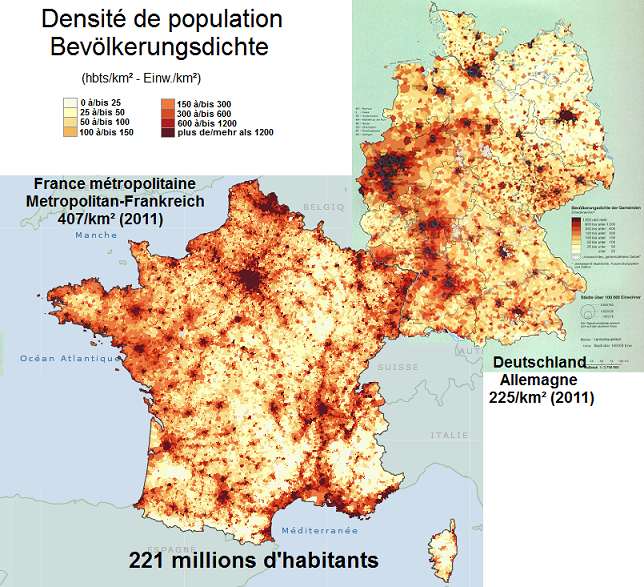
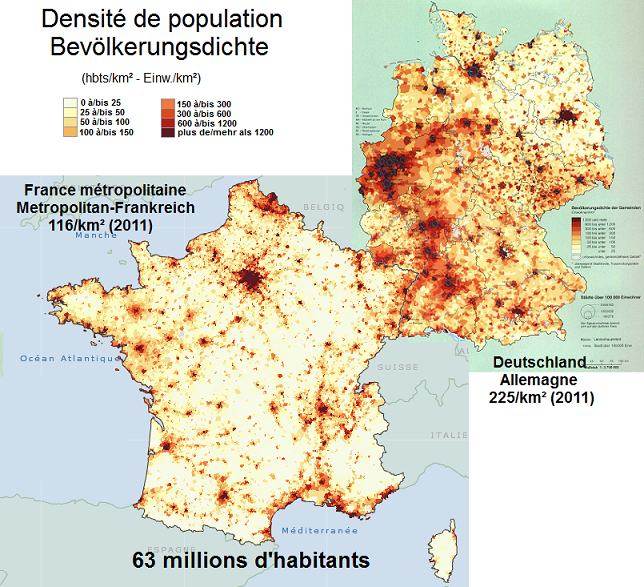
^^To say nothing of England, which has more than double the population density of Germany, and 4 times the population density of France.

In 1800, France had the same population density as England. If France still had the same population density as England today (i.e. if France had grown exactly like England since 1800), there would be... 245 million people living in France!

This was from the 2011 censuses. A France of 221 million inhabitants in 2011 (245 million today) would have had the same density as England.


And in the real world...

__________________
New Axa – New Brisavoine
Reply With Quote
     
     
  #1531  
Old Posted Aug 17, 2026, 4:39 PM
Crawford Crawford is online now
Registered User
 
Join Date: Nov 2003
Location: Brooklyn, NYC/Polanco, DF
Posts: 34,863
England doesn't have empty areas. Is there even one substantial forest?

Germany thankfully has tougher land use laws, and large forestlands everywhere, even in the populated corridors. But the cities are overburdened now.
Reply With Quote
     
     
  #1532  
Old Posted Aug 17, 2026, 4:51 PM
Yuri's Avatar
Yuri Yuri is online now
Registered User
 
Join Date: Sep 2008
Posts: 6,204
Quote:
Originally Posted by Crawford View Post
England doesn't have empty areas. Is there even one substantial forest?

Germany thankfully has tougher land use laws, and large forestlands everywhere, even in the populated corridors. But the cities are overburdened now.
I went to Scotland by the end of June. My 4th in Britain,but the 1st visiting somewhere besides London.

I took the train and it's amazing how everything looks small. In France, Italy and even Germany you can have vast expanses of forests, mountains, uninterrupted farmland. In England, even the rail line itself feels constrained. Farms have those small plots, with green fences everywhere, making the whole thing like a rural garden. It's super dense.
__________________
London - São Paulo - Rio de Janeiro - Londrina - Frankfurt
Reply With Quote
     
     
  #1533  
Old Posted Aug 17, 2026, 4:55 PM
Docere Docere is online now
Registered User
 
Join Date: Jul 2014
Posts: 9,062
England was already majority-urban by 1850. Half a century before Germany and 80 years before France.
Reply With Quote
     
     
  #1534  
Old Posted Aug 17, 2026, 5:01 PM
Yuri's Avatar
Yuri Yuri is online now
Registered User
 
Join Date: Sep 2008
Posts: 6,204
Quote:
Originally Posted by Docere View Post
England was already majority-urban by 1850. Half a century before Germany and 80 years before France.
Another interesting feature on Great Britain is they don't have sizeable shrinking areas. In this century, even their Rust Belt has grown fueled by immigration. Germany, Italy, Spain and specially in Eastern Europe, there are massive differences between regions.
__________________
London - São Paulo - Rio de Janeiro - Londrina - Frankfurt
Reply With Quote
     
     
  #1535  
Old Posted Aug 17, 2026, 5:04 PM
New Brisavoine New Brisavoine is offline
Registered User
 
Join Date: Nov 2007
Posts: 5,286
Quote:
Originally Posted by Crawford View Post
England doesn't have empty areas. Is there even one substantial forest?

Germany thankfully has tougher land use laws, and large forestlands everywhere, even in the populated corridors. But the cities are overburdened now.
England has the smallest % of forests in Europe (along with Ireland and The Netherlands). It was already the case in the 19th century. They massively deforested the country in the Middle Ages and Early Modern period. Since the 1920s, they have laws that protect the countryside and the nature areas much more than any European country, even Germany, but there's very little left of it after Medieval deforestation + 150 years of Industrial Revolution.

In France, on the other hand, the % of forests has actually increased since the 19th century! France experienced deforestation like England during the Middle Ages and Early Modern period, but not as systematically as England, because the French monarchy heavily protected the forests (which were a key source of revenue for the royal demesne). The French monarchy even created an entire administration (complete with its own courts) to protect the domanial forests of France: the so-called 'eaux et forêts' administration (which had its own judges to try people who infringed on the domanial forests). Colbert under Louis XIV greatly modernized the 'eaux et forêts' administration, and issued an entire legal code overseeing all aspects of forestry in the kingdom (in 1669).

The local aristocrats also had their large private forests which they protected from trespassing with their private feudal police forces. These private feudal police forces were hated by the population (you could be fined if you were found to have collected branches in the forest of the local feudal lord, or if you had poached in his/her forests). They were abolished at the beginning of the French Revolution, but the domanial forests remained in the hands of the French state, and most aristocrats who did not emigrate during the French Revolution also kept their forests, but this time they were considered private property, not feudal demesne anymore.

Nonetheless the 10 chaotic years that France experienced during the Revolution led to the destruction of many forests, but with Napoleon order was restored, and the forests became protected either because they were domanial forets of the French state, or private properties of their former feudal lords (or their new owners who took advantage of the Revolution to buy cheaply at auctions the forests seized from aristocrats who were guillotined or who emigrated).

From a nadir of 12%-15% of Metropolitan France covered by forets in the 1820s, the forest cover has expanded due to stricter protection of the forests following Napoleon's restoration of order + development of coal as the primary way to heat houses + modern construction methods not requiring timber anymore + rural flight that left many former fields abandoned and reclaimed by forests. As a result, 32% of Metropolitan France is now covered by forests, and the % is rising every year, as less and less fields are cultivated (due to our crazy Green lobby that makes it more and more impossible for farmers to cultivate the land).

In England (I mean England, not UK), forests cover 10% of the territory, but they have also recovered significantly from a nadir of 5% in the 1920s.

In Germany, the forest cover is about the same as in Metropolitan France, ca. 32%. It has recovered from a nadir of 20%-25% in the early 18th century (Germany reached its nadir earlier than France and England).

__________________
New Axa – New Brisavoine
Reply With Quote
     
     
  #1536  
Old Posted Aug 17, 2026, 5:29 PM
iheartthed iheartthed is online now
Registered User
 
Join Date: Oct 2009
Location: New York
Posts: 12,025
Quote:
Originally Posted by Docere View Post
England was already majority-urban by 1850. Half a century before Germany and 80 years before France.
Foreshadowing the major power wars of the 20th century.
Reply With Quote
     
     
  #1537  
Old Posted Aug 17, 2026, 5:33 PM
Yuri's Avatar
Yuri Yuri is online now
Registered User
 
Join Date: Sep 2008
Posts: 6,204
Number of births stopped falling in Brazil:

---------- Births ----- Deaths ------- Surplus

2000: 3,206,761 ----- 946,686 --- +2,260,075

2005: 3,329,431 --- 1,010,052 --- +2,319,379

2010: 2,985,406 --- 1,132,701 --- +1,852,705

2015: 3,058,783 --- 1,244,558 --- +1,814,225

2019: 2,888,218 --- 1,332,466 --- +1,555,752

2020: 2,728,273 --- 1,524,949 --- +1,203,324

2021: 2,708,884 --- 1,802,487 ----- +906,397

2022: 2,621,015 --- 1,524,731 --- +1,096,284

2023: 2,598,289 --- 1,450,421 --- +1,147,868

2024: 2,442,726 --- 1,516,381 ----- +926,345

2025: 2,452,875 --- 1,528,085 ----- +924,790


2025 are preliminary figures and the number of births and deaths will probably rise by 50k and 30k respectively. We already have figures for the first half of 2026 and it's repeating 2025.

I was projecting Brazilian population to start declining in 2033 or 2034, now I'd say 2036. TFR is holding on a bit, at around 1.5 children/woman.
__________________
London - São Paulo - Rio de Janeiro - Londrina - Frankfurt
Reply With Quote
     
     
  #1538  
Old Posted Aug 17, 2026, 5:33 PM
New Brisavoine New Brisavoine is offline
Registered User
 
Join Date: Nov 2007
Posts: 5,286
Quote:
Originally Posted by Docere View Post
England was already majority-urban by 1850. Half a century before Germany and 80 years before France.
Ironically the largest cities were in France at the beginning of the Industrial Revolution. Britain had very few cities besides London

These are population figures from 1806 (census figures for urban areas), already 30 years into the Industrial Revolution (which explains why Manchester and Birmingham are already pretty high up the list).

All cities (urban areas) besides London and Paris with more than 25,000 inhabitants in 1806 (in Great Britain and France):
- Lyon: 114,643
- Manchester: 99,830
- Marseille: 99,169
- Bordeaux: 94,214

- Edinburgh : 92,210
- Liverpool: 89,394
- Glasgow: 88,298

- Rouen: 86,672 (for the city proper, but nearly ca. 110,000 if including suburban communes)
- Nantes: 80,366

- Birmingham: 79,482
- Lille: 71,067
- Bristol: 69,747
- Leeds: 57,658

- Toulouse: 51,689
- Strasbourg: 51,465

- Plymouth: 49,208
- Orléans: 42,651
- Metz: 41,595
- Nîmes: 41,195
- Amiens: 39,853

- Norwich: 37,043
- Portsmouth: 36,713

- Caen: 36,498
- Paisley: 33,837
- Sheffield: 33,501

- Montpellier: 33,264
- Rochdale: 32,910
- Reims: 31,779
- Nottingham: 31,442
- Aberdeen: 31,249

- Brest: 31,169
- Clermont-Ferrand: 30,982
- Nancy: 30,532

- Bath: 29,530
- Rennes: 29,225
- Angers: 29,187
- Troyes: 29,005
- Besançon: 28,727
- Toulon: 28,170
- Saint-Etienne: 28,075

- Newcastle: 27,974
- Dundee: 27,794

- Le Havre: 27,691
- Dunkirk: 27,226
- Versailles: 26,974


In total, 19 British cities (incl. London) of more than 25,000 inhabitants in 1806 vs 28 French cities (incl. Paris). Of note: Versailles in 1789 had 60,000 inhabitants and was one of the largest cities in Europe, but by 1806 its population had fallen to barely 27,000.

Britain and France had the largest number of big cities in Europe in the early 19th century. German cities were considerably smaller. For example, at the same 1806 imperial census (French Empire), Cologne had only 40,400 inhabitants (ca. 48,000 with its suburbs), Aachen/Aix-la-Chapelle had only 27,168 inhabitants, Mainz/Mayence had only 23,505 inhabitants, Koblenz/Coblence had only 11,077 inhabitants, Trier/Trèves had only 8,829 inhabitants, Bonn had only 8,219 inhabitants. Outside the French Empire, Frankfurt had ca. 44,000 inh. , Munich had ca. 50,000 inh.

Only Hamburg and Berlin could compare with the larger French and British cities (Hamburg had approximately the same population as Lyon and Rouen).
__________________
New Axa – New Brisavoine
Reply With Quote
     
     
  #1539  
Old Posted Aug 17, 2026, 6:25 PM
New Brisavoine New Brisavoine is offline
Registered User
 
Join Date: Nov 2007
Posts: 5,286
__________________
New Axa – New Brisavoine
Reply With Quote
     
     
  #1540  
Old Posted Aug 17, 2026, 6:32 PM
Crawford Crawford is online now
Registered User
 
Join Date: Nov 2003
Location: Brooklyn, NYC/Polanco, DF
Posts: 34,863
Spain and Portugal have really low salaries, and since pandemic certain hotspots are besieged by Americans who find these places "cheap".
Reply With Quote
     
     
This discussion thread continues

Use the page links to the lower-right to go to the next page for additional posts
 
 
Reply

Go Back   SkyscraperPage Forum > Discussion Forums > City Discussions
Forum Jump


Forum Jump


All times are GMT. The time now is 7:11 PM.


Powered by vBulletin® Version 3.8.7
Copyright ©2000 - 2026, vBulletin Solutions, Inc.