 Posted Jul 22, 2026, 10:45 PM
|
 |
Moderator
|
|
Join Date: Jan 2009
Location: Austin, TX / Portland,OR / Chicago, IL
Posts: 14,492
|
|
Texas Global Equity not finalizing the sale before the deadline has jeopardized their ability to purchase the property.
The proposal was reduced in size due to the city's temporary height limit, but they can now gain city approval to go higher.
Legal battle to buy downtown Austin World Class Holdings sites intensifies
Quote:
The legal battle surrounding the sale of two prime redevelopment opportunities in downtown Austin owned by World Class Holdings has intensified, as one developer fights to retain its rights to purchase the sites and a new potential buyer enters the fray.
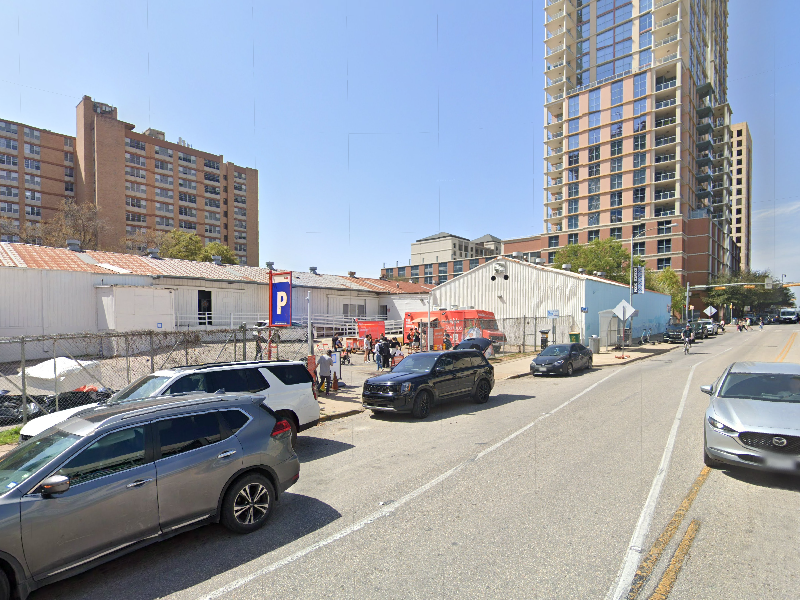
The two sites in question are 99 Trinity St. and an assemblage of sites around the Austonian condo tower — 201 Colorado St., 203 Colorado St. and a neighboring parking lot. They carry sky-high redevelopment potential for whomever can lay claim to them.
Greg Milligan — who in 2019 was named receiver by a Travis County court for the World Class-affiliated entities that own the properties — received court approval earlier this year to sell the properties for a combined $88.3 million to Texas Global Equity Property Fund XV LP, an investment arm of Austin-based Texas Global Equity Partners LLC. But a March 31 deadline to close on the sale came and went without the properties changing hands.
TGE’s purchase and sale agreement for the World Class properties was completed in March 2025. But later that year, a city of Austin decision to temporarily cap the height of downtown developments at 350 feet threw a wrench into TGE's plans. That temporary cap drastically reduced what could be developed at the sites and TGE now wants more time to buy the land.
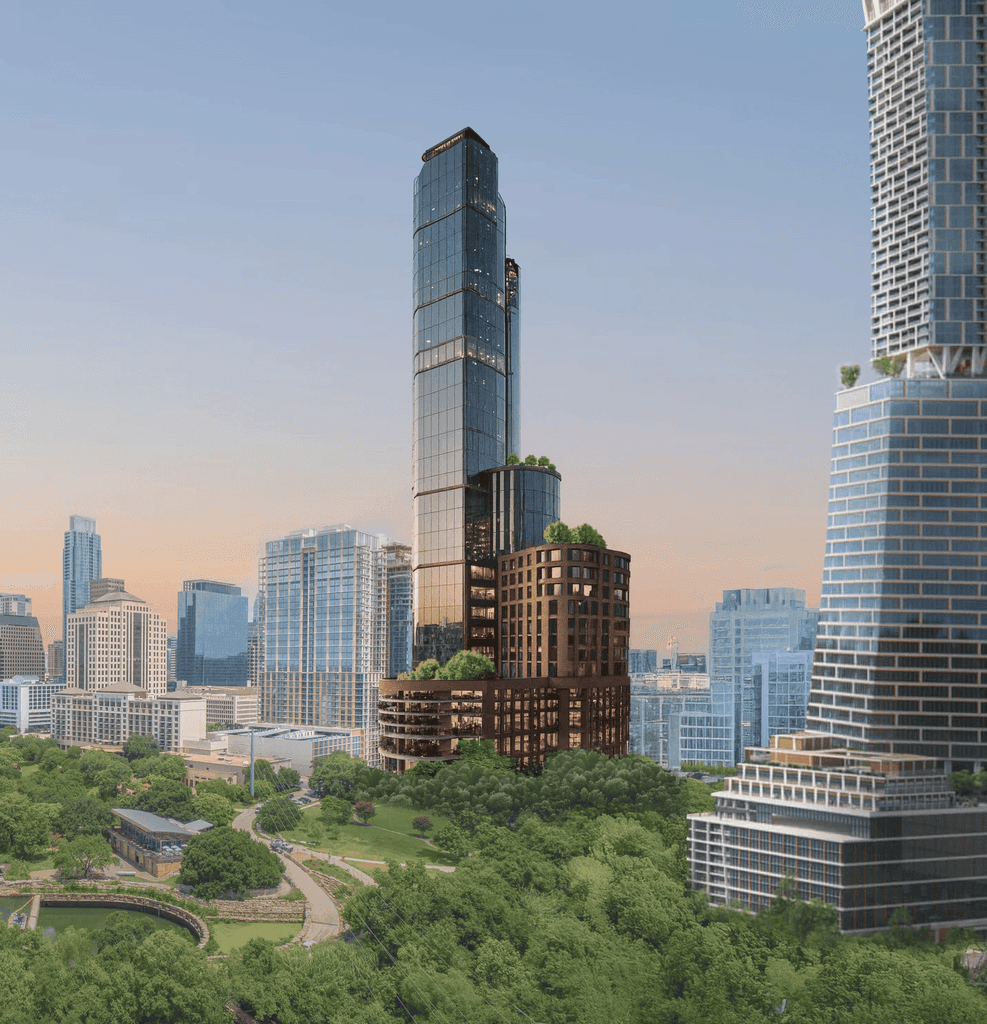
TGE’s original plans for the two sites were two 950-foot-tall towers, each with hotel and live arts performance uses. But due to Austin’s recent changes in downtown height restrictions the projects have since been re-engineered to fit within 750-foot-tall envelopes, Gritz said. The original plans would still be pursuable with City Council approval.
Gritz previously told the ABJ that TGE did not want to renegotiate the $88.3 million sale price or back out of the deal, but wanted more time to close on the deal because of the uncertainty raised at City Hall.
Milligan declined to comment, but the receivership alleged in court filings that while TGE claims it cannot obtain funding, the reason is because TGE misrepresented aspects of the properties to investors and lenders.
Specifically, TGE allegedly represented the properties to its capital partners as fully entitled, zoned and approved, with no additional discretionary government approvals, variances or rezoning actions required — a representation that the receiver alleged it did not make.
“The problem for TGE is that it repeatedly agreed in the Purchase and Sale Agreements and their amendments for the Trinity Property and the Congress Property that it had completed its due diligence, that it was not relying on any representations by the Receiver, that it accepted the properties” as is, the filing stated.
TGE also alleged that the purchase and sale agreements should stand because the receiver failed to satisfy closing conditions.
But, in a July 7 court filing, the receivership challenged that claim and alleged that TGE’s own conduct caused the failure of the closing conditions.
“First, even if the sale orders lapsed by their own terms when closing did not occur, TGE created this problem when it refused to perform under the PSA,” the filing read. “Upon the court’s entry of the sale orders on March 26, 2026 … and the title company’s confirmation that it would insure title … the closing conditions were satisfied and TGE was required to close.”
The Travis County legal dispute began when TGE initially filed for and received a temporary restraining order and injunction order on March 31, the day the sales were set to close. But Travis County Judge Jan Soifer dissolved those orders on April 6.
TGE again filed for temporary injunction on May 14. Soifer denied that request in a June 15 order, and on June 16 issued an order dismissing with prejudice any of TGE’s pending claims as of April 23 with prejudice, though some claims still remain active.
TGE has not disputed the June 16 order. But, on July 10, TGE filed a motion to appeal the June 15 order denying temporary injunction with the Texas Third Court of Appeals. With that motion, TGE requested a temporary order staying the sale of property to another buyer in order to preserve TGE’s rights to purchase.
The receivership opposed that motion, but a court decision has not yet been made.
On July 7, the receivership filed a motion for summary judgement in Travis County for all of TGE’s remaining claims. According to the receivership’s motion, those claims include:
The sale orders became null and void when closing did not occur on March 31.
There was no final sale order because the sale orders were not final.
TGE has no standing to object to the sale orders.
Closing conditions were never satisfied.
A hearing will be held on that motion on Aug. 27, meaning TGE is still fighting to retain its rights to purchase the sites in both Travis County and a court of appeals.
|

|





 Prev
Prev






 Linear Mode
