HomeDiagramsDatabaseMapsForum About
     

Go Back   SkyscraperPage Forum > Regional Sections > Canada > Ontario > Ottawa-Gatineau > Transportation


Reply

 
Thread Tools Display Modes
     
     
  #9161  
Old Posted Jun 17, 2026, 4:12 PM
Uhuniau Uhuniau is offline
Registered User
 
Join Date: Jan 2010
Posts: 9,006
The slide on run-time adjustments is also fun and interesting. It is heavily concentrated downtown.

The proposed transit-priority priorities (or priority transit priorities?) are not heavily concentrated downtown at all.
__________________
___
Enjoy my taxes, Orleans (and Kanata?).
Reply With Quote
     
     
  #9162  
Old Posted Jun 18, 2026, 1:43 PM
skyscraperaccount skyscraperaccount is offline
Registered User
 
Join Date: Jun 2023
Posts: 288
Office of the Auditor General Ottawa - Audit of Bus Service Planning and Scheduling


Last edited by skyscraperaccount; Jun 18, 2026 at 2:39 PM.
Reply With Quote
     
     
  #9163  
Old Posted Jun 18, 2026, 2:51 PM
Uhuniau Uhuniau is offline
Registered User
 
Join Date: Jan 2010
Posts: 9,006
Huh:

Quote:
RECOMMENDATION 1 – RUN-TIME ADJUSTMENTS

...

Further, trips with highly variable run times that are not strong candidates for run time adjustment (e.g. not on time but not consistently late or early) should be prioritized for other potential transit priority measures to support reliability.

MANAGEMENT RESPONSE 1

[The response is conspicuously silent on the question of transit priority measures.]
Huh 2:

Quote:
3.3 Not all operational decisions are driven by technical, priority-based analysis.

The audit also found that the E1 route, which operates parallel to the LRT Line 1 from Blair to Lyon station during specific periods, was not discontinued after the introduction of New Ways to Bus. This route serves as a supplemental rail alternative and was implemented in response to ongoing rail line issues, in addition to the ad hoc R1 service used during unexpected rail disruptions. Interviews with management indicated that the decision to retain the E1 route was made to support riders until trust in the LRT was reestablished. However, this route is inconsistent with the approach stated in the Bus Route Review that informed New Ways to Bus, which emphasized taking advantage of the LRT network. The estimated annual operating cost of this route is $1.3 million and requires buses during peak service hours. Overall, without analysis of these proposed service changes against others, we are unable to confirm if they represent the best use of limited resources.
Kinda crazy how a whole entire expensive wasteful bus route can be instituted and then kept for purely political reasons, if it keeps suburban commuters happy.
__________________
___
Enjoy my taxes, Orleans (and Kanata?).
Reply With Quote
     
     
  #9164  
Old Posted Jun 18, 2026, 3:24 PM
BanjoUnchained BanjoUnchained is offline
Registered User
 
Join Date: Sep 2022
Location: ottawa
Posts: 60
So the mid-day LRT frequency cuts were necessary to save $1.6M, but they have $1.3M to run a parallel redundant bus service?
Reply With Quote
     
     
  #9165  
Old Posted Jun 18, 2026, 3:41 PM
Uhuniau Uhuniau is offline
Registered User
 
Join Date: Jan 2010
Posts: 9,006
Quote:
Originally Posted by BanjoUnchained View Post
So the mid-day LRT frequency cuts were necessary to save $1.6M, but they have $1.3M to run a parallel redundant bus service?
See also "cannibalizing routes 12 and 7 to keep the 'empty' suburban routes running".
__________________
___
Enjoy my taxes, Orleans (and Kanata?).
Reply With Quote
     
     
  #9166  
Old Posted Jun 18, 2026, 4:42 PM
Truenorth00 Truenorth00 is online now
Registered User
 
Join Date: May 2017
Posts: 28,809
Quote:
Originally Posted by J.OT13 View Post
A few interesting slides from last week's transit committee.
....
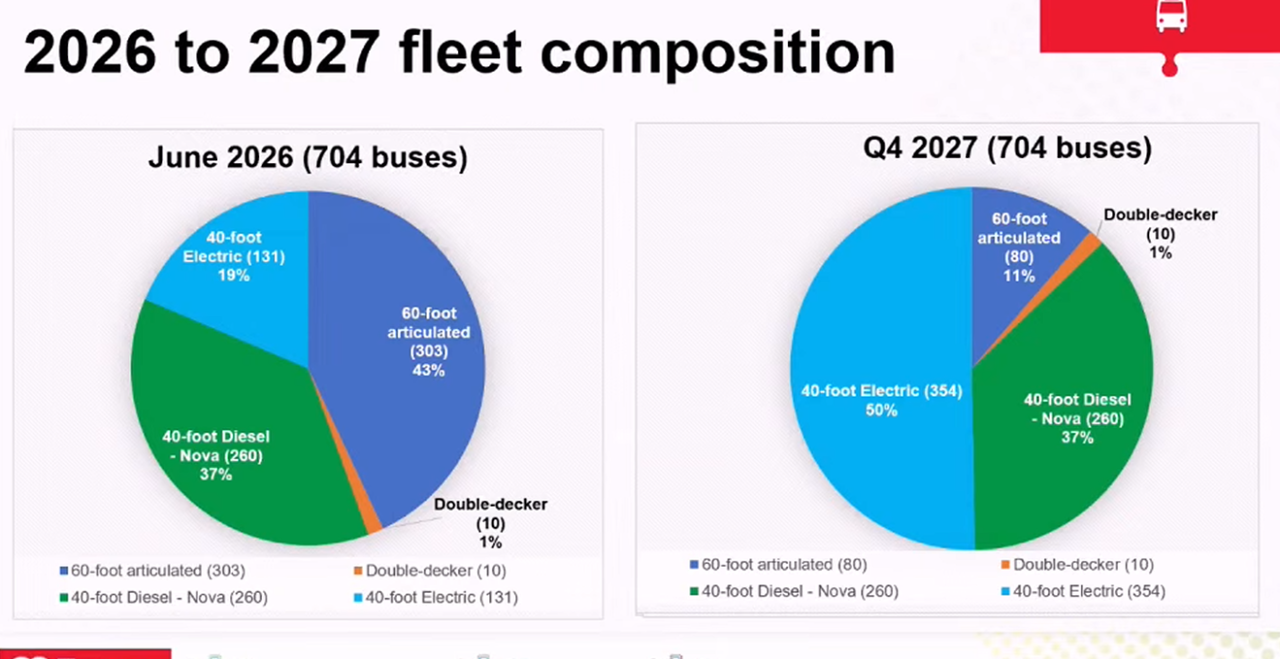
Keeping 10 DDs. Why?

The really need a plan to add more sixty footers beyond 2028 and to progressively retire the 40 foot diesels by 2035 with some combination of 60 ft diesels and 40 ft electric.
Reply With Quote
     
     
  #9167  
Old Posted Jun 18, 2026, 4:59 PM
Truenorth00 Truenorth00 is online now
Registered User
 
Join Date: May 2017
Posts: 28,809
Quote:
Originally Posted by BanjoUnchained View Post
So the mid-day LRT frequency cuts were necessary to save $1.6M, but they have $1.3M to run a parallel redundant bus service?
And that may not account for wear and tear on the buses.
Reply With Quote
     
     
  #9168  
Old Posted Jun 18, 2026, 6:05 PM
Uhuniau Uhuniau is offline
Registered User
 
Join Date: Jan 2010
Posts: 9,006
Quote:
Originally Posted by Truenorth00 View Post
Keeping 10 DDs. Why?

The really need a plan to add more sixty footers beyond 2028 and to progressively retire the 40 foot diesels by 2035 with some combination of 60 ft diesels and 40 ft electric.
Good god.
__________________
___
Enjoy my taxes, Orleans (and Kanata?).
Reply With Quote
     
     
  #9169  
Old Posted Jun 18, 2026, 7:20 PM
Truenorth00 Truenorth00 is online now
Registered User
 
Join Date: May 2017
Posts: 28,809
Quote:
Originally Posted by Uhuniau View Post
Good god.
What's your objection to my suggestion? The amount of capacity they are planning to cut by the end of next year is nuts (I calculated a drop of 11 819 spaces between going from D60LFR to XE40 as replacement). Especially from a service who doesn't think frequency is important. They need to grow the 60 ft fleet. And given that the 40 ft Novas will be a decade old in 2030, planning their replacements now as part of a fleet plan beyond all the current deliveries (which end next year) would seem prudent.

Keeping 10 DDs seems silly to me. The added maintenance burden of another type for such a small number can't be worthwhile. Just buy or refurbish more 60 footers. As it stands they are only buying 50 of the 60 footers.
Reply With Quote
     
     
  #9170  
Old Posted Jun 18, 2026, 7:26 PM
Uhuniau Uhuniau is offline
Registered User
 
Join Date: Jan 2010
Posts: 9,006
Quote:
Originally Posted by Truenorth00 View Post
What's your objection to my suggestion?
I don't have one?

My reaction is to the disappearance of higher-capacity buses.
__________________
___
Enjoy my taxes, Orleans (and Kanata?).
Reply With Quote
     
     
  #9171  
Old Posted Jun 18, 2026, 8:04 PM
lrt's friend lrt's friend is offline
Registered User
 
Join Date: Dec 2006
Posts: 12,750
Quote:
Originally Posted by Uhuniau View Post
I don't have one?

My reaction is to the disappearance of higher-capacity buses.
high capacity buses are being replaced with trains. We needed so many articulated buses because of the Transitway. That will soon mostly be trains.

If capacity is not sufficient on specific routes, improve frequency. That is a win win. More buses means shorter transfer wait times. This is important at a time when more transfer are expected.
Reply With Quote
     
     
  #9172  
Old Posted Jun 18, 2026, 8:07 PM
lrt's friend lrt's friend is offline
Registered User
 
Join Date: Dec 2006
Posts: 12,750
Quote:
Originally Posted by Uhuniau View Post
See also "cannibalizing routes 12 and 7 to keep the 'empty' suburban routes running".
Would you let this go? The suburbs are funding much of the transit system through transit levies, and service has already been cut substantially in the suburbs. The result has been ridership loss and more congested roads.
Reply With Quote
     
     
  #9173  
Old Posted Jun 18, 2026, 8:29 PM
OCCheetos OCCheetos is offline
Registered User
 
Join Date: Aug 2017
Posts: 2,104
Quote:
Originally Posted by Truenorth00 View Post
Keeping 10 DDs. Why?

The really need a plan to add more sixty footers beyond 2028 and to progressively retire the 40 foot diesels by 2035 with some combination of 60 ft diesels and 40 ft electric.
If they're still operational enough, they may as well keep using them for now.

Unrelated to OC Transpo specifically, but it'd be nice if they started producing hybrid articulated buses again-- if for no other reason than the centre-wheel drive motors.

Quote:
Originally Posted by lrt's friend View Post
high capacity buses are being replaced with trains. We needed so many articulated buses because of the Transitway. That will soon mostly be trains.

If capacity is not sufficient on specific routes, improve frequency. That is a win win. More buses means shorter transfer wait times. This is important at a time when more transfer are expected.
I agree with this. It's an opportunity for change, and I think a lot of people are set on keeping the status quo (or at least "too much" of it).
Reply With Quote
     
     
  #9174  
Old Posted Jun 18, 2026, 9:16 PM
Truenorth00 Truenorth00 is online now
Registered User
 
Join Date: May 2017
Posts: 28,809
Quote:
Originally Posted by lrt's friend View Post
high capacity buses are being replaced with trains. We needed so many articulated buses because of the Transitway. That will soon mostly be trains.

If capacity is not sufficient on specific routes, improve frequency. That is a win win. More buses means shorter transfer wait times. This is important at a time when more transfer are expected.
Quote:
Originally Posted by OCCheetos View Post
I agree with this. It's an opportunity for change, and I think a lot of people are set on keeping the status quo (or at least "too much" of it).
This only works if the trains actually run a decent schedule to generate capacity through frequency.

Quote:
Originally Posted by OCCheetos View Post
If they're still operational enough, they may as well keep using them for now.
They've retired a whole bunch of them early because of cost and reliability issues. So I don't see the point of keeping 10 of them. Presuming they are from late 2019 to early 2020 means they'll have 8 years on them by end 2027. Trade them to Metrolinx for some 60 footers.
Reply With Quote
     
     
  #9175  
Old Posted Jun 19, 2026, 12:54 AM
Richard Eade Richard Eade is offline
Registered User
 
Join Date: Mar 2008
Location: Nepean
Posts: 2,591
The audit was part of the department’s 2024-25 plan – so when was it actually investigated? During the time when Ms. Amilcar was struggling with no e-buses and a slew of failing, old, buses? Graphs include March 2026 numbers, so I assume that the beginning of the up-swing of e-buses is included. And it will probably be Mr. Leary which acknowledged the recommendations. (I expect that he had already found many of these issues himself.)

I know that I shouldn’t be surprised, but when I clicked through to the adopted 2026 budget document, I found this information:
2025 Actual Operating Amounts:
$815,624,000 – Total Cost (i.e., how much was paid, from all sources, to run the transit system)
-$311,974,000 – Revenue (from all sources, but overwhelmingly rider fares, which was used to pay for transit costs)
$503,650,000 – Net City Expense (i.e., what the City had to collect from tax-payers and contribute for transit costs)

2026 Adopted Budget Operating Amounts:
$904,760,000 – Total Cost (i.e., how much will be paid, from all sources, to run the transit system)
-$413,589,000 – Revenue (from all sources, including upper levels of government, but overwhelmingly rider fares)
$491,171,000 – Net City Expense (i.e., what the City had to collect from tax-payers and contribute)

Well, isn’t that wild? The City’s share was budgeted to DROP from $503.7M to $491,2M. Yes, if everything had gone according to plan, the City would actually pay LESS of its tax revenue for transit in 2026. So, when the current Mayor says that the City’s funding for OC Transpo was increased, you can just show him these COUNCIL ADOPTED budget numbers. The increase in spending was mostly coming from the riders.

(Of course, the City will wind up spending more, since the budgeted Revenue amount was conceived during a psychedelic dream – so the City will need to cover the shortfall of income.)

Then the Audit Report tells me how much OC Transpo budgets for operating each of the three branches:
2025:
Bus - $408M
Rail - $164M
Para - $40M

2026:
Bus - $419M – an increase of 2.7%
Rail - $200M – an increase of 22%
Para - $42M – an increase of 5%

The BIG 22% jump in Rail operation cost is unexpected. I first thought that it was due to the opening of Lines 2 and 4 – but that happened in early Jan., 2025, so that cost would have already been in the 2025 number.
I’m open to ideas on why the cost to run the trains increased so much.

Interesting that the report has no mention of the 400-series routes to special events. They mention the 600-series buses.

About the Conclusions of the audit:
1. I think that anyone who has taken a bus in the last 6 months will agree that buses are unreliable. The need to re-time runs, deadheading, and layovers has been obvious to everyone but OC Transpo’s past management and City Councilors. That I believe that I have seen a recent change in the # 88 schedule, however, makes me think that GM Leary had already noticed the problem and had already begun to take corrective measures – albeit, slowly.

2. Here we find out that, when planning New Ways to Bus, the actual number of buses available was not taken into account. And that in spring 2025, OC Transpo quietly removed runs from the schedule so that fewer buses would be needed (540 buses -> 524 buses) – and they did the same thing, again, in Jan. 2026, but went even further (down to 500 buses needed). At least the new GM informed the City Council, and public, in January. The audit notes that the TTC – during Leary’s leadership time – maintained 110% bus availability. Hopefully, he can do that here. For example, if OC Transpo had 688 buses, and could keep 80% of them ready for service, then there would be 550 buses available. However, OC Transpo must maintain the correct ratio of bus types in the fleet. Having 550 regular buses is not the same as 550 high-capacity buses. As well, OC Transpo needs to allocate the correct type of bus for the various routes. In short, OC Transpo must divine what its future bus requirements will be, based on which type of bus should be run on which route; make sure they are available; and then assign appropriate buses to routes.

However, buses are of no use if there is no operator to drive them. According to Figure 7, there was a drop in bus operators; from 1640 at the end of Jan., 2025, down to 1500 at the end of July, 2025. I am open to suggestions as to why about 140 bus operators would leave during those 6 months. And It doesn’t look as if the issue will be fully resolved until the second quarter of 2027.

3. You have to know what you need to do before you try to do it; or even to know if you achieved it. And you need to be able to monitor any changes to know if you are getting closer or further from the goals. The problem is that OC Transpo has nothing to aim at. It needs guidance from the Transit Committee. The solution from OC Transpo is for OC Transpo to write its own requirements, and then tell the Transit Committee what it should be telling OC Transpo to do. And it should be ready sometime late in 2028.

A couple of things wrong here: The Transit Committee should be setting the direction and standards for OC Transpo. In their scenario, OC Transpo is telling the Committee what to say. It means that the Committee does nothing but rubber-stamp what it is handed. The Transit Committee should be doing the work here. Yes, there should be input from OC Transpo, but this is why there is a Transit Committee. The Councilors on that committee should be doing the work to figure out what OC Transpo is to be directed to do. What have the Councilors on the Transit Committee actually been doing? They get sent a report from OC Transpo. It is ‘For Information’ only. The Councilors might read the report – although, more likely, just the summary – and ask a couple of superficial questions. Then they ‘Accept’ the report, as is. Phew, done for another month.

And the other problem? Management confirms that the adaptation of the bus network to mesh with the extended LRT will be done “in alignment with those standards.” HOW? The standards aren’t coming until late 2028; the extensions open earlier than that – we hope.

Reply With Quote
     
     
  #9176  
Old Posted Jun 19, 2026, 10:50 AM
Truenorth00 Truenorth00 is online now
Registered User
 
Join Date: May 2017
Posts: 28,809
Scathing....

Quote:
City auditor blasts OC Transpo bus scheduling

....

The audit found that scheduled run times do not reflect actual travel times, in part because of delays launching the "New Ways to Bus" changes, which the audit said were primarily driven by a desire to cut costs.

"OC Transpo’s run times were last holistically updated for implementation of New Ways to Bus, based on data collected in 2023," said the audit, released by Auditor General Nathalie Gougeon's office on Thursday.

"Due to delays in launching New Ways to Bus in April 2025, run times became inaccurate because of evolving traffic patterns throughout the city."

She found that 29 per cent of select weekday routes had times that were off by 10 per cent or more, and there weren't enough resources available to make adjustments and keep them accurate.

New Ways to Bus altered more than 100 bus routes across the city. While OC Transpo publicly sold it as a way to bring service in line with ridership patterns and the opening of O-Train lines 2 and 4, the audit suggests they had a different motivation.

....

"The redesign focused on achieving an annual bus operating cost reduction of approximately $10 million, equivalent to a reduction of 70,000 bus service hours annually."

...

The audit explains in detail how OC Transpo is failing to properly draw up timetables for bus trips.

For example, it should be leaving enough of a buffer between trips to make sure that one late arrival doesn't delay the same bus's next run. But the audit finds that OC Transpo often didn't leave a long enough buffer. Others routes had too long of a buffer, wasting resources.

That can ripple though the schedule, making one trip after another run late, Vineberg explains.

"That next trip is already two or three minutes late," he said. "When you take out that recovery time, you're cascading and eroding the system and making it impossible to keep things on time."

....

But the problems with New Ways to Bus go beyond bad timetables. The audit found that OC Transpo didn't make sure it would have enough buses available to actually operate the redesigned routes.

It would have needed 540 under the original plan, though that was later cut back to 524 when OC Transpo removed trips from its timetables in spring of last year.

That was reduced still further to 500 in January, as an aging fleet kept buses in the garage and left OC Transpo facing a bus cancellation crisis.

But even that didn't fix the problem. From January to the end of March, OC Transpo found itself without enough buses to deliver peak afternoon service on about half of all weekdays.

...

On top of the bus shortage, OC Transpo has also grappled with a shortage of drivers, as 28 per cent of cancellations from January to early March happened because there was no one available to drive the bus.

In some cases, that was because the driver was still operating a bus that was running late.

The audit doesn't expect OC Transpo bring on enough drivers to close its staffing gap until early next year.

....

Ottawa’s new general manager of transit services, Rick Leary, has made reliability a core commitment in his 10-point action plan. He promised to adjust bus schedules “to reflect real travel times” with a goal of meeting OC Transpo’s service delivery target of 99.5 per cent.

Gougeon’s audit makes 10 recommendations, all of which were accepted by OC Transpo management. They include:
  • A methodology to monitor and update run times.
  • A more conservative approach to bus and operator resources.
  • Review and update the bus fleet plan to make sure there's enough spares.
  • A system-wide process to monitor performance against service standards.
  • Evaluating route additions and other service changes based on consistent criteria to show value for money.
  • Gower said progress on some of the recommendations is already in the works, while Vineberg said Leary's plan is on track with what's needed to fix some of the problems.
Source: https://www.cbc.ca/news/canada/ottawa/oc-transpo-bus-transit-scheduling-audit-report-9.7239808


Unfortunately, very little of this will get pinned on the mayor and councillors running for re-election who shortchanged transit.

Last edited by Truenorth00; Jun 19, 2026 at 11:16 AM.
Reply With Quote
     
     
  #9177  
Old Posted Jun 19, 2026, 11:15 AM
Truenorth00 Truenorth00 is online now
Registered User
 
Join Date: May 2017
Posts: 28,809
Seems to me from AG report that they still aren't planning a bus fleet that is big enough and with enough capacity. I would think the fleet needs to grow. Assuming they go back to 540 buses required to deliver the schedule, and assuming 110% readiness with a 25% sparing ratio would imply 742.5 buses.

I think they need something like ~600 forty foot buses and ~150 sixty foot buses both for day to n day capacity and to cover contingencies like a portion of the rail network being down.
Reply With Quote
     
     
  #9178  
Old Posted Jun 19, 2026, 1:20 PM
lrt's friend lrt's friend is offline
Registered User
 
Join Date: Dec 2006
Posts: 12,750
With shortages in buses, operators, budget, and greatly increased spending on rail, shall we prepare for another service cut?
Reply With Quote
     
     
  #9179  
Old Posted Jun 19, 2026, 2:00 PM
J.OT13's Avatar
J.OT13 J.OT13 is offline
Moderator
 
Join Date: Mar 2012
Location: Ottawa
Posts: 28,594
Quote:
Originally Posted by BanjoUnchained View Post
So the mid-day LRT frequency cuts were necessary to save $1.6M, but they have $1.3M to run a parallel redundant bus service?


Quote:
Originally Posted by Uhuniau View Post
See also "cannibalizing routes 12 and 7 to keep the 'empty' suburban routes running".
The pandering to the suburbanites is insatiable .
Reply With Quote
     
     
  #9180  
Old Posted Jun 19, 2026, 2:54 PM
Uhuniau Uhuniau is offline
Registered User
 
Join Date: Jan 2010
Posts: 9,006
Quote:
Originally Posted by lrt's friend View Post
high capacity buses are being replaced with trains.
Not on Bank Street, Montreal Road, Rideau Street, Somerset-Wellington, they're not.

Quote:
If capacity is not sufficient on specific routes, improve frequency. That is a win win. More buses means shorter transfer wait times. This is important at a time when more transfer are expected.
Improve frequency, how? The frequent buses as they are are highly susceptible to unreliable frequencies, unpredictable start times, bunching, etc., and we have absolutely no plan to do Transit Priority Thingies in the city centre that are required to remedy the situation. And even then, there is a limit to what transity-priority measures are going to accomplish.

The busy downtown routes need high capacity AND frequency. And since we refuse to do the things that can buy us some frequency, capacity is all that is left to play with, AND THEY ARE SCREWING THAT UP.
__________________
___
Enjoy my taxes, Orleans (and Kanata?).
Reply With Quote
     
     
This discussion thread continues

Use the page links to the lower-right to go to the next page for additional posts
 
 
Reply

Go Back   SkyscraperPage Forum > Regional Sections > Canada > Ontario > Ottawa-Gatineau > Transportation
Forum Jump


Forum Jump


All times are GMT. The time now is 4:34 AM.

     
SkyscraperPage.com - Privacy Statement - Top

Powered by vBulletin® Version 3.8.7
Copyright ©2000 - 2026, vBulletin Solutions, Inc.