Castelo de Estremoz (Estremoz Castle)
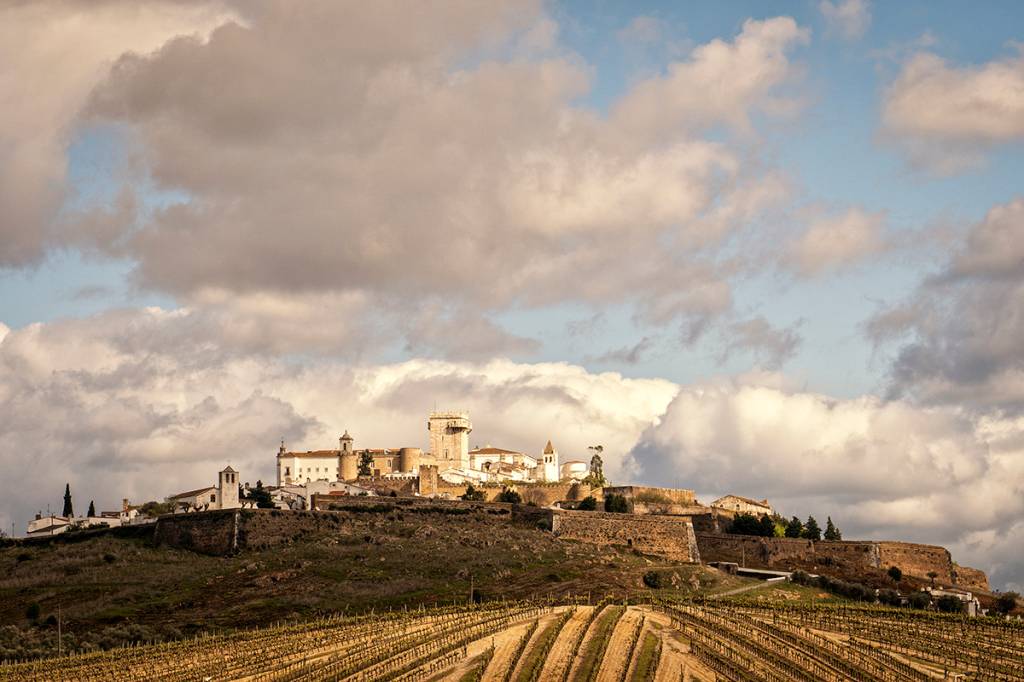
History
There is no further information regarding the early human occupation of the site, although archaeological remains from the Roman period show a rustic village in Santa Vitória do Ameixial and the "Tanque dos Mouros" (Moorish Tank), a water storage and supply structure near the Mártires site, which was later occupied by the Muslims, who are believed to have fortified it.
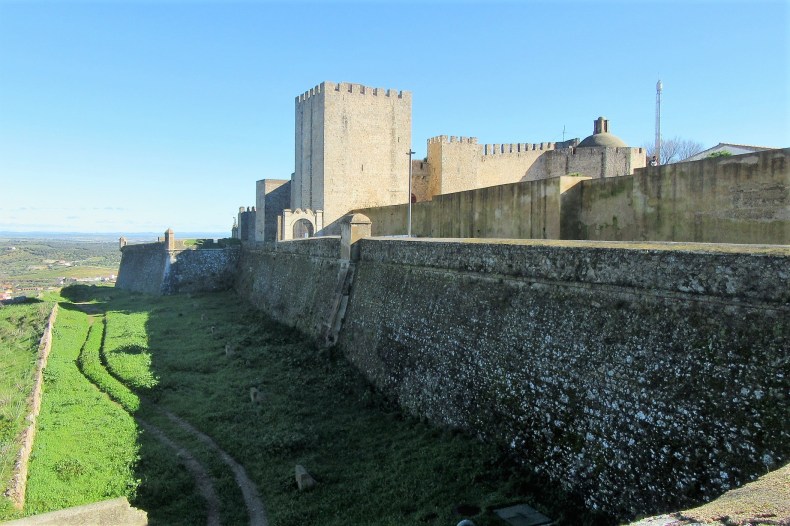
During the Christian Reconquista of the peninsula, it was conquered at the same time and by the same forces with which Geraldo Sem Pavor took possession of neighboring Évora (1165). Having lost possession shortly afterwards, Estremoz was only definitively incorporated into Portuguese domains in the mid-13th century, during the reign of King Sancho II (1223-1248), when reconstruction work on the castle is believed to have begun. Under the reign of King Afonso III (1248-1279), aiming to increase its population and defense, this sovereign granted a charter to the town in 1258, ordering the reconstruction and reinforcement of its defenses, as well as the construction of the town walls. The erection of the Keep dates from this time, around 1260.
The construction work on the walls continued under the reign of King Dinis (1279-1325), the monarch who had the Royal Palace built next to the castle. Here, in the Palace, Queen Saint Isabel died (July 4, 1336), her body later being transferred to the Convent of Santa Clara-a-Velha in Coimbra. While still alive, she had prevented, here in Estremoz, an imminent clash between her son, King Afonso IV, and King Alfonso XI of Castile.
The Keep was completed during the reign of King Fernando of Portugal (1367-1383), around 1370. During the 1383-1385 crisis, the chief magistrate João Mendes de Vasconcelos sided with Castile. He was ordered by the population to leave the castle, which he handed over to the squire Martim Pires in the name of the Master of Avis. In 1384, the Constable Nuno Álvares Pereira established his headquarters here, from where the Portuguese forces under his command would set out to fight and defeat the Castilian army at the Battle of Atoleiros.
The town received its new charter (1512) from King Manuel I (1495-1521).
During the succession crisis of 1580, the Castle of Estremoz and its chief magistrate remained loyal to António, Prior of Crato. Meanwhile, Castilian troops under the command of the Duke of Alba invaded Portugal, besieging Estremoz, the only Alentejo town to resist. Faced with the disproportionate forces and the heavy consequences that could befall the town and its population, the mayor of Estremoz, Admiral D. João de Azevedo, surrendered and was imprisoned in the Castle of Vila Viçosa.
With the advent of the Restoration of Independence (1640), during the ensuing struggles, Estremoz once again served as headquarters for the Portuguese troops. Its detachments were decisive for the Portuguese victory at the Battle of the Lines of Elvas (1659), and the same was true at the Battle of Ameixial (1663) and the Battle of Montes Claros (1665), which brought an end to the Restoration War. To that end, a commission composed of the military engineers João Pascácio Cosmander, Rui Correia Lucas, and Jean Gillot was commissioned by the War Council of King John IV to inspect the Alentejo fortresses, promoting the necessary works therein (1642).
The defenses of Estremoz and its castle were modernized, under the design and guidance of Cosmander. After his death in 1648, Nicolau de Langres, with the assistance of Pierre de Saint-Colombe, was put in charge of the works (1662?), which included the construction of four bastions, two demi-bastions, and a ravelin, later reinforced by other bastioned lines, notably that of the so-called Lower Square.
Also during the Restoration period, and in gratitude for the Portuguese victories over the Spanish forces in the Alentejo, Queen Regent Luisa de Gusmão, mother of King Afonso VI, had the apartments where Queen Saint Isabel had died transformed into a chapel.
In the 18th century, fortification work continued, marked, from 1736 onwards, by the reconstruction of the old Royal Palace, repurposed to house the War Warehouses, with a design by António Carlos Andreis. Between 1738 and 1742, in the new and imposing Baroque-style building, King John V (1706-1750) founded the Arms Room, one of the most famous armory museums on the European continent at the time, and greatly improved the Chapel of Queen Saint Isabel.
In the 19th century, it aided Portuguese forces besieged in the Elvas fortress during the so-called War of the Oranges (1801), and was briefly occupied by French troops under the command of General Kellerman, who abandoned it on July 12, 1808, during the Peninsular War. A few decades later, during the Liberal Wars, Miguelist forces murdered 39 liberals who were being held in the dungeons of Estremoz.
Peace and urban development took their toll on Elvas' defenses, both those from the Middle Ages and those from the Restoration period. For example, a large section of the northern wall was demolished to make way for the railway station in the town center. On August 17, 1898, a violent explosion in one of the gunpowder magazines caused severe damage to the structure of the War Warehouses (former Royal Palace) and the medieval castle.
At the beginning of the 20th century, the castle complex, the town walls, the so-called Tower of the Breastplates, and the Chapel of Queen Saint Isabel were classified as a National Monument by decree published on June 23, 1910. However, public action only became apparent when a consolidation and conservation intervention was initiated by the DGEMN (Directorate-General for National Monuments and Buildings) in 1939. The same organization promoted roof repair work in 1961. A major intervention, however, took place between 1967 and 1988, aiming to requalify the War Warehouses (former Royal Palace) for use as a pousada (a type of historic hotel).
Currently, the monument serves a tourist function (Pousada da Rainha Santa Isabel), a cultural function (Drawing Gallery of the Estremoz Municipal Council, in the former Audience Chamber of King Dinis), and a religious function (Chapel of Saint Isabel).
https://www.castelosdeportugal.pt/castelos/CastelosSECXII/estremoz.html







 Prev
Prev




 . But the reason why many Portuguese people emigrate to various parts of the world has mainly to do with the high cost of living and low wages, among other things like corruption, excessive bureaucracy, etc., etc.... Apart from that, it's not a bad country to live in.


 Linear Mode
