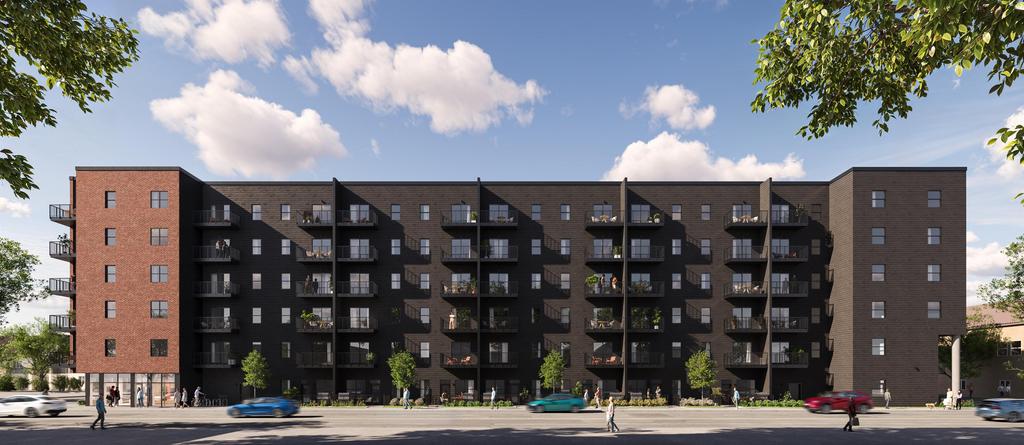
The applicant is proposing to rezone from “C2” Community – Community district to the
“RMU” Residential Mixed Use district for the purpose of constructing a 6-storey mixed-use
building with ground floor commercial units and residential units above.
• According the submitted site plan, the building will be 129.25 feet (39.4 metres) in width,
75.25 feet (22.94 metres) in depth, and 77 feet (23.47 metres) in height.
• At grade, the building features three (3) commercial units with 6,157 square feet of
commercial space and a total of 10,654 square feet of storage and flex space.
• Storeys two (2) through six (6) will contain 45 dwelling units with a mix of one, two, and thee
bedrooms.
The applicant is proposing to rezone from “C2” Community – Community district to the
“RMU” Residential Mixed Use district for the purpose of constructing a 6-storey mixed-use
building with ground floor commercial units and residential units above.
• According the submitted site plan, the building will be 129.25 feet (39.4 metres) in width,
75.25 feet (22.94 metres) in depth, and 77 feet (23.47 metres) in height.
• At grade, the building features three (3) commercial units with 6,157 square feet of
commercial space and a total of 10,654 square feet of storage and flex space.
• Storeys two (2) through six (6) will contain 45 dwelling units with a mix of one, two, and thee
bedrooms.
PRESERVING THE PAST
A landmark restoration is giving Winnipeg’s St. Boniface Museum new life while safeguarding its history for the next 175 years
By James Peters
Few North American institutions can boast of anniversaries longer than the span of their own countries, but Winnipeg’s St. Boniface Museum is one of them. The museum will celebrate its 175th birthday next year in 2026 while Canada will mark its 159th on July 1 of the same year.
The venerable museum on Tache Avenue, across from the historic junction of the Red and Assiniboine rivers, stood the test of time — even though Mother Nature has taken its toll. Creaky floors and staircases and an aging exterior have given way to a flurry of reasons the time was right for a major renovation on the heritage structure. The museum, which was opened to the public as the “Grey Nuns’ Convent and mission house since 1957, closed its doors in June 2024 for the undertaking. To clear the way for construction and protect its artifacts, everything from the building’s interior has been relocated to the old St. Boniface City Hall building at 219 Provencher Boulevard.
The museum’s original structure was completed in 1851, almost two decades before Manitoba became a province. In addition to being a nunnery, the building has also served as an orphanage, a school, a seniors’ home and the first hospital in the city. But the building’s role as a museum, it’s home to 30,000 artifacts, many connected to Métis leader Louis Riel, including strands of rope said to have been used in his 1885 hanging and the coffin that carried Riel from Regina to St. Boniface.
Cindy Desrochers, the museum’s executive director, describes the renovation as “the biggest upgrade ever in our 175-year history.” “Like many renovation projects, this one started out in a less ambitious way with some leaky roof repairs in 2023 and the expectation of repairing the windows and applying a much needed coat of paint. But things went sideways when reports from the engineers indicated a much more important issue, the 1990s installation of the mechanical system on the mezzanine suspended from the roof structure was negatively impacting the roof structure.
“That led to having a major assessment performed, which resulted in the decision to strengthen the roof structure, upgrade energy systems with new HVAC, restore some of the windows and replace damaged exterior finishes. In addition, we’ll be refurbishing the lobby and reception area, resurfacing the floors and adding a new accessible ramp.”
To suggest the museum is in Desrochers’ blood is an understatement. She’s been executive director since 2016 and has held a variety of positions, all dating back to her original stint as a summer student in 1990. “Because the museum is a national, provincial and municipal heritage site, the primary concern is to always preserve the building,” she says. “So removing the extra stress on the roof with new glulam beams, metal plates and roof decking on the inside will create a much stronger building for many years to come.”
Glulam beams are a modern structural element in building design, consisting of stress-rated wood laminations bonded together with durable, moisture-resistant adhesives. they are often used for their versatility, ranging in complexity from straight beams to complex, curved members, much of what was requested at the museum.
PROJECT STATUS
At time of writing, much of the important structural work on the roof has already been accomplished. Soon the team led by Bockstael Construction — will start on the new HVAC systems and fit up of the third-floor spaces, before moving on to retrofitting the historic windows.
“We’re going to replace the exterior sashes with wood windows. They’ll have the exact same historic appearance — still with wood, only newer,” Desrochers says. “The window replacements have been one of the trickiest elements because that’s where we found lead paint, asbestos in the putty that holds the glass in place — it was the only area in the entire museum where that was revealed. And that, of course, meant an abatement, which is necessary, but lengthens the construction process a bit. With a heritage building, there are many different layers of considerations that need to be taken into account. ”
The steam campus system is being replaced with hydronic cooling — a method of cooling buildings by circulating chilled water through a closed pipe system, absorbing heat from the building’s interior and effectively lowering the temperature. “This will allow us to have cooling throughout the building, where we previously only had cooling In the 3rd floor offices,” explains Desrochers. “So it’s going to be much more comfortable for our patrons in the summer, as well as the preservation of artifacts. Preserving the integrity of the artifacts is a part of every museum’s mandate.”
“This project has its fair share of unique challenges,” says Matthew D’Ottavio, project manager with Bockstael. “We’re trying to balance modern upgrades with the preservation of Winnipeg’s oldest building, which requires careful attention to every detail. the accessibility improvements and a roof remediation are now complete, and the mechanical and electrical redevelopment along with the 3rd floor office fit out is now underway. ”
“We will also be replacing some of the damaged exterior finishes,” adds Desrochers. “The siding is very aged and much of it has shrunk, so we’re going to fix it up and replace any of the boards that might be rotten. Other boards have substantial gaps, so we’re also going to fill them in and replace all of the window shutters. And then, of course, we have to paint.”
Two fully accessible bathrooms have just been added to the museum, one on each of the main and second floors. In addition, museum staff are looking at how to make the front area accessible while preserving the historic porch. Although not yet refined, new landscaping for the front yard is also in the works.
CHALLENGES
thus far, one of the project's bigger challenges has been bringing the glulam beams into a heritage structure with very narrow staircases.
“We brought in the beams — more than 20 feet long — through the third-floor window on the north side,” Desrochers says. “There was no other way to get them in and no swing space for the beams, which is why everything on the 3rd floor was essentially gutted. So the crane lifting the beams took over the back parking lot. ”
Another challenge could lie beneath on the front grounds Landscaping. “we potentially might have to do some archaeology because of the national designation of the site”, Desrochers explains. “ My understanding is that when ground is disturbed on a National Historic Site, there's some investigative work that has to happen, which was not something that was anticipated at the beginning. ”
while having full confidence in her construction team, Desrochers is wearing many hats throughout the restoration. She's not only responsible for the integrity of the structure, but she also keeps an eye on safety protocols and attention to detail at every step to ensure historical accuracy is maintained wherever possible.
“Yes it's a complicated process. But I think my upbringing helped with that,” she says.“ my father was a Carpenter, and even as kids we helped out on job sites with him. He taught us a few things about carpentry and went running a project was like and keeping the worksite clean. And after being a Carpenter he became a building inspector so we learned a little bit about building codes and what your expectations should be. All of that early experience has been very helpful to me, without a doubt. ”
“The target for completion is still next year because it will be the museum's 175th anniversary, providing all the funding is secured.” Desrochers Concludes. “ it's ambitious, but according to the punch list and the remaining work, I think it can all be accomplished in the next 12 months.”
“It’s rewarding to see our work help preserve this historic building for generations to come,” D’Ottavio says.
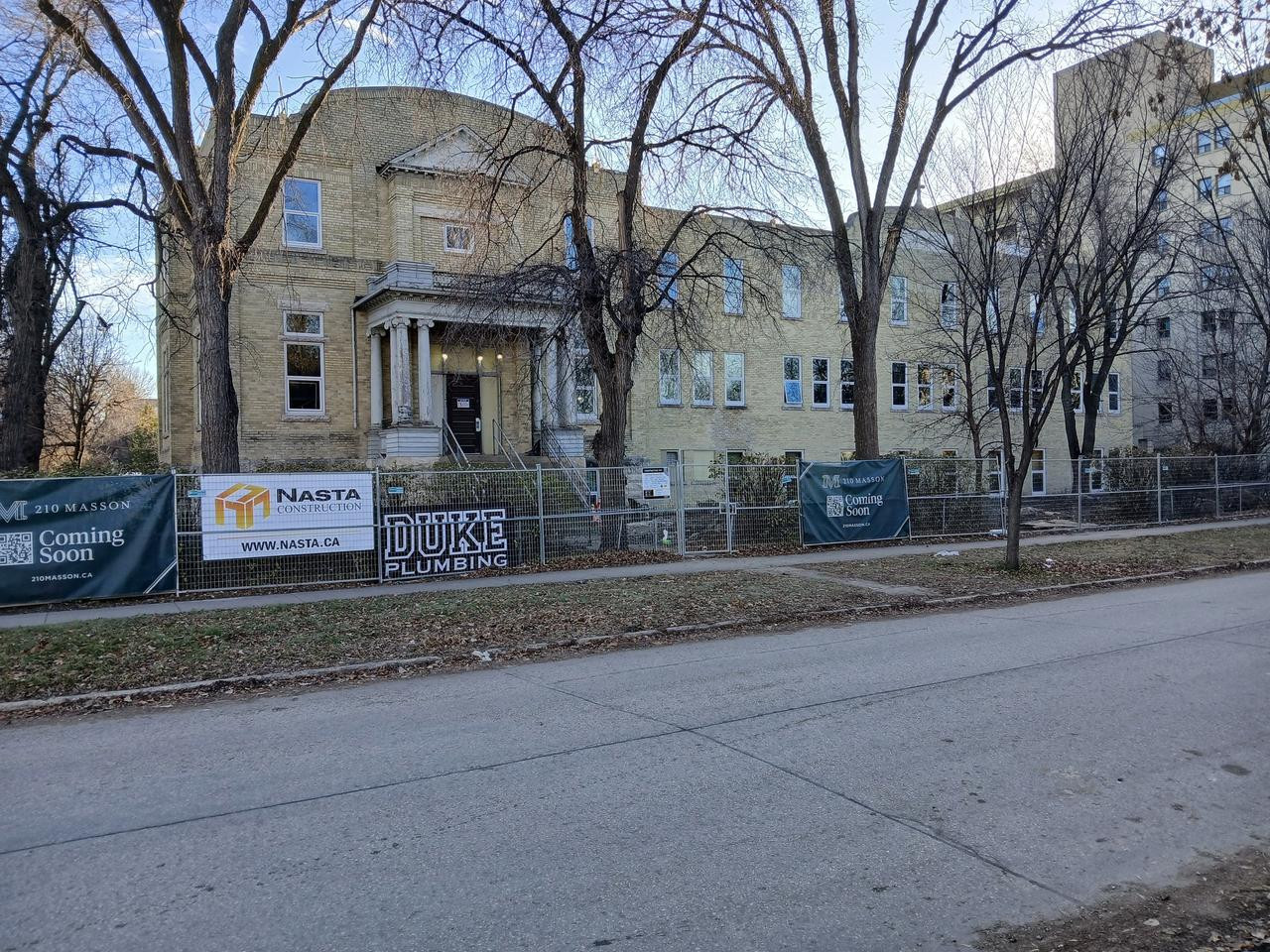
Nice to see the old school at Masson and Aulneau in St. Boniface being transformed into apartments. The windows are now in. Should be a great place to live once it's finished, just a block from Provencher.
Edit: Dumoulin Apartments Location: 158-160 Dumoulin Str Developer: 10173049 MANITOBA LTD. Architect:Verne Reimer Architecture Status: Partial Foundation Permit Documents:Design Review – February 21, 2025 | Submitted Plans Media: Description: 6-storey multi-family residential building encompassing 20 self-contained units and 8 single room occupancy units. The 8 single room occupancy units will be located on the second floor and have access to a shared kitchen/lounge room. Permits:#25-173628 DP-2025-08-20, Permit. New site development - Development permit for a new MFD (20) units & SRO (12 beds),6-Storey Multi-Family Residential Building with 18 indoor parking stalls
This one continues to move along. I see some columns now above grade.
175 Aubert Street Location:175 Aubert Street Developer: Architect:2 Architecture Inc. Status:U/C Documents:Subdivision and Rezoning–January 5, 2022 |Variance – DAV 186611/2021D |Design Review–July 15, 2025 |Submitted Plans–July 15, 2025 Media: Description: The developer proposes a 4-storey, 32-unit multi-family residential building on a 7,169 sq. ft. It includes 27 underground parking stalls, 39 bicycle parking stalls (12 in a secure enclosure, 27 wall-mounted), and vehicular access via a public lane. The unit mix comprises 5 barrier-free main-floor units, 5 three-bedroom two-storey townhomes, and 22 one-bedroom units. Amenities include a 495 sq. ft. co-working space and boardroom with kitchenette on the upper floors, a 600 sq. ft. rooftop garden, and a 450 sq. ft. rooftop terrace. The building features non-combustible hardie board shakes/panels, extensive glazing on the Aubert façade, and balconies on three elevations. Landscaping includes 8 native trees (3 Silver Maples along Aubert, 5 along St. Joseph) and 36 shrubs (Western Snowberry and Highbush Cranberry) . Garbage and recycling bins are stored in the underground parking area and moved to the street for pickup. Permits:#22-200688 MU-2025-07-28, Construct New. Construct a new 4 story, 3648m2, Multi-family dwelling building, with 32 units, and underground parking.
First storey is going up on this project now. Hopefully it looks like the rendering, if so it’ll add a lot to the area and hopefully the developer can copy and paste a few dozen more around town
Freedhome Developments Ltd. has an application to build another large multi-family building (100+ units) in St. Boniface at 470 Des Meurons, just down the street from their other two developments, 316 Des Meurons & 366 Marion.
A variance has been requested for the following:
1. For the Apartment Building
Front yard: They want zero front yard (building right up to the sidewalk/street) instead of the normal 25 feet setback.
North side yard: Only 8 feet gap to the neighbour instead of the required 18 feet.
South side yard: Only 6 feet gap to the neighbour instead of the required 20 feet.
Rear yard: 20 feet at the back instead of 25 feet.
Balcony overhang: The balconies on the south side will stick out 5 feet instead of the maximum allowed 2 feet.
Lot area per unit: They plan to have less land per apartment than required (344 sq ft per unit instead of 400 sq ft). This basically means they want to fit more units on the lot.
Street landscaping: They are not providing as much landscaping along the street edge as the rules require.
2. For the Parking Lot
Number of spaces: They want to provide only 105 parking spaces instead of the required 120.
Guest parking: They want zero unassigned guest parking spaces instead of the required 11 spaces.
Drive aisles: The lanes between parking rows will be slightly narrower (19 to 19.5 feet wide) instead of the required 20 feet.
Parking lot landscaping: They are not providing as much landscaping inside the parking lot as the rules require.
Freedhome Developments Ltd. has an application to build another large multi-family building (100+ units) in St. Boniface at 470 Des Meurons, just down the street from their other two developments, 316 Des Meurons & 366 Marion.
A variance has been requested for the following:
1. For the Apartment Building
Front yard: They want zero front yard (building right up to the sidewalk/street) instead of the normal 25 feet setback.
North side yard: Only 8 feet gap to the neighbour instead of the required 18 feet.
South side yard: Only 6 feet gap to the neighbour instead of the required 20 feet.
Rear yard: 20 feet at the back instead of 25 feet.
Balcony overhang: The balconies on the south side will stick out 5 feet instead of the maximum allowed 2 feet.
Lot area per unit: They plan to have less land per apartment than required (344 sq ft per unit instead of 400 sq ft). This basically means they want to fit more units on the lot.
Street landscaping: They are not providing as much landscaping along the street edge as the rules require.
2. For the Parking Lot
Number of spaces: They want to provide only 105 parking spaces instead of the required 120.
Guest parking: They want zero unassigned guest parking spaces instead of the required 11 spaces.
Drive aisles: The lanes between parking rows will be slightly narrower (19 to 19.5 feet wide) instead of the required 20 feet.
Parking lot landscaping: They are not providing as much landscaping inside the parking lot as the rules require.
Not really necessary to link to variances when you list them all. Can you follow linking to addresses in maps? Thanks
^ i'm quite happy with 366 Marion so far....the brick looks awesome. I think the Marion facade is going to feel like a building that has always been there.





 Prev
Prev










 Linear Mode
