Again, this article is not really presenting enough information on a further reduction of transit service. It appears to be a regurgitation of what the reporter was handed by OC Transpo – without much thought put into what was provided.
For the Winter Booking session, the scheduled bus requirement was 520 buses during the peak weekday periods. Since January 12, there has been a TEMPORARY removal of 255 scheduled runs to reduce the peak bus demand to 500 buses. Once the available buses consistently numbered above 520, the TEMPORARY reduction would be reversed.
And now, we read in the article that the AVERAGE daily bus availability is up to 534 buses. This is above 520, so why have the 255 runs not been restored yet?
Because that 534 is a weekly AVERAGE. Here is a chart of the actual number of buses available per day:
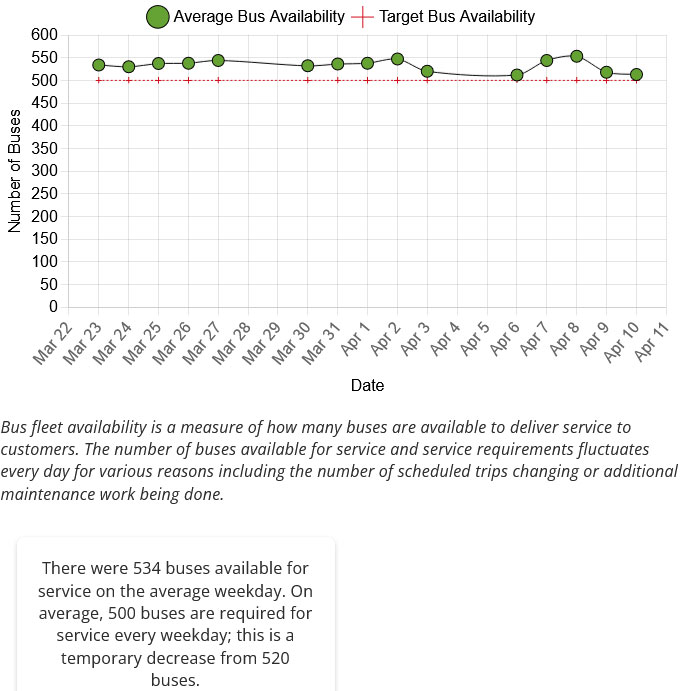
The values: Apr. 2 = 547; Apr. 3 = 520; Apr. 6 = 512; Apr. 7 = 544; Apr. 8 = 553; Apr. 9 = 518; Apr. 10 = 513; There are no values recorded for week-ends.
Notice that during the last week, Apr. 6-10, there are only two days when the number of available buses is over 520. Although the WEEKLY AVERAGE is over 520, for 3 of the 5 days, OC Transpo would still not have enough buses to add back the 255 cut runs. There is no point in restoring the cuts if you can’t consistently provide the service.
An interesting thing I noticed is that from March 23 through April 3, OC Transpo did have 520 or more buses available each day. So for 2 weeks, things looked good. However, on April 3, there were only 520 buses available – a drop of 27 buses overnight. To me, this looks like OC Transpo stopped putting out a group of buses. My suspicion is that OC Transpo might be trying to minimize wear on older buses by not sending them out of days that have lower passenger counts. The theory being that, Mondays and Fridays have fewer riders, so there is not as much overcrowding if additional runs are cut. The ‘bus availability hump’ outlined between Monday, Apr. 6 and Friday, Apr. 10 also follows that idea. This might be to give the over-worked mechanics a break from all of the over-time work that they have been putting in.
Something else to realize is that from the beginning of January, OC Transpo has received almost 100 e-buses. On January 4, the available buses numbered 466; while as of April 8, there were 553 buses declared as available. So, I’m guessing that some of the older buses are no longer available, or not all of the e-buses are in revenue service yet.
However, OC Transpo still hasn’t even been able to deliver all of the runs the TEMPORARILY reduced schedule.
Here is the graph of the number of undelivered trips per week:
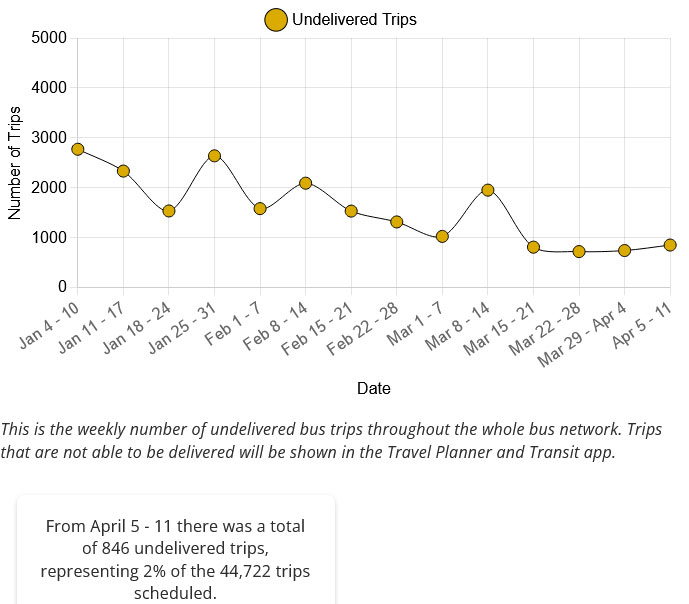
Values: Mar. 15 = 804; Mar. 22 = 715; Mar. 29 = 736; Apr. 5 = 846.
There is a disturbing slight upward slope on that line, starting from March 22.
So, what is actually preventing OC Transpo from providing the promised service? Is it a lack of available buses?
Here is an image showing the reasons for undelivered trips:
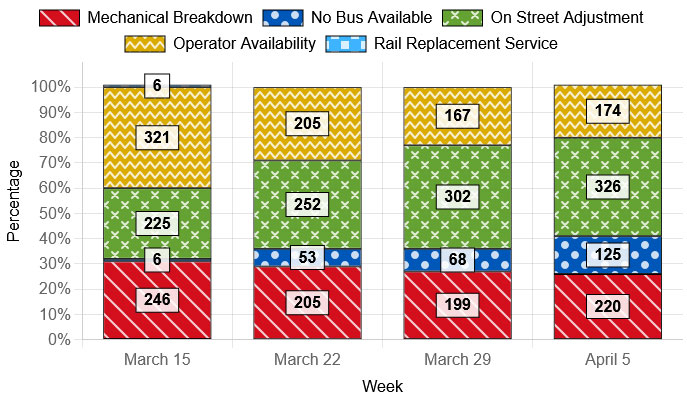
Note that ‘No Bus Available’ (blue with white Polka Dots) is growing. The weekly change from March 29 to April 5 is an increase of 84%! This latest jump, with 57 fewer available buses, is the biggest jump of any of the reasons – all of which increased from the previous week.
Hopefully, OC Transpo can correct the lack of bus operators with the new Spring Booking session. It was, no doubt, difficult to make changes once the Winter session had been booked.
The largest component for run cancelation, however, is ‘On Street Adjustment’. This usually happens because a bus gets too far behind schedule. In the olden days, before much interlining, a single run would be affected by a slow bus. Now, that can result in a chain of cancelations. Personally, I think that OC Transpo has swung the pendulum too far with interlining, and needs to increase its fleet and reduce interlining.
All that said, this latest article claims that 279 trips will be TEMPORARILY canceled. This is an increase over the 255 previously removed trips. I assume that this is instead of the 255, and not in addition to them.
What I find odd is that so many trips still need to be canceled. OC Transpo has more buses than before. And it has moved to the Spring Schedule – which has a reduction of bus runs due to lower demand by college and university students. For example, the frequency of the # 88 has been reduced to every 15 minutes in the spring. The Spring Schedule should reduce the fleet requirements – not increase it, as the article implies. Check the list of spring adjustments listed at the bottom of the article. They mostly reduce the number of buses needed.
Of course, this further reduction in transit service will result in more people changing from the bus to their own vehicle. This will increase the congestion on the roads, which will further delay buses, which will increase the number of buses required, and run cancelations.
(All graphs from:
https://www.octranspo.com/en/about-us/transparency/bus-service-delivery-action-plan)





 Prev
Prev


 Linear Mode
